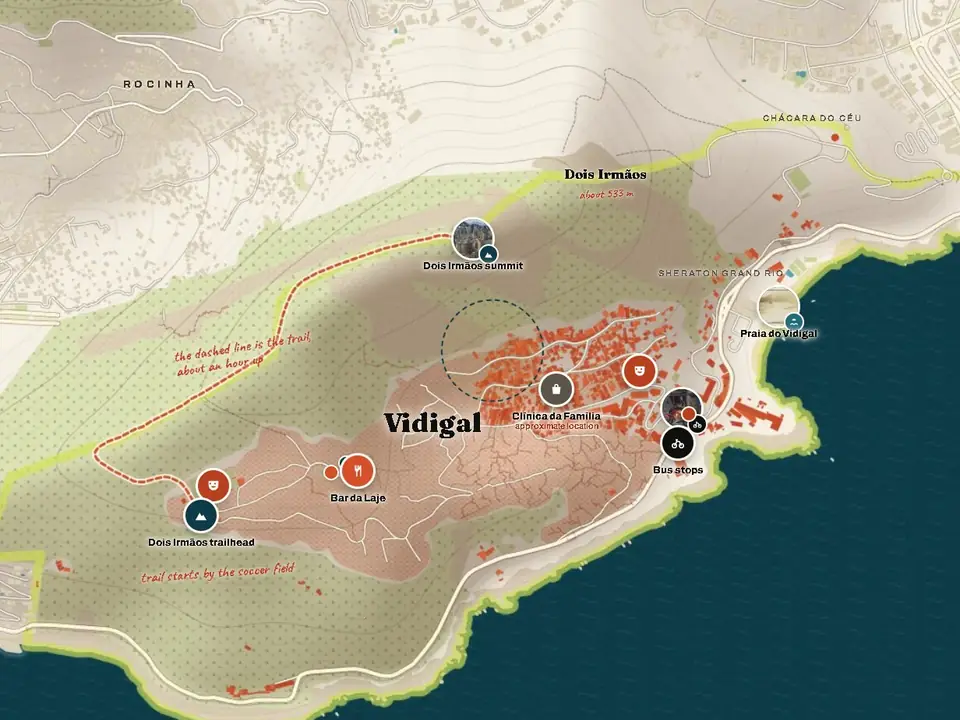

Seven in the evening on Rua Armando de Almeida Lima. The padaria is still handing out pão francês at R$1.20 a roll, the kids are chasing a ball across the tile in front of the *botequim*, and somewhere two blocks up the Sheraton's rooftop bar is pouring the first caipirinha of the night. This is the Vidigal restaurants map we actually use — iconic, neighborhood, worth the walk, and cheap — with what to order, what it costs, and whether you need to book.
Lux Vidigal is our two-story apartment in Vidigal, with the ocean on one side and the Dois Irmãos mountain on the other, and you can check dates and book it on Airbnb.
Why this guide is different (and what it isn't)
There are two kinds of food writing about this hillside. The first treats Vidigal like a theme park: one mention of Bar da Laje, one photo of the view, one sentence about how "safe it feels now", and out. The second treats it like a secret: a blog post from 2018 about a lady who sells moqueca from her kitchen, except the lady moved to Niterói in 2021. Neither is useful.
So here is the honest version. We live on the eighth floor of a building near the top of the morro. We eat out four nights a week. We eat breakfast at the same padaria every morning because the coffee is R$4 and the counter lady remembers our order. The places below are the places we actually use — plus a handful of splurges downhill in Leblon and São Conrado that are close enough to count as ours.
A quick honesty note on the price marks. R$ means under R$40 a head. R$$ means R$40–80. R$$$ means R$80–150. R$$$$ means you're looking at R$200 or more by the time you've had wine. Brazil does not include service by default — you'll see a 10% taxa de serviço on the check which is technically optional but functionally expected. Tipping above that is rare. Pix is king, cards are universal, cash is increasingly awkward.
This is the long-form version of the short advice we text guests when they land. If you only have one night, skip to the bottom — there's a one-night-in-Vidigal plan that answers the question before you ask it.
What you'll spend, roughly
Prices sampled April 2026. Reais, not dollars. Service charge not included unless noted.
- Service charge (taxa de serviço): 10%, almost always added.
- Couvert: bread/olives/butter at sit-down places, R$10–20, you can decline.
- Pix works everywhere. Cards work everywhere. Bring R$50 in cash just in case.
- The word for the check is a conta, and you have to ask for it.
The icons — what Vidigal is known for
Start with the two places everyone has heard of and one that everyone should have. These are the postcard rooms. Reservations matter, prices are real, but they're real for a reason.
Bar da Laje
- Where
- Rua Armando de Almeida Lima, top of the morro, follow the signs from the main road.
- Order
- Caipirinha de maracujá, the bolinho de bacalhau, the prawn moqueca to share.
- Price
- R$$$ R$120–180 a head with two drinks.
- Best time
- Arrive by 5pm for sunset. Kitchen closes around 11pm.
- Reservations
- Yes on weekends. WhatsApp only. Weekdays you can walk in.
The 360-degree view is not hype — you see Ipanema, Leblon, Dois Irmãos, the ocean, Pedra da Gávea, and on clear days the mountains behind Barra. The food is not the point, but it's better than it needs to be. Our honest take: come for one drink at sunset, stay for dinner only if the weather is flawless. On windy nights the terrace is cold. Wear layers. They take Visa, Mastercard, and Pix.
Casa Alto (Sheraton Grand Rio, the rooftop)
- Where
- Avenida Niemeyer 121, the Sheraton rooftop. Ten-minute walk or R$15 moto-taxi from Vidigal's main road.
- Order
- The carpaccio de polvo, the short rib ravioli, any of the sours.
- Price
- R$$$$ R$250–350 a head with wine.
- Best time
- Reserve the 7:30 table if you can. Daylight on one side, city lights on the other.
- Reservations
- Essential. Book two to three days out on weekends.
Casa Alto is the grown-up version of Bar da Laje. Same ocean, different altitude, very different crowd. The menu leans Mediterranean with strong seafood — the kind of room where a couple celebrating an anniversary sits next to a table of four in quiet suits. Service is formal without being stiff. The sommelier actually knows the list. Allegra, the Italian sister restaurant on the same property, is open for lunch and is a better value if you're hungry and don't need the rooftop.
Zero Zero (Gávea)
Not in Vidigal — fifteen minutes by car, ten if traffic is kind — but included because guests ask. Zero Zero has been the poolside restaurant at the Planetário do Rio for over twenty years. Modern Brazilian food, sushi bar, DJ from 10pm on Saturdays. R$$$. Reserve. The tasting menu is a quiet win; the late-night scene is loud and fun and not for everyone. If you're under 35 and want a night out that feels local, this is it.

The neighborhood staples — where residents eat
These are the places we put on rotation. None of them have a website. Two of them don't have a sign. All of them take Pix. Prices are low, portions are generous, the moças at the counter will remember your face by day three.
The açaí shop with no sign (Rua Armando de Almeida Lima, halfway up)
There's a storefront two doors down from the pharmacy with a blue awning, a freezer, and no visible name. Locals call it Açaí do Beto even though Beto might not exist. A 500ml bowl, loaded with banana and granola and a small pour of condensed milk, is R$18. The açaí is the real stuff — thick, cold, faintly sour, served like ice cream not a smoothie. Go after the beach. Go after a run. Go instead of dessert. Open from about 11am to 10pm, closed Mondays. R$.
A note for newcomers: what most of the world calls açaí is a runny purple smoothie. What Brazilians call açaí is a scoop of dense frozen paste you eat with a spoon, usually topped with banana, granola, condensed milk, or all three. The bowl-form is the Rio form. Accept no substitutes.
Padaria Vidigalense (Estrada do Vidigal, at the base)
- Order
- Pão francês (R$1.20), pingado (coffee with steamed milk, R$4), a misto quente if you're hungry.
- Price
- R$ R$10–25 for breakfast.
- Hours
- Open 6am. This is where Vidigal starts its day.
Every Brazilian neighborhood has a padaria and every padaria has the same menu — fresh bread, hot coffee, a ham and cheese sandwich pressed flat on the grill, pão de queijo from the case, a glass dome of brigadeiros if the owner has a sweet tooth. The pleasure is in the routine. You walk in, you say bom dia, you point at what you want, you eat standing at the counter, you pay R$12, you leave. This is the most carioca thing we do every morning.
The boteco on Sargento (Rua Sargento Silva Nunes)
A botequim is a very specific kind of bar — plastic tables on the sidewalk, cold draft beer (chopp) in small glasses, and fried finger food that goes down in three bites. The one on Sargento doesn't have a proper name; we call it "the boteco on Sargento" because that's what directions sound like up here. Order the bolinho de bacalhau, the pastel de carne, a plate of fries, and a round of chopp. You'll spend R$40 a head and stay three hours. R$$. This is the Vidigal restaurants experience everyone wants and no one books — there's nothing to reserve, you just show up.
The churrasco place (Rua João Goulart)
A storefront grill, three plastic tables, a menu of three things — picanha, linguiça, chicken thighs, all with rice, beans, farofa, and a small salad. R$35–45 a plate. Open Friday through Sunday, lunch only, ends when they run out of meat. The owner will upsell you a beer and he's right to. R$$.
The pizza joint (Rua do Arvrão)
Forno a lenha, thin crust, Neapolitan-adjacent. Not chasing awards, not charging Leblon prices. A margherita is R$48, a pepperoni is R$58, the calabresa is the one to order because Brazilian pork sausage on a pizza is a thing you need to try. Delivery within Vidigal is R$5. R$$.
The best meal you'll have in Vidigal will not be the most expensive one. It will be the one where you sat too long and missed the sunset on purpose. — what we tell every guest on night one
Worth the walk — downhill in Leblon and São Conrado
Vidigal sits between two of Rio's best eating neighborhoods. Leblon is a four-minute walk downhill (ten back up) and has a dense strip of restaurants on Dias Ferreira, General San Martin, and Ataulfo de Paiva. São Conrado is the other direction — ten minutes by car, along the coastal road — and is quieter but has a few standouts. Here's the shortlist we recycle.
Bibi Sucos (Avenida Ataulfo de Paiva, Leblon)
A Rio institution since 1954. A hundred juice combinations on a lit-up board. Also burgers, sandwiches, açaí, and the best sanduíche natural in the city. Go for breakfast or after the beach. Open till 1am. R$25–45 a visit. R$$. There are now a dozen Bibi Sucos branches across the Zona Sul — any of them works, but the Ataulfo one is the original.
Talho Capixaba (Avenida Ataulfo de Paiva, Leblon)
A deli, a bakery, a café, and a small restaurant, all in one building. The window case has the best pastries in Leblon and the sandwich counter makes the misto we measure all other mistos against. Breakfast here beats every hotel breakfast in the city. R$40–70. R$$. No reservations, expect a wait on Sundays.
CT Boucherie (Rua Dias Ferreira, Leblon)
Claude Troisgros' steakhouse. Prix-fixe dinner where they bring you rounds of different cuts, carved at the table, until you ask them to stop. Sides are unlimited. It's a meat version of a sushi omakase and it works. R$260 a head before drinks. R$$$$. Reserve a week out. This is the "special occasion" pick on our list.
Manoel & Joaquim (Avenida Bartolomeu Mitre, Leblon)
A Rio-wide chain that does the classics — feijoada on Saturdays, picanha, bolinho de bacalhau the size of a golf ball, caipirinhas by the pitcher. Loud, friendly, quick. Not culinary journalism, just a good night out. R$80–120 a head. R$$$.
Sushi Leblon (Rua Dias Ferreira, Leblon)
The best sushi in the Zona Sul for over thirty years. The omakase at the bar is R$350 and worth it. The à la carte is expensive but precise — order the usuzukuri and whatever the chef recommends that night. R$$$$. Reserve.
Palaphita (Lagoa Rodrigo de Freitas)
Outdoor, under thatched roofs, on the edge of the lagoon that sits behind Ipanema. The setting does most of the work. Amazonian-inspired drinks, decent small plates, a kitchen that's better than it has to be for the view it offers. Fifteen minutes by car from Vidigal. Go at sunset, order the caipirinha de cajá, stay one drink longer than planned. R$$$.
If you only have one night in Vidigal
A single-page plan we give guests who land at 2pm and fly out the next evening.
- 5:00pm — Walk up to Bar da Laje. Caipirinha de maracujá and the bolinho de bacalhau. Watch the sun hit Dois Irmãos.
- 7:30pm — Moto-taxi (R$15) or Uber (R$25) down to Leblon. Dinner at Manoel & Joaquim if you want loud and local, Sushi Leblon if you want precise.
- 10:30pm — Back up the hill. Nightcap at the boteco on Sargento. One chopp, one pastel, bed by midnight.
- Next morning — Pão francês and pingado at Padaria Vidigalense. Açaí after the beach. Flight caught.

Cheap eats — R$15 lunch, R$5 snack
Brazil's street food and prato feito tradition is a pleasure that doesn't require a reservation, a dress code, or a destination. A prato feito — "PF" on menus — is a plate lunch: a protein, rice, beans, a small salad, sometimes farofa, always cheap. A PF in Vidigal or the base of the morro runs R$15–28. The cost-per-calorie champion of Rio food.
Pastel stands
A pastel is a deep-fried pocket of thin dough with filling inside — queijo, carne, palmito, camarão, sometimes pizza-style with tomato and mozzarella. They're R$8–15 and they're handed to you in a napkin still sizzling. The pastel stand at the base of Vidigal's main entrance is open lunch only, closed Sundays. Pair one with a caldo de cana (sugarcane juice, R$6) and you've eaten for under R$20.
Tapioca
Gluten-free before gluten-free was a marketing category. A white crepe of tapioca starch, cooked on a dry griddle, folded over cheese and ham, or coconut and condensed milk, or banana and cinnamon. R$12–18. The tapioca lady sets up on Estrada do Vidigal most afternoons. Savory for lunch, sweet for dessert.
Pão de queijo
Small, chewy, hot cheese rolls. The best ones are made with cassava flour and curd cheese and are light in the middle. R$3 each at the padaria, R$2 at the boteco, R$1.50 at a good street cart. Eat them with coffee. Eat them in the car. Eat them on the bus.
Brigadeiros
Chocolate truffles rolled in sprinkles, the national dessert. Every birthday party in Brazil has them, and every padaria sells them single. R$3–6. If you see gourmet variants (brigadeiro de pistache, brigadeiro de maracujá) at a café in Leblon, they'll be R$8–12. Worth it once.
Acarajé
Technically a Bahian dish, not a Rio one, but you can find it at a few stands around São Conrado. A deep-fried ball of black-eyed pea dough, split and filled with shrimp stew (vatapá), okra paste (caruru), and chilli. R$18–25. Ask for pouco pimenta if you don't want your face to hurt.
Here's the split-screen every visitor runs in their head, so we'll name it.
Vidigal casual (R$40 a head)
- Boteco on Sargento: chopp, bolinho, pastel.
- Plastic chairs on the sidewalk. Kids kicking a ball.
- No reservation. No couvert. No stress.
- You walk home up the hill and sleep hard.
- The memory you bring home.
Leblon splurge (R$300 a head)
- Sushi Leblon or CT Boucherie or Casa Alto.
- White tablecloths. Wine list in two languages.
- Reservation essential. Service charge added.
- Uber back up the hill, R$25, five minutes.
- The meal you photograph.
You can do both in one weekend. You probably should. The secret of eating well in this corner of Rio is the contrast — the chopp at the boteco means more after the tasting menu, and the tasting menu means more after three days of PF lunches.
~~~Brazilian food fundamentals — for first-timers
If this is your first trip, here's the short glossary you'll need by day two. None of this is complicated; the joy is in the specifics.
Feijoada is the national stew — black beans, pork (sometimes salted, sometimes smoked, sometimes both), served with rice, farofa (toasted cassava flour), sautéed couve (collard greens), orange slices, and a caipirinha. It's a Saturday lunch, traditionally. You eat it slowly and then you nap. Manoel & Joaquim does a reliable one. So does the boteco tradition across the city.
Moqueca is a seafood stew cooked in a clay pot with coconut milk, palm oil, tomato, onion, coriander, and either fish or shrimp. The Bahia version is rich and orange; the Espírito Santo version is lighter and redder. Order with rice and pirão (a starchy side made from the broth). Bar da Laje's prawn moqueca is the easy one to try.
Farofa is toasted cassava flour, sometimes with bits of bacon, egg, or banana mixed in. It's a texture — served alongside meat to soak up juice. Westerners sometimes skip it; locals think that's strange. Try a spoonful.
Picanha is the cut of beef Brazil is serious about. It's a top sirloin cap, grilled with a thick layer of fat on top, sliced thin, served with chimichurri or just salt. The best picanha you eat in Rio will ruin you for all subsequent steaks in your home country.
Caipirinha is the national drink: cachaça (sugarcane spirit), lime, sugar, ice. Variations use other fruits — passion fruit (maracujá), cajá, strawberry, kiwi. The vodka version is a caipiroska. The sake version is a caipisake. Start with a classic lime; earn the variants.
Suco is fresh fruit juice, and Rio takes it seriously. The juice boards at Bibi Sucos have forty options. Start with maracujá, abacaxi com hortelã (pineapple with mint), or açaí com banana. A medium is R$15–20. No ice unless you ask.
Cafezinho is a small, strong, sweet coffee served after meals, on the house at many restaurants. Drink it. Then drink the second one they bring you.
And on manners: you say bom dia until noon, boa tarde until sunset, boa noite after. You greet people when you enter a shop. You don't split the bill at the table — one person pays, everyone Pixes later. The taxa de serviço goes to the staff; an extra tip is unusual but appreciated. And when a Brazilian says "vamos tomar uma cerveja", they don't mean one beer.
Three things that catch first-timers
None of these are problems. They're just different from what you might expect.
- No tap water. Everyone drinks bottled or filtered. Restaurants bring you a closed bottle — small (300ml, R$6) or large (500ml, R$9), still (sem gás) or sparkling (com gás).
- Dinner starts late. Brazilian dinner at 7pm is early. 8:30–9:30pm is normal. Tables turn twice on weekends — book the first seating (7–7:30) or the second (9:30–10).
- No split bills. Servers will not divide one check into six cards. One person pays, the rest transfer via Pix. If you don't have Pix, tell your host at the start of the meal.

How to actually use this list
Here is the rhythm we suggest to guests who stay three to five nights. It's not rigid. It's the one that seems to work.
Day one — you land tired. Don't book anything fancy. Walk to the padaria for breakfast. Have lunch at a PF place at the base of the hill. Drinks at the boteco on Sargento after sunset. Bed early.
Day two — beach day. Açaí at the no-sign place on the way back up. Dinner downhill in Leblon at Manoel & Joaquim or Bibi Sucos. Easy, fast, good.
Day three — this is the splurge night. Book Bar da Laje for the 5:30 sunset drink, then move to dinner somewhere serious — Casa Alto, Sushi Leblon, or CT Boucherie. This is the night you'll photograph.
Day four — day trip or long lunch. Palaphita at Lagoa, or Zero Zero at Gávea for a laid-back afternoon. Dinner back in Vidigal at the pizza joint or the churrasco place on the weekend.
Day five — pack, eat one more açaí, say goodbye to the counter lady at the padaria. Lunch light at Talho Capixaba on the way to the airport.
If you're staying at our condo, the kitchen is fully set up — the blue-cabinet one with the good knives and the espresso machine — so you can alternate between eating out and cooking with what you find at the feira on Rua Cupertino Durão in Leblon (Thursdays, 7am–1pm). Good fruit, cheap fish, the best strawberries in the city for about ten weeks a year. For everything you can't find at the feira, see our stores and services guide. And for getting between all these restaurants without losing an hour to traffic, the getting around Vidigal piece has the moto-taxi and Uber math.
One last thing. Restaurants close. Owners retire. A favorite boteco turns into a phone repair shop. If a place on this list is gone by the time you read it, the hill will have a new one open by the time you arrive. Ask a neighbor. Ask the doorman. Ask the lady at the padaria. The next great meal is always one conversation away.
Quick questions.
Do I need reservations for most Vidigal restaurants?
Not for the neighborhood places — the boteco, the padaria, the pizza joint, the churrasco place. For Bar da Laje on weekend evenings, yes, via WhatsApp. For Casa Alto, Sushi Leblon, and CT Boucherie, reservations are essential, especially Thursday through Saturday.
How much do I tip?
The 10% taxa de serviço is added to most checks and covers the standard tip. It's technically optional but almost always paid. Tipping above that is uncommon in Brazil. At the padaria, boteco, and cheap-eats places there's no service charge and no tip expected, though rounding up is nice.
Can I pay by card everywhere?
Yes. Every restaurant on this list takes Visa and Mastercard. Most take Amex too. Pix (instant bank transfer) is faster and universal. Bring R$50–100 in cash for pastel stands, moto-taxis, and the very small places.
Is it safe to walk up to Bar da Laje at night?
Yes, on the main road. Rua Armando de Almeida Lima is the well-lit spine of Vidigal and the walk up is done by everyone from backpackers to wedding parties. Don't wander into side alleys after dark. For more on this see our beach and neighborhood piece.
What's the single best meal for under R$100 a head?
The prawn moqueca at Bar da Laje for two, a caipirinha each, split the bolinho de bacalhau, skip dessert. You'll land around R$95 a head with the service charge and leave with the view still in your head.
Are any of these places good for vegetarians?
Bar da Laje, Casa Alto, Talho Capixaba, Bibi Sucos, Zero Zero, and Palaphita all have solid vegetarian options. Pizza, tapioca, pão de queijo, açaí, and most sucos are naturally meat-free. Vegan is harder — ask specifically for sem laticínios (no dairy).
When does Vidigal get loud? When does it get quiet?
Weekend nights (Friday, Saturday) are the loud nights — botecos full till 1am, music from the bars. Sunday lunch is sleepy and slow. Weekday evenings are calm by 10pm. If you need early quiet, book a weekday stay.
The best guide is the one you stop using halfway through. By night three you'll have your own padaria, your own açaí spot, your own stool at your own boteco. This list exists to get you to that point faster. The rest is saudade in advance — the feeling you'll have on the plane home, already planning the return.