
Tuesday evening. A woman in scrubs walks up the Avenida João Goulart carrying two bags of groceries and a small child on her hip. Two German tourists pass her on the way down to the beach, arguing about where to have dinner. A moto-taxi driver hums samba while he waits. This is what people mean when they ask is Vidigal safe, and this is also most of the answer.
Lux Vidigal is our two-story apartment in Vidigal, with the ocean on one side and the Dois Irmãos mountain on the other, and you can check dates and book it on Airbnb.
The question gets asked about a hundred times a week on Reddit, Tripadvisor, WhatsApp groups, and inside our inbox. It is the single most-Googled phrase about this neighborhood. We have hosted 115+ stays on our laje on the eighth floor, and we get some version of it from roughly a third of our guests. Sometimes the night before arrival. Sometimes the morning of. Always, underneath, a reasonable traveler trying to do the smart thing.
So here is the honest version. Not the tourism-board version. Not the CNN-headline version. The one we would give a friend flying in next Thursday.
What Rio actually looks like right now
Rio de Janeiro is a city of 6.2 million people with about 760 *favelas*, which are self-built, informally-organized neighborhoods that house roughly a quarter of the population. Some are dangerous. Some are calm. Most are simply working-class residential, the way any neighborhood anywhere is working-class residential: school runs, *botequim* lunches, motorbike repair shops, evangelical churches, kids in flip-flops.
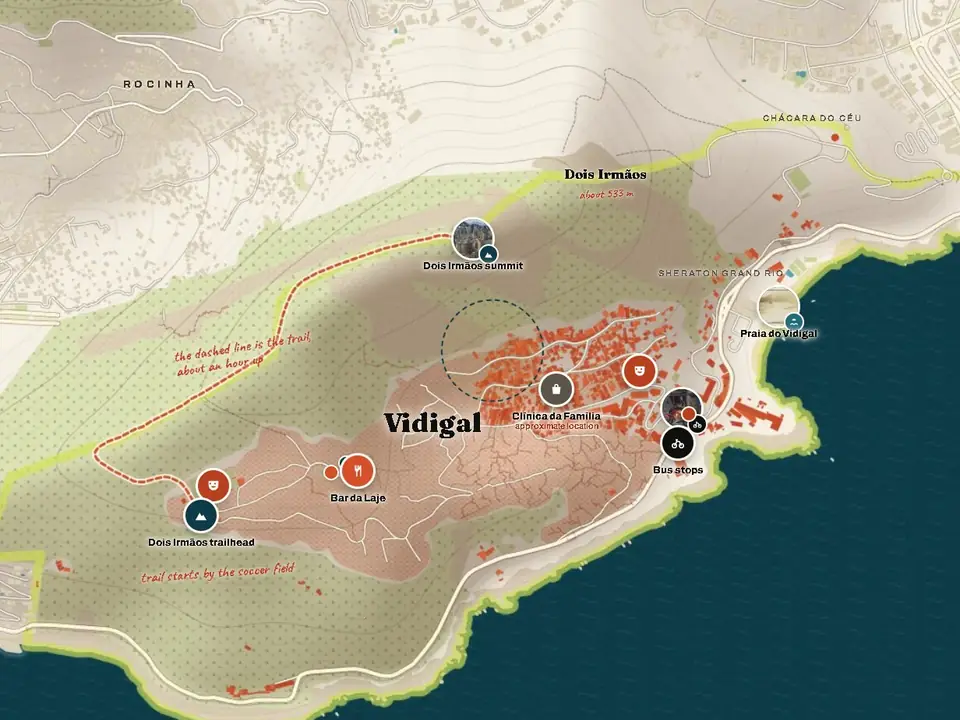
Vidigal is one of the calm ones. It sits on a hillside between Leblon and São Conrado, wraps around the southern face of Dois Irmãos, and has maybe 12,000 residents in a footprint you can walk across in twenty minutes. Rocinha, its much larger neighbor on the other side of the mountain, has somewhere between 70,000 and 100,000. The two places get grouped together in English-language travel writing and they should not be. They are different neighborhoods with different histories, different leadership structures, and different risk profiles.
The broader context first, because it matters. Rio state's homicide rate has trended down through the 2020s. The Instituto de Segurança Pública, Rio's official crime statistics body, reported violent lethality dropping about 12% in the first quarter of 2026 compared to the same period of 2025. The state's 2024 murder rate was 20.35 per 100,000 people, down from 21.96 the year prior. These are not tourism-brochure numbers. They are not great. They are also trending in the right direction, and almost none of the violence they describe happens in the South Zone where visitors stay.
Zona Sul — Copacabana, Ipanema, Leblon, Vidigal, Gávea, Botafogo — recorded zero homicides in the first quarter of this year. The violence in Rio is real. It is heavily concentrated in the Baixada Fluminense (the outer suburbs) and the North Zone. Those areas are not on your itinerary.
Is Vidigal safe? In one paragraph.
Yes, for daily tourist use. Vidigal is considered one of the safer *favelas* in Rio and has been a routine stop on the tourist circuit for over a decade. The real risks are the same ones you navigate anywhere in Rio: phone snatching on the beach, occasional muggings at quiet hours, scooters you should not be stepping in front of. The specific favela-risks people worry about — stray bullets, cartel retaliation, being kidnapped — are overwhelmingly not Vidigal's story.
- Vidigal has hostels, restaurants, rooftop bars, and art studios operating openly.
- The main road (Avenida João Goulart) is lit, patrolled, and busy until late.
- Most incidents involving visitors in Rio happen in Copacabana, not in Vidigal.
A quick history, because the context helps
Vidigal was settled in the 1940s by fishermen and construction workers priced out of the flats below. The neighborhood grew organically up the mountain for sixty years with almost no state presence. Electricity arrived by improvisation. Plumbing the same. Streets were named by residents. The community built itself, and it built a tight social fabric in the process, which matters to the safety question more than most travelers realize.
In the 1980s and 90s, as the cocaine economy restructured Rio, some *favelas* — not all — became staging grounds for drug-trafficking factions. Vidigal was among them at various points, though never on the scale of Rocinha or Complexo do Alemão. In November 2011, ahead of the 2014 World Cup and 2016 Olympics, Rio's state government launched a *Unidade de Polícia Pacificadora* — a UPP, or pacifying police unit — into Vidigal. It formally opened in January 2012.
The UPP era (2012–2017) changed the neighborhood fast. Tourism arrived. A David Beckham-owned hostel made international press. Property values climbed. Rooftop bars opened. New restaurants with ocean views started drawing crowds from Leblon. The *asfalto* — the formal city below — came up the hill for the first time on any real scale. Some of this was good. Some of it was gentrification pressure on residents who had lived there for forty years. All of it is still being sorted out.
The UPP wound down around 2017 as state budgets collapsed and the program lost political support citywide. Vidigal's formal policing now looks more like community-style patrols plus a rotating battalion presence, supplemented by residents' associations, longtime business owners, and informal order-keeping that predates the UPP and outlasted it. This is the part that requires nuance. The neighborhood is not ungoverned. It is governed differently. Most of the time, for most visitors, the difference is invisible.

What the numbers and the stays tell us
Since we opened the condo as a short-term rental, we have logged more than 115 stays from guests across roughly thirty countries. Couples, solo travelers, families with small children, one film crew, one bachelorette party, two professional surfers, a retired dentist from Stuttgart who came back twice. Average stay length is about five nights. Our review rating sits at 4.86.
Zero of those guests have reported a safety incident inside Vidigal. That is not a statistical proof. It is a data point. The broader picture around it is what matters: Vidigal hosts several working hostels, a jazz bar on a terrace near the top of the hill, a handful of full restaurants, a pizza place that delivers down to the beach, a Lebanese spot, an açaí place that is genuinely unreasonably good, a CrossFit gym, three small markets, two bakeries, and a constant flow of moto-taxis moving up and down the one main road. This is infrastructure. Infrastructure does not survive in a neighborhood that is unsafe for its customers.
Compare that to the broader Rio context. The Instituto de Segurança Pública reported close to 200 cell phone thefts per day across the city in 2025 — more than 72,000 cases in total. The geographic concentration of those thefts is in Copacabana and around the central bus station. Copacabana residents have been organizing informal neighborhood patrols because of it. That is the real story of street crime in Rio this year. It is not happening in Vidigal. It is happening on the boardwalk two neighborhoods over.
When an incident does make international news — the April 2026 police operation near Vidigal that briefly stranded 200 tourists on Dois Irmãos, for example — it is worth reading carefully. That event was a targeted police action. Nobody was hurt. Three arrests were made. The tourists walked down the mountain a few hours later. It is the kind of thing that gets one English-language headline and zero Portuguese-language ones, because in Rio it is a Tuesday.
The real question isn't "is Vidigal safe." It's "am I traveling intelligently." — a thing we say to every guest who asks
What's overstated, and what's real
Most of what the internet tells you about favela danger was written ten years ago by someone who has never been to one. Some of it is flat wrong. Some of it is outdated but plausible-sounding. Some of it is real and worth heeding. Separating the three is the whole job.
Overstated
- "You'll be stopped at an armed checkpoint." You will not. Not in Vidigal. Not in 2026.
- "Tourists get kidnapped." Statistically near-zero. Foreign tourist kidnappings in Rio are vanishingly rare and almost always involve organized schemes unrelated to *favelas*.
- "You need a guide to enter." You do not. Vidigal is a residential neighborhood. You walk in. You walk out. You pay for dinner. You leave a tip.
- "Stray bullets are common." They are not uncommon in some Rio neighborhoods. Vidigal is not one of those neighborhoods.
- "You'll stand out and be targeted." You will stand out. You will not be targeted. Tourists are a routine sight on the main road.
Real and worth knowing
- Phone snatching by passing scooter is a Rio-wide risk, mostly on the boardwalk and at bus stops below.
- The hill is steep and the pavement is uneven. More travelers twist ankles than are robbed.
- Small alleys (*becos*) deeper into the community are residential and private. You don't wander into them uninvited any more than you would wander into someone's backyard in Brooklyn.
- The bus station (Rodoviária Novo Rio) is a genuine high-risk zone late at night. This is a general Rio rule, not a Vidigal one.
- Filming people — especially children — without asking is a serious social breach. It reads as hostile and can get a reaction.
The asymmetry is the interesting part. The fears travelers bring to Vidigal are mostly fears about *favelas* as an abstract concept, imported from films and old news cycles. The actual risks they will encounter are the boring universal risks of traveling in a big Latin American coastal city: don't be flashy, don't get drunk in unfamiliar places, don't pull out expensive electronics on public transit, don't walk back from a bar at 4am with your wallet in your back pocket.
If you already know how to travel in Mexico City or Buenos Aires or Lisbon, you already know how to travel in Vidigal. The grammar is the same.
The practical list
Five rules, in order of usefulness. Print them. Screenshot them. Ignore the rest of the internet.
- Going up the hill after dark, take a moto-taxi or an Uber. Do not walk the switchbacks alone at night. The *mototaxistas* are licensed, fast, cheap (R$5–R$8), and they know the road. R$5
- Do not film strangers without asking. Especially not kids. Especially not anyone standing at the top of the hill. Ask first, and if someone says no, put the phone away.
- Keep your phone tucked on the boardwalk below. This is a Copacabana/Ipanema rule, not a Vidigal rule. The risk is at bus stops, at crosswalks, on the waterfront. Not on the hill.
- No Rolexes. No iPhone Pros in the open. No chunky gold. Wear a Casio. Carry the iPhone in your front pocket. Nobody in Rio is impressed by your watch; they are only calculating the math.
- Ask your host first. If you're unsure whether a street, a bar, or a walking route is a good idea, ask. We answer within a minute. This is the whole job.

Vidigal vs. Rocinha: different places, different answers
This is the distinction English-language travel writing gets wrong most often. Vidigal and Rocinha share a mountain but not a neighborhood character. Treating them as the same place is like treating the East Village and East New York as the same place because they both have "East" in the name.
Vidigal is small — around 12,000 residents — and has become heavily touristed over the past fifteen years. The main artery is one road that goes up, with side streets branching off. You can understand the layout in about a day. There are visible businesses catering to outside visitors. The community has a long memory of that tourism being part of the local economy, and most residents consider it welcome in moderation.
Rocinha is a small city — 70,000 to 100,000 people depending on whose estimate you use, though some residents say the real number is much higher. It has its own bus system, two highways running through it, a commercial strip that feels like downtown anywhere, and a layered organizational structure that is genuinely complex. It is not unsafe as a through-road, and many people visit on guided tours, but walking in alone as a tourist is a different calculus than in Vidigal. If you want to see Rocinha, go with someone who knows it — we've written a longer guide to visiting Rocinha responsibly if you want the specifics, and a side-by-side breakdown in Rocinha vs. Vidigal.
Inside Vidigal, the tourist footprint is established. You can eat at Bar da Laje (yes, it really is called that), catch a sunset at Mirante do Arvrão, attend a capoeira class, take a muay thai session at the academy near the top. You can do any of those things without a guide and the staff will speak enough English to get you through. Try the same things in some other Rio *favelas* and you will have a more complicated time. Vidigal is the one where the gradient of tourism-readiness is unambiguously in your favor.
Worth noting: tourism in Vidigal is also not frictionless for residents. Gentrification is a live conversation here. Rents have climbed, long-term tenants have been pushed further up the hill, and some locals feel their neighborhood is being photographed more than lived in. Being a respectful visitor is both a safety rule and a decency rule. They are the same rule.
Comparing Vidigal to the rest of Rio
Here is a heuristic that reframes the question. In Rio, ranked roughly from lowest-tourist-risk to highest across an average 24-hour cycle:
- Lowest-risk
- Vidigal main road during the day, Ipanema beach during the day, Jardim Botânico at any time, Leblon residential.
- Low-risk
- Vidigal at night (if you take transport up), Copacabana during the day away from the Arpoador end, Lapa on a weekday.
- Moderate
- Copacabana boardwalk at night, Lapa on a Friday or Saturday, downtown after 6pm.
- Higher-risk
- Central station areas late at night, the bus terminal at any hour, the favelas of the North Zone, certain stretches of the elevated highway.
The traveler who has dinner at a terrace restaurant in Vidigal, takes a moto-taxi back to their apartment at 11pm, and wakes up the next morning for surf at Praia do Arpoador is statistically in one of the calmer parts of Rio. The traveler who spends three hours drinking Skol at a Copacabana beach kiosk, loses track of their phone, and walks home through the metro station at 1am is not. Neither of those two travelers is doing anything unreasonable. They are simply working with different risk profiles.
The punchline: per capita, Copacabana has more phone snatchings and more tourist-specific muggings than Vidigal does. That fact surprises people. It should not. Tourists are the economic prey animal in Copacabana because tourists are where the money is. In Vidigal, most days, you are just another person walking up the hill.
The *carioca* way to put it is shorter. Use a cabeça — use your head. In whatever city. On whatever hill.
~~~A quick word on police operations, because it comes up. Rio's state government occasionally runs targeted operations in *favelas*, including in Vidigal's vicinity. These are scheduled, intelligence-led, usually over by breakfast, and virtually never affect tourists staying in the neighborhood. If an operation is happening, your host will tell you. You will not walk into one accidentally. The viral April 2026 Dois Irmãos event — tourists briefly held back from descending the hiking trail while police worked an operation — is the kind of thing that makes for dramatic headlines and, in practice, a forty-minute delay.
The much more common "incident" in Vidigal is a blown fuse in someone's building, a *bloco* street party during Carnaval that runs past 2am, or a stray cat on your balcony. We have had many more of all three than anyone has had anything else.

One more framing. People ask about Vidigal safety because they have been taught to think of *favelas* as a category of place. They are not a category of place. They are a housing typology — informally-built neighborhoods in a country where formal housing has been underfunded for a century. The people living there are teachers, nurses, carpenters, graphic designers, grandmothers, students at the federal university, bus drivers, street-food cooks, a lot of kids. The danger people imagine is almost always a fiction written somewhere else. What is actually there is a neighborhood. For the long version of how that neighborhood came to be, see our history of Vidigal.
Quick questions.
Is it safe to walk up the hill during the day?
Yes. The main road (Avenida João Goulart) is busy, commercial, and lined with shops and restaurants. Plenty of residents, tourists, and delivery drivers are moving up and down it at all hours of daylight. The walk is steep, but it's a workout issue, not a safety one.
What about at night?
Daytime rules relax a little at night, and the practical move is to take a moto-taxi or an Uber up. They cost almost nothing. Residents use them constantly. Walking down at night is generally fine if the main road is busy; walking up alone at 1am is not the move.
Can I take an Uber into Vidigal?
Yes, Uber (and 99) enter Vidigal normally. Drivers will take you up the hill to any posted address. Some drivers prefer to drop at the bottom and let you moto-taxi the rest — this is a vehicle-preference issue, not a safety issue.
Is it safe for solo female travelers?
It is. We host solo women regularly and have for years. The same rules apply as anywhere in Rio: use transport at night, keep your phone tucked, trust your read of a room. Vidigal specifically has a calm residential feel and a strong neighborhood awareness that solo travelers often describe as reassuring rather than intimidating.
What do I do if I see a police operation?
Stay indoors. Close the windows. Message your host. These operations are rare, usually brief, and targeted at specific addresses. They are not mass events. If you're out on the main road, turn around calmly and walk back toward your accommodation. Do not film. Do not approach.
Is it okay to bring my laptop?
Absolutely. Our guests bring laptops, cameras, and work gear all the time. Inside the apartment you're fine. Outside, use normal big-city discretion — don't sit on the beach with it open, don't work from a crowded bus stop.
Do I need travel insurance for Rio?
Always, everywhere. Not because Vidigal is unusually risky, but because international travel without insurance is a bad idea in any city. For Rio specifically, make sure your plan covers medical evacuation and lost electronics.
You came here looking for a straight answer, and here it is. Vidigal in 2026 is one of the calmer, more touristed, and more welcoming neighborhoods in Rio. The honest risks are small and manageable. The imagined risks are mostly imported from somewhere else. You'll walk the main road, eat the pizza, ride the moto-taxi up, stand on a laje at dusk and watch Leblon turn gold across the water, and you'll understand why people come back. If you want the view from the balcony we mean, the condo is here. Either way, travel intelligently. The rest takes care of itself.