
Seven in the morning. A single fisherman waist-deep, casting into water the color of cold tea. No umbrellas yet. No vendors yet. The Vidigal beach sits at the base of the hill like a well-kept secret the city forgot to publicize, three hundred meters of soft sand tucked between Leblon's noise and São Conrado's golf course. From our door to the sand is a four-minute downhill walk. The walk back is earned.
Lux Vidigal is our two-story apartment in Vidigal, with the ocean on one side and the Dois Irmãos mountain on the other, and you can check dates and book it on Airbnb.
The beach most of Rio forgets.
If you look at Rio de Janeiro on a map, you see a long curve of sand that runs from Leme through Copacabana, breaks briefly at Arpoador, runs again through Ipanema and Leblon, and then seems to stop. The mountains push in. Avenida Niemeyer climbs up the cliff. On the tourist map, there is nothing between Leblon and São Conrado but a winding road and an expensive hotel.
There is, in fact, a beach. The Vidigal beach. Praia do Vidigal in Portuguese, though even cariocas from Zona Sul will sometimes pause when you say the name, as if trying to place it. You mean the Sheraton beach, they say. Sometimes. You mean Leblon. No. You mean the little one, under Vidigal. Yes. That one.
It is maybe three hundred meters long. A gentle crescent. Behind it rises the hillside of Vidigal itself, dense green and pastel house-fronts stacking up toward the twin peaks of Dois Irmãos. In front of it the Atlantic, slightly more protected here than at Leblon because the bay curves in, which means the water is usually calmer and the swim is usually easier.
There are no kiosks on the sand selling caipirinhas. There is no beachfront avenue with volleyball nets every ten meters. There is no crowd. On a Saturday in high summer you might count forty people on the whole stretch. On a Tuesday in April — and we're writing this in April 2026 — you might count six. One of them is the fisherman. Two of them are Vidigal residents walking their dog. The others are probably staying at the apartment, or at the Sheraton, or they found their way down from the favela and know something the guidebooks don't.
The first thing you should understand is that this beach is public. It belongs to no one. Brazilian federal law — the 1988 Constitution and the subsequent Lei de Terrenos de Marinha — declares every inch of every beach in the country federal property. You cannot buy a beach. You cannot gate a beach. You cannot charge admission to a beach. The Sheraton Grand Rio, which sits directly beside the sand, would likely prefer if things were otherwise. They are not.
Praia do Vidigal, the quick version
Everything you need to know before you grab a canga and walk down.
- Access via a public walkway through the Sheraton Grand Rio property, or from Largo do Vidigal down the hillside.
- No kiosks on the sand. Sheraton pool bar sells cold beers and água de coco to beach-goers.
- Lifeguard post operates daily, roughly 8am to 6pm.
- Expect twenty to eighty people on a weekend, under ten on weekday mornings.
How you actually get there.
There are two honest ways to reach Praia do Vidigal. A third exists — swimming around the rocks from Leblon — and we will not recommend it, though teenagers from the hill have been doing it forever.
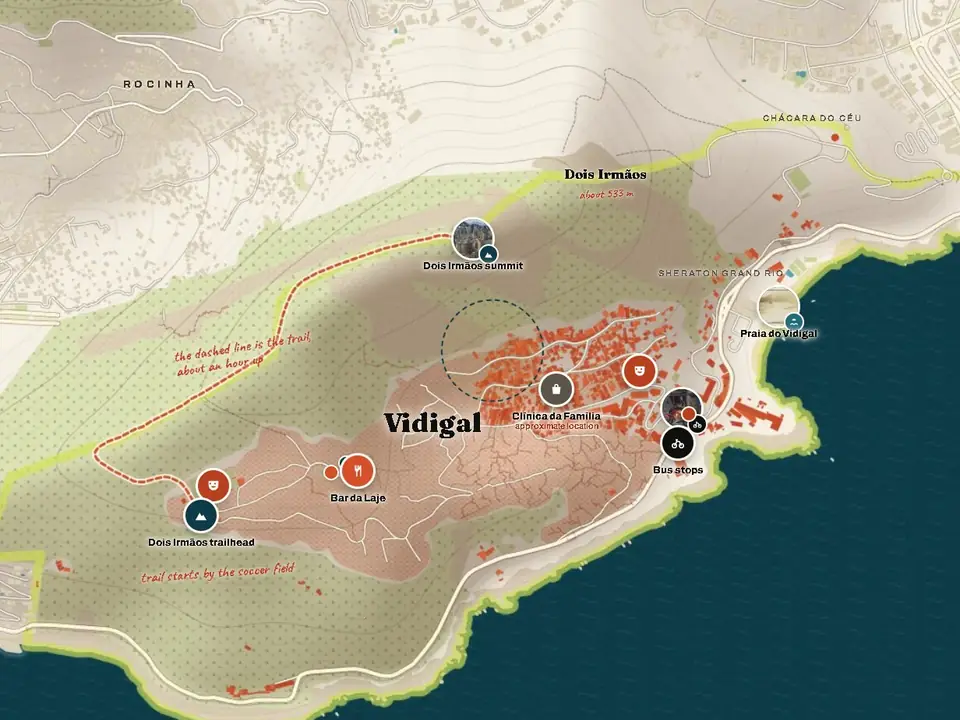
The first route is the one the apartment uses. You walk out the front door, you head down Rua Armando de Almeida Lima, and you keep going until the road forks. You take the right-hand fork and you continue down toward Av. Niemeyer. Four minutes, sometimes five if you stop to photograph the view (you will stop to photograph the view). At the bottom, you cross Niemeyer at the light, and a small path cuts left past the Sheraton perimeter. The path is paved. It is signed, if you look carefully, as a passagem pública. It ends on the sand.
The second route comes in from the Leblon side. If you're staying in Ipanema or Leblon and want to visit for the morning, walk or drive along Av. Niemeyer toward São Conrado. The Sheraton's main entrance is on your right after about 1.2 kilometers from Leblon's western end. Walk into the lobby like you belong there, because you do — the hotel cannot refuse transit to the beach — and follow the signs (they exist, discreetly) toward acesso à praia. Elevators take you down. A path walks you out. Ninety seconds later you are standing on the sand.
We have heard variations of the same story from guests over the years. The desk clerk looked at them funny. A doorman asked where they were going. No one has ever been turned away. If someone tries, you smile, you say praia pública, por favor, and you keep walking. The Ministério Público do Rio de Janeiro has weighed in on this multiple times, most recently in 2024, affirming that the Sheraton's beach access is a legally protected public right. You are fine.
A third variant: from inside the favela itself. If you are staying in Vidigal and you ask around at Largo do Vidigal — the main plaza at the bottom of the hill — someone will point you at a pedestrian-only cut-through that runs behind the Sheraton property and spills onto the sand near the rocks. It is not well-marked. It is not illegal. It is, quietly, the way most Vidigal residents have always used the beach. Ask politely in Portuguese if you can. Our housekeeper, Dona Elza, took it every Sunday of her teenage years.
What the water is actually like.
This matters more than people expect. The ocean at Vidigal behaves differently from the ocean at Copacabana or Ipanema, which behave differently from each other. The hillside that rises from the sand changes things.
First: the water is often calmer. The little bay curves in just enough to soften the surf. You still get waves — this is the Atlantic, not a lake — but on a normal day the break is at knee-height, manageable for a competent swimmer, friendly for a strong child. On big swell days (usually June through August, sometimes in March) it gets serious, and the lifeguards will raise the red flag, and you will respect the red flag.
Second: the water is cooler in the morning. This is the mountain's fault. The hillside casts a long shadow across the beach until roughly 10am in April, which means the sand stays cool and the shallow water doesn't warm up the way it does at Copacabana. If you want the warmest swim, come after 11. If you want the most refreshing swim, come at 8. In April the water sits around 24 degrees Celsius. In January it might touch 26. In July it drops to 21 and you gasp when you go in, and then you love it.
Third: the clarity. Because there's less foot traffic and less sand-churn from people, the water at Vidigal is noticeably clearer than at Leblon. On calm mornings you can see your feet. Sometimes you can see small fish — garoupas, sardinhas — schooling in the shallows. Once, in 2023, our neighbor Luiz swears he saw a small sea turtle near the rocks. The IBAMA field station at Barra confirms that green turtles (Chelonia mydas) do occasionally feed along this stretch of coast.
Fourth: the currents. There is a small rip near the east end of the beach, where the water funnels between the sand and the Sheraton's rock jetty. It is not lethal, but it will pull you out if you ignore it. Stay in the middle third of the beach for swimming. The lifeguards know where the hazards are and they put the flags accordingly. Watch the flags.

Vidigal beach versus Leblon.
Leblon is Leblon. It is one of the great urban beaches in the world. It has Posto 11 and Posto 12 with their kiosks, their mate vendors, their endless parade of joggers and dogs and stand-up paddleboarders and models and grandfathers playing frescobol. It is a carnival. It is wonderful. It is also, increasingly, very loud.
Vidigal beach is the opposite of Leblon. Not better. Different. The split below is the honest version, the one we walk guests through in the kitchen on their first morning.
Why you'd choose Vidigal beach
- Almost no crowds. Ten people on a weekday morning is a busy day.
- Calmer water. Better for swimming with kids or as a less-confident swimmer.
- The view. Mountain behind, ocean in front, no high-rises in sight.
- The walk. Four minutes down from the apartment, no car needed.
- The quiet. No kiosk speakers. No vendors. Just surf and gulls.
- The people. Locals, fishermen, a few Sheraton guests. Everyone is low-key.
Why you'd choose Leblon instead
- The energy. Leblon on a Saturday is Rio at full volume.
- The kiosks. Thirty types of petiscos, ice-cold chopp, everything on the sand.
- The people-watching. Nowhere better in Rio.
- The calçadão. The mosaic boardwalk, the sunset joggers, Sunday car-free.
- The surf. Bigger waves, better body-boarding.
- The sheer size. Over a kilometer of sand, easy to find space.
Most of our guests end up doing both, and most of them end up surprised by which one they prefer. The pattern is consistent: they arrive assuming they'll spend every morning at Leblon. They do Leblon once. Then they do Vidigal. Then they do Vidigal three more times. Then, on their last day, they go back to Leblon because they feel they should, and they admit — quietly, looking at the kiosk crowd — that they miss their little beach.
Nicolas Behr, the Brasília poet, once wrote about the difference between a beach that gives you something and a beach that takes something from you. Leblon gives you Rio. Vidigal takes Rio away for ninety minutes.
The walk to the beach is four minutes downhill. The walk back is earned. — a thing we say to every guest
The best time of day.
There are three good windows on Praia do Vidigal, and they are different beaches.
The first is early morning, between 7 and 10. This is when locals come. The sand is cool. The water is cool. The light is soft. The hill is still in shadow. Fishermen are out. The lifeguard is setting up the post. You swim, you sit, you watch the bay. A woman walks past with a small dog. Two teenage boys from the hill run into the water and out and keep running down the beach. You can count on being more or less alone, even in high season.
The second is mid-afternoon, roughly 2 to 5pm. The sun is over the top of the hill by noon, and by early afternoon the sand is warm and the water is lit from above. This is the window for a real beach day — canga on the sand, book, água de coco from the Sheraton bar, slow swim every forty minutes to cool off. You'll share the beach with maybe fifteen or twenty others on a weekday, thirty to fifty on a weekend. Never crowded. Always manageable.
The third window is the one that surprises visitors: sunset. Vidigal faces roughly south-southwest, which means the sun sets behind you — behind the hill — not out over the water. This disappoints some people. It shouldn't. What happens instead is that the last hour of sunlight strikes the hillside directly, and the pastel houses stacked up the slope turn gold, and then pink, and then violet, for maybe twenty minutes. The ocean, meanwhile, goes dark silver. You turn around and watch the hill. It is one of the best light shows in the city and almost no one knows to watch it.
The one window we'd avoid: noon to 1:30pm. The sun is directly overhead, the sand is too hot to walk on without flip-flops, the UV is at its peak, and there is almost no shade. Go back up to the apartment. Eat something. Rest. Come back at three.
Packing list for the four-minute walk down
Keep it light. You're walking back up.
- Canga (the thin Brazilian beach cloth — a towel works but takes up more space in your bag). We keep two at the apartment for guests.
- Reef-safe sunscreen, SPF 30 minimum. The tropical sun is not your home sun.
- Flip-flops, not sandals. The path back up has some loose sand and small stones.
- A 1-liter water bottle. There is no drinking fountain on the beach.
- R$50 to R$100 in cash if you want food or drinks from the Sheraton pool bar.
- A small dry bag or sealed pouch for your phone. Optional but wise.
- A light cotton shirt for walking back up. The hill can feel warmer in the afternoon.
- A tip pair of cheap polarized sunglasses. The glare off the water is real.
The Sheraton question.
We keep coming back to the Sheraton because you will too, whether you want to or not. The hotel is the most visible man-made thing on the beach. A long white curved building rising out of the rocks on the eastern end. Opened in 1974 as the Sheraton Rio, rebranded as the Sheraton Grand Rio in 2016, sold and re-operated multiple times since. Its relationship with the beach is complicated.
Here's the short version. The hotel owns the land behind the sand — the pools, the garden, the building itself. It does not own the beach. No one does. Beach access is a constitutional right in Brazil. The hotel is legally required to maintain a public walkway through its property so that non-guests can reach the sand, and it does, though not always with visible enthusiasm. Signage is discreet. Staff will occasionally ask where you are going. A polite eu vou para a praia ends any question.
Once you are on the sand, you are on the sand. Public. Yours. The Sheraton has its own private pool area behind a low wall that runs along the back of the beach, and you cannot enter that area without being a hotel guest. But the sand in front of the wall is open to anyone. Lifeguards on that stretch are municipal, not hotel-employed, and they serve everyone equally.
The hotel's pool bar is genuinely worth knowing about. It serves non-guests if you walk up from the beach and order at the outdoor bar. Água de coco for around R$18. Caipirinha for R$42. A light prato do dia for R$80 or so. It is not cheap. It is not a ripoff either — the prices are roughly Leblon-kiosk prices, and the view from the bar stools is extraordinary. We send guests there once, usually on day three, when they've had enough groceries and want someone else to make them lunch.
If you are a hotel guest, the calculation is different. You get pool, restaurant, gym, towel service, and a dedicated beach concierge who will set up chairs and an umbrella on the sand for you. This is a fine way to do it. It is not, however, the same experience as arriving on foot with a canga over your shoulder and the hillside above you. That experience is free.

A short history, by way of context.
Praia do Vidigal has had a strange, quiet biography. For most of the twentieth century it was a working-class beach, used almost exclusively by residents of the hill. Vidigal itself grew as a favela beginning in the 1940s, as workers came to build Avenida Niemeyer and stayed, and then stayed further when the construction of the Sheraton in the early 1970s displaced some of them and consolidated others on the hillside above. The beach was a refuge. Fishermen kept boats here. Kids learned to swim here. The Sheraton, when it opened in 1974, attempted to operate as if the beach were an extension of its property. That attempt has been slowly walked back over fifty years, aided by lawsuits, media pressure, and a gradually more assertive understanding of public-space rights in Brazilian law.
In the 1980s and 1990s, as Rio's international film output grew, Praia do Vidigal became a quietly famous location. Orfeu (1999), Carlos Diegues's remake of Orfeu Negro, shot several sequences here. So did parts of the Globo mini-series Anos Dourados. The beach read, on camera, as authentic-Rio-without-the-crowds. It still does.
Around 2010, something shifted. Vidigal — the neighborhood above — began a slow transformation, with artists, foreign residents, and a new generation of Brazilian creatives moving in. Bar da Laje opened. Alto Vidigal followed. A documentary scene, a music scene, a small art scene clustered on the upper streets. The beach, meanwhile, stayed almost exactly as it had been. Locals still came. Fishermen still cast. The Sheraton still did its thing. But now, when visitors came up the hill for dinner at a rooftop, they sometimes wandered down to the sand the next morning and understood that the hill and the beach were the same place.
If you want a deeper sense of that transformation and how it continues to shape daily life up on the hill, our honest piece on safety in Vidigal lays out where we are in 2026. Short version: safer than people expect, quieter than the coverage suggests, and more integrated with the rest of Zona Sul than it has been in a generation.
The beach flag system, in thirty seconds
Rio's municipal lifeguard service (GMar) uses a three-flag code you'll see at the post. Learn it before your first swim.
- Green flag: safe conditions. Swim freely, stay within flagged area.
- Yellow flag: caution. Stronger currents, higher waves, experienced swimmers only.
- Red flag: swimming prohibited. Dangerous currents or water quality issues. Respect it. The lifeguards do not raise red flags for fun.
- Black-and-white checkered flag: surfing or body-boarding zone — no swimming here.
- Lifeguards are stationed at Posto Vidigal from roughly 8am to 6pm. They speak Portuguese, basic English, and whistle fluently.
What the apartment has to do with any of this.
A small disclosure, because the brief requires it and because it's relevant. We own and manage the apartment at the top of the hill, eighth floor, Sugarloaf on the left, ocean on the right. We spend a lot of time thinking about the relationship between the apartment and the beach below it, because the four-minute walk down is one of the most honest things about the place.
It is not a pé-na-areia apartment. We do not pretend it is. Pé-na-areia in Rio means the building opens directly onto the sand — the apartments on Av. Delfim Moreira in Leblon, for example, where you walk out the lobby and cross the calçadão and you are on the beach. Those apartments exist. They cost a fortune. They also sit on a loud avenue with a lot of foot traffic and no real view because the building next door blocks it.
What the apartment offers instead is a different trade. You are four minutes above the beach, not at it. You have the view — Sugarloaf, Ipanema, the full sweep of the coast — that you cannot get at street level. You have the silence of being up on the hill. And you have a commute to the sand that is shorter than most Ipanema guests walking from Rua Visconde de Pirajá to the calçadão. The catch is the walk back up. The hill is a hill. Ten minutes, sometimes twelve if it's hot. You will sweat. You will arrive at the door ready for the shower and the cold water and the balcony. The apartment earns its view by asking this of you, once or twice a day, for as long as you are here.
This is the exchange we describe to every guest, usually in the first ten minutes. Some of them hear it and light up. Some hear it and decide this is not the place for them. Both responses are fine. If you are curious what the view looks like from the other end of that walk, the condo page has the full gallery and the honest floor plan.

Small rules, quiet etiquette.
Praia do Vidigal is small enough that it still has a village-beach social code, and you'll feel better for knowing it. Nothing is strictly enforced. Everything is noticed.
Dogs are technically not allowed on the sand. Locals bring them anyway, off-leash, early in the morning. If you don't have a dog, you don't have a problem. If you do, keep it leashed and keep it out of the lifeguard's flagged swim area, and clean up after it. The beach is tiny.
Music is welcome, speakers are not. A small Bluetooth speaker played at conversation volume is fine, especially in the afternoon. A speaker loud enough to reach the next canga is a Leblon thing. Please keep Leblon things in Leblon.
Fires and camping are prohibited outright. The municipal ordinance covering all Rio beaches applies here and there is no exception. The environmental police patrol occasionally. If you want a beach fire, go to Itacoatiara in Niterói, not here.
Topless sunbathing is not common in Rio generally and is uncommon on this beach specifically. No one will call the police. People will notice. Calibrate accordingly.
The vendors who do walk the beach are mostly selling sarongs, shrimp skewers, and Biscoito Globo — the ring-shaped tapioca cracker that is the closest thing Rio has to a national snack. They are friendly. A polite não, obrigado with a smile is the right response if you're not buying. A bigger smile and a R$10 note is the right response if you are.
Finally: the sand. Pack out what you pack in. There are no bins on Praia do Vidigal. The municipal crew that cleans the beach comes at dawn and they do a real job, but the beach is at its best when visitors take their own trash back up the hill. A small plastic bag is enough.
~~~Comparisons with other quiet beaches.
Rio has a short list of beaches that claim to be quiet, hidden, or undiscovered. Most of them aren't. Here's where Vidigal fits on the honest ranking.
Praia do Secreto, near Joatinga, is the one most often cited as Rio's secret beach. It is small, it is dramatic, and it is reached by a scramble down rocks at low tide. It is also genuinely crowded on weekends because it has become Instagram-famous. Access is weather-dependent. If you are twenty-three and in good shape, go once. If you are traveling with older family or with kids, don't. Vidigal is dramatically easier.
Praia do Arpoador, at the east end of Ipanema, is not really a separate beach — it's the rocky point at the end of Ipanema where surfers go. The rock itself, Pedra do Arpoador, is worth climbing at sunset. The "beach" is technically the eastern sliver of Ipanema. Good for a surf lesson. Not a quiet beach by any definition.
Praia da Joatinga, further west past São Conrado, is a genuine gem — small, high-cliff-walled, gorgeous. Access requires climbing down a ladder. Parking is a nightmare. Without a car or a guide, a visit eats half a day. Vidigal beach is a fifteen-minute mission; Joatinga is a half-day expedition.
Praia Vermelha, at Urca beneath Sugarloaf, is small and protected and surrounded by forest. It is beautiful. It is also popular with families and often has a small crowd. Calm water. Minimal waves. Worth a visit. Different feel — more forest, less mountain.
In the ranking of easy-to-reach, genuinely-quiet, swimmable-any-day beaches in Rio, Vidigal is top three, and possibly top one. That is not a boast. It is a consequence of the geography — the hillside pushing in, the Sheraton occupying the adjacent land, the single public walkway — and the accident of history that kept it off the tourist map for fifty years.
A typical day down there.
So you're staying at the apartment. Morning one. Here's how the beach day actually unfolds.
You wake up around 7:30. You put coffee on. You stand on the balcony with the cup and you look at the ocean and you realize how close it is. You text the group chat: beach this morning. You put on swimwear under whatever you are wearing, you grab a canga from the basket by the door (we keep them there), and you head out. 8:15. The path down the hill is shaded at this hour, cool, quiet. Four minutes later you are at Av. Niemeyer, waiting for the light.
8:20. You cross the avenue, take the path past the Sheraton wall, and step onto the sand. The water is a pale green. There are three other people on the beach. The lifeguard has just raised the green flag. You spread the canga, you put sunscreen on your shoulders, you walk into the water. The first three meters are cold. The next three are perfect. You swim out to where you can still touch bottom, you turn around, you look back at the hillside — Dois Irmãos, the pastel houses, the small figures of the fishermen on the rocks — and you understand, in that specific way that only Rio teaches you, why anyone would live here.
9:30. The beach has filled up a little — maybe ten people now. A couple with their dog. Two Sheraton guests setting up loungers. A group of four friends who arrived with a small speaker playing something that sounds like Caetano. You swim another set. You lie on the canga and dry off. The sun is now above the hill and the sand is warming.
10:15. You walk up to the Sheraton pool bar, you order two águas de coco and a plate of pastel de queijo, you carry them back to the sand. The coconuts are R$18 each. The pastel is R$32 for four. Total R$68. Worth it.
11:30. Beach fatigue sets in — happy fatigue, the good kind. You pack up. You walk back across Niemeyer, up the path, up the hill. Ten minutes up. You sweat the last third. You arrive at the apartment, you shower, you put on something light, you eat fruit on the balcony, you look down at the little stretch of sand you just left, and you plan the afternoon. Maybe you go back at four. Most likely you do.
This pattern repeats itself for most of our guests. On day one they think the beach is an event. By day three they think it's a habit. By day five they have a favorite spot on the sand and a favorite order at the pool bar. By day seven they are sad to leave. This is a thing beaches do, when they are small and when you return to them.
If you want a proper breakfast before you head down, our Vidigal restaurant guide has the three spots we send guests to. For everything else — getting from the airport, ride-share pickup points, the moto-taxi system on the hill — the getting around Vidigal post covers the logistics.
Wildlife, quietly.
We would not call Praia do Vidigal a wildlife destination. It is not Fernando de Noronha. But small things live here, and if you watch, you notice.
Seabirds are constant. Brown pelicans — atobás in Portuguese — cruise the waves in formation at sunrise, sometimes three or four in a line, wings almost touching the water. Frigatebirds ride the updrafts off the hillside; when the fishermen clean their catch on the rocks at the east end, the frigates come in close. Smaller: kelp gulls, terns, the occasional oystercatcher poking at the tide line.
In the water, small schools of sardines flash near shore. On calm mornings you can watch them for a long time. Occasionally — less than once a week, in our experience — a larger dark shape moves past the breakers, and you hold your breath, and it turns out to be a green turtle cruising along the reef-edge. They are protected. Do not follow them. Do not touch them. Admire and move on.
At the eastern rocks, when the tide drops, you'll see small crabs (siris), anemones, and the small black fish locals call maria-mole. Tide pools are shallow and safe to explore. Flip-flops help. The rocks are slick.
Dolphins are very rare here. Whales — humpbacks, migrating north from Antarctica — pass offshore in August and September, and from the apartment balcony we have occasionally seen a distant spout. You will not see one from the beach. The sight-line is wrong.
Getting here without the apartment.
We mostly write for guests staying with us, but the beach is the beach, and plenty of people visit for a morning. If you are based in Ipanema, Leblon, or Copacabana and want to come over, here's the short version.
From Leblon: walk. It's 1.2 kilometers along Av. Niemeyer. Twenty minutes. The road has sidewalks on the ocean side for most of the stretch, and the view of the coast is worth the walk on its own. Wear decent shoes.
From Ipanema: Uber or local taxi. R$25 to R$40 depending on traffic. Ask to be dropped at Sheraton Grand Rio. Walk in.
From Copacabana: Uber or taxi. R$40 to R$60. Same instruction.
From the apartment: four minutes on foot. You already know this.
Parking: limited and expensive. The Sheraton has a valet garage at hotel-guest rates. On-street parking along Av. Niemeyer is technically possible but heavily controlled, with parking wardens, and a real risk of being towed if you misread the signs. If you are driving, leave the car at the hotel and accept the valet fee. Better yet, don't drive.
Quick questions.
Is Vidigal beach safe to visit as a tourist?
Yes. The beach itself is public, has a full-time lifeguard post, is overlooked by the Sheraton's security perimeter, and sees consistent daily foot traffic. We have sent hundreds of guests down over the years. Zero incidents. Standard beach common sense applies everywhere in Rio: don't leave valuables unattended on the sand, carry what you need and no more, keep your phone in a dry bag. The safety dynamics of the beach are different from the safety dynamics of the favela above it, which are in turn calmer than most international coverage suggests.
Do I have to be a Sheraton guest to use the beach?
No. Brazilian federal law makes every beach in the country public property. The Sheraton is legally required to maintain a public walkway through its grounds, and it does. Walk in, say praia pública if anyone asks, and keep going. You do not need a reservation, a wristband, or a hotel room.
Are there kiosks and food on the beach?
Not on the sand itself, which is part of the charm. The Sheraton's pool bar, set back behind the low wall at the east end, serves non-guests who walk up from the beach: água de coco around R$18, beers R$20 to R$28, caipirinhas R$42, small plates R$30 to R$80. Vendors occasionally walk the sand selling sarongs, shrimp skewers, and Biscoito Globo. Bring water.
How does it compare to Ipanema for swimming?
Vidigal is usually calmer. The bay curves in just enough to protect the water from the biggest swell, so the break is typically gentler, and the current is generally more predictable. Ipanema has bigger waves, more people, and more rip activity, especially near the canal between Ipanema and Leblon. For a relaxed morning swim, Vidigal wins. For body-boarding in real surf, Ipanema wins.
What's the best time of year to visit?
Honestly, most of the year. Water temperatures stay in the 22 to 26 degrees Celsius range year-round. The dry season (May to October) has cooler mornings, clearer skies, and smaller crowds. The wet season (November to March) has hotter days, bigger afternoon storms, and warmer water. For beach mornings specifically, March through June and September through November are the easiest windows: warm, mostly dry, not overcrowded.
Are there lifeguards?
Yes. The municipal GMar service staffs Posto Vidigal daily, typically 8am to 6pm. Lifeguards raise colored flags based on conditions — green, yellow, red, or the checkered surf flag — and are responsible for rescues, basic first aid, and general safety on the sand. Respect the flags. They are placed carefully.
Is it dog-friendly?
Officially no, practically yes if you're discreet. Municipal rules prohibit dogs on Rio beaches, but on a small local beach like Vidigal, residents bring well-behaved dogs early in the morning with little issue. Keep the dog leashed, away from the swim area, and clean up after it. Enforcement is minimal but not zero.
The beach will be here whether you visit or not. That's part of what makes it what it is — Praia do Vidigal does not need you. It has its fishermen, its lifeguard, its dawn pelicans, its evening light on the hill. What it offers, when you do show up, is the slightly startling sense that a place this quiet and this beautiful can exist four minutes from a door in a city of six million people. You go down. You swim. You walk back up the hill. You earn the view, and then you are inside it.