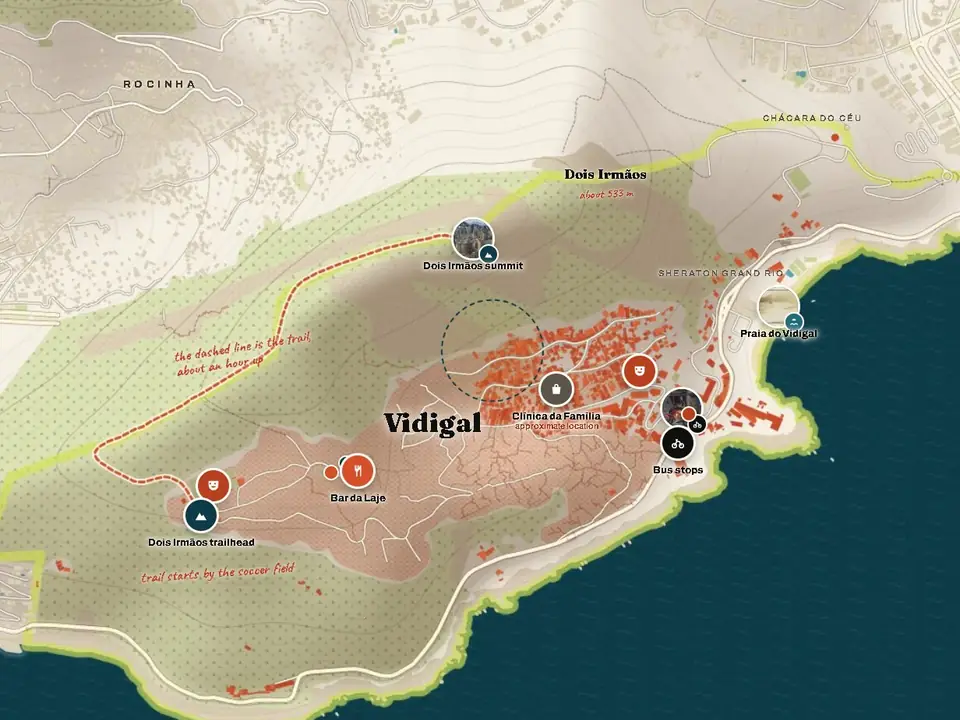

Eighth-floor coffee, then the door. Three minutes down the ladeira to the moto-taxi stand. Five minutes up to the last stop. And then, forty-five minutes later, the whole city is under your shoes. The Dois Irmãos trail in Rio starts inside Vidigal — which is why, for a certain kind of traveler, Vidigal is the only place to stay. 533 meters up, a 360-degree view, and you are back for a second coffee before most of Leblon is awake.
Lux Vidigal is our two-story apartment in Vidigal, with the ocean on one side and the Dois Irmãos mountain on the other, and you can check dates and book it on Airbnb.
The mountain you have already been looking at
You have seen Dois Irmãos before. If you have ever stood on Ipanema beach and looked west — past the surfers, past the sand, past the row of towers on Leblon — you have seen it. Two green peaks rising together out of the ocean, with the Rocinha favela spilling down the inland side and Vidigal spilling down the ocean side. The taller peak reads 533 meters on the map. The shorter one reads 506. From the beach they look like brothers leaning slightly apart. From the top of the taller one, Rio unrolls like a pulled tablecloth.
The name is old. The Tamoio, the Indigenous people who lived on this coast before Portuguese contact, told the story of two brothers, Tymbiré and Crimirim, who fought over a woman and were turned into stone by the gods as punishment. Every *carioca* knows the story in broad outline. Geologists have a different version — limestone and gneiss, part of the Tijuca massif, uplifted and weathered over millions of years into the twin profile you see from the sand. Both versions are correct in their way. The mountain is old enough to hold both.
For most of the twentieth century, climbing Dois Irmãos was a project. You needed a guide, you needed a plan, you needed to be willing to pick your way up an unofficial path through forest that belonged, unofficially, to whoever had the run of Vidigal that year. After the UPP pacification in 2011 and the growth of the tourism economy inside Vidigal, the trail became something different: a short, signposted, legally managed day hike that starts inside the *favela* and ends at one of the most spectacular viewpoints in South America. The trailhead sits inside Parque Natural Municipal Paisagem Carioca, a protected urban park that also contains parts of Corcovado and Tijuca. You pay a small community fee to enter. You walk up. You look.
The pitch of the thing is this: the Dois Irmãos trail Rio gives you, in under three hours door-to-door, the single best panoramic view of the city. Not the most famous — that is Cristo, and Cristo is beautiful. Not the most photographed — that is Pão de Açúcar, which you can ride to in a cable car. But the most complete. From the top you see Ipanema, Leblon, Copacabana, Sugarloaf, Cristo Redentor on his perch, the Rocinha roofs pouring down the hill, the green sweep of Tijuca Forest, the beach curve of São Conrado, the long flat of Barra da Tijuca in the distance, the sharp blade of Pedra da Gávea. All of it, at once. You turn in a slow circle and Rio rotates under you.
Trilha Dois Irmãos, at a glance
The short version for people who just want numbers.
- Height
- 533 meters (taller peak)
- Distance
- ~1.5 km one way
- Duration
- 45 min up (fit), 60–75 min (casual). Plan 2.5–3 hours total.
- Difficulty
- Moderate. Stairs and rocky sections.
- Entrance fee
- Community fee, typically R$10 (or 2 kg of non-perishable food) at the trailhead. Verify at entry.
- Hours
- Tuesday–Sunday, roughly 8:00 to 16:00 (last entry around 13:00). Closed Mondays and in heavy rain.
- Trailhead
- "Ponto Final" — the last stop at the top of Vidigal, via Av. Niemeyer extension.
- Moto-taxi up
- R$5–8 from Largo do Vidigal to the trailhead.
- Bring
- Water (1 L min), closed shoes, sunscreen, hat, small cash.
Getting to the trailhead
This is the part that surprises first-time visitors. The Dois Irmãos trailhead is not in a national park carpark. It is not on a highway. It is at the top of Vidigal, inside the *favela*, at a place everyone just calls Ponto Final — "the last stop." Which sounds dramatic. It is not. It is a small paved turnaround where the moto-taxis idle in a loose line and the community association keeps a little booth for trail entries.
If you are staying in Leblon or Ipanema, the simplest route is a standard taxi or Uber to Largo do Vidigal — the entrance to the *favela* on Av. Niemeyer. From there you take a moto-taxi up. R$5 to R$8, depending on traffic and whether you are local-looking. Hop on the back, hold the side of the seat, and enjoy the eight-minute ride as the road switches back and back and back up the hillside. You will pass *botequins*, a school, dogs, murals, the cable-car tower that was never finished, and suddenly the view opens and you are at the top.
If you are staying at Lux Vidigal — our apartment on the eighth floor of a quiet block inside Vidigal itself — the calculation is different. You walk out the front door. Three minutes downhill to the moto-taxi stand at Largo do Vidigal. Five minutes up to the trailhead. Total door-to-trail time: under fifteen minutes. This is not an incidental detail. It is the reason a lot of hikers choose Vidigal over Ipanema as a base. On a sunrise-tour morning the rest of Rio is setting alarms for 4:30. You set yours for 5:00 and still beat them to the gate.
A note on vans. In addition to moto-taxis there are yellow community vans that run the same route for R$4 to R$7. They are cheaper and slower and less fun. If you have luggage, knees, or a general objection to the back of a motorbike, take the van. Otherwise the moto is the correct choice. The drivers do this climb a hundred times a day. They know the road better than you will ever know any road.
At the top you pay your entry fee in cash at the little booth. In 2026 this is typically R$10 per person — a community fee that goes to the Associação de Moradores do Vidigal to fund local projects. Some days you can trade 2 kg of non-perishable food for your entry. Bring small bills. No one has change for a R$100. If a tour operator tells you the fee is higher, it is because they are bundling guide, transport, and access into one price. Solo, at the gate, it is R$10 and a signed register.
The climb itself
You leave the Ponto Final through a metal gate and immediately you are in forest. Not landscaped forest. Not manicured. Actual Atlantic Forest — *Mata Atlântica* — the same biome that once covered most of Brazil's east coast and now survives in fragments like this one. The air changes. The sound of the city drops by a full register. You hear cicadas, birds, the scuff of your own shoes on the path.
The first ten minutes are the easiest. A wide, slightly muddy track climbs gently through tall trees, mostly *jaqueiras* — jackfruit trees that drop their prehistoric green fruits onto the path in season. Saguis, the small tufted-ear marmosets of the Atlantic Forest, will watch you from branches. They are unafraid. Do not feed them. They bite, and they carry things that humans do not want.
Then the path tilts. The next twenty minutes are the work of the thing. A series of wooden steps, then rock steps cut into the hillside, then the occasional rope-assisted scramble where the grade gets serious. You will sweat. Your calves will notice. If you have been sitting at a desk in São Paulo or London for the last three months, the climb will humble you briefly, and then you will adjust. A reasonable fitness level gets you up in 45 minutes. A casual pace with photo stops gets you up in 60 to 75. The path is well-marked and well-trafficked — on any given morning you will cross a dozen other hikers coming down as you go up, and greetings in four languages are traded on the switchbacks.
About two-thirds of the way up there is a small false summit — a flat rocky outcrop with a partial view out over Rocinha and São Conrado. It is not the top. People sit here, drink water, assume they are done, and then realize they are not. Keep going. The last fifteen minutes are the steepest, but they are short, and the payoff is imminent.
And then you come out of the trees onto the summit. And the view does what the view does.

What you actually see from the top
Stand on the summit. Face east first. The beach directly below you is São Conrado, a curved strip with its tiny Pepino surf break and its hang-gliders dropping in from Pedra Bonita somewhere to your right. Beyond São Conrado, the ocean. Far out: Cagarras Islands, small and green, about five kilometers offshore.
Now turn slowly clockwise. The next beach in the sweep is Ipanema, with its distinctive lifeguard-post numbering and the straight wall of beachfront buildings behind it. Then Leblon, Ipanema's slightly older sibling. Then the Lagoa Rodrigo de Freitas — the big saltwater lagoon — with its ring of joggers and its row of sailing clubs. Behind Lagoa, rising, is Corcovado. And on Corcovado, small from here but unmistakable, is Cristo Redentor with his arms out. Keep turning. You pass the peaks of the Tijuca Forest, dense green, and then you see Pão de Açúcar — Sugarloaf — poking up from the entrance of Guanabara Bay. Beyond it, on a clear day, the silhouette of downtown Rio and the long flat line of Niterói across the water.
Keep turning. Behind you, to the west, the view is different but no less dramatic. You look down into the bowl that holds Rocinha, the largest *favela* in Rio — tens of thousands of houses stacked down the mountainside in an impossible geometry. Beyond Rocinha, the long white beach of Barra da Tijuca stretches to the horizon. And to your right, rising close enough to feel like you could step onto it, is Pedra da Gávea — the enormous flat-faced rock that looks, depending on your angle, like the profile of a sleeping giant.
There are a few good flat rocks at the top and not much shade. People sit. They pass water bottles. They take the photo they came for — the one with Ipanema curving behind their shoulder — and then they just sit. Most people stay at the top for 30 to 45 minutes. There is no rush. The park ranger at the gate does not mind. The view does not mind.
One thing you notice, up here, is how small Rio feels. From the ground the city is enormous, overwhelming, a mess of neighborhoods and highways and traffic. From 533 meters it is a village. You can see where you slept, where you ate, where you swam, where you plan to eat dinner, all in a single glance. Few cities give you this. Rio gives it to you twice — once from Cristo, once from here. Cristo is more famous. This one is better.
The view from Cristo is beautiful. The view from Dois Irmãos is personal. You see the corner where you bought oranges. — a guest, summer 2025
When to go (and when not to)
The trail is officially open Tuesday to Sunday, typically from 8:00 to 16:00, with last entrance around 13:00. Monday is closed for maintenance and to give the forest a day off. In heavy rain the trail closes — the rock steps become dangerous and the park management, reasonably, shuts the gate. Check the Trilha Dois Irmãos Instagram or ask at your accommodation before you set out in bad weather.
Inside those hours, the question of when to climb breaks into three honest options.
Morning, 8:00 to 10:00. This is the sweet spot for most people. The gate opens at 8:00, you are up by 8:45, and the top is cool, clear, and mostly empty. The sun is still low so the light on Ipanema is the golden hour's extended cousin. By 10:00 you are on your way back down, passing the late crowds on their way up. You are at breakfast by 11:00.
Sunrise tours. A handful of guides — most of them operating out of Vidigal hostels — run sunrise tours that enter the trail before the park officially opens. You climb in the dark with headlamps, you reach the top just as the first orange hits Pão de Açúcar, and you watch Rio wake up from above. It is the best version of this hike if you are willing to set an alarm for 4:45. The tours run roughly R$100 to R$180 per person and require booking the day before. Favela Chic Hostel and a few others inside Vidigal run them regularly.
Afternoon. Honest answer: avoid, unless you have no choice. The sun is overhead, the rock steps are hot, the haze rolls in from the ocean and flattens the view. You still get the panorama, but not the clean one. If afternoon is the only time that works, go anyway — the view is still the view. Just bring more water than you think you need.
Sunset is its own conversation. The park technically closes before sunset in most of the year, but a few operators run special sunset climbs with permission and a rangered descent by headlamp. These are wonderful and rare and worth the extra planning if you can swing it.
The morning rhythm
How we tell guests to structure the day if they only have one shot at Dois Irmãos.
- 05:30 — wake up, coffee on the *laje*.
- 06:00 — door. Moto-taxi to Ponto Final.
- 06:15 — pay fee, start walking (sunrise tour) or 08:00 — gate opens (regular entry).
- 07:00 or 08:45 — summit. Sit. Drink water. Rotate.
- 09:30 — back at the trailhead. Moto-taxi down.
- 10:00 — second breakfast in Leblon or on your own terrace. Done before most tourists are out of bed.

What to bring, what to wear
The trail is short enough that you do not need a real hiking kit. It is serious enough that you do not want to show up in flip-flops, which some people do, and then regret. The minimum is: closed shoes with some grip (sneakers are fine, hiking shoes are better), a hat, sunscreen applied before you start, one liter of water per person, a small amount of cash for the entry fee and tips. That is the entire list.
Additions that are worth carrying. A small towel — you will sweat. A phone with charge — the photos at the top are non-negotiable and phones die faster than you think in the heat. A light rain shell in the wet months (December through March), because the weather can turn between the trailhead and the summit. A snack — the fruit vendors at the bottom are great, but they do not follow you up.
What you do not need. A proper backpack — a small day bag is plenty. Trekking poles — overkill for 1.5 kilometers of moderate trail. A guide, if you read Portuguese or basic English signage. The path is extremely well-marked. The occasional fork has an arrow. You will not get lost.
A word on clothes. Light, breathable, moisture-wicking, and forgiving of sweat. We have watched people climb in denim cutoffs and watched them suffer. The Rio sun at 9 a.m. on a clear day is not the sun you are used to. Respect it.
Bring
- 1 L water per person
- Closed, grippy shoes
- Sunscreen (apply before)
- Hat + sunglasses
- R$20–30 small cash
- Phone with charge
- Light snack
Skip
- Flip-flops or sandals
- Jeans
- Trekking poles
- Heavy backpacks
- Drone (not permitted in the park)
- Bluetooth speaker (please)
Safety, honestly
The question gets asked, so it gets answered. The Dois Irmãos trail is safe. It is inside a protected municipal park, it is patrolled by rangers, it is one of the most-trafficked day hikes in Rio, and the trailhead sits at the top of a *favela* that is comfortable with tourists and has been for fifteen years. We have put hundreds of guests on this climb. No one has ever had a problem. The forest has no snakes you need to worry about. The wildlife is small and friendly (saguis, hummingbirds, the occasional toucan passing over). There is, simply, nothing on the mountain that wants to hurt you.
The access through Vidigal is the part that gives some travelers pause before they come. It should not. Vidigal is one of the safest communities in Zona Sul. Our longer piece on this — is Vidigal safe? — goes through the history, the UPP, the current reality, and what guests actually experience. The short version: you take a moto-taxi up, you take one down, you are polite with the drivers, you tip a real, you do not pull out a R$500 camera in the middle of an alley. Same rules as anywhere in Rio, possibly lower stakes.
What you do want to be careful about is the trail itself. Wet rock is slippery. The rope-assisted sections require two hands. Do not rush the descent — most injuries happen going down, when knees are tired and ego says "I'm fine." And drink the water. Dehydration on the way up is the single most common reason the rangers have to help someone.

Solo, guided, or sunrise tour
Three ways to do this trail, and the right one depends on what you want out of the morning.
Solo. Perfectly doable. Moto-taxi up, R$10 at the gate, sign in, walk up, walk down. Best for fit travelers comfortable navigating a foreign *favela* by themselves — which, after one day in Vidigal, most guests are. You set your own pace. You stay at the top as long as you want. Total cost: about R$25 with moto-taxis both ways and the entry fee.
Guided. R$80 to R$150 per person for a standard morning climb with a local guide. The guide meets you at Largo do Vidigal, handles the moto-taxis, tells you the history of the mountain and the *favela* on the way up, points out the birds and the *jaqueiras*, and adjusts the pace to your group. Worth it if you have never hiked in Brazil, if you want the context, or if you want to support the community economy directly. Most of the guides are Vidigal-born and know every switchback by name.
Sunrise tour. R$100 to R$180, pre-dawn, headlamps provided, summit just before the sun clears the horizon. This is the premium version. You miss the sleep but you gain something few tourists in Rio ever see. Book the day before through your accommodation or through any of the Vidigal hostels — Favela Chic, Alto Vidigal, or Mirante do Arvrão all run them or partner with the guides who do.
If you are staying with us at Lux Vidigal, we will point you to the current operators we trust, and you can walk to the meeting point. On a good day, our guests do the sunrise climb, get back by 9:30, shower, and are on Vidigal beach by eleven. Whole day, still have a day left.
~~~A small argument for staying in Vidigal
Most guides to Dois Irmãos assume you are staying in Ipanema or Leblon and commuting in. This is the standard Rio logic — stay on the "safe" side, visit the favela as a tourist, leave before dark. And it works. You can absolutely do the trail from a hotel in Leblon. You just add thirty minutes on either side: Uber to Largo do Vidigal, moto up, moto down, Uber home, shower, lunch.
But there is a better version, and it is embarrassingly simple. Stay in Vidigal. Sleep on the hillside. Wake up already halfway to the mountain. Our apartment, Lux Vidigal, sits three minutes on foot from the moto-taxi stand that leads to the trailhead. From the *laje* — the rooftop terrace — you can literally see the green shoulder of Dois Irmãos. The morning of your climb, you make coffee in the blue-cabinet kitchen, you drink it watching the ocean, you put on your shoes, and you leave. No Uber. No traffic on Av. Niemeyer. No waiting at the gate of the *favela* while two drivers argue about who takes the fare. You are already inside.
This is also the version where Dois Irmãos becomes casual. Guests who stay one night tend to make it a big event: wake up, climb, recover. Guests who stay a week sometimes do it twice. Once at sunrise for the photos, once on a random Wednesday morning because the weather is clear and they want to see the view one more time. The trail becomes a feature of the neighborhood, not a bucket-list tick. See our longer guide to Rio for how this fits into a full week.
We are not going to oversell the apartment. This is a piece about a mountain. But the apartment exists, the view from the *laje* is what it is, and if you are reading this far into an article about a hike that starts 400 meters from our front door, you are the audience we built it for. See the condo when you are ready.
Wildlife you might actually see
Short list of forest neighbors on the Trilha Dois Irmãos.
- Saguis — common marmosets with white ear tufts. Curious, quick, not to be fed.
- Beija-flores — several hummingbird species, especially near flowering plants mid-trail.
- Tucanos — toucans pass over occasionally. Early morning is best.
- Borboletas — big blue morphos flash through the canopy if the light is right.
- Urubus — black vultures wheeling at the summit. They live up there. They do not mind you.
- Jaqueiras — not wildlife, but the giant jackfruits on the ground are worth stopping for.
A short history of how this trail became a trail
For most of its life, the path up Dois Irmãos was informal — a track used by residents of Vidigal and Rocinha, by a handful of rock-climbers, and by the occasional adventurous *carioca* who knew someone willing to guide. The mountain itself has always been public land, technically, but "public" in Rio has always depended on who held the hill.
Things shifted in the early 2010s. The UPP pacification program reached Vidigal in 2011, the community opened to outside visitors in a way it had not since the 1980s, and a small tourism economy grew up — hostels, restaurants, the Alto Vidigal parties on Friday nights, the David LaChapelle-photographed *Mirante* at the top. The trail became visible. Guides started running it. Backpackers started asking about it. The Associação de Moradores began managing access and charging a small fee to support the community.
In 2013 the Parque Natural Municipal Paisagem Carioca was created, folding Dois Irmãos, Corcovado, and parts of Tijuca into a single protected municipal park under a UNESCO World Heritage listing for "Rio de Janeiro: Carioca Landscapes between the Mountain and the Sea." The trail gained signage, rangers, and regular maintenance. Over the last decade the access model has evolved — different concession arrangements, different fees, different hours — but the core has stayed: you enter through Vidigal, you pay a small community-linked fee, you climb.
What has not changed is the character of the walk. It is still a forty-five minute climb through Atlantic Forest. The view at the top is the same view the Tamoio saw, and the Portuguese saw, and the 1960s bossa-nova composers saw from the beach, pointing up. You are joining a long line of people who have put their feet on this rock and turned slowly in a circle. The line is part of what you are climbing into.
Quick questions.
How hard is the Dois Irmãos trail, really?
Moderate. It is 1.5 km one way with about 200 meters of elevation gain, mostly on stairs and rocky sections. If you can walk briskly for an hour and climb three flights of stairs without stopping, you can do this. Kids from about age 8 up handle it fine with pace adjustments.
How much does it cost in 2026?
The community entrance fee is typically R$10 per person at the gate, or 2 kg of non-perishable food. Moto-taxis up and down add another R$10 to R$16 round trip. Guided tours run R$80 to R$150; sunrise tours R$100 to R$180. Verify the current fee at the booth on the day.
What are the opening hours?
Tuesday through Sunday, roughly 8:00 to 16:00, with last entry around 13:00. Closed Mondays. Closed in heavy rain. The schedule can shift — check the Trilha Dois Irmãos Instagram or ask your accommodation the morning of.
Do I need a guide?
Not for safety or navigation — the trail is well-marked and well-trafficked. You need a guide if you want context (history, flora, community stories), if you are doing the sunrise climb, or if you prefer not to organize the moto-taxis yourself.
Is it safe to enter Vidigal to reach the trail?
Yes. Vidigal is one of the safer Zona Sul communities and has hosted thousands of hikers a year for over a decade. Normal Rio common sense applies — take moto-taxis or vans on the main route, keep valuables tucked. Our deeper piece on Vidigal safety goes further.
What happens if it rains?
Light rain is fine — the forest canopy helps and the trail drains reasonably. Heavy rain closes the park because the rock steps become genuinely dangerous. If the forecast looks bad, check before you go up. The gate will turn you around if conditions are unsafe.
Can I do it in flip-flops?
Physically yes, sensibly no. Closed shoes with grip make the rock scrambles and the descent dramatically easier and safer. You do not need hiking boots. Sneakers are the move.
That is the trail. A 45-minute climb from a moto-taxi stand inside Vidigal, through jackfruit forest and past marmosets, up rock steps, onto a summit that shows you Rio entirely. Most people do it once on a trip and remember it. A few people do it twice in a week because they are staying 400 meters from the gate, and it turns out that when a mountain is your neighbor, you visit it more often. Either way — climb slow on the way up, slower on the way down, and do not skip the second coffee when you get home.