
Eighth floor in Vidigal. Sugarloaf on the left, open ocean on the right, Dois Irmãos at your back. From this balcony, half the places to visit in Rio de Janeiro are already in frame. The rest are a short cab ride or a long walk away. This is the list we give friends when they land at Galeão with three days, or seven, or two weeks and the good sense to slow down.
Lux Vidigal is our two-story apartment in Vidigal, with the ocean on one side and the Dois Irmãos mountain on the other, and you can check dates and book it on Airbnb.
A list is not a checklist
Most Rio guides hand you a grid of ten attractions and send you sprinting between them with a metro map and a sunburn. That is not how this city works. Rio is not Paris. You do not tick it off. You wander into it, get a little lost on a Tuesday afternoon, find a botequim that serves a cold Antarctica in a styrofoam sleeve, and then you keep going because the light at six is about to turn the whole bay copper.
So what follows is not a ranking in the traditional sense. It is an order. The order we would do these fifteen places if we had a week and a half and wanted to leave feeling like Rio had actually let us in. We wrote it for the guests who stay at our place in Vidigal, which is why a few of the walks start from our door. But even if you are somewhere in Leblon or Botafogo or Santa Teresa, this is a defensible route through the best of the city.
Some are unavoidable. Cristo Redentor, Pão de Açúcar, Copacabana. You will do them, and you should. Others are earned: Pedra da Gávea, Dois Irmãos, a Sunday at São Cristóvão. A few are simply the ones we love most and will defend with a cold beer in hand: Arpoador at sunset, Parque Lage in the morning, Confeitaria Colombo inside the fort. The target keyword here is places to visit in Rio de Janeiro, and if you do this whole list, you will have seen more of the city than ninety percent of the people who live in it.
The list, at a glance
Fifteen places, rough price and time for each. Reais as of April 2026.
- Four are free (Arpoador, Vidigal viewpoint, Escadaria Selarón, Parque Lage).
- Three are hikes (Dois Irmãos, Pedra Bonita, Pedra da Gávea).
- Two are Sunday-only (Feira de São Cristóvão, Lapa samba in the street).
- One requires a game on the schedule (Maracanã).
The ones you'll do no matter what
Every Rio trip has four non-negotiables. You already know them. Cristo Redentor, Pão de Açúcar, Copacabana, Ipanema. Skipping any of them to seem more interesting than the next tourist is a silly game. Do them. But do them on our order and you will not hate your photos.
1. Cristo Redentor. Go early. Seven-thirty out the door, summit by nine. The official route is the Paineiras Corcovado van operator, which runs the last leg up from the Paineiras Visitor Center; the round-trip van plus monument entry lands somewhere in the R$100–130 range for adults, with children and Brazilian seniors around R$70. You can also take the cog train from Cosme Velho, which is prettier but slower and often full. Book online at least forty-eight hours out. The statue is thirty meters tall on a pedestal of eight more, and the platform looks down seven hundred meters to the bay. On a clear morning you can see Niterói, Flamengo, Botafogo, Copacabana, Ipanema, and — if the air is kind — a small white speck that is our building in Vidigal. Forty-five minutes at the top is plenty.
2. Pão de Açúcar. Do this one for sunset. The bondinho is the cable car. Two stages: from Praia Vermelha at ground level up to Morro da Urca (220 meters), then a second car from Urca to Pão de Açúcar itself (396 meters). A round-trip adult ticket runs around R$160 online with the ten-percent web discount, or R$180 at the ticket window. There is a premium sunset VIP option for around R$280 that includes priority boarding and a glass of sparkling; skip it unless you hate queues. What you want is to be on the upper rock at five-thirty in April, six o'clock in December, and watch the city light up behind Cristo. The last car down runs near nine, so there is no rush.
3. Copacabana. Walk the mosaic. The famous wave-pattern calçadão stretches four kilometers from Leme to the Copacabana Fort. Do it once in each direction on different days. Stop at a kiosk for an água de coco, which will cost you somewhere between R$10 and R$15 depending on how tourist-facing the kiosk feels.
4. Ipanema + Arpoador. Ipanema is the beach you were promised: cleaner sand than Copacabana, slightly cooler crowd, posto numbers that tell you which tribe of carioca you have just sat down among. Posto 9 is the classic meeting point. When the day is ending, walk the ten minutes to Arpoador — the small rocky outcrop between Ipanema and Copacabana — and climb up. Everybody claps when the sun sets. This is not a tourist gimmick. It started with a journalist named Carlos Leonam around 1968, and sixty years later the applause is still there, every clear evening, automatic as breathing. The sun dips between the Dois Irmãos peaks, which rise directly behind our apartment. You are looking straight at our hill.

The view earners
There are the views you pay for. Then there are the views you earn. Rio has an unfair number of both, and three of the best are hikes that let you look down on the things that looked down on you yesterday.
5. Pedra Bonita. If you have one morning and no hiking history, this is the one. Six hundred and ninety-six meters, roughly an hour up on a clear trail inside Tijuca National Park, and the summit is a flat granite slab that hang-gliders use as a launch ramp. Nothing technical. Good shoes, two liters of water, start at seven before the sun bites. You will share the top with pilots waiting for thermals and a handful of cariocas who did this before breakfast. Free.
6. Pedra da Gávea. The same trailhead as Pedra Bonita, but a different animal entirely. Eight hundred and forty-two meters, the highest coastal monolith in the world, and the last thirty meters are a near-vertical rock wall locals call the Carrasqueira. Grade 5.2 climbing. People have fallen. Do not do this without a guide unless you genuinely know what you are doing with a rope and a harness. The round-trip takes five to six hours. The top looks like a face carved by a giant. The view is the view of a lifetime. Hire a certified guide for around R$200–R$350 per person and go on a weekday.
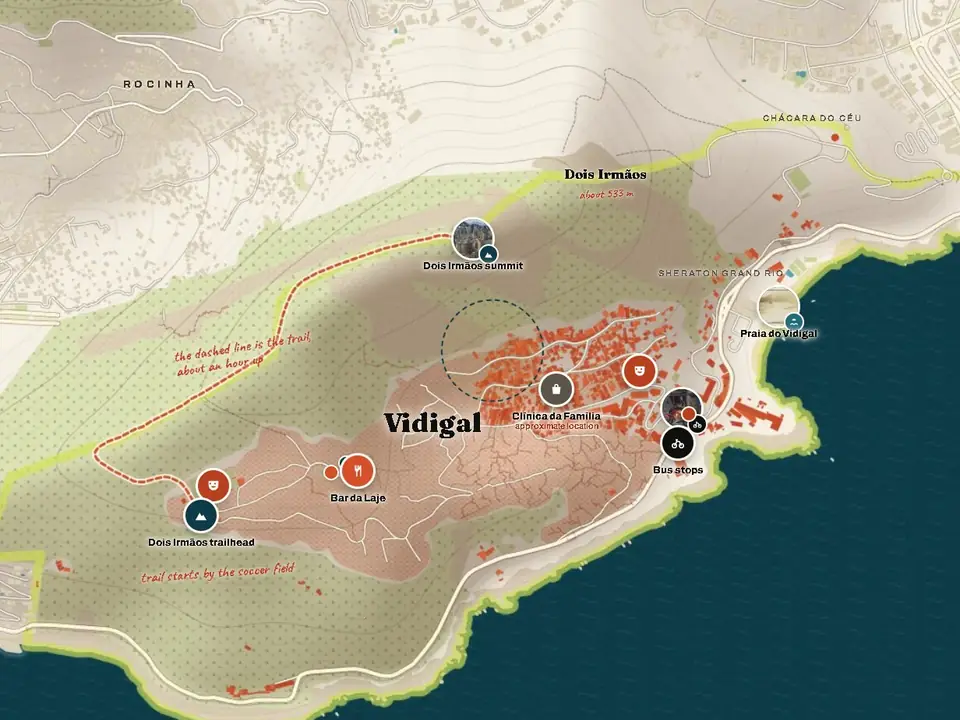
7. Dois Irmãos. Our local mountain. The trail starts in Vidigal, three minutes from our front door — which is why we wrote a separate field guide to the Dois Irmãos trail — and climbs five hundred and thirty-three meters in a little over an hour. Moto-taxis take you from the bottom of the favela to the trailhead at Alto Vidigal for about R$15. Guides at the entrance charge R$30 per person if you want company, which we recommend the first time. The summit looks down on Ipanema, Leblon, the lagoon, and Rocinha spreading across the opposite ridge. Go at dawn. The photograph you think Rio is will take itself.
Pão de Açúcar is the view you buy. Dois Irmãos is the view you earn, then drink a beer over. — a thing we say to every guest
The cultural ones
Rio is not only beach and mountain. The city has a nineteenth-century heart in Centro, a French-colonial botanical obsession from Dom João VI, a cable-car neighborhood of old mansions, and two hundred and fifteen tiled steps built by a Chilean who glued the world onto them. These are the slow mornings and cooler afternoons.
8. Jardim Botânico. Two hundred acres of Atlantic Forest inside the city, planted in 1808 by the Portuguese crown that was hiding from Napoleon. Forty meters of royal palms form an avenue you have seen in every film about Rio. Foreign visitors pay R$80. Brazil residents pay R$40. Cash only, which is the single most annoying thing about this place. Open every day except Wednesday morning — Wednesday opens at 11 a.m., the rest of the week from 8 a.m. to 5 p.m. Plan two hours. Bring water. The orchidarium is worth the detour. The Japanese garden is not a detour, it is the reason you came.
9. Parque Lage. Next door to Jardim Botânico, free, open from eight to six, and built around an Italianate mansion with a swimming pool in the central courtyard. Corcovado rises directly behind the palace; the postcard shot is unavoidable. Have coffee at the café on the patio. The palace itself has been in renovation for most of 2025 and 2026, but the grounds, caves, and aquarium rooms are open. An hour here is fine. Two is better if you have a book.
10. Vidigal viewpoint. We mean the lookout near the top of the favela, reachable by moto-taxi for around R$10, not the Dois Irmãos trailhead proper. It is five minutes of walking from where the motos drop you. From here you see Leblon, the lagoon, and the back side of Dois Irmãos lit from a different angle than any postcard offers. No ticket, no queue. If you are staying at our place, you are already halfway there — see our piece on the history of Vidigal for why this hill matters.
11. Santa Teresa + Escadaria Selarón. The bondinho (the yellow tram) runs again from Carioca station and costs R$20 round-trip. It rattles across the Arcos da Lapa and climbs the hill to Santa Teresa, a neighborhood of cobblestone streets and tile-roofed houses that survived the twentieth century largely by being too steep to redevelop. Eat lunch at Aprazível or at a simpler place on Largo do Guimarães. Walk down to the Escadaria Selarón, the 215-step mosaic stairway that Jorge Selarón kept tiling from 1990 until his death in 2013. Free. Go before ten or after four to avoid the tour-group crush.
A practical note on safety
Rio is a real city, not a theme park. Treat it like any major metropolis and you will be fine.
- Don't walk with a phone in your hand on empty streets. Put it in a zipped pocket between shots.
- Uber and 99 are cheap and universal. Use them at night. Metered taxis are fine in the day.
- Carry a little cash. R$50 covers most one-off purchases. Leave the card in the apartment.
- Santa Teresa, Lapa, and Centro are safer by day than by night. Plan accordingly.
- The beach is fine. The things left on your towel when you swim are not always fine.

Lapa, Leblon, and the Sunday specials
Some of the best of Rio happens on one specific day of the week, or at one specific hour, or only if the calendar cooperates. Miss the window and you miss the place. Three of these are worth building your week around.
12. Lapa arches + Sunday samba in the street. The Arcos da Lapa is an eighteenth-century aqueduct that is now a tram bridge and an unofficial dance floor. Friday and Saturday nights it becomes a full-scale open-air party, loud and crowded and young. Sunday afternoons are calmer and more musical; smaller samba circles set up under the arches and in the adjacent praças, and you can stand with a beer and listen for an hour without committing to anything. Beer at a street bar is around R$10. A caipirinha, well-made, runs R$20 to R$30 at places like Bar da Carioca. Go at five, leave before midnight on a weekend if you are tired.
13. Leblon. The quieter, wealthier neighbor of Ipanema. Lunch at Zaza, Venga, or CT Boucherie. Walk the beach west until you hit Mirante do Leblon, a small promontory at the end with a view of Vidigal and Dois Irmãos rising directly ahead — you will be looking straight at our building again. This is also the best neighborhood in Rio to sit in a café for two hours and not be hurried. We come here on the off days, when the list above feels like work.
14. Maracanã (if a game is on). The stadium is a cathedral. Built for the 1950 World Cup, rebuilt for 2014, still the spiritual home of Brazilian football. If Flamengo or Fluminense or Vasco or Botafogo have a home game during your week, go. Tickets for regular league matches start around R$60 and can run to R$300 for big derbies. Match-day is loud, smoke-y, occasionally unhinged, and one of the most concentrated cultural experiences in South America. If no game is on, the stadium tour runs Monday to Sunday from 9 a.m. to 4:30 p.m., costs under R$100, and includes the pitch, the locker rooms, and the trophy gallery. Worth it on a rainy afternoon; skippable on a sunny one.
15. Feira de São Cristóvão (Sunday only, if you time it). The Northeastern fair is a huge roofed pavilion in the neighborhood of São Cristóvão, open continuously from 10 a.m. Friday through Sunday evening. Sunday afternoon is when it's most alive. This is where Rio's nordestino diaspora goes to eat baião de dois, dance forró until two in the morning, and buy cachaça by the jug. No tourists, really. Take an Uber; it is in the north of the city, not walkable from the South Zone. Entry is R$10 on weekends. The food is R$30 to R$60 a plate and worth every reais. We try to do this once per visit from out-of-town friends, and nobody has ever been disappointed.
A small map of the month
April through October is the quieter, cooler half of the Rio year. Here is what to expect.
- April–June
- 22–28°C, fewer crowds, clear mornings, the best hiking weather
- July–August
- Cooler evenings (18°C), whale season offshore, surf swells pick up
- September–November
- The shoulder: warm, dry, unhurried
- December–March
- High summer, thirty-plus degrees, rain-bursts, Carnival week

The bonus sixteenth: the Copacabana Fort and Café Colombo
We said fifteen. We are adding one more, because it is the single most civilized hour in Rio, and because most visitors never figure it out. The Copacabana Fort sits at the south end of the beach, on the rocky point that separates Copacabana from Arpoador. You pay a small entry fee — five or six reais — and walk in through a military gate onto a peninsula of old artillery emplacements with a view north across the full length of Copacabana. Inside the fort, in a building that used to be the officers' mess, is a branch of Confeitaria Colombo, Rio's century-old tea house. The downtown Colombo is the famous one. This one has the view.
Breakfast from around R$90 per person for the full spread. Coffee and a pastry for R$25. Open Tuesday to Sunday, 10 a.m. to 7:30 p.m., kitchen closes at 7. Closed Monday. Sit on the outside terrace with the beach in front of you and the fort walls behind. Spend an hour. Then walk back through the garden of the Museu Histórico do Exército, which is also inside the fort and free. This is the hour you will describe to friends at home when they ask what Rio is really like. It is the hour when the city stops performing and lets you sit with it.
You can combine this with Arpoador sunset immediately after. The Fort closes its food service around 7, Arpoador's sun dips a bit earlier in winter and a bit later in summer, and the walk between them is ten minutes along the beach end. This is one of our favorite self-contained afternoons in the whole city, and it costs under R$100 per person.
First visit vs second: a short argument
If this is your first time in Rio, we would front-load the unavoidable: Cristo, Pão de Açúcar, Copacabana, Ipanema, and one hike. The other places will be there on your second trip. If it is your second or third visit and you have already done the headliners, we would skip them outright and build the week around Santa Teresa, Parque Lage, Feira de São Cristóvão, a football match, Pedra da Gávea, and as many slow Arpoador sunsets as the week allows. The city rewards a second visit more than almost any city in the world; the first trip is for seeing it, the second is for living in it.
First-timers' list (7 days)
- Cristo Redentor (early morning, day 2)
- Pão de Açúcar (sunset, day 2)
- Copacabana + Ipanema beach day (day 3)
- Dois Irmãos or Pedra Bonita (day 4)
- Jardim Botânico + Parque Lage (day 5)
- Arpoador sunset + Fort Colombo (day 6)
- Lapa + Selarón (Saturday evening)
Second-timers' list (10 days)
- Pedra da Gávea with a guide
- Feira de São Cristóvão on a Sunday
- Maracanã match if the schedule fits
- Santa Teresa slow day
- A full day on Vidigal beach
- Ilha de Paquetá (day trip by ferry)
- Tijuca Forest drive + waterfalls
How we'd actually do a week
Seven days, April through October, starting from Vidigal. Day one is a beach morning at Vidigal beach, an afternoon at Leblon, and Arpoador at sunset. You clap with everyone else. Day two is Cristo Redentor at eight-thirty and Pão de Açúcar at six; lunch in Urca in between. Day three is Jardim Botânico, Parque Lage, and a long lunch in Leblon. Day four is Dois Irmãos at dawn, Vidigal viewpoint after, coffee at home, a nap. Day five is Santa Teresa, the Selarón stairs, and samba in Lapa at night. Day six is Copacabana Fort for breakfast at Colombo, a long beach walk north, and dinner in Ipanema. Day seven is Feira de São Cristóvão if it's a Sunday, or Pedra Bonita if it's not.
That leaves three full Rio landmarks on the table — Pedra da Gávea, Maracanã, and Copacabana the full length — for a second trip you will almost certainly book within the year. We have watched it happen more times than we can count. People come for a week and stretch it to two. Or they come once and then come back in September with different friends. Rio does that to a person. The list exists to get you started. The city does the rest.
Quick questions.
What's the best time of year for these places to visit in Rio de Janeiro?
April to October. The weather is cooler, the rain is lighter, the crowds are thinner, and the hikes are bearable. December to February is high summer — hotter, wetter, and much busier, though also Carnival. The in-between months of May, June, September, and October are our favorites.
Can I do Cristo Redentor and Pão de Açúcar in the same day?
Yes, and we usually recommend it. Cristo at eight or nine in the morning, lunch near Urca, Pão de Açúcar for sunset. It is a long day but a clean one, and it frees the rest of the week for slower things.
How safe is Rio for a first-time visitor?
Safer than its reputation, riskier than a European capital. Use Uber at night, don't flash phones on empty streets, keep the bulk of your cash and cards at the apartment, and stick to the South Zone, Santa Teresa (daytime), and tourist-standard parts of Centro. Lapa is fine in a group. Most of our guests go a whole week without any incident.
Do I need to book tickets in advance?
For Cristo Redentor, yes — the Paineiras Corcovado vans require booking at least forty-eight hours ahead, and weekend slots sell out. For Pão de Açúcar, online tickets save you a queue and roughly ten percent. For Jardim Botânico, just show up with cash. For a Maracanã match, book the moment the fixture is confirmed.
Is Vidigal a good base for all of this?
It's our base and our bias, but yes. Vidigal sits between Leblon and São Conrado, which means Ipanema is a fifteen-minute Uber, Leblon is a short walk, the Dois Irmãos trailhead is up the hill, and Arpoador sunset is twenty minutes of traffic. Most of our guests use the apartment as home base and cab to Centro for the cultural day.
How much will a week of this cost per person, excluding lodging?
Plan for roughly R$400–R$600 per day per person if you eat well, cab comfortably, and do one major ticketed attraction each day. Tighter budgets work at R$250 a day if you lean on botequins and public transport. Luxury pushes past R$1,000. Rio scales.
Which place would you keep if you could only do one?
Arpoador at sunset. It is free, it takes an hour, and it gives you the whole city in one wide frame — Ipanema curving west, the Two Brothers rising above it, the sun setting into the horizon, and a couple of thousand strangers clapping together. If you do only one thing in Rio, do that.
A last thing
We have lived on this hill long enough to know when a guest is going to love Rio and when they are going to tolerate it. The ones who love it are the ones who let the list break. They skip Maracanã because Pedra Bonita was better than they expected. They do Arpoador four nights in a row. They eat the same pastel at the same stand on Rua Gomes Carneiro three times in a week because the lady recognizes them now. The fifteen places to visit in Rio de Janeiro on this list are the structure. What you do in between is the trip.