
Two hundred years ago, a colonial police chief named Miguel Nunes Vidigal owned a stretch of coast nobody wanted. Today his surname belongs to a neighborhood of twelve thousand people, a cable-car of ocean views, and one of the most documented chapters in Rio's modern history. The history of Vidigal Rio is a history of migration, of a stopped eviction, of a drug war, of a party, and of what comes after.
Lux Vidigal is our two-story apartment in Vidigal, with the ocean on one side and the Dois Irmãos mountain on the other, and you can check dates and book it on Airbnb.
Stand at the top of the hill and you can read most of it in the architecture. Wooden barracos from the first wave. Red-brick houses stacked four high from the second. Painted concrete and solar panels from the third. A few steel-and-glass guesthouses from the boom. The favela reads from the bottom up like tree rings. You just have to know what you're looking at.
A name that was already old in 1940
Before it was a neighborhood, Vidigal was a last name. Major Miguel Nunes Vidigal was Rio's chief of police in the early nineteenth century — a figure who appears in the city's criminal history as much as its folklore. He was feared. He ran the capoeira suppression squads and the slave-catcher patrols of late colonial Rio. He was also, unusually for his rank, a capoeirista himself. By the 1820s he had been granted a sesmaria — a colonial land concession — that covered part of the coast between present-day Leblon and São Conrado. The hill that now carries his name was on that concession.
For most of the nineteenth and early twentieth century, the land did almost nothing. It was part of the old Fazenda da Gávea, a sugar and coffee estate that bled slowly into ranches and fruit farms as the city grew toward it. The slopes were too steep to plant on and too far from the center to develop. Rio's wealthy built mansions on the flat land below — Ipanema, Leblon, São Conrado. The hillside stayed bush.
The first recorded settlement on the Morro do Vidigal comes in the late 1930s and early 1940s. A handful of fishermen's shacks near the beach. A few families working on road construction for the opening of Avenida Niemeyer, which was cut into the oceanside cliffs in 1916 and kept extending through the 1930s. They built where no one was watching. Nobody cared yet. The land was technically private, technically public, technically contested. The paperwork was a hundred years out of date and nobody had bothered to sort it.
That is how most of Rio's favelas started. Not with a plan but with an absence of one.
Vidigal by the numbers
A neighborhood that is small, steep, and mapped in a dozen ways.
- Namesake: Major Miguel Nunes Vidigal, early-19th-century police chief and landowner.
- Administratively part of the Zona Sul neighborhood of São Conrado, bordering Leblon.
- Elevation climbs from sea level to roughly 250 meters at the top of the occupied area.
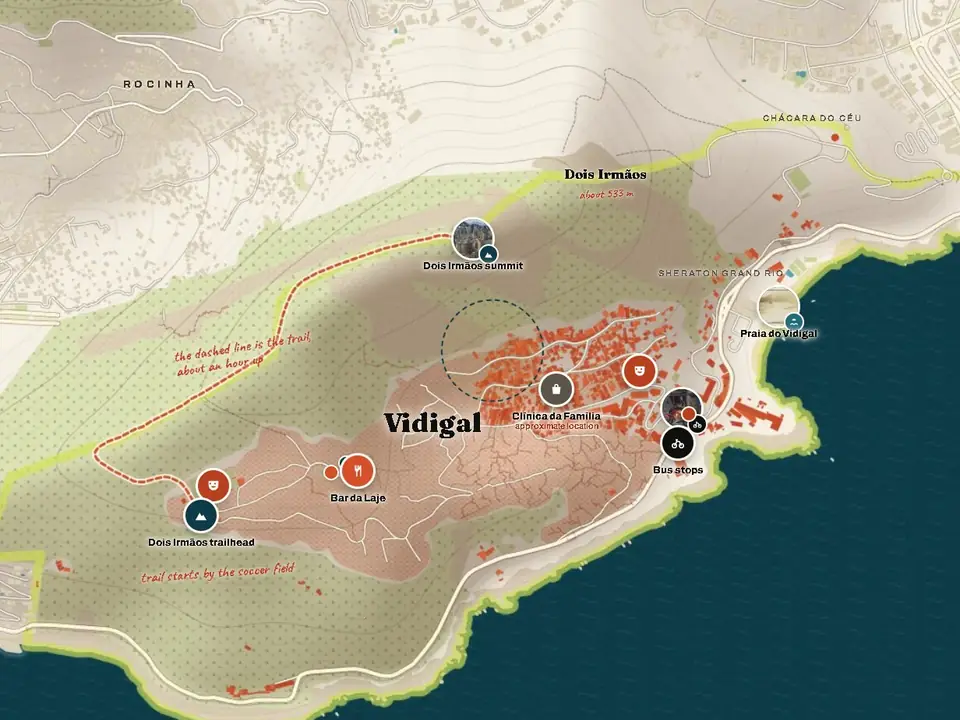
- The Morro Dois Irmãos peak above the favela rises to 533 meters.
The first wave — 1940s to 1950s
The people who built the first streets of Vidigal did not come from Rio. They came from the Northeast — Bahia, Pernambuco, Ceará, Paraíba — and from the rural interior of Minas Gerais. They were escaping drought, land consolidation, and the slow collapse of small-farm agriculture under Getúlio Vargas's industrialization push. Rio was the federal capital until 1960, and it was the only city in Brazil that could plausibly absorb them.
What they found when they arrived was a housing market that did not want them. The formal rental stock in the Zona Sul was tiny and expensive. The public housing that existed was in the far North Zone, two hours by bus from the construction sites and wealthy houses where the jobs were. So they did what migrants to Rio had been doing since the 1890s. They climbed.
The first barracos on the Vidigal hillside were wood — hand-sawn planks and scavenged corrugated metal roofs. They had no electricity, no piped water, no sanitation. Water came from a spring higher up on the Dois Irmãos. Kerosene lamps lit the interiors. A handful of tiny shops — a botequim, a venda selling rice and beans on credit — anchored the earliest commercial streets.
By 1950 the community was substantial enough to have a name beyond "Vidigal" itself. The upper section became known as Alto Vidigal. The middle as Avenida do Vidigal. The bottom, nearest the beach, kept the plain name. A chapel went up. A samba school — the precursor to what would become Acadêmicos do Vidigal — started holding rehearsals in a yard. The neighborhood had not been planned. But it had started to organize itself.

The boom years — 1960s and 1970s
Brazil's military coup of 1964 did two things to the favelas of Rio at the same time. It accelerated rural migration by pushing hard on industrial-scale agriculture, which displaced millions of small farmers. And it decided, periodically and inconsistently, that the favelas of the Zona Sul were an embarrassment that had to go.
Vidigal grew fast in the 1960s. The opening of the Tunel Zuzu Angel in 1971 connected São Conrado directly to the rest of the Zona Sul by car, which meant that the day-labor market for housekeepers, gardeners, construction workers, and drivers expanded overnight. People who had been walking to Leblon could now catch a bus. The population of the hill roughly doubled in a decade. Wood began to give way to brick. The first electricity connections — informal, dangerous, but functional — were strung up the hillside by residents themselves.
Then came 1977. The state government of Faria Lima, acting under the military regime, announced that Vidigal was to be cleared. The plan was to relocate its roughly nine thousand residents to a public housing complex in Antares, in the far West Zone — forty kilometers from the Zona Sul, two and a half hours by bus, with no jobs and no infrastructure. The official justification was "risk of landslides." The unofficial one was that the Zona Sul real estate market had noticed the hill.
The residents organized. What happened next is the single most important event in the history of Vidigal Rio and one of the pivotal moments in the broader history of Rio's favelas. The Pastoral de Favelas — a Catholic social-justice movement that had been quietly organizing in the city's hillsides for years — mobilized. Its leader was Dom Eugênio Sales, the Cardinal Archbishop of Rio. He was not a left-wing bishop. He was a cautious, institutional figure. But on this issue he drew a line.
Sales wrote a public letter to the governor. He gave homilies from the Catedral Metropolitana calling the eviction a moral failure. He sent young priests into Vidigal to document what was happening and help residents hire lawyers. The lawyers went to federal court and won an injunction. The removal stopped. The residents stayed. Within a decade the state would issue the first formal land-tenure documents to Vidigal families, making the settlement legal in a way it had not been before.
It is hard to overstate how rare that outcome was. In Rio in the 1970s, favelas were cleared routinely and violently. Catacumba, Praia do Pinto, Ilha das Dragas — all erased. Vidigal is one of the very few that fought back and won. The neighborhood's self-image, even today, carries that memory.
We did not ask to be saved. We asked to be left alone. — a Vidigal resident, quoted in the Pastoral de Favelas archive, 1978
Consolidation — the 1980s
The decade after the stopped eviction was the decade Vidigal became a real neighborhood. Wood gave way to brick and then to concrete block. Roofs went from corrugated tin to terracotta and then to concrete slabs — the flat lajes that would later become the defining architectural feature of Rio's favelas, because every laje is also the floor of a future second story. Families who had arrived in the 1950s with nothing watched their grown children add a third and fourth story onto the original shack.
Electricity became nearly universal by the mid-1980s, though still mostly through the informal gato — the hooked-up line from the municipal grid. The city water utility, CEDAE, began extending official pipes to the lower and middle sections. Sewage mostly still went into open channels. A few streets were paved. The bus line up the main road, the 557, was formalized. Post started being delivered, sort of.
1986 brought something that would turn out to matter disproportionately: Guti Fraga, a stage actor and director, founded Nós do Morro — a theater company based inside Vidigal, made up entirely of residents. Nós do Morro had no budget, no stage, no building. It started with classes held in a borrowed room at the community association. Over the next thirty years it would train dozens of actors, many of whom would appear in films like Cidade de Deus (2002) and Tropa de Elite (2007). The Globo-produced soap operas that followed would cast Nós do Morro alumni for years. Before there was any "Vidigal cultural scene" in the journalistic sense, there was Guti Fraga running a theater class in the dark.
By 1989 the samba school Acadêmicos do Vidigal was parading in the second tier of Carnival. The favela had a flag, a school, a theater, a bus line, a church, and — crucially — legal title to most of its houses. It was, in every meaningful sense, a neighborhood.
Ten dates that made Vidigal
The short version, if you need the short version.
- c. 1820
- Miguel Nunes Vidigal granted coastal sesmaria; hill takes his name.
- 1940s
- First fisherman and laborer shacks on the lower hillside.
- 1971
- Tunel Zuzu Angel opens; population doubles over the decade.
- 1977
- Forced-removal plan announced and then blocked by residents, Dom Eugênio Sales, and Pastoral de Favelas.
- 1986
- Guti Fraga founds Nós do Morro theater company.
- 1990s
- Drug-trafficking factions consolidate control; police operations become routine.
- Jan 2012
- Unidade de Polícia Pacificadora (UPP) installed in Vidigal.
- 2013
- Pope Francis visits a Rio favela during World Youth Day; global attention surges.
- Sep 2017
- UPP presence quietly withdrawn; community enters a new phase.
- 2024–2026
- Long-stay foreigners, Airbnbs, and a fourth wave of new residents arrive.

The lost decade — 1990s and 2000s
The period between roughly 1988 and 2011 is the hardest chapter of Vidigal's history to write about honestly, because it is the chapter that outsiders most want to flatten into a single word. The word is usually "dangerous." The reality was more complicated and much sadder.
The Comando Vermelho, Rio's original drug-trafficking faction, had emerged from a political-prisoner pipeline during the military dictatorship. By the late 1980s it had extended its control to most of the favelas of the Zona Sul, including Vidigal. In the 1990s a splinter group, Amigos dos Amigos, took over in a brief and violent transition. The trade was cocaine, bound mostly for export through the port of Rio. The foot soldiers were local teenagers, recruited young and buried young.
What this meant for Vidigal's residents — the vast majority of whom had nothing to do with the trade — was a decades-long equilibrium of uneasy order punctuated by police operations. The traffickers imposed their own rules. No street theft. No rape. No unpaid debts. Shops stayed open late. Women walked home alone at night. The homicide rate among non-involved residents was, counterintuitively, lower than in parts of the asphalt city a few blocks away. But the price was a community that lived inside someone else's law, and a youth cohort that was being hollowed out.
Tourists did not come. Taxis often refused to enter. The national press reported on Vidigal only when somebody was shot. Real estate inside the favela was cheap and nobody outside the community bought. Meanwhile the Zona Sul below — Leblon, São Conrado — became one of the most expensive addresses in South America, and the view from the top of Vidigal became, strictly in real estate terms, the most valuable unsold view in Rio.
This was the paradox that would, eventually, change everything.
Pacification — 2011 and 2012
The Unidade de Polícia Pacificadora was a program launched by the Rio state government in 2008. The theory was simple, even if the execution was not. A military-police operation would enter a favela, clear the trafficking leadership, and then a specially trained community-policing unit — the UPP proper — would install a permanent base inside the neighborhood. Services would follow. Tourism would follow. Peace would follow.
Vidigal's UPP was installed in January 2012, after a November 2011 military operation. The operation was bloodless — the traffickers had left the day before, tipped off like they always were. The UPP base went up in a refurbished building near the top of Alto Vidigal. A sign went up reading Polícia Pacificadora. Residents were, by most accounts, cautiously hopeful.
What happened next is impossible to separate from what was already happening in the city. Rio had been announced as host of the 2014 World Cup and the 2016 Olympics. International capital was pouring in. The real estate boom of 2010–2013 was the largest in the city's modern history. Into this, dropped a pacified Vidigal with the best ocean view in the Zona Sul and prices one-tenth of Leblon.
The first hostels opened within months. Alto Vidigal, a guesthouse at the top of the hill run by Pedro Henrique — a German-Brazilian with a taste for house music and late nights — pivoted from backpacker lodge to cultural venue and started hosting Friday parties on its laje. Bar da Laje, opened in 2010 by resident Elizeu Bernardo, became the preferred sunset spot for a new generation of tourists. Hollywood arrived: David Beckham reportedly purchased a house near the top of the hill in 2013. Alicia Keys played a set at Bar da Laje. David Guetta spun at the Sheraton at the foot of the morro. Snoop Dogg filmed a music video. Pope Francis visited a Rio favela during World Youth Day 2013 — technically Varginha in the North Zone, though the ripple effects reached every pacified community including Vidigal.
Real estate prices inside Vidigal rose by roughly 400% between 2009 and 2014. Many residents sold and moved. Others renovated, added a story, and started renting rooms. A new generation of carioca professionals — designers, chefs, architects — rented houses in Vidigal specifically because they could afford the view that no one on the formal asphalt could. The neighborhood became, for a window of about four years, one of the most photographed places on earth.
If you want a sense of who came through in those years, our separate celebrities in Vidigal piece is the deep dive. The short version is that almost everyone did.
The boom was real. The boom was complicated.
Two things were true at the same time between 2012 and 2016.
What residents gained
- Property values that made many families newly wealthy.
- Tourism income — hostels, bars, tours, restaurants, rentals.
- Infrastructure investment from the city that had been deferred for decades.
- A shift in how outsiders spoke about the favela.
What got harder
- Rents rose faster than wages; original residents were displaced.
- Tourism commodified aspects of daily life.
- The UPP model, oversold, would not survive the state's fiscal crisis.
- Some long-standing community spaces were replaced by short-term rentals.

After pacification — 2017 to 2019
The UPP program was unsustainable and most people close to it knew by 2015. The Rio state government had entered a fiscal collapse, unable to pay its pensioners and struggling to pay its police. The community-policing training that had been the core of the UPP model was cut. The officers rotated became less experienced. The units in several favelas were quietly downsized.
In September 2017 the UPP presence in Vidigal was effectively withdrawn. The base stayed technically operational but the numbers fell and the patrols thinned. There was a brief, tense period in late 2017 and early 2018 when old trafficking cells attempted to reassert themselves. A few shootings. An Olympic-era Spanish tourist was shot in a car that entered Rocinha by mistake. The international press wrote the obituary of pacification.
But Vidigal did not go back. This is the part of the story that gets missed. Too much had changed — too much capital, too many resident-run businesses, too many outsiders who now lived on the hill, too much informal infrastructure. The community's commercial association organized its own security coordination. Hostels and bars stayed open. The beach path, the buses, the small shops continued. What replaced the UPP was a hybrid of informal order, community organizing, and a much less visible state presence. It was imperfect. It worked.
Tourism dipped but did not vanish. The 2018 World Cup in Russia and the 2019 Copa América in Brazil kept a trickle of international visitors arriving. The Nós do Morro theater continued. Acadêmicos do Vidigal kept parading. The samba rehearsals on Wednesday nights at the community center continued, largely unnoticed by the asphalt city below.
If you want the current working answer to whether all of this adds up to a safe place for visitors in 2026, that is its own piece — is Vidigal safe walks through the honest 2026 picture.
~~~The pandemic and the fourth wave — 2020 to 2026
COVID hit Vidigal hard. Hostels closed. Bars closed. The tourism economy that had built up over a decade went to zero in three weeks. Several long-running businesses did not reopen. The community association ran emergency food distribution through 2020 and 2021, funded partly by a diaspora of former residents and sympathetic Zona Sul neighbors. Nós do Morro moved its classes online. Bar da Laje sold marmitas out of a back window.
Recovery started slowly in 2022 and accelerated through 2023. The people who came back were different from the people who had come during the 2012–2016 boom. Fewer celebrities. Fewer weekend party tourists. More long-stay remote workers, more digital-nomad couples renting for three months, more European and American creatives in their thirties and forties who wanted a neighborhood rather than a resort. Airbnb inventory in Vidigal roughly tripled between 2022 and 2025, and the average stay length roughly doubled.
This fourth wave has a different texture from the earlier ones. The 1940s migrants built. The 1970s consolidators fought for legal title. The 2012 wave rented hostel beds and drank on lajes. The 2024–2026 wave makes coffee at home, works from the balcony, walks down to the beach at four, and stays for a season. Some of them come back. Some of them buy.
The neighborhood's cultural infrastructure has, meanwhile, kept going. Nós do Morro celebrated its fortieth year in 2026 and continues to run classes out of its building on the middle section of the hill. The annual samba rehearsals at Acadêmicos do Vidigal continue. A generation of Vidigal-born DJs and producers — raised on the 2012–2016 boom — are now touring internationally and splitting their time between Rio and Lisbon or Berlin. Street-art projects continue. A few small galleries have opened. The favela is neither a museum of itself nor a gentrified shell. It is a working neighborhood that has learned how to host people without being hosted.
For those curious how this compares to its larger neighbor across the ridge, our favela Rocinha guide walks through that separate story. Rocinha is ten times the size, has a different history, and a different present.
What Vidigal is now
If you walk up the Avenida João Goulart today — the main commercial strip that threads up the hill from the beach — you walk past layers of history you can almost read in order. The beach-adjacent blocks are polished. A beach-club quiosque. A surf shop. Two new restaurants with Portuguese-speaking waiters who are actually Portuguese. Fifty meters up, the architecture gets older and denser. A padaria that has been on its corner since 1987. A hardware store. A hair salon. A açougue. Another hundred meters and you are deep in the residential middle of the hill, where the neighborhood is still overwhelmingly what it was in the 1980s — working-class, tight-knit, loud with conversation from open windows. Keep climbing and you reach the guesthouses and party venues of Alto Vidigal: a layer of outsider infrastructure grafted onto the top.
What you do not find, anywhere, is the sanitized tourist simulacrum of a favela that marketing copy elsewhere in Rio tries to sell. Vidigal has not been made into a theme park. The residents are residents. The shops are real shops. The kids play soccer on the same small courts their fathers played on. The history we just walked through — the migrant decades, the eviction that did not happen, the trafficker decades, the pacification, the boom, the pandemic, the recovery — is all still present in the same two square kilometers. You can stand in one spot and point at three of them.
The view from the top is, for what it is worth, genuinely one of the great ocean views in the world. That is partly why people came. But the reason people stay — or come back — is not the view. It is the fact that Vidigal is still a neighborhood. There is a difference between a view and a place, and Vidigal, for now, remains both. Our own small piece of this is a two-bedroom with a laje and a terrace looking straight at Dois Irmãos. The apartment is, in the scheme of a century of history, a footnote. But if you want to sleep inside the story rather than read about it, that is how.

History questions.
Where does the name Vidigal come from?
From Major Miguel Nunes Vidigal, a colonial-era chief of police in Rio who was granted a coastal land concession in the early nineteenth century. The hill that now carries his name was part of that concession. The favela grew on it more than a century later.
When did Vidigal become a favela?
The first recorded settlement dates from the late 1930s and early 1940s, built by fishermen and laborers working on Avenida Niemeyer. Major growth came in the 1960s and 1970s as Northeast and Minas migrants arrived during the military dictatorship.
What was the 1977 eviction?
The Rio state government, under the military regime, ordered the forced removal of roughly nine thousand Vidigal residents to public housing in the far West Zone. Residents organized; Cardinal Dom Eugênio Sales and the Pastoral de Favelas movement supported them; federal courts blocked the removal. It remains a pivotal moment in the history of Vidigal Rio and a rare favela-removal defeat for the regime.
What was the UPP?
The Unidade de Polícia Pacificadora was a Rio state community-policing program installed in many favelas between 2008 and 2014. Vidigal's UPP was installed in January 2012 and unlocked the tourism and real estate boom of 2012–2016. It was effectively withdrawn in September 2017.
Is Vidigal still a favela in 2026?
Yes, in the administrative and historical sense. It is a self-built hillside community with a specific history, its own governance, and its own social fabric. The word favela in Portuguese is not a pejorative — it is a description. Vidigal is a favela that is also, now, partly integrated into the formal tourism economy. Both things are true.
Who is Nós do Morro?
A theater company founded inside Vidigal in 1986 by Guti Fraga. It has trained dozens of actors, many of whom appeared in Cidade de Deus, Tropa de Elite, and Globo soap operas. It still operates on the hill in 2026, in its fortieth year.
Can visitors just walk up the hill?
Yes. The main commercial road is open and busy. Moto-táxis run up and down constantly. Respect the community — photograph people only with permission, do not wander into unmarked residential alleys without a reason — and the walk is part of the point. For concert nights at Bar da Laje or Alto Vidigal, see our concerts guide.
A century is a short time for a neighborhood and a long time for a memory. The people who built the first barracos in the 1940s are gone. Their grandchildren are running hostels, driving moto-táxis, acting in Netflix series, selling açaí at the beach, and in a few cases selling the family house for a number no one could have imagined in 1977. The history of Vidigal Rio is not over. The next chapter is being written by the fourth wave of arrivals, by the families who stayed, and by whoever is up on the laje tonight watching the lights come on across Leblon.