
Stand on the upper road in Vidigal at dusk. Turn your back to the ocean. The hillside opposite is lit like a circuit board, thousands of windows stacked up the spine of Dois Irmãos. That is Rocinha. Favela Rocinha Rio is the largest community of its kind in Brazil — our neighbor across the ridge, a short walk and a whole other world.
Lux Vidigal is our two-story apartment in Vidigal, with the ocean on one side and the Dois Irmãos mountain on the other, and you can check dates and book it on Airbnb.
The neighbor across the ridge
From the top of Vidigal, you can see Rocinha. Not from a distance. From directly over the saddle.
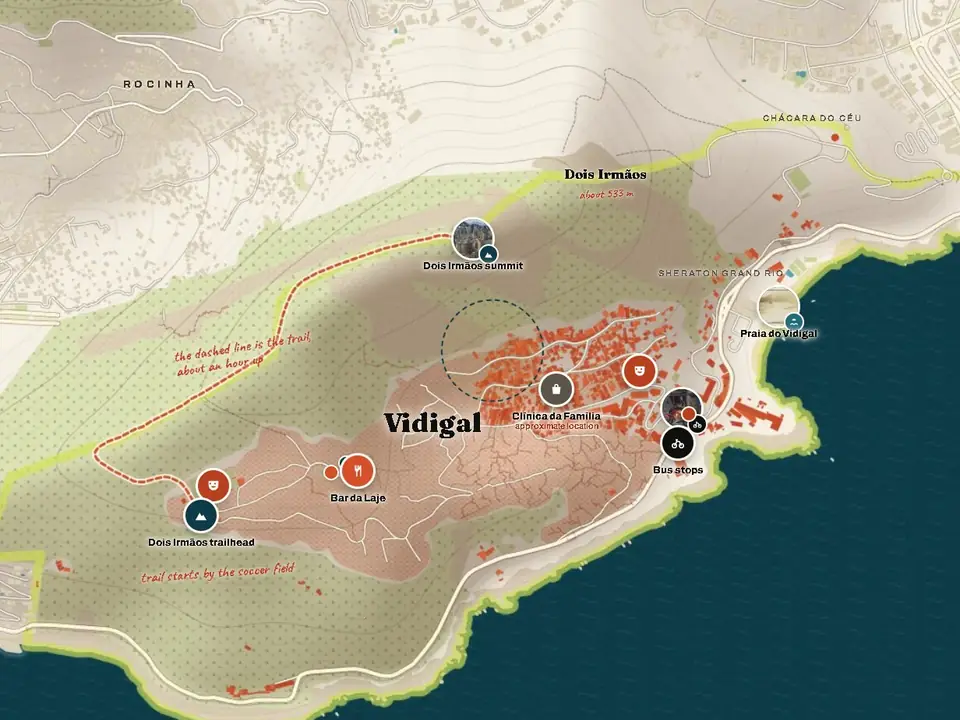
The two favelas share a hilltop. Walk up from Avenida Presidente João Goulart in Vidigal, follow the trail past the last laje with its water tank and cable dish, and you cross into Rocinha territory on foot. Locals do it every day. Tourists, for the most part, should not — at least not the first time, not without a guide — but the point stands. We are the same mountain. Different valleys.
Vidigal faces the Atlantic, tucked between Leblon and São Conrado along Avenida Niemeyer. Rocinha faces the other way — down into São Conrado proper, spilling toward the Autoestrada Lagoa–Barra and climbing back up toward Gávea. The access road is Estrada da Gávea, a single serpentine artery that carries everything in and out: delivery trucks, moto-taxis, school buses, ambulances.
The scale is what gets you. Vidigal, if you count every laje and alley, holds somewhere around ten to twelve thousand people. Rocinha, depending who you ask, holds between seventy thousand and one hundred eighty thousand. The official IBGE 2022 census puts the figure closer to seventy-six thousand inhabitants within the official perimeter. Long-time community leaders and researchers at PUC-Rio argue the real number is meaningfully higher — closer to one hundred and fifty thousand — once you count every unregistered laje, every back-alley extension, every mezzanine carved into a concrete ceiling.
Either way, Rocinha is the largest favela in Brazil. It is also one of the densest urban environments in the Western Hemisphere. Streets become stairs become tunnels between buildings. Kitchens open onto other kitchens. Someone's rooftop is someone else's front yard.
Rocinha in figures
A quick snapshot of the community across the ridge.
- Largest favela in Brazil by population.
- Sits between São Conrado (below) and Gávea (above).
- Shares a hilltop border with Vidigal along the Dois Irmãos spine.
- Officially designated a bairro (neighborhood) of Rio in 1993.
A short history.
The name is a diminutive. Rocinha — "little farm" or "small garden." It dates to the 1920s and 1930s, when the hillside between São Conrado and Gávea was still rural land dotted with vegetable plots. Migrants from the Northeast, chasing work in the growing southern capital, bought or squatted small terraces and grew greens there. Lettuce, tomato, herbs. They carried baskets down into the wealthy flatlands and sold the produce door to door. "Vou na rocinha." I'm off to the little farm. The name stuck.
The story from there is familiar to anyone who has read a page of carioca history. Rio industrialized. Housing for the working poor did not keep pace. The hills filled up. First with wooden shacks, then with brick, then with reinforced concrete stacked four and five stories high. By the 1960s, Rocinha was no longer a cluster of farms. It was a small city.
The military dictatorship of 1964 to 1985 tried, at various points, to evict favela residents. Rocinha resisted and grew instead. By the late seventies it had grocery stores, a bank, schools, bus lines, its own samba school, its own football clubs. In 1993, the city formally recognized Rocinha as a bairro. Residents had fought for the designation for decades. It mattered. It meant mail delivery. Street addresses. A line on the map.
The shadow side of that growth, through the eighties and nineties, was organized crime. The drug trade consolidated control in most of Rio's larger favelas during those decades, and Rocinha became a stronghold of one of the city's major factions. For a long stretch, the state effectively ceded day-to-day governance. Schools still ran. So did the post office. But the rules on the street were set elsewhere.
That is the context behind the most-photographed event in the community's recent history: the November 2011 operation.

Pacification, and after.
On November 13, 2011, at dawn, roughly three thousand soldiers and police officers entered Rocinha. The operation was led by the Brazilian Army and BOPE, Rio's elite police unit, with the Marinha providing aerial support. Helicopters hovered. Armored vehicles climbed the Estrada da Gávea. It was televised on every major Brazilian network. Foreign correspondents filed from the upper road.
The faction leadership had already been arrested the previous week while trying to escape in the trunk of a car. The operation itself, on the day, was largely bloodless. Within hours the state had planted flags on rooftops and declared the community "pacified." A Unidade de Polícia Pacificadora — a UPP, a community policing unit — was installed the following year.
For a while it seemed to hold. Tourism grew. Journalists wrote optimistic pieces. Investment trickled in. A cable car was planned and then scrapped. A new sanitation project started and stalled. The UPP model, which worked passably well in some smaller favelas, struggled in Rocinha. The community was simply too big, too internally complex, and the state's commitment too uneven.
By 2017, the security situation had deteriorated. Public shootouts that September drew national headlines. In February 2018, the federal government declared a security intervention in the state of Rio, and the Army was deployed again. Rocinha was a focus. The intervention ended in December of that year with mixed results.
Through the late twenties, the situation has continued to evolve. Parts of the community feel remarkably calm — the main drag, the commercial strip, most daytime areas. Other sections, particularly at night and in the upper reaches, remain sensitive. Residents navigate the geography by intuition and social code, reading cues that a visitor simply cannot read.
In April 2026, the practical read is this: organized guided tours continue to run six days a week. Residents continue to work in the Zona Sul and come home at night. The commercial life is thriving. And the faction dynamics, though reduced from their nineties peak, have not disappeared. This is the texture of Rocinha today — a living city, not a pacified one, not a war zone, something more complicated than either narrative.
Rocinha is not a story the outside tells. It is a neighborhood that tells itself, in the language of stairs and bakeries and moto-taxis, every single day. — a Vidigal neighbor who grew up on the other side of the ridge
Geography, up close.
Rocinha occupies a steep bowl on the inland side of the Dois Irmãos massif. The lowest point sits at about 20 meters above sea level, where Estrada da Gávea meets the São Conrado flats. The highest inhabited laje pushes above 280 meters. In between: roughly 143 hectares of extremely dense construction.
The community is divided, informally, into around two dozen sub-bairros — microneighborhoods with their own names, characters, and internal politics. Some of the names you will hear: Valão, Vila Verde, Cachopa, Rua 1, Rua 2, Rua 4, Roupa Suja, Macega, Laboriaux, 199 (the building that gave a whole section its nickname), Cidade Nova.
Laboriaux sits at the very top. It is one of the highest settlements in Rio and, on a clear day, has views that rival anything on the Zona Sul. Cidade Nova, on the São Conrado side, is flatter and more recent. The historic heart is along Estrada da Gávea itself, the serpentine road that runs up through the community like a spine.
The movement of people tracks the geography. Morning rush: down. Thousands of workers descend on foot, by moto-taxi, by van, heading for the buses that take them into the Zona Sul. Evening rush: up. The same flow in reverse, heavier, slower, more groceries carried. Saturday afternoon is the community's own time. Families on the laje. Music from every third window. Laundry hanging off rebar. The whole hillside reads as one enormous shared living room.
- Official area
- ~143 hectares
- Lowest point
- ~20 m above sea level
- Highest laje
- ~280 m (Laboriaux)
- Main access
- Estrada da Gávea
- Sub-bairros
- ~24 named sections
- Shared border with Vidigal
- Along the Dois Irmãos ridge
Tourism in Rocinha, honestly.
People ask all the time whether it is alright to visit. The short answer: yes, on a guided tour run by a reputable operator, at the right hours, with a guide who actually lives or works inside the community. The longer answer has nuance.
Favela tourism is an old and contested subject in Rio. The first tours started in the early nineties, and the field has matured since. The serious operators today emphasize community benefit, walk routes designed in consultation with residents, local guides, and a portion of revenue returned to neighborhood projects. The weaker operators still run it like a zoo. The difference shows up fast.
What a good tour looks like: three hours on foot, top to bottom. The van picks you up in Copacabana, Ipanema, or Leblon around nine in the morning or early afternoon. It climbs the Estrada da Gávea to the upper part of the community. From there you walk down, through a route that mixes the main drag, smaller alleys, a panoramic viewpoint or two, a visit to a community bakery or craft cooperative, and ending at the commercial strip near the bottom. Typical price: R$80 to R$150 per person, depending on operator and group size.
The names that consistently come up as reliable, as of April 2026, include Favela Tour (run by Marcelo Armstrong, the operator who more or less invented the format in the nineties), Favela Experience, Rocinha Original Tour (run by local residents), and Exotic Tours. All of them will pick you up from Zona Sul hotels. All of them brief you, at length, on the photography rules before you start.
Those rules deserve their own paragraph. Do not photograph people without asking. Do not photograph any individual who does not want to be photographed. Do not photograph armed people, ever. Do not photograph inside private homes unless invited. The guides will tell you which streets are fine for cameras and which are not, and the line shifts — sometimes week to week. Respect the ask.
Before you book a Rocinha tour
A handful of things worth knowing the night before.
- Book through a named operator. Avoid anyone who approaches you at the beach or your hotel lobby without credentials.
- Ask about the guide. Reputable tours use guides who live or grew up in Rocinha. That matters.
- Wear closed shoes. The streets are uneven. Stairs everywhere. Sneakers, not sandals.
- Bring small bills. R$5, R$10, R$20. For bakery stops, cooperatives, the moto-taxi ride up (if included), tips.
- Leave the expensive watch. Not because anything will happen. Because it's tone-deaf.
- Follow the photography rules to the letter. Always.
- Check the morning of. If there has been any incident overnight, tours pause. Your operator will tell you.

What you actually see.
A tour is not a greatest-hits list. It is a walk. But there are a handful of points that most itineraries touch, and they are worth naming so you know what you are looking at when you get there.
Estrada da Gávea. The spine. You will cross it, walk along it, cross it again. It is the only road through the community that a car can physically negotiate. Everything else is stairs or alleys. Traffic on Estrada da Gávea is constant and creative. Moto-taxis weave. Delivery vans back up around blind curves. Buses the size of small buildings somehow make the turns.
Street art. Rocinha has become, over the last decade, one of the most muraled neighborhoods in Rio. You will see work by local artists throughout. Internationally, Eduardo Kobra has painted here. Luna Martinez has pieces tucked into smaller alleys. The murals change constantly — walls get repainted, new artists cycle through — so each visit looks slightly different. A good guide will point out what is new.
Casa Nova and the padarias. Rocinha runs on bread. The community bakeries open around five in the morning and bake continuously through the day. Most tours stop at one. Casa Nova is a longstanding favorite. The pão francês comes out hot, five for R$4 or thereabouts. You will eat one on the stairs while the guide explains something, and it will be the best bread you have had in Rio.
Casa do Morro. A community center that hosts cultural programming, classes, and events. Several tours swing through for a brief visit. If something is happening when you pass — a rehearsal, a dance class, an art workshop — linger.
The viewpoint. There is a platform near the top, on the São Conrado side, where the whole city opens up beneath you. São Conrado beach directly below, the Pedra da Gávea to the right, the ocean fading into haze on the horizon. On clear mornings you can see to Niterói across the bay. It rivals the view from any postcard spot in the Zona Sul. It is also free, and nobody is charging you R$160 to get up there.
The commercial strip. Lower Rocinha, where the community flattens out toward São Conrado, has a commercial density that rivals any bairro in Rio. Pharmacies, banks, phone shops, lanchonetes, açaí bowls, fish counters, motorcycle repair, hairdressers. It is a working neighborhood, not a sanitized showpiece. Tours usually end here.
~~~Culture, institutions, and the people who built them.
Rocinha's cultural infrastructure is extensive and largely self-built. A partial tour of what exists:
The Two Brothers Foundation (Fundação Dois Irmãos), founded in 2000 by the American journalist Michael Royster alongside local partners, runs free English classes, computer workshops, and scholarship programs for Rocinha residents. It has put hundreds of young people through university. You can visit on most tours, or contact them directly to volunteer.
The Rocinha Cinema — Cine Carioca Nova Brasília was the long-promised indoor cinema project. A smaller independent space, Espaço Acolher Rocinha, now hosts regular screenings and serves as a gathering spot for local filmmakers. Community cinema nights happen on Fridays in the plaza during dry season.
Samba. The community's own escola is Acadêmicos da Rocinha, which parades in the Série Ouro (the second-tier Carnaval division). Rehearsals from September through February are open to visitors at the quadra down near the commercial strip. The energy is concentrated, serious, and joyful in equal measure.
Capoeira. Multiple academies run classes through the week. Grupo Senzala has a long-standing presence. Children start around age six and can stay for decades.
The community radio, Rádio Rocinha FM, broadcasts local news, music, and interviews on 87.5 FM to a listenership of tens of thousands. It is one of the oldest community radio stations in Brazil.
And the people. MC Marcinho, the funk icon whose voice shaped the genre through the nineties and early two-thousands, grew up on these stairs. A long list of Brazilian footballers came up through Rocinha's youth clubs before making their way to the professional leagues. Artists, actors, journalists, academics — the community produces talent relentlessly, and a lot of that talent stays.
Rocinha, perception versus reality
The split is wider than almost any visitor expects.
What outsiders often picture
- A dangerous, lawless place you shouldn't set foot in.
- Uniformly poor, homogenous, undifferentiated.
- A "problem" waiting to be solved by the state.
- Silent, hidden, tucked away.
What actually shows up
- A working city with bakeries, banks, schools, hair salons, churches.
- Two dozen distinct sub-neighborhoods with their own cultures.
- A population that has fought for and won its own designation as a bairro.
- Music, art, football, funk, samba — all of it loud, all of it proudly local.

Rocinha and Vidigal, side by side.
The two communities get lumped together in guidebooks. Understandable. Same mountain, same general story, same hillside posture. But the lived experience of each is meaningfully different, and if you are trying to decide where to stay — or whether to visit one, both, or neither — the contrast matters. We wrote a longer piece on this at Rocinha vs Vidigal. The short version:
Vidigal is smaller, calmer, easier to navigate. Roughly one-tenth the population of Rocinha. A single main road (Avenida Presidente João Goulart) loops up through the community, and most of the tourist-facing businesses — the bars, the restaurants, the hostels, the sunset viewpoints — sit along or just off that road. Hiking to the top of Dois Irmãos starts here. The Airbnb inventory is substantial. Tourist-friendly infrastructure is real.
Rocinha is vastly bigger, more complex, denser, and — frankly — more intimidating to a first-time visitor. The Airbnb presence is much smaller. There are a few hostels (Favela Chic being one of the longer-running options) and a growing number of homestays, but the volume does not compare. What Rocinha offers instead is depth. If you want immersion, the opportunity exists. You go with a resident. You stay a few nights. You actually see something.
For most visitors to Rio who want the Zona Sul-adjacent hillside experience, the practical recommendation is: stay in Vidigal, and do Rocinha as a guided day trip. You get the calmer Airbnb experience of Vidigal — ocean view, quieter streets, four minutes to the beach — and you get a meaningful engagement with Rocinha through the tour. Both communities benefit.
That happens to be the configuration our own apartment supports. The place sits high on the Vidigal side with a full view across to Rocinha, and several of our guests have done exactly this: morning coffee on the balcony, afternoon tour in Rocinha, back up to Vidigal for sunset.
Safety, plainly.
The honest version, because anything less would be insulting.
Rocinha is not Copacabana. It is also not a war zone. The day-to-day experience, for the vast majority of residents and visitors on any given week, is ordinary life. Commuting. Bread. Laundry. Church. Football.
That said, organized crime has not disappeared, and the geography of the community is genuinely difficult for an outsider to read. A street that feels fine at ten in the morning may have different rules at ten at night. An alley that welcomes one visitor may not welcome another. The cues that residents use to navigate — who is standing where, what is being carried, which way the foot traffic is flowing — are invisible to you. They are legible to a local guide.
The working rules, which your tour operator will repeat and which you should internalize:
- Go with a licensed, reputable tour operator the first time.
- Go during the day. Morning tours are calmer than afternoon ones.
- Follow the photography protocol. Exactly.
- Do not wander off the route. Do not take a "quick detour."
- If your guide says stop, stop. If your guide says move, move.
- Do not go at night unless you are with a resident friend who has invited you specifically to an event.
- Check conditions the morning of. Any operator will cancel if overnight incidents warrant it. That is a feature, not a bug.
We wrote a companion piece on the same question for Vidigal — Is Vidigal safe? — and the reasoning is similar, though the specifics differ. Size changes the calculus. Density changes it more.
One more thing worth saying. A lot of what gets written about favelas in foreign media is sensationalist and mostly wrong. A lot of what gets written in Brazilian media skews in the opposite direction, depending on the outlet. The view from Vidigal, looking across every morning to Rocinha, is that it is a community. Huge, layered, sometimes troubled, always alive. Treat it like one. Bring curiosity, leave the stereotypes, follow the local protocol. You will see more than you expected.

When to visit, and a few practical notes.
Rocinha tours run year-round, six days a week for most operators (Sunday schedules vary). The best months, weather-wise, are April through October — cooler, drier, less slippery on the stairs. January and February, Rio's high summer, are bright and hot. Afternoon thunderstorms are common from December through March. The community is steep; wet stairs in full sun are the worst version of the walk.
Book at least a day in advance. Most operators run one or two daily departures, with a cap of around ten to fifteen visitors per group. Pickup is typically from your Zona Sul hotel between 8:30 and 9:30 a.m. for morning departures, or around 2:00 p.m. for afternoon ones. Duration: three hours door to door for the shorter tours, four or five for the longer ones that include a bakery sit-down and a cooperative visit.
Pair it with something. A Rocinha tour in the morning works beautifully with a walk through Vidigal in the afternoon — you get both hillsides in one day, the full carioca neighbor-across-the-ridge experience. Or combine it with a Dois Irmãos hike (which starts in Vidigal and climbs the same mountain Rocinha sits on the other side of). The geographical logic holds: it is one mountain, two valleys.
What to bring. Closed shoes with grip. A small backpack. Water. Sunscreen. Cash in small denominations. A phone with a camera, ready to be put away the instant your guide signals. An appetite for bread.
What to leave behind. The big camera with the big lens (your phone is fine, and less conspicuous). The Rolex. The assumption that you already understand what you are about to see.
Quick questions.
How big is Rocinha, really?
The IBGE 2022 census recorded around seventy-six thousand residents within the official perimeter. Community estimates and independent researchers put the number closer to one hundred and fifty thousand once you count unregistered lajes and recent construction. Either figure makes it the largest favela in Brazil.
Can I walk from Vidigal to Rocinha?
Technically yes — the two communities share a hilltop border along the Dois Irmãos ridge, and residents cross on foot every day. For a first-time visitor, we would not recommend it. The trails are unmarked, the community protocols on the Rocinha side are not obvious, and you lose the benefit of a guide. Do the guided tour first.
Is it safe to visit Rocinha in 2026?
On a reputable guided tour during daylight hours, yes. Tourism has run continuously for decades and most days pass without incident. That said, always book with a named operator, follow the photography rules, and check conditions the morning of — responsible operators cancel tours when overnight events warrant it.
What does a Rocinha tour cost?
Typical price range in April 2026 is R$80 to R$150 per person, depending on operator, group size, and duration. This usually includes pickup from a Zona Sul hotel, a local guide, and a small stop at a community bakery or cooperative. Tips for the guide are customary — R$20 to R$50 is fair.
Who are the reputable tour operators?
The names that come up consistently include Favela Tour (operated by Marcelo Armstrong), Favela Experience, Rocinha Original Tour (run by local residents), and Exotic Tours. All are bookable online, all pick up from Zona Sul hotels, and all use local guides. Avoid anyone soliciting at the beach or hotel lobby.
Can I photograph people in Rocinha?
Only with permission, and only when your guide signals it is fine. Never photograph anyone who declines, never photograph inside private homes without invitation, and never photograph armed individuals under any circumstances. The rules shift week to week — your guide will tell you which streets are open for cameras and which are not.
Should I stay in Rocinha or Vidigal?
For most visitors, Vidigal. It is smaller, calmer, has substantially more Airbnb inventory, and sits a four-minute walk from the ocean. Rocinha is better experienced as a guided day trip or, for the deeply curious, a multi-night homestay. We break the comparison down in detail in our Rocinha vs Vidigal post.
The hill does not need you to understand it. It has been getting on without outside interpretation for a hundred years. What you can do, if you come, is arrive curious, listen more than you talk, tip the guide, buy the bread, and remember that every window you see lit up across the valley is somebody's kitchen. That is the whole posture. The rest takes care of itself.