
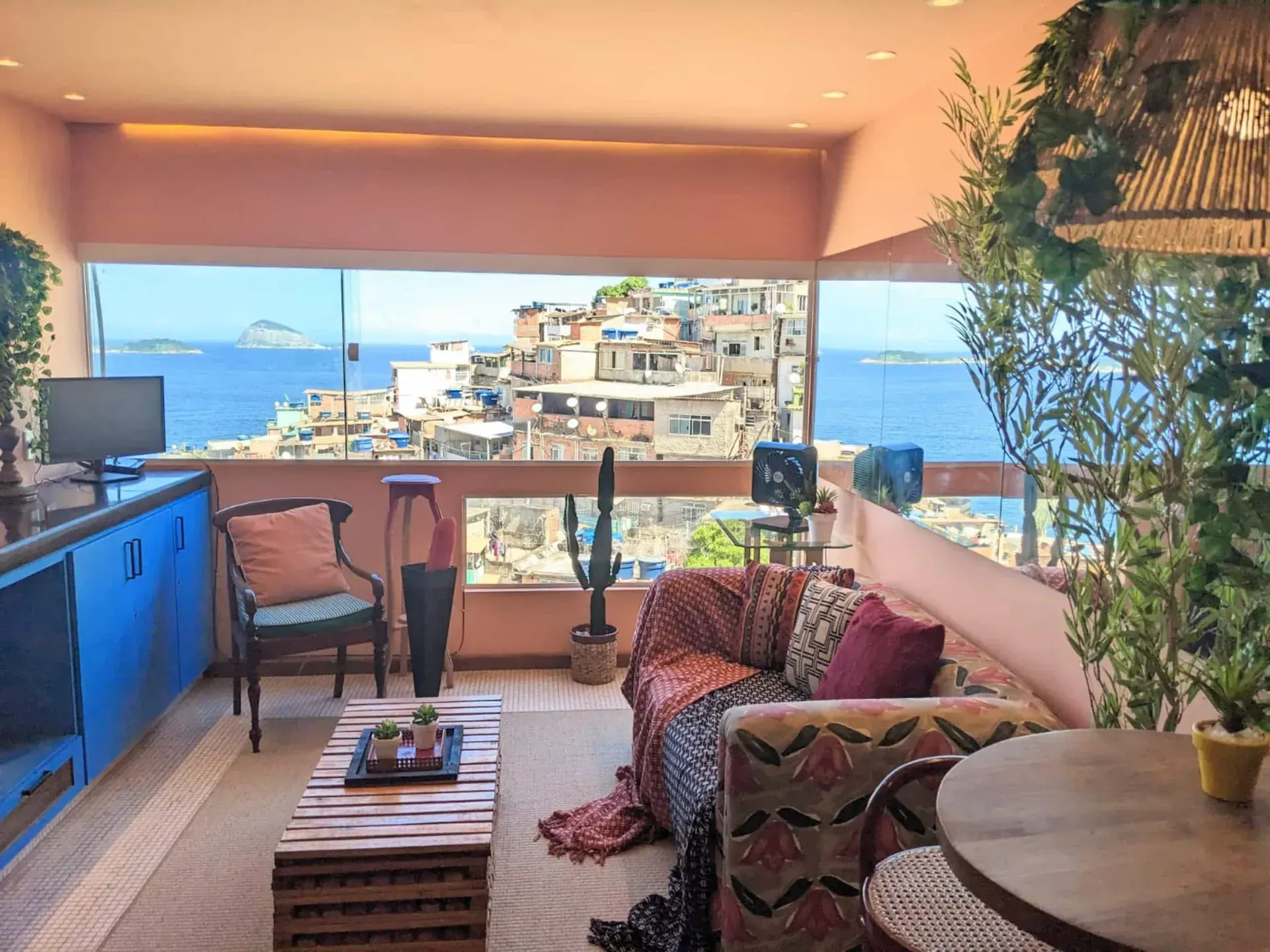
Eighth floor, Vidigal. The window opens and the whole Atlantic opens with it — Ipanema curving left, Dois Irmãos stacked behind you, a container ship the size of a matchstick on the horizon. This is the case, made plainly, for why a Vidigal Airbnb ocean view beats what Copacabana and Ipanema are selling for the same money, or less. Not louder. Not trendier. Honest about the trade-offs. And right about the view.
Lux Vidigal is our two-story apartment in Vidigal, with the ocean on one side and the Dois Irmãos mountain on the other, and you can check dates and book it on Airbnb.
The argument in one paragraph
Copacabana and Ipanema are the names you know. They are the names every cab driver in Rio assumes you want when you land at GIG. They have the postcard, the mosaic sidewalk, the Girl From Ipanema, the bossa nova ghost. They are also, in 2026, aging. Copacabana is loud and frayed at the edges. Ipanema is expensive and polished to the point of feeling like a nicer version of a neighborhood you already know. Vidigal, three kilometers west, is something else entirely. It is a favela that climbed a mountain in the 1940s and refused to come down. It is now the address creative-class cariocas request by name. The apartments near the top of the hill look straight into the ocean at a height the beachfront towers cannot touch. And the nightly rates — still — have not caught up to the view.
This is not a takedown of Copa or Ipanema. Both are legitimate places to stay. Both have real advantages. But if you are picking your neighborhood in Rio because of the view from the window you will wake up to, there is a correct answer. It is the one at altitude.
What the math actually says
Indicative April 2026 nightly rates for a one-bedroom with a genuine ocean view, pulled from Airbnb search across the three neighborhoods.
- Copa/Ipanema "ocean view" listings often mean lateral-angle views with another tower in the frame.
- Vidigal listings above the fifth street up the hill tend to look clean past every obstruction.
- Vidigal is a 4-minute walk downhill to Leblon beach. The walk back is a stairs-and-calves workout.
What you are really buying when you pay for a view
A view is not one thing. It is four. There is the angle — how much of the horizon the window sees, in degrees. There is the altitude — how high you are above the beach, which determines whether you look at the ocean or across it. There is the obstruction — the buildings, wires, awnings, and antennas in the frame. And there is the light — what the view does between 5:40 and 6:20 every evening, when the sun drops behind Dois Irmãos and the hills go copper.
Copacabana towers have a narrow window to win all four. The ocean-facing buildings on Avenida Atlântica are beautiful on the outside, often tired inside, and almost always fronted by another tower slightly forward of the property line. Your angle is maybe 90° if you are lucky and facing directly out to sea. Your altitude is 20 to 40 meters above beach level, which is low enough that the beach promenade — with its kiosks and joggers and late-night crowd — is always part of the picture. The obstruction is the neighbor's window fifteen meters to your left, staring back at you. The light is honest, but you are watching it between buildings.
Ipanema does it better. The blocks are shorter, the buildings generally lower and better maintained, and the ocean side of the Rua Vieira Souto has almost no tower-in-the-way problem. A direct-facing Ipanema apartment is, genuinely, a magnificent place to wake up. But you pay for it. The price per square meter on Vieira Souto is among the highest in Brazil, and the short-let listings reflect that. A clean ocean-facing one-bedroom in Ipanema in April 2026 starts around R$1,100 a night and climbs fast. A view with the lagoon on the other side — Lagoa Rodrigo de Freitas, for which the neighborhood is partly named — costs almost as much and faces the wrong direction for sunset.
Vidigal solves the physics differently. It does not put you on a tower; it puts you on a hillside. The apartments that matter — the ones that justify the climb — sit between 60 and 120 meters above sea level. At that altitude the view is no longer "looking at the beach." It is "looking over everything." Leblon, Ipanema, the Arpoador headland, the Cagarras archipelago on the horizon, the white curve of surf breaking against Pedra da Gávea to the west. Your angle is closer to 200° than 90°. Your obstructions are other rooftops on the hillside, which fall away beneath you. And the light — saudade does not quite cover what the light does up here between six and seven on a clear evening.
Copa vs. Vidigal, honestly
The case for Copacabana is real. Let's not pretend otherwise. It is the most convenient neighborhood in Rio for a tourist who wants the essentials within sixty seconds of the front door. Pharmacies every block. Cafés every block. A Metrô station on the same street. The biggest concentration of English-speaking hotel staff in the city. If you are arriving for three nights and your priority is removing friction, Copacabana is a defensible choice.
The case against is also real. Avenida Atlântica is loud in a way the photos do not capture — traffic six lanes deep, horns, sirens, street vendors calling out água mineral at ten-second intervals. The back streets behind the beachfront carry a different kind of energy after dark, especially near Posto 5 and 6. The buildings are mostly from the 1950s and 1960s, and the ones that have not been renovated have a lot of tile and not a lot of light. The beach itself is crowded, excellent for people-watching, mediocre for swimming, and closes with a police presence that tells you what the midnight hours can bring.
Copacabana wins on
- Amenities on every block, 24 hours
- Metrô access to Centro and the North Zone
- Classic beachfront hotels if that is what you want
- Lowest entry price of the three
- Easiest arrival from either airport
Vidigal wins on
- View angle and altitude, by a wide margin
- Quiet at night, except Saturday baile funk
- Closer to Leblon beach than Copa is to Ipanema
- Creative-class residential feel, not tourist density
- Better per-real value for anything with a view
The price conversation is the one that decides it for most guests. A reliable Copacabana one-bedroom with an actual ocean frame — not "sea view" code for "you can see a sliver between two towers if you lean on the railing" — runs R$800 to R$1,400 a night in the 2026 high season. A Vidigal apartment with a 180° view that ruins every other Rio view you will ever see starts meaningfully lower and rarely crosses R$1,800 even at the top of the market. For the same money you get more sky.

Ipanema vs. Vidigal, which is harder
Ipanema is the harder comparison. It should be. Ipanema is objectively one of the most pleasant beach neighborhoods in the Americas, and it has been for fifty years. The streets are clean. The cafés are good. The bookstore on Visconde de Pirajá is still there. The Saturday hippie fair at Praça General Osório is still there. The bossa nova bar where Tom and Vinícius wrote the song is still there, more or less. You can walk from Ipanema to Leblon along the sand and feel like the city has been designed for this specific purpose.
What Ipanema does not give you — cannot give you, because of its geography — is elevation. The neighborhood is flat. The buildings along the beach are capped at twelve stories by the gabarito zoning rules, and even the top floors look across the beach, not over it. The light is beautiful. The view, for most apartments, is a rectangle of ocean bordered on three sides by concrete. And the nightly rates assume you understand exactly what you are paying for: the address, the walk to Garota de Ipanema, the idea of Ipanema.
Vidigal sits three kilometers west of Ipanema's western edge. From the top of the hill you can see Ipanema's entire shoreline as a postcard — not as your immediate reality. You can be in the middle of that shoreline in twelve to fifteen minutes by ride-share, which means you are effectively staying in both neighborhoods at once. You sleep in Vidigal. You brunch in Ipanema. You swim in Leblon. You come home up the hill when you are done.
Ipanema wins on
- Beach access measured in meters
- Restaurant and café density per block
- Perceived safety for late-night walks
- English infrastructure at hotels and shops
- The walk itself — flat and pleasant
Vidigal wins on
- View altitude and obstruction profile
- Residential calm during weekdays
- Price per view, by a factor of roughly two
- Sunset light behind Dois Irmãos, on your side
- A sense of being somewhere, not everywhere
There is a question under the question. It is: do you want a hotel room with a beach next door, or do you want a living space with a horizon line. If the answer is the first, stay in Ipanema. You will not regret it. If the answer is the second — and for most returning Rio guests, it eventually becomes the second — the math points you up the hill.
Copacabana sells you a beach. Ipanema sells you an address. Vidigal sells you the window you will keep thinking about six months after you leave. — a line we keep coming back to
The vibe question, spelled out
Neighborhoods have a texture. It is not quantifiable and it is the thing guests talk about when they describe a trip a year later. Copacabana's texture is busy, loud, and democratic — everyone is there, from families to surfers to sex workers to pensioners, all mixing on the same mosaic sidewalk. The kiosks are open past midnight. The vendors walk the sand yelling queijo coalho, mate gelado. You are in Rio, unambiguously, from the moment you step outside.
Ipanema's texture is polished. The sidewalks are cleaner. The crowd is wealthier, younger on the west end, and disproportionately foreign in April. The boutiques on Visconde de Pirajá are the Brazilian equivalent of mid-range Parisian boutiques — competent, expensive, predictable. At night, the restaurants along Rua Garcia D'Ávila fill with a mix of cariocas and tourists, and the conversations are in four languages. Ipanema feels like a neighborhood that has figured itself out.
Vidigal's texture is different again. It is residential in a way the beachfront neighborhoods are not. The men at the botequim on the corner have been showing up at 5 p.m. for fifteen years. The kids playing football in the street at the bottom of the hill are the same kids every day. The motorcycle taxis that run up and down the single road — moto-táxi, R$5, the only fast way to the top — are operated by drivers who know every resident by name. When you walk back from the bakery with a loaf of pão de queijo in the morning, someone says bom dia and means it.
That texture comes with a cost. Vidigal is not a tourist neighborhood and does not pretend to be. There are three cafés. There are two restaurants worth a walk. The English infrastructure is thin. The street names are not on Google Maps in any consistent way, and addresses use the beco system — numbered alleys that branch off numbered alleys. If the idea of asking a neighbor where to find something is stressful, stay in Ipanema. If it sounds like the best part of a trip, come up the hill.

Eight dimensions, three neighborhoods
The side-by-side, without the marketing gloss. Based on April 2026 listings and on walking these streets every week.
- View angle (typical)
- Copa 90°, Ipanema 100°, Vidigal 180°+
- Ocean-view nightly (1BR)
- Copa R$800–1,400, Ipanema R$1,100–2,000, Vidigal R$450–1,800
- Walk to best nearby beach
- Copa 0 min, Ipanema 0 min, Vidigal 4 min down / 8 min up
- Nightlife density
- Copa high, Ipanema high, Vidigal low to medium
- Breakfast options nearby
- Copa dozens, Ipanema dozens, Vidigal three worth it
- Safety perception (2026)
- Copa moderate, Ipanema high, Vidigal moderate-to-high
- To GIG airport by car
- Copa 45–60 min, Ipanema 50–65 min, Vidigal 55–70 min
- Feels like
- Copa a hotel district, Ipanema an address, Vidigal a home
The walkability reality check
This is the part of the argument where Vidigal loses ground, and we should be honest about it. Copacabana and Ipanema are flat. Vidigal is not. The single road that climbs from the São Conrado side — Avenida Presidente João Goulart — is steep, curves often, and takes between ten and fifteen minutes to walk from the bottom to where most apartments sit. It is not a punishing climb, but it is a climb. With groceries, at 32°C in February, after two caipirinhas on the beach, it is a meaningful climb.
The moto-táxi system solves this for residents. Five reais, thirty seconds from your door to the bottom of the hill, and a driver who is as fast as you are brave. It works at any hour. It runs in the rain. It is, in practical terms, a private elevator for the neighborhood. Many guests refuse to try it on the first day and ride it twice a day by day three.
For the beach part of the equation, Vidigal actually beats Copacabana on distance-to-best-beach. Leblon is a four-minute walk down the São Conrado side of the hill, and Leblon is, by consensus, the best beach in the South Zone for swimming — cleaner water, calmer surf, less crowd than Ipanema after Posto 9. You are closer to good sand from Vidigal than you are to good sand from most of Copacabana's side streets. The trade is that you walk back up.
Inside the neighborhood, walkability is fine if you like stairs. Vidigal is built on a ladeira — a hill street — with sub-streets that branch off as concrete staircases climbing between buildings. Once you know the layout, moving around the middle of the hill takes five to ten minutes. First-time guests get lost. That is part of it. Someone will point you home.
Noise, neighbors, and what Saturday night sounds like
People ask about noise, and the honest answer is: every Rio neighborhood is loud at some point, and the question is when. Copacabana is loud continuously — traffic, sirens, street vendors, the occasional funk sound system from a car at 2 a.m., the low hum of a beachfront avenue that never fully sleeps. Ipanema is loud on weekend evenings and around the beach kiosks, then quiets to a well-behaved murmur. Vidigal is quiet on weekdays. On Saturday nights — specifically between 11 p.m. and roughly 4 a.m. — the baile funk at the bottom of the hill does exactly what it says on the tin. It is loud. It is the sound of the neighborhood. If you are up the hill, it is distant bass; if you are near the bottom, it is a concert.
There is an upside to the pattern. Six nights a week, Vidigal is dramatically quieter than either beachfront neighborhood. You hear the ocean. You hear the monkeys — saguis, the tiny hillside marmosets — before sunrise. You hear a rooster somewhere, always the same rooster. You hear the moto-táxi engines starting up at 6 a.m. and that is the real wake-up call, along with the pão de queijo bakery opening at 6:30. The noise floor is low in a way Copacabana cannot match.
Noise is not actually a deciding factor for most guests once they understand the pattern. It is a scheduling question. If you are in Rio on a weekend and want to sleep through Saturday night, pick a Vidigal apartment on the upper half of the hill. If you are in Rio on weekdays and want dead quiet, Vidigal is the quietest of the three neighborhoods by a clear margin. Ipanema is second. Copa is third, and it is not close.
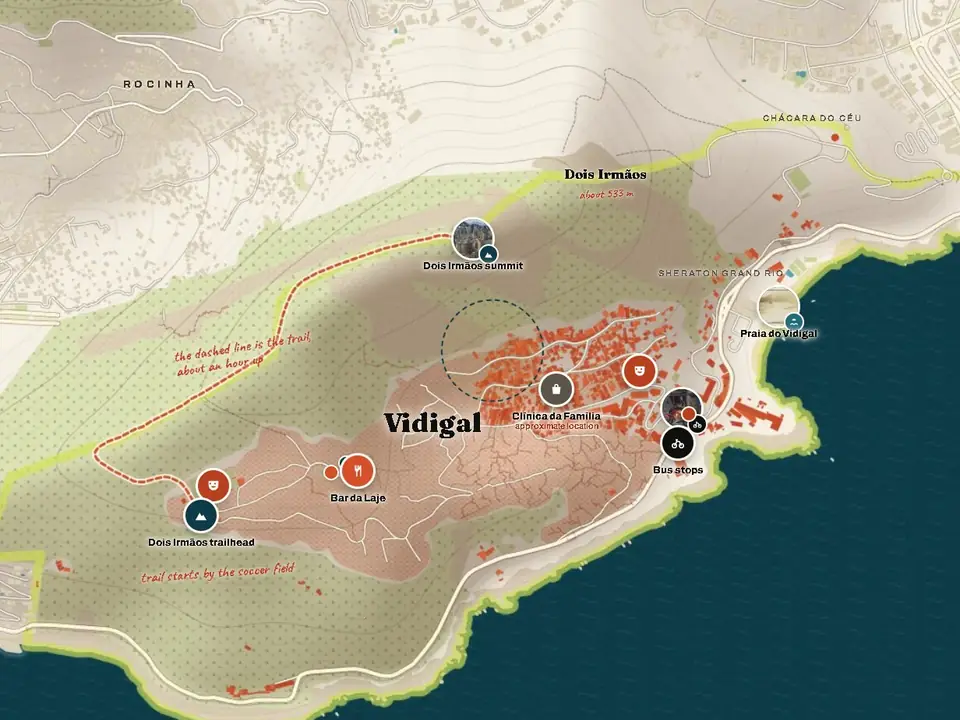
~~~The proximity map, drawn from above
Rio's South Zone is narrow and stretched along the coast. From east to west, the beach neighborhoods line up as Leme, Copacabana, Arpoador, Ipanema, Leblon, Vidigal, São Conrado, and then Barra da Tijuca twenty minutes further. Vidigal sits at the west end of the South Zone proper, wedged between Leblon and São Conrado, with Rocinha — the largest favela in Brazil — directly uphill to the west. This location is underappreciated. From Vidigal, you have Leblon on your doorstep, Ipanema a twelve-minute ride, Copacabana an eighteen-to-twenty-five-minute ride, Botafogo and Flamengo thirty minutes, Centro and Lapa thirty-five to forty-five depending on traffic.
Copacabana is further east, which makes the trip to Centro a touch shorter (twenty-five to thirty-five minutes) but the trip to Leblon or São Conrado longer. Ipanema is the geographic middle, which is part of its appeal; it is roughly equidistant from everything South Zone. Vidigal loses on trips to Centro. It wins on trips to the beaches that actually matter, to Cristo Redentor access via Cosme Velho (about forty minutes), and to the airport, which is a six-of-one situation — all three neighborhoods sit fifty minutes from GIG in normal traffic, plus or minus ten. SDU (Santos Dumont, domestic) is closer from Copacabana, further from Vidigal, but we are talking about a fifteen-minute difference at most.
If your itinerary revolves around Cristo, Pão de Açúcar, the Maracanã, or the Sambódromo at Carnival, Copacabana has a modest logistical edge. If your itinerary revolves around beach, food in Leblon or Ipanema, hiking Dois Irmãos (which starts in Vidigal), and looking at a sunset you will describe to friends, Vidigal wins by every measure that matters for the specific trip you are planning. For a deeper map, see our guide to getting around Vidigal.
Where Vidigal is not the right answer
Honest disqualifiers. If any of these describe your trip, pick Ipanema or Copacabana instead.
- You have reduced mobility or cannot manage stairs and hills. The neighborhood is not designed for you.
- You are in Rio for two nights or fewer and want zero friction. The learning curve is not worth the short stay.
- You want the apartment to have a hotel concierge downstairs. We do not have that. We have a neighbor named Seu Zé.
- You are traveling with very young children and the idea of a moto-táxi up the hill is a hard no. Take a car. But budget the extra minutes.
- You need English-speaking infrastructure at every step. Vidigal has some English. Not as much as Ipanema.

The safety question, answered straight
Vidigal is a favela, and that word means a specific thing in Brazilian cities that is different from what it often implies in foreign coverage. It is a community that was not originally recognized by the municipal planning department, built and expanded by its own residents, with a distinct social and political structure. In 2026, Vidigal is one of the safest favelas in the South Zone for visitors, and has been for more than a decade. This is not a universal statement about all favelas in Rio; it is specific to this one, and the reasons are specific — geography, the 2012 pacification era, the residents' association, the fact that the neighborhood has become partly residential for artists, musicians, and middle-class cariocas priced out of Leblon. Guests walk the main road at all hours. We walk it. We have walked it for years.
Comparing safety across the three neighborhoods is not about Vidigal being more or less safe; it is about understanding how the risk profile is shaped. Copacabana has the highest concentration of petty theft of the three, driven by tourist density, the beachfront, and the back-street pattern after dark. Ipanema has less of it and feels tangibly calmer at night, though theft on the beach itself is a constant low-grade issue. Vidigal has very little petty theft within the community — social pressure handles it — and the risk profile is more about route choice than personal safety. You are advised not to wander into the parts of Rocinha that border Vidigal without a local guide. You are not advised to avoid Vidigal. For a full treatment, we wrote a deeper post on whether Vidigal is safe in 2026.
The pragmatic summary is this: all three neighborhoods are safe enough for normal travel with normal precautions. Vidigal is not the highest-risk of the three. On most weekday nights, it is the lowest. The perception gap — what people assume versus what is actually true — is the largest for Vidigal, and it is the reason the view is still underpriced.
Where your money actually goes
When you book an ocean-view Airbnb in Copacabana, a meaningful share of the nightly rate is paying for the beachfront address. That is an honest thing to pay for. You are also paying for the building's management fees, the high property tax on prime avenida land, and the platform fees, which leave the host with a smaller slice than you might think. The apartment itself — the furniture, the light, the kitchen — is often the smaller part of the budget.
Ipanema does the same thing with a larger multiplier. The Vieira Souto address is a luxury item. A ten-year-old one-bedroom on that street, with the ocean out the window, rents for more than a renovated three-bedroom one block inland. You are paying for the address in cash form, and the return you get is the address.
Vidigal inverts the pattern. Because the neighborhood has not been in the "luxury" category on the platforms — and, in the platforms' implicit scoring, still isn't — the address premium is thin. Hosts compete on the apartment itself: the renovation, the furniture, the kitchen, the view from the balcony. The result is that when you pay R$1,400 a night in Vidigal, you are paying for a better-finished apartment than you would get in Ipanema at the same rate, with a better view. The neighborhood is not charging you for being the neighborhood. That is changing — prices rose roughly 18 to 25 percent between 2022 and 2026 — but the gap has not closed.
The other thing your money buys in Vidigal is the climb itself. That is either an amenity or a penalty, depending on who you are. For the guests who come back — and the repeat rate in the neighborhood is unusually high — it reads as an amenity. The five-minute climb home is part of the reset. By day four, you stop noticing it. By day six, you miss it when you leave.
What a week looks like, concretely
A Vidigal week is not a Copacabana week translated uphill. It has its own shape. Morning, you take coffee on the balcony while the fishermen go out from São Conrado below you and the first surfers paddle at Leblon. Mid-morning, you walk — or moto-táxi — down the hill to Leblon beach, which is four minutes on foot and close to zero minutes on the back of a bike. You swim. You come back up for lunch at one of the handful of spots worth a walk, or you take a car to Zazá Bistrô in Ipanema because you feel like it and you are fifteen minutes away. Afternoon, you nap. You work from the balcony. You read. The afternoon light does a thing. Early evening, you climb Dois Irmãos — the trail starts inside Vidigal, at the campinho football pitch — and you watch the sun set from 533 meters up, over the city you are staying in. Night, you eat at Bar da Laje or you take a car to Leblon or Ipanema for dinner. You come home, up the hill, to the balcony, and the ocean is black and silver, and the lights from Leblon and Ipanema trace the coast to your left. This is the week. People underestimate how hard it is to replicate from a beachfront tower. For more on the beach specifically, we wrote a whole post about Vidigal's own small strip of sand.
A Copacabana week, by contrast, is beach-forward and street-dense. You are outside the apartment a lot because there is a lot to do within a block. This is excellent for some travelers, draining for others, and fundamentally different from a week at altitude. An Ipanema week is Copa's week refined — more restaurants, more boutique, less street noise, a higher nightly rate, and the same flat-geography view from the window.
The Vidigal Airbnb ocean view week is the one where you keep going back to the window. That is the proof. Copa and Ipanema do many things well. They do not do that one thing.
Quick questions.
Is Vidigal actually safer than people think in 2026?
Yes, and by a meaningful margin. Vidigal has been one of the more stable communities in the South Zone for over a decade and has a visible residents' association and community-policing presence. Use normal precautions — ride-share at night, do not wander uphill past the marked areas without a guide — and the risk profile is similar to or lower than Copacabana's back streets.
Do I really need to walk up a hill every time I come home?
No. The moto-táxi system runs from 6 a.m. to roughly 2 a.m., costs R$5, and drops you at your door in under a minute. Ride-share cars also climb the main road, though drivers sometimes prefer to drop at the bottom. Most guests walk down in the morning and ride up after the beach.
How much should I expect to pay for a good ocean-view one-bedroom in April 2026?
In Vidigal, a well-finished one-bedroom with a genuine 180° view runs R$450 to R$1,800 a night depending on tier and season. A comparable ocean-facing one-bedroom in Copacabana runs R$800 to R$1,400, and in Ipanema R$1,100 to R$2,000. Weekly and monthly discounts typically reduce effective nightly rates by 15 to 30 percent across all three.
Is the Saturday baile funk really loud?
At the bottom of the hill, yes — it is the whole point of a baile. Two-thirds of the way up the hill, where most short-let apartments sit, it is audible but distant. By midnight on most nights other than Saturday, the neighborhood is quieter than Copacabana's avenues. Earplugs solve the edge case.
Can I take an Uber from GIG straight to a Vidigal Airbnb?
Yes. Uber, 99, and licensed taxis all serve the neighborhood. The ride is 50 to 70 minutes depending on traffic and costs roughly R$140 to R$220 in 2026. Drivers will take you to the door of most apartments; for addresses deep in the becos, they will drop you at the main road and a moto-táxi or the host will meet you.
Is Vidigal better for a first-time Rio visit or a return visit?
Either. First-time visitors who want the view and the neighborhood feel choose Vidigal and rarely regret it, though the learning curve is a day. Return visitors who have already done Copa and Ipanema choose Vidigal because it is the Rio they did not see the first time. The wrong fit is a two-night trip where you need zero friction; that is an Ipanema or Copa stay.
What about families with kids?
It works, with planning. The hill is manageable with school-age kids and a non-issue with teenagers. For toddlers and strollers, use ride-share up and down rather than walking, and choose an apartment with a balcony that has safe railings. Ipanema is genuinely easier with small children, and that is an honest trade-off.
The three neighborhoods are not competing for the same traveler. They are competing for the same first question: where in Rio do I wake up. Copacabana answers with a beach and a mosaic sidewalk. Ipanema answers with an address. Vidigal answers with a window you will keep thinking about. The math on price per view has not caught up yet. The neighborhood is still the best-kept correct answer in the South Zone. Come up the hill once and you will understand why the argument is not close.