
Nine in the morning at the base of Vidigal. A kombi van grinds up the hill in first gear, someone's radio leaks pagode from an open window, and a couple stands at the bottom deciding whether to walk up or wait for a guide. Are favela tours ethical, they are asking each other, and can they just go in on their own. Both are fair questions. Here is the honest answer.
The question behind the question
When people type "are favela tours ethical" into a search bar, they are usually asking two things at once, and it helps to pull them apart. The first is a moral question: is it wrong to walk through a poor neighborhood as a paying tourist, camera in hand. The second is a practical one: do you need a tour at all, or can you visit a place like Vidigal on your own, the way you would any other part of Rio. The two get tangled together, and the tangle is where most travelers get stuck.
The short version, which the rest of this piece will earn: the tour model that most people picture when they feel uneasy — a bus or an open jeep rolling through narrow streets while strangers photograph families on their stoops — is genuinely worth feeling uneasy about. That model deserves the criticism it gets. But it is not the only way to see a favela, and in Vidigal specifically it is not even the common one. Vidigal is the favela in Rio you can generally walk into yourself, stay in, eat in, and spend an evening in without a guide at all. Whether you should hire one anyway is a separate and more interesting question.
Some context first, because the word favela carries more weight in English than it does in Portuguese. A favela is a self-built neighborhood, historically outside the formal city, historically underserved by the state. Roughly a fifth of Rio lives in one. They are not camps or slums in the tent-city sense. They are dense, permanent, working neighborhoods with shops, churches, samba schools, bakeries, internet, and, in Vidigal's case, ocean views that the formal city would kill for. Calling the whole category "poverty" flattens a lot of ordinary life into a single sad word. Holding that in your head is the first step to visiting well.
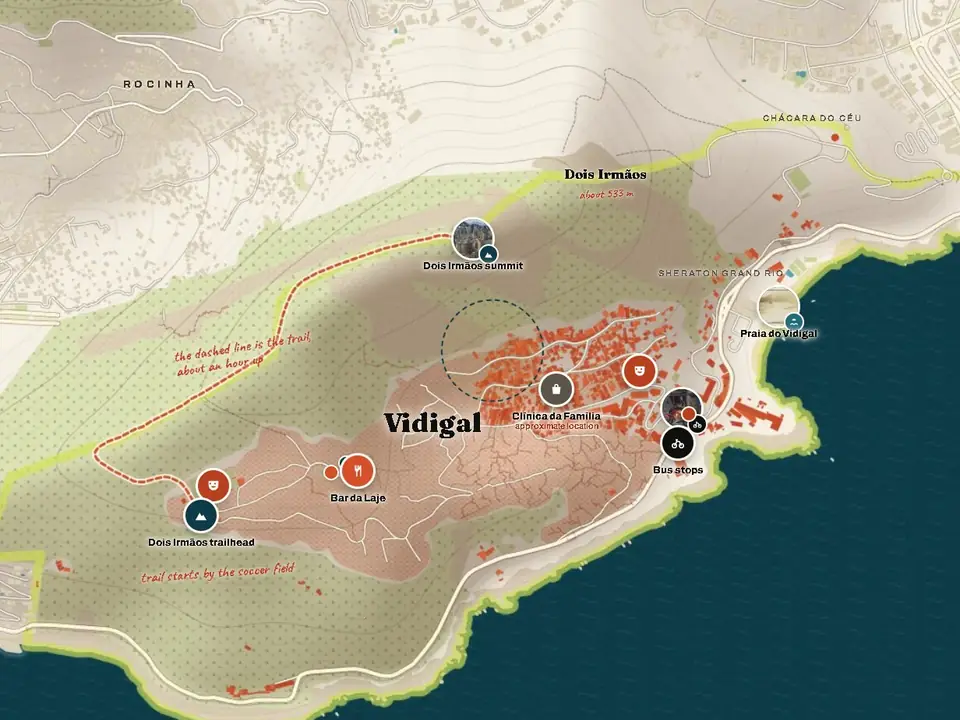
Vidigal sits in the Zona Sul, the wealthy South Zone, wedged on the hillside between Leblon and São Conrado, under the twin peaks of Dois Irmãos. That location matters to this whole conversation. It is why Vidigal has hostels, guesthouses, restaurants and bars that welcome outsiders, and it is why the ethics of visiting here look different from the ethics of rolling a tour bus through a community that has none of that infrastructure and never asked for you.
If you only read one box
The debate in three lines, before the detail.
- The bad version is real. Drive-through and jeep tours that treat residents as scenery earn the "human zoo" label honestly.
- Vidigal is the exception. You can walk its main road, eat, drink and stay here without a guide. Most visitors do.
- A resident-led walk can be a good thing — if the guide lives here and the money stays here. Choose on those two questions alone.
Where the unease comes from
Favela tourism in Rio started in the 1990s, and it started badly. The early model was an outside company driving foreigners through a hillside in a van or an open-topped jeep, windows down, cameras up, a narrated loop past the poorest streets and back out to the beach in ninety minutes. Nobody got out. Nobody spoke to a resident. The pitch was proximity to danger and hardship, and the product was a photo you could show at home. That is the version of the favela tour that people are picturing when they ask whether the whole thing is exploitative, and they are right to picture it, because it existed and in some corners of the city it still does.
Residents have been blunt about how that feels. In community after community, people describe the jeep tours in the same language: like being animals in a zoo, photographed without a word exchanged, their homes turned into a backdrop. In Santa Marta, guides have complained for years about operators who bring tourists in with no local involvement at all, letting visitors shoot pictures freely and leaving nothing behind. The phrase "poverty tourism" exists because this happened, and the sharper critics call it what it can be at its worst: turning inequality into a spectacle you buy a ticket to watch.
Two things make a tour slide toward that bad end. The first is the vehicle. A tour where you never step out of the car is almost automatically a safari, and the safari framing is the problem, because it puts the people you are looking at in the position of wildlife. The second is where the money goes. When an outside company pockets the fare and hires a driver who has never lived on the hill, the community that supplied the scenery gets nothing. Many residents across Rio's favelas say exactly that: they feel ignored, they see the buses, and they see none of the return. Some community leaders describe the tours flatly as exploitation.
So the unease is not snobbery or squeamishness. It is a correct read of a real and bad product. The mistake is to stop there and conclude that all visiting is exploitation, because that conclusion quietly erases the residents who have built businesses, guesthouses, bars and guiding work precisely so that outsiders can come and spend money here on the community's own terms. Poverty tourism is one way to enter a favela. It is not the only way, and in Vidigal it is the least common one.

Why Vidigal is the one you can usually walk yourself
Here is the practical answer to the question travelers actually lose sleep over: can tourists go into favelas in Rio, and do you need a guide to visit Vidigal. For most favelas the honest response is nuanced. For Vidigal it is close to simple. You do not need a tour to enter Vidigal. The main road up the hill — Avenida Presidente João Goulart, the spine everyone just calls the estrada — is a working commercial street lined with bakeries, bars, hostels, a pharmacy, small markets and guesthouses that exist because visitors walk up it every day. Vans and moto-taxis run it constantly. You are not sneaking in. You are a customer on a street that wants customers.
This is what makes Vidigal different from the favelas the "always hire a guide" advice was written for. That advice is sound for a place like Rocinha, which is vastly larger and denser, a city inside the city where the streets fold into a maze and an outsider genuinely can get lost or wander somewhere they shouldn't. If Rocinha is where you want to spend a morning, a resident guide is the right call and we say so in our Rocinha versus Vidigal comparison. Vidigal is smaller, more legible, and more used to outsiders. Its tourist-facing life runs along one clear axis, and staying on that axis is not hard.
None of which means switch your brain off. Vidigal was pacified in the 2010s, a police unit installed, and tourism and investment followed. The citywide pacification model has frayed a great deal since then, and conditions in any favela can shift week to week. As of 2026 Vidigal remains one of the calmer, more visitor-friendly communities in Rio, but "calmer" is a relative word and the honest posture is to read the room. Walk the main road and the tourist areas, not the far upper lanes on your own. If there is a heavier police presence than usual, or the street mood changes, go back down. We keep a fuller, non-sensational treatment of all this in is Vidigal safe, and it is worth reading before you come.
What a guide adds in Vidigal, then, is not permission and not safety in the basic sense. It is context and access. A good resident guide takes you off the main road into the parts of the hill you would not confidently find or read on your own, tells you what you are looking at, introduces you to people who are glad to be introduced rather than photographed cold, and turns a walk-through into a conversation. That is a real thing to pay for. It is just a want, not a need, and knowing the difference is what lets you decide honestly rather than out of fear.
You do not need a ticket to enter Vidigal. You need manners. Those are not the same purchase, and confusing them is how people end up on the wrong kind of tour. — what we tell guests who ask if they should book a favela tour
If you want a guide, hire a resident, not a bus
Say you do want the guided version, and plenty of thoughtful travelers do, because context is worth having and because a well-run walk is one of the better ways to put money directly into local hands. The question then is not whether to take a community-led favela tour in Vidigal but how to pick one that deserves the name. The good news is that the test is short. You are checking two things: does the person leading it actually live here, and does the money stay here. Almost everything else follows from those two answers.
A guide who grew up on the hill is not a nicer version of an outside guide. It is a different product. They are showing you their own street, their own neighbors, their own history, and they carry the social permission to do it. When they stop to talk to someone, it is a greeting between people who know each other, not a stranger being interrupted for your benefit. The walk moves at a human pace, on foot, two hours or so, small group. You end up in a botequim or a viewpoint, not filing back into a van. Operators like this exist in Vidigal and have for years. Russo, who has lived and worked on the hill for two decades, runs a well-reviewed walking tour of exactly this shape. Vidigal Hang Out is another community-rooted option, with guides who are known and respected in the neighborhood. There are others, and the number matters less than the two questions.
The money question is the one people forget to ask out loud, so ask it out loud. Some resident-run operators are explicit that more than half of what you pay goes back into community projects, and the honest ones will tell you where. If a guide cannot or will not say who benefits, that is your answer. You want the fare landing on the hill: paid to a local guide, spent in a local bar at the end, dropped into a project you can see. You do not want it disappearing into a company registered in Barra whose only presence here is a logo on a jeep.
One more filter, and it is the bluntest one. If the tour involves a vehicle you never leave, skip it. The safari format is the format the criticism is about, and no amount of good intention redeems watching a neighborhood through glass. Walk or do not go. A community-led favela tour in Vidigal is a walk by definition. Anything else is the old bad model wearing a friendlier brochure.
Choosing a guide, in five questions
Ask these before you book anything. A good operator answers all five without flinching.
- Do you live in Vidigal. Resident-led or nothing. This is the whole game.
- Is it on foot. Walking only. No jeeps, no vans you ride through the streets in.
- Where does the money go. A straight answer, ideally a named project you can visit.
- How big is the group. Small. A crowd of fifteen strangers is not a conversation.
- What is the photo rule. A guide who sets one up front is a guide who respects the people you'll meet.

The camera question, and the difference between looking and taking
More arguments about favela ethics come down to photography than to anything else, so it deserves its own section. The rule is not complicated and it is not unique to favelas. You would not photograph a stranger's children on a street in your own city without a thought, and the fact that the street here is poorer does not lower the bar. It raises it, because the imbalance of power is greater. A visitor with an expensive camera and a resident on their own doorstep are not meeting as equals, and the camera makes that gap visible.
So: ask. A smile, a gesture at the camera, a posso, and you will find most people are generous, especially with a portrait they can see afterward. What you are avoiding is the drive-by shot of someone as scenery, the frame where a person becomes texture for your feed. The difference between looking and taking is consent, and consent takes about three seconds to request. Landscapes, views, the ocean over the rooftops, murals with no one in front of them — shoot freely. People, homes through open doors, anything that reads as private — ask, or lower the camera.
Two specific don'ts. Do not fly a drone over the hill. It is loud, it is invasive over people's roofs and courtyards, and in a community with a long and complicated relationship to being surveilled it lands badly, quite apart from the airspace rules. And do not photograph anything that looks like it belongs to the drug trade — a lookout, a weapon, a transaction. This is not a squeamishness point. It is a safety one, and it is non-negotiable, and it is the one hard line every honest guide will draw for you before you take a step. If you are ever unsure whether a photo is fine, it is not, and you have lost nothing by not taking it.
The reward for getting this right is that you get to actually see the place, because a camera held down is a camera that lets you notice things. The staircase murals, the improvised genius of the water tanks and wiring, the kid selling picolé from a cooler, the view that stops you at a bend in the road. Vidigal's street art alone rewards a slow eye, and we map it in the community arts and culture guide. Some of that art was made for exactly the reason you should photograph it: to be seen, and to say something about who lives here.
Where the money actually goes
This is the part of the ethics conversation that gets the least attention and matters the most, because it is where you have the most control. Whether your visit helps or extracts is decided less by your intentions than by the path your money takes once it leaves your hand. A favela is not helped by your guilt. It is helped, in the small and real way tourism can help, by cash landing on local counters and staying there. So the practical ethical question is not "should I feel bad about being here" but "how do I make sure my spending stays on the hill."
The mechanics are easy once you look for them. Eat at the botequim on the corner rather than carrying food up from Leblon. Take the moto-taxi up the hill and pay the driver directly, five to ten reais for most hops, more to the top. Buy your water and your beer at the little market on the estrada. Have your caipirinha at a bar owned by someone who lives above it. Tip your guide in cash. Every one of those transactions is money that circulates in Vidigal instead of passing through it, and none of them asks anything of you except to shop where you already are.
Where you sleep is the biggest line in that budget, which is why it matters most. A bed in a resident's guesthouse or a hosted apartment on the hill keeps the largest single chunk of your trip inside the community, and booking direct rather than through a chain of intermediaries keeps more of it there still. This is the one place we will point at our own corner of the hill: staying somewhere like the condo is, among other things, a vote for the local economy, and it is a more honest way to experience Vidigal than being driven through it for an hour. Sleeping here, waking up to the same view the residents wake up to, buying your morning bread where they buy theirs — that is the version of "visiting a favela" that gives something back, and we wrote the fuller account of what it is like in what staying in a favela is really like.
And the money does not only buy your comfort. Vidigal has built its own institutions with it. Nós do Morro, the theater group founded on this hill in 1986, has spent nearly four decades teaching acting and film to kids who could never have paid for it, and its alumni are now familiar faces across Brazilian screens. When the cameras came looking for a cast for City of God, some of the talent they found had trained right here. That is what a favela with agency looks like: not a community waiting to be pitied, but one that has made art out of its own name. Your fare, your dinner, your bed, spent well, is a small tributary into that. Spent badly, on a jeep and a long lens, it is a withdrawal.
Spending that stays
- A resident-led walking tour, paid in cash.
- Dinner at a hill botequim, drinks at a local bar.
- Moto-taxis paid to the driver, direct.
- A bed booked direct with a local host.
- A donation or a ticket to a community project.
Spending that leaves
- A drive-through jeep tour run from outside.
- Food and drink carried up from the Zona Sul.
- A tour company with no local staff on the hill.
- Nothing bought locally, no time spent, no meal.
- Photos taken, wallet closed.

What responsible looks like, in reais
Rough figures, sampled 2026. Prices move, so treat these as the shape of it rather than a quote.
- Private guides and longer tours cost more. So does a guide who is worth it.
- Carry cash in small notes. Moto-taxi drivers, market stalls and guides all prefer it, and many accept Pix.
- A tour priced far below the rest is usually cutting the guide's pay, not yours.
The history that should change how you walk
One more piece of context, because it reframes the whole ethics question in a way a price list cannot. In the 1970s the state tried to remove Vidigal. The beachfront land the community sat above was valuable, the plan was to clear the hillside and move its residents to distant housing projects, and for a while it looked inevitable. The residents fought it. With lawyers, with the Church, with an organized residents' association and a great deal of stubbornness, they resisted the eviction and they won the right to stay. Vidigal became a symbol in Rio precisely because it refused to be erased.
Hold that next to the word "poverty tourism" and it rearranges. This is not a community that materialized to be looked at. It is one that had to fight the formal city for the right to exist on land the formal city wanted, and it is still here, still building, still making theater and murals and businesses out of its own life. Walking in with that in your head changes your posture. You are not a benefactor and you are not a voyeur. You are a guest in a place that chose itself, and the correct behavior of a guest is neither pity nor performance. It is respect, curiosity, and a wallet that opens locally.
That is finally the answer to whether favela tours are ethical, and it does not fit on a bumper sticker. The tour is not the unit of ethics. The behavior is. A jeep with a good slogan is still a jeep. A walk with a resident who lives what she shows you, paid fairly, is a decent human exchange. And a traveler who books a bed on the hill, learns ten words of Portuguese, eats where the neighbors eat and asks before lifting a camera has done more good, and had a far better trip, than one who bought the ninety-minute loop and never got out of the car.
~~~A short code for visiting Vidigal well
Everything above compresses into a handful of habits. None of them are hard. All of them are the difference between being a guest and being a problem, and once they are habits you stop thinking about them and simply enjoy the place, which is the entire point.
- Enter on foot
- Walk the estrada or take a moto-taxi. Never a jeep you ride through the streets in. R$
- Guide, if any
- Resident-led and walking, small group, transparent about where the money goes. tip
- Photos
- Views and murals, freely. People and homes, only after you ask. No drones.
- Spend local
- Eat, drink, sleep and tip on the hill. Direct bookings keep the most here. local
- Read the room
- Main road and tourist areas by default. If the mood shifts, head down.
- Greet people
- Bom dia before noon, boa tarde after. You are on someone's street.
Do those six things and you will not spend a second worrying about whether you are the problem, because you will not be. You will just be a person visiting a neighborhood, spending money where you stand, and paying attention. That is all "responsible" has ever meant. The word sounds heavier than the practice.
Quick questions.
Are favela tours ethical, yes or no?
It depends entirely on the tour. A drive-through or jeep tour run by an outside company, where you photograph residents from a vehicle and no money stays in the community, earns the "human zoo" criticism and is best avoided. A small walking tour led by someone who lives in Vidigal, paid fairly and transparent about where the money goes, is a decent and mutually beneficial exchange. The format and the money trail decide it, not the label.
Can tourists go into favelas in Rio on their own?
In Vidigal, generally yes. It is the most visitor-accustomed favela in the city, with hostels, restaurants and bars along a walkable main road, and people come and go without a guide every day. For larger, denser communities like Rocinha, an independent visit is not advisable and a resident guide is the right call. As of 2026, conditions in any favela can change, so read local advice close to your trip.
Do you need a guide to visit Vidigal?
No, not to enter, eat, drink or stay. The main road and the tourist-facing areas are walkable on your own. A guide is optional and buys you context and access to the upper lanes you would not confidently navigate or read yourself, plus introductions rather than cold encounters. Think of it as a want, not a requirement.
How much does a community-led favela tour in Vidigal cost?
As of 2026, a resident-led walking tour of roughly two hours tends to run somewhere in the R$100 to R$200 per person range, with private and longer tours costing more. Prices move, so confirm when you book. A tour priced far below the rest is usually paying its guide badly, which defeats the purpose of choosing an ethical one.
Is it disrespectful to photograph people in a favela?
Photographing people without asking is, yes, the same as it would be anywhere, only more so given the power imbalance. Ask first and most residents are happy to oblige, especially for a portrait. Shoot views, rooftops and murals freely. Never fly a drone over the hill, and never photograph anything connected to the drug trade, which is a safety line, not just an etiquette one.
What is the difference between Vidigal and Rocinha for visiting?
Vidigal is smaller, in the South Zone, with ocean views and a walkable tourist spine, and you can visit it independently. Rocinha is far larger and denser, effectively a city in itself, where an outsider can easily get lost and a resident guide is genuinely advisable. We compare them in detail in our Rocinha versus Vidigal guide.
How do I make sure my visit actually helps the community?
Spend on the hill and spend direct. Eat and drink at local places, pay moto-taxi drivers and guides in cash, buy from the markets on the main road, and book a bed with a local host rather than being bused through for an hour. Where you sleep is the biggest line in the budget, so booking direct with someone who lives in Vidigal keeps the most money in the community.
So spend the afternoon. Walk the estrada, buy the beer, ask before the photo, learn the two greetings, and if you want the deeper version, hire someone who lives here to show you around on foot. Vidigal does not need your rescue and it does not want your pity. It wants what any good neighborhood wants from a visitor. Your attention, your manners, and your money spent where you are standing. Do that and the question you came in with answers itself.