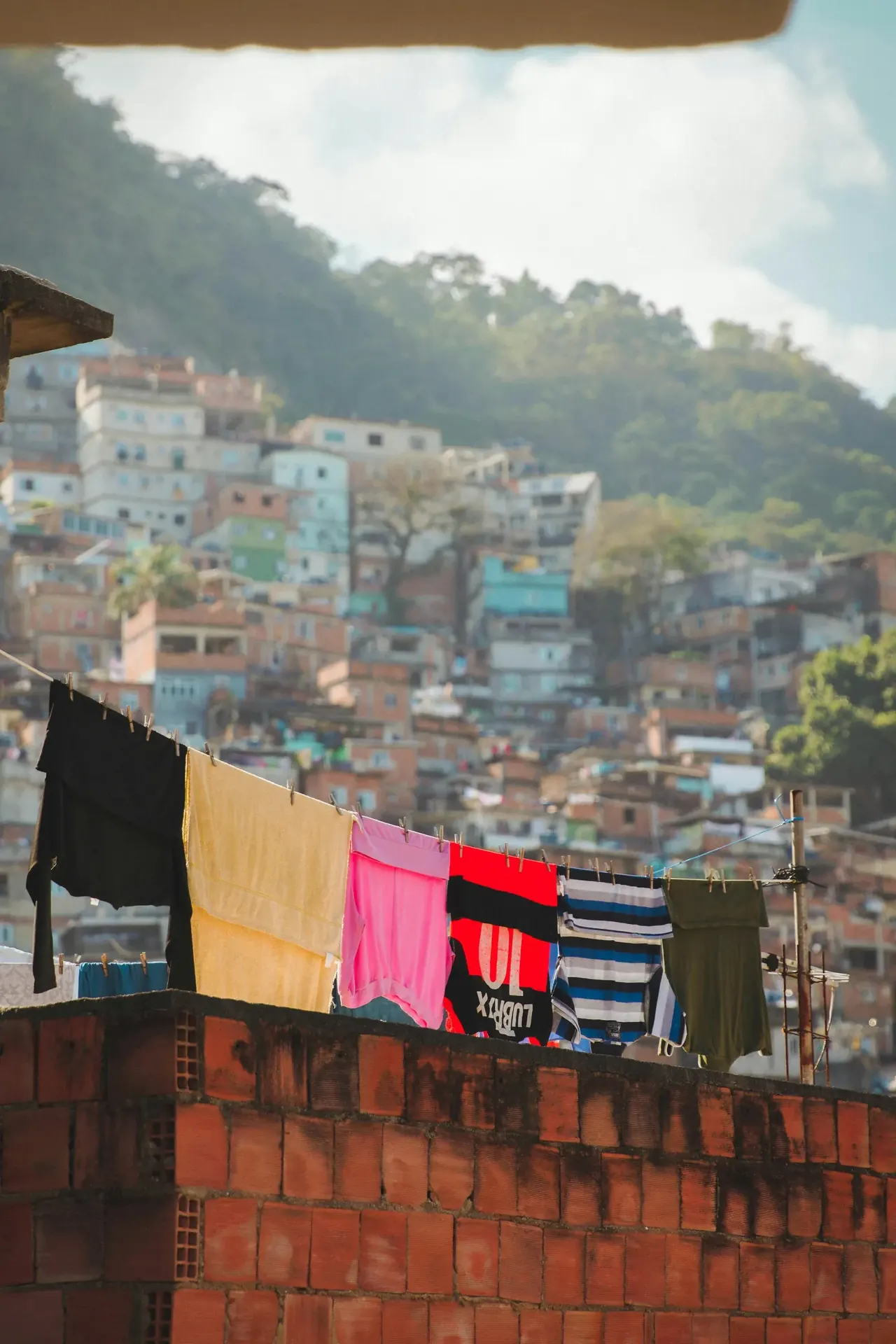
Ten at night, and a moto-taxi drops you at a blue door halfway up the hill. Below you, Leblon glitters like spilled sugar. Somewhere above, a bassline you can feel in your sternum. This is what staying in a favela in Rio de Janeiro actually feels like — not the version in the headlines, but the one with laundry on the line and the whole Atlantic laid out at your feet.
What people actually mean when they ask (should I stay in a favela?)
The question arrives in our inbox a few times a week, phrased a dozen ways. Is it safe. Is it real. Is it exploitative. Is it worth it. Underneath all of them is the same nervous hope: that the most interesting version of Rio might also be the one their mother told them to avoid. So let us answer the honest way, which is the only way that helps.
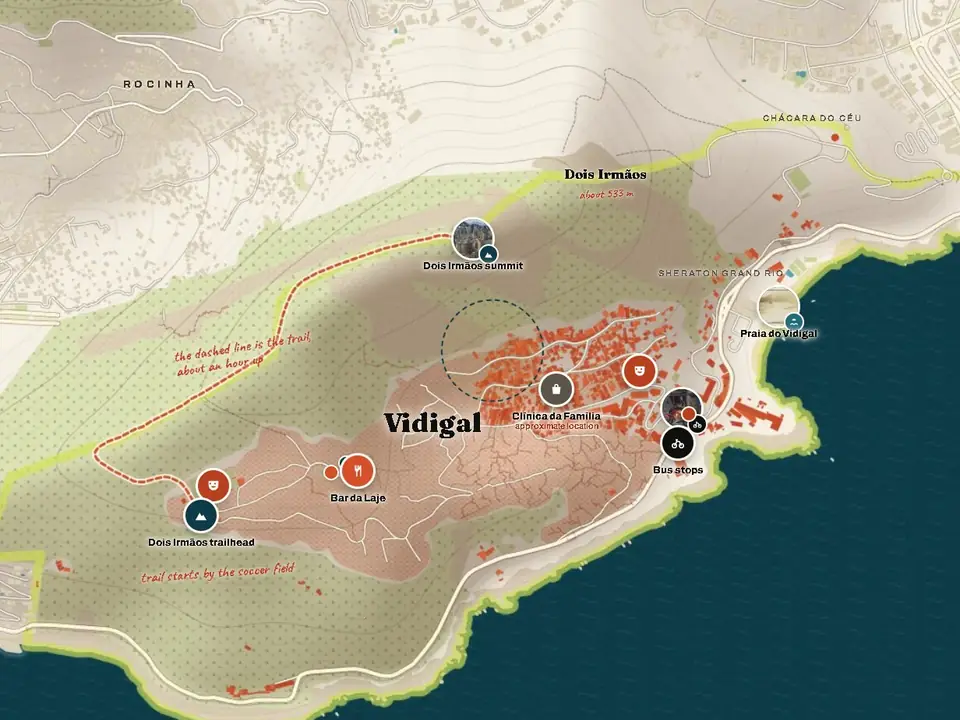
Start with the word. A favela is not a slum, not a shantytown, not a set from a film about drug wars. It is a neighborhood that built itself — house by house, brick by brick, up a hillside the formal city decided was too steep to bother with. Vidigal is one of the oldest, dating to the 1940s, clinging to the flank of Dois Irmãos, the twin peaks that close the western end of Ipanema and Leblon. Roughly ten thousand people live here, give or take, on some of the most expensive-to-look-at land in the country. What they cannot always afford is a fixed address the postman recognizes. What they wake up to is a view that the apartments directly below, in Leblon, would price at several million reais.
That contradiction is the whole story. You are staying somewhere the map calls informal and the eye calls extraordinary. And Vidigal, specifically, is the favela where a visitor can do this with the least friction. It is small. It is in the Zona Sul, the wealthy South Zone, wedged between Leblon and São Conrado. It has been a destination for backpackers, artists and curious travelers for well over a decade. You do not need a tour to walk in. You do not need permission. You need a little sense, a moto-taxi fare, and an honest picture of what you are signing up for. If the ethics of that give you pause, they should — we work through them properly in our piece on visiting Vidigal responsibly, and the short version is that where and how you spend matters more than whether you come at all.
What follows is not a brochure. It is the texture of the thing: the first night, the sounds, the daily rhythm, the tradeoffs nobody photographs, and a straight answer to whether staying in a favela in Rio is a good idea for someone like you.
Vidigal, in a few numbers
Figures sampled as of 2026. Reais, not dollars. Treat prices as honest ranges, not promises.
- Vidigal sits on the Dois Irmãos slope, in the Zona Sul, between Leblon and São Conrado.
- Cars stop at the base on Avenida Niemeyer. From there it is moto-taxi, van, or your own legs.
- Water arrives by rooftop tank, power by proper meter in the better buildings. Confirm both before you book.
- Weekends are loud. Sunday afternoons are near-silent. Both are the point.
The first night — arriving on the hill
Your Uber will not take you to the door. This is the first thing to understand, and it catches almost everyone. Ride apps and taxis stop at the base of the morro, on Avenida Niemeyer, at a small square that never fully sleeps. This is where the drivers politely decline the climb, because the lanes above are too narrow, too steep, and too much theirs. So you get out with your bag at the foot of a hillside stacked with lights, and for about four seconds you feel very far from the hotel you did not book.
Then a moto-taxi driver in a numbered vest catches your eye, quotes you R$10, straps your backpack to his tank, hands you a helmet that has seen things, and takes you up. The ride is ninety seconds of the best two-wheeled cinema in Rio: a near-vertical lane, walls close enough to touch, a turn, a dog, a child, a burst of open sky where the whole ocean appears at once, and then your door. You will overpay him a couple of reais out of sheer adrenaline and he will not correct you. We break down the moto-taxi, van and Uber math properly in the getting-around guide, but the first ride you take on faith.
Inside, the apartment is quiet and cool and the balcony is doing the thing you came for. But it is the outside that reorganizes you. The first night in Vidigal, lying in a bed you do not yet trust, you will hear the hill talk. A moto-taxi two-stroke whining up somewhere. A door. A television behind a thin wall, a football match, a goal, a small human roar. Further up, faint, the low pulse of a party that has not decided how serious it is yet. And under all of it, if your building faces the water, the sea doing what the sea does. You lie there and you catalogue every sound and you decide, somewhere around two in the morning, that you are either going to love this or count the nights until you leave.
Most people love it. Not despite the noise. Because of it. A hotel room is a sealed box that could be in any city on earth. A room on this hill is unmistakably, insistently here. You are not looking at Rio through glass. You are inside its evening, folded into ten thousand other evenings, and by the third night you stop hearing the noise as noise. You hear it as the place breathing.

By morning the hill has changed shifts entirely. Here is the shape of it, the frame you will slot every day into once you have been here a week.
- Where
- The Dois Irmãos slope, Zona Sul, between Leblon and São Conrado.
- Getting up
- Moto-taxi (about R$10), van (a couple of reais), or a genuine climb on foot.
- The view
- Ipanema, Leblon, the open Atlantic, Dois Irmãos rising at your back.
- Loudest
- Friday and Saturday nights, from the top of the hill down.
- Quietest
- Sunday, roughly two in the afternoon, when the whole morro naps.
The soundtrack of the hill — what you actually hear
If you take one thing from this, take the sound. More than the view, more than the moto-taxis, it is the audio of Vidigal that stays with people. A favela is a place where life happens outdoors and out loud, because homes are small and the street is the living room. You are moving into a soundscape, and it runs on a schedule you will learn without trying.
Dawn belongs to the roosters. Yes, there are roosters, more than seems reasonable for a hillside in the middle of a city of six million, and they do not care about your jet lag. Then the bus brakes and the first moto-taxis, the metal shutter of the padaria rolling up, the smell of fresh pão francês reaching the third floor before the coffee does. By eight the lanes are full of the ordinary traffic of a place going to work: school uniforms, delivery bikes, the vans grinding up and down for a couple of reais a seat, someone's radio, someone's baby.
Midday flattens out and gets hot and quiet. And then there is the gas man. Every few days a small truck edges up the lanes broadcasting a recorded jingle for cooking gas — o gás, sung in a loop so lodged in the carioca brain that Brazilians abroad get homesick hearing it. You will hate it on day one and hum it on the plane home. There are vendors on bicycles with bells, a man who sells brooms, a woman who calls out for scrap metal, the sound of a place that still does a lot of its commerce on foot and by voice.
Weeknights soften. Evangelical churches, of which Vidigal has many, hold their worship with the windows open, and gospel and keyboard drift out over the lanes. Somewhere a samba rehearsal, a pagode circle on a rooftop, a cavaquinho and a tambourine and a dozen people who all know the words. This is the Vidigal that surprises visitors most: not the party, but the church music on a Tuesday, the tenderness of it, the ordinariness.
Then the weekend. Friday and Saturday, from somewhere near the top, the baile funk starts, and it does not whisper. Funk carioca is Rio's homegrown sound, born in favelas in the 1980s, built on enormous bass and stacked speakers and lyrics that are not for the faint of heart. It carries down the hill on the night air and, depending on where your building sits, it is either a distant heartbeat or a neighbor. The famous rooftop bars — Alto Vidigal near the top, with its 180-degree parties, and the reggae and samba nights that put Vidigal on the traveler map — run late and run loud. If nightlife is the reason you are coming, stay close to it; if sleep is, book lower down and ask the host the honest question. We map the venues, the party nights and the etiquette in the nightlife guide.
One sound needs naming plainly, because it startles people and the internet exaggerates it. Occasionally you will hear fireworks, sometimes at odd hours. Often it is a birthday, a goal, a saint's day, a party announcing itself. In favelas fireworks can also be a signal. Residents do not flinch either way, and neither, in Vidigal, will you need to most of the time. But it is real, and pretending otherwise would be the kind of dishonesty this whole piece is trying to avoid.

You do not watch a favela from a window. You live inside its noise, and by the third night the noise has become the thing you know you will miss. — what nobody tells you before you book
The rhythm of a day — and the neighbors who set it
Here is the part the safety-anxious traveler never sees coming: the warmth. Vidigal is one of the friendliest places we have lived, anywhere, and the friendliness is not performed for guests. It is simply how a tight community that spends its life outdoors behaves. You will be greeted. You are expected to greet back. Bom dia until noon, boa tarde until dark, boa noite after, said to shopkeepers, to the moto-taxi drivers waiting at their point, to the old man on the plastic chair outside his door who has watched the hill change for fifty years and will watch you walk past every morning of your stay.
Your day organizes itself around a handful of fixed stars. The padaria at the base, open from six, where a coffee and a hot roll costs less than a subway ride and the counter staff learn your order by day three. The moto-taxi point, which is also the neighborhood's news desk and men's club and lost-and-found. The little grocery, the mercadinho, for cold beer and eggs and the specific Brazilian cleaning products that make every apartment smell the same in the best way. The pharmacy. The botequim with plastic tables where a small cold chopp and a plate of something fried is the entire evening's plan.
And above all, the laje. Every building in a favela has a rooftop slab, and the laje is where favela life goes vertical: laundry dries there, kids fly kites there, families barbecue there on Sundays, couples watch the sunset there free while tourists pay a cover charge two hundred meters away. If you rent well, your own terrace is your private laje, and it will quietly become the reason you overstay. Sunrise coffee over Ipanema. A caipirinha as the light goes gold on Leblon. The kind of morning, from our own building near the top, where you cannot make yourself go inside. This is the single strongest argument for a private apartment over a hostel bunk: the view stops being something you queue for and starts being something you own for a week.
You will also feel, more than in any hotel, that you are contributing something by being here rather than taking something. Your moto-taxi fare, your bread, your beer, your rent, the tip to the guy who carried your bag — it all stays on the hill. Vidigal has a real economy of guesthouses, bars, artists and small businesses built by residents, and a guest who spends locally is part of it, not a spectator of it. That is the responsible-tourism case in one sentence, and it is worth sitting with.
The tradeoffs, said out loud
None of these are dealbreakers. All of them are things a hotel would hide and we would rather you knew.
- It is a hill, and it is steep. Ask which floor, how many steps from where the moto-taxi stops, and whether there is a lift. "Ocean view" and "forty steps up an alley" often come together.
- Water and power have moods. Supply is by rooftop tank and can dip. Good buildings have backup tanks and proper meters. Confirm both, and confirm the wifi speed while you are at it.
- Weekends are loud. If you need silence, book lower on the hill and ask the host directly how close the nearest baile is.
- Cash still helps. Pix and cards are everywhere, but a moto-taxi at midnight and the smallest shops prefer a few reais in hand.
The tradeoffs, honestly (the part the reels skip)
Now the harder conversation, because a piece that only sells you the sunset is not worth your trust. Staying in a favela asks a few things of you that a beachfront hotel does not.
The physical reality first, because it is the one that actually affects most guests. Vidigal is vertical. The main road switchbacks up, but a great many homes and rentals are reached by becos — narrow stepped alleys that are charming in a photograph and a cardio session with luggage. If you have a bad knee, a stroller, a heavy suitcase, or a strong preference for lifts, this matters more than any headline about safety. The single most useful question you can ask a host is not "is it safe" but "how many steps from where the moto-taxi drops me to the front door, and is there an elevator." An eighth-floor apartment with a lift and a view is a different holiday from a fourth-floor walk-up reached by sixty stone steps, and both exist here.
Then the utilities. Water reaches the hill by pipe and is stored in rooftop tanks, and in a dry spell or after a mains problem the pressure can drop. Electricity, historically drawn through the informal hookups favelas call gatos, is now metered in the better buildings, which is why some residents have watched their bills leap. For you, as a guest, this all cashes out as one instruction: rent a building that has invested in backup water and legitimate power, and you will likely never notice a thing. Rent the cheapest room on the hill and you may spend an afternoon waiting for the shower to come back. Ask. A good host answers this without flinching.
And the safety question, which deserves a straight answer rather than either a scare or a sales pitch. Vidigal is, by the standards of Rio's favelas, calm, and has been for years. It received a police-pacification unit in 2011, tourism followed, and while that pacification program has faltered across most of the city since, Vidigal — small, visible, half-full of guesthouses and foreigners — stayed steadier than most. Drug trafficking exists here, as in most favelas. It is not oriented toward you, it does not want your attention, and in a week you may see no sign of it at all. Police operations do happen, rarely, and when they do the rule is simple and the neighbors will teach it without words: go inside, stay away from windows, do not film. The rest of the time the practical risks are the same petty-theft rules as anywhere in Rio. Do not flash a phone in a dark alley. Do not wander becos you do not know at three in the morning. Come home by moto-taxi late at night rather than on foot. We give this its own full, honest treatment in the Vidigal safety guide — read it before you decide, not after.

So — is staying in a favela worth it? (a straight answer)
For the right traveler, staying in a favela is the single best decision you can make in Rio, and it is not close. You trade a small amount of polish and a bit of climbing for a view that costs ten times as much one street down, a neighborhood that treats you like a person rather than a room number, prices that leave money for the rest of your trip, and a Rio you will actually remember. The couples who stay a week almost never wish they had booked the Copacabana high-rise instead. The value case against Ipanema and Leblon is real enough that we broke it down separately, and the short version is that you are paying South Zone location on informal-city terms.
But it is genuinely not for everyone, and pretending otherwise would push the wrong people up the hill. Here is the split, plainly.
Stay in Vidigal if
- The view and the atmosphere are the point of your trip.
- You can handle stairs and a moto-taxi, and pack light.
- You want to spend where your money stays local.
- A little noise is a fair price for being inside a real place.
- You will book a well-run building and ask the honest questions.
Skip it if
- You need step-free access, a lift, or minimal walking.
- Silence and a sealed, climate-controlled room are non-negotiable.
- You want a front desk, a concierge and a doorman at 3am.
- The word "favela" would keep you anxious the whole stay.
- You are the kind of traveler who cancels over a dropped wifi hour.
Notice that none of the reasons to skip it are really about danger. They are about comfort, access and temperament. That is the truth the fear obscures: the honest reasons not to stay in a favela are the same honest reasons you might not want a walk-up apartment in any hilly old town in the world. Steep, characterful, hands-on, alive. If that reads as a downside to you, believe yourself and book Leblon. If it reads as the entire appeal, you already know where you are staying.
The one-line verdict
After enough nights up here to lose count, this is where we land.
- Vidigal gives you the best view in Rio for the price of the climb.
- The community is the amenity. The sea is the bonus.
- Choose the building carefully and almost every tradeoff disappears.
- Nobody who belongs here has ever regretted the moto-taxi.
How to do it well — booking the right stay
If the answer is yes, then the difference between a great week and a mediocre one comes down almost entirely to what you book and where. A favela stay is not a lottery. It rewards the specific questions.
Get the location on the hill right. "Vidigal" spans everything from the busy base on Niemeyer to the near-silent top under Dois Irmãos, and where you sleep sets the whole tone. Higher means better views, cooler air, and the baile as a neighbor rather than a rumor. Lower means an easier climb and quicker access to the beach and the buses. Ask the host to place the building precisely, ask how far it is from where the moto-taxi stops, and ask what you will hear on a Saturday night. tip A host who answers these clearly and specifically is a host who will answer everything else that way too.
Confirm the boring things in writing. Wifi speed, in numbers, if you plan to work. Hot water and air conditioning, both, not one. Backup water and legitimate power. Whether there is a lift or how many steps replace it. Which floor. The exact handoff at arrival — most good hosts will meet you at the base or send a trusted moto-taxi, which turns the intimidating first ten minutes into a solved problem. None of this is unusual to ask, and the quality of the answers is itself the review.
Choose a private apartment over a bunk if you can. Vidigal has real hostels and guesthouses and they are sociable and cheap and fine. But the thing that makes staying here extraordinary — your own terrace, your own laje, the sunrise you do not share, the kitchen where you cook what you carried up from the Leblon market — is the province of a private place. For a couple, a family, a group of friends or a long stay, it is not close. It is also the format that lets you set your own volume: cook in on a quiet night, walk up to the party when you want it, come home when you are done.
Book direct where you can, and keep the money on the hill. Airbnb works, and the Praia do Vidigal listings rate well, but every booking platform takes its cut in fees. A place that lets you reserve directly with the host, or through the property's own page, usually costs less and puts more of your payment into the community that built the view you came for. That is the same principle as spending locally once you arrive, applied to the biggest line on your trip.
Do the paperwork before you fly, because it is duller than the hill and just as necessary. As of 2026, United States, Canadian and Australian citizens need a Brazil eVisa, reinstated in April 2025, applied for online, valid up to ten years and running to a little over eighty US dollars. Sort a way to pay locally — Pix if you can arrange it, cards otherwise, a little cash always. And know that the moto-taxi, the van, the metro at R$7.90 and the new Jaé transport card are all part of the same simple daily grammar you will have down by day two. The hill is easier to live than it is to worry about.
Quick questions.
Is staying in a favela in Rio actually safe?
Vidigal is calm by favela standards and has been for years, which is why it became a traveler destination in the first place. Use the same street sense you would anywhere in Rio: no flashy phones in dark alleys, moto-taxi home late at night, do not wander lanes you do not know after midnight. Read our full Vidigal safety guide before you decide.
What will I actually hear at night?
It depends where on the hill you sleep. Expect moto-taxis, a distant television or two, church music on weeknights, and baile funk from higher up on Fridays and Saturdays. Book lower down and ask the host about noise if you are a light sleeper. Occasional fireworks are normal and residents do not react to them.
Do I need a tour or a guide to stay in Vidigal?
No. Vidigal is a favela you can walk into freely, and staying overnight needs no guide at all. A community-led walking tour on your first day is a lovely way to get oriented and to spend money locally, but it is a choice, not a requirement. We cover the ethics of it in our responsible-visiting piece.
How do I get up to my apartment with luggage?
Cars stop at the base on Avenida Niemeyer. From there a moto-taxi will take you and your bag up for about R$10, or a van for a couple of reais. Pack light, and ask your host in advance to meet you at the base or arrange a trusted driver, which most good hosts do.
Is the internet good enough to work from Vidigal?
Often yes. Fiber has reached much of the hill and many rentals advertise fast connections, but quality varies building to building. If you are working, ask the host for the actual wifi speed in numbers and whether there is a backup, and confirm before you book a long stay.
Hostel, guesthouse or private apartment?
Hostels are cheap and sociable. Guesthouses are a comfortable middle. A private apartment gives you your own terrace, your own kitchen, the sunrise you do not share, and control over your own noise, which for couples, groups and longer stays is the reason most people remember the trip. It is the format Vidigal does best.
Is it disrespectful to stay in a favela as a tourist?
Staying, spending locally and treating the place as a neighborhood rather than a photo backdrop is welcomed. What grates is the drive-through gawk — the tour van, the camera in a stranger's doorway, the visitor who takes pictures but not a single caipirinha. Greet people, spend on the hill, ask before you photograph anyone, and you are a guest, not a spectator.
You came to Rio for a view. You will leave having heard a place — the roosters and the gas man and the church keyboard and the bass that carries down the hill after midnight, all of it stacked under a sky that turns the ocean gold at six. That is the difference between a hotel and a hill. One gives you a room. The other gives you a week you keep hearing long after the plane lands, which the Portuguese have a word for. Saudade, already, before you have even gone.