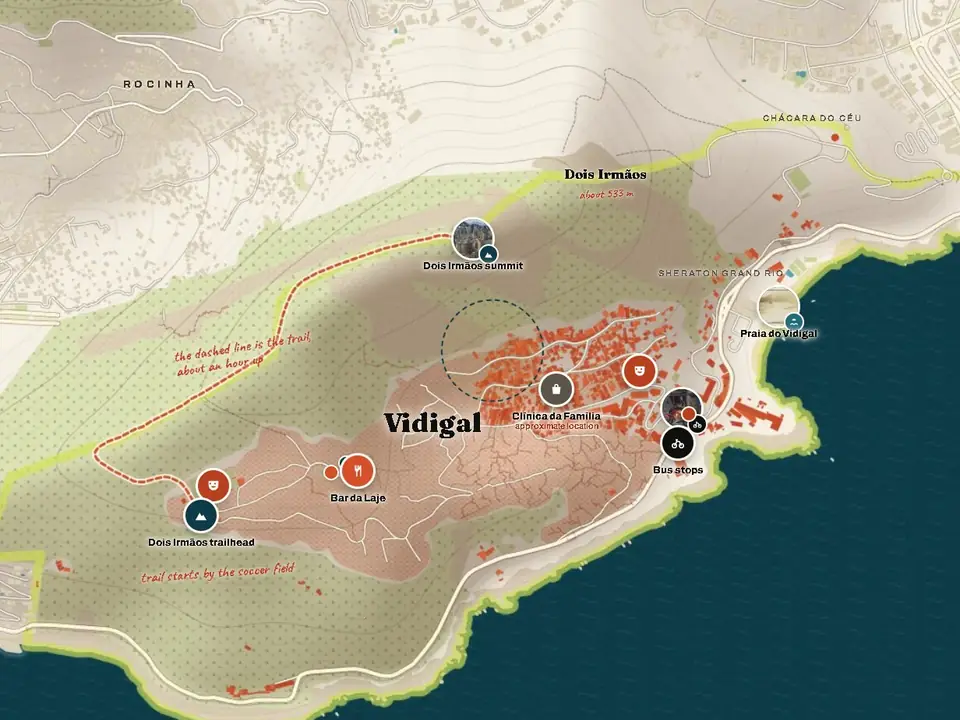

Sunday, a little after six. You are on a rooftop near the top of the morro and the bass has already started somewhere below you, felt in the floor before you hear it. The ocean goes copper, then rose, then dark. Ipanema switches on its lights in the distance. That is Vidigal nightlife in a single frame: the party is uphill, the view costs nothing, and the walk home is short.
How a night on the hill actually works (it has an altitude)
Most of Rio goes out and down. Down to the beach, down to Lapa's arches, down to a club at sea level with a line and a list. Vidigal goes up. The bars you have heard of, the loud ones, the ones with the panorama, sit at or near the top of the hill, strung along Rua Armando de Almeida Lima in the stretch residents call Comunidade da Paz. The higher you climb, the wider the view and the later the music runs. That is the first thing to understand about Vidigal nightlife. It is vertical. Where you sleep decides how far you have to travel to the party, and how far you have to travel home from it.
The scene sorts into three registers, and most nights you will touch two of them. There are the sunset bars, terraces built onto the roofs of houses where the point is the light on the water and a cold drink in your hand. There is baile funk, the sound of Rio's hillsides, bass-heavy and communal, which arrives late and runs until the sky turns grey. And there is live music in the older sense, a roda de samba on a Saturday, a pagode band on a Sunday, reggae on a warm weeknight. The good news is that the same three venues cycle through all of it depending on the day.
Then there is the clock, which you should reset on arrival. Rio runs late. Sunset drinks are a five-thirty to seven affair. Dinner is eight-thirty, nine. Bars do not fill until somewhere near eleven, and a proper baile funk does not find its feet until one in the morning, peaking between two and four. If you come from a city where the lights come up at one, recalibrate before you go out, not after. Nap in the afternoon. Eat something. The hill rewards patience.
The reason to care about all of this is the walk home. The single best argument for staying up here rather than down in Leblon is that when the night is done you do not queue for a taxi or negotiate a fare. You climb the last hundred meters to your own door with the whole bay behind you. Guests at our condo tend to figure this out on night two and never book a hotel again. One honest tradeoff comes with it: on a Friday or Saturday the bass carries, and a light sleeper near the top will hear it. Bring earplugs, or book a weekday, or lean in and go dancing. For the sober version of the after-dark question, our piece on whether it is safe to walk Vidigal at night covers the parts this guide skims.
What a night out runs, roughly
Sampled 2026. Reais, not dollars. Cover charges swing hard by night and act, so treat these as the middle of a range.
- Pix and cards work at the bigger venues. Carry R$ cash for moto-taxis and small counters.
- Live nights often add a couvert artístico, a music charge, on top of what you drink.
- The marquee parties sell tickets in advance on Sympla. Cheaper early, and some sell out.
- Nothing here needs a dress code. Sturdy shoes beat nice shoes on these lanes.
Sunset first — the golden-hour bars
Start with the light while you still have it, because the same terraces that hold a quiet sundowner at six become dance floors by midnight. There are three names worth knowing at the top of the hill, and they are not interchangeable. One is a party that happens to have a view. One is a view that happens to serve drinks. One sits between them. Pick by mood.
Alto Vidigal (Bar 180°)
This is the one the backpackers cross the city for, and the reason an Alto Vidigal party has a small international legend attached to it. The terrace hangs off the top of the hill with something close to a hundred and eighty degrees of open ocean in front of it, Ipanema and Leblon curving away to the left, the arc of Copacabana visible from the higher rail on a clear night. The feel is less polished lounge and more open-air commune with projections on the wall and an eclectic crowd from a dozen countries. The music wanders on purpose, Brazilian disco into house into samba into funk, and on the legendary Sunday sessions it does not stop until the sun comes back up over the water. Come for the sunset near six, stay for whichever direction the night takes. Bigger nights are ticketed in advance through Sympla, so check before you climb. R$$
Mirante do Arvrão
If Alto Vidigal is the party, Arvrão is the seat with the view. It is a hotel, bar and restaurant in one, right at the top in Comunidade da Paz, built by the artist and architect Hélio Pellegrino so that the whole place reads like a small museum, glass walls and reclaimed art and eight suites that each face the sea. The on-site bar pours through the afternoon and the weekends bring pagode and samba, a band and a crowd that leans a touch older and calmer than the one uphill at Alto Vidigal. This is where you take someone on a second date, or park yourself with a plate and a bottle and let the light do the work. Reach it by moto-taxi from the base, or on foot if your building is already near the top. We wrote it up in full in our Mirante do Arvrão guide, viewpoint and all. R$$
Bar da Laje
The famous laje, a rooftop slab turned into a bar, and the single most searched venue on the hill. The view earns it. The logistics need a heads-up.
- Hours
- Open from noon most days, closed Tuesdays. The weekend program tends to kick off around 4pm.
- Cover
- On live-music nights expect a couvert artístico. The common gripe in reviews is that the entry charge does not count toward what you drink, so budget it as a separate line.
- Best time
- Arrive by five for the sunset. The terrace faces the ocean and the light show is the whole point.
- Getting there
- Moto-taxi from the base of the hill, or a short walk from an upper building. Full directions in our dedicated Bar da Laje piece.
Our honest read: Bar da Laje is worth one sunset, and it is genuinely lovely at that hour. On a live night with a cover it becomes a night out rather than a drink. Nothing wrong with that, just know which one you are signing up for before you hand over the entry fee.
One rung down from the famous terraces are the botecos, the plain street-corner bars that are the actual engine of a normal night up here. No view to speak of, plastic tables set on the slope, a cooler of Antarctica and Brahma, a television showing whatever match is on, and prices a third of what the rooftops charge. This is where residents drink, where a chopp costs a few reais and a plate of bolinho feeds the whole table, and where a traveler who sits down and orders in even broken Portuguese tends to end the night with new company. Every good Vidigal night touches one of these at some point, usually the best point.

Baile funk, honestly — what it is and how to go
Baile funk is the sound Rio's hillsides made for themselves. It was born in the favelas in the eighties and nineties, built on a heavy Miami-bass kick, an MC over the top, and a room dancing close enough that there is no real gap between the crowd and the show. It is not a tourist product, though tourists are welcome at plenty of them. It is Saturday night for a large part of this city, and understanding it is most of the work of understanding Vidigal nightlife at all.
Here is the part the tour listings gloss over. The huge, roped-off, week-in-week-out bailes that people mean when they say they went to one in Rio are more often in Rocinha or at bailes like Santa Amaro than inside Vidigal itself. A baile funk Vidigal night is real, but it is smaller and more woven into the bars and the occasional street party than it is a standing weekly institution. That is not a downside. It means the funk you hear up here tends to be closer to a neighborhood party than a spectacle, and it means you should ask your host or the bar what is actually on this weekend rather than assuming a schedule. The calendar is a living thing.
Now the honest caveat, said plainly and then set down. Some bailes, especially the proibidão ones whose lyrics name the local trade, sit close to that world. That proximity is the real reason a first-timer does better arriving with someone who knows the room, not a horror story to scare you off. Vidigal is, by broad agreement, the favela an outsider can move through most freely of any in Rio. It is also a community that was pacified in 2011 and has seen the calm wobble since, with the occasional police operation and, some nights, the sound of it. Read the room you are in. If there is an operation on, the party waits and so do you.
Etiquette is short and it is mostly courtesy. Dance, because standing still is the only wrong move. Do not point a phone at strangers, and never film the crowd like it is scenery. Keep the good phone and the jewelry at home and bring a cheap one and small notes. Buy your drinks at the bar, tip the people working, and follow the mood of the locals rather than setting your own. You are a guest at someone's street party. Behave like one, and it opens up completely.
What the listings never capture is how physical it is. A good baile is not a concert you watch. It is a room moving as one body, the funkeiros down front trading steps, couples locked into the slow grind of a funk melody, the bass sitting in your chest until you stop registering it as sound and start feeling it as weather. The MC works the crowd in Carioca slang you will not follow and will not need to. Somewhere around three in the morning the whole thing tips into a particular kind of euphoria, strangers singing the choruses at each other, and you understand why this music outran every attempt to ban it. Give it until then before you decide whether it is for you.

The best part of a night in Vidigal is not a bar. It is the last hundred meters uphill, when the music is behind you and the whole bay is laid out below. — what we tell guests who ask where to go
Live music — samba, pagode and reggae on the roof
Funk gets the headlines, but the steadier pleasure of the hill is live music in the older key. This is where the terraces earn a second visit. Alto Vidigal built its reputation as much on reggae and samba nights as on its funk sets, and the crowd on a good samba evening is a different, gentler animal than the four-in-the-morning one. Arvrão leans into pagode on the weekends, a band on the deck and a roda that pulls people up out of their chairs by the second set. The tradition underneath all of it is the roda de samba, a circle of musicians around a table, cavaquinho and pandeiro and a surdo keeping time, everyone singing the choruses they have known since childhood. You do not need the words. You need to be in the room.
The practical note for Vidigal live music is the same as for the parties. The marquee nights sell tickets ahead on Sympla, the smaller ones you pay at the door, and the schedule lives on each venue's Instagram rather than any printed calendar. Check the day before, not the day of. Bands cancel, bands get added, a Tuesday goes quiet and a Wednesday catches fire because a name showed up. That unpredictability is a feature. It is also why a resident's tip beats any guide, including this one.
The reggae nights deserve their own mention, because they are the hill at its most easygoing. Vidigal has a long thread of Jamaican-tinged sound running through it, and on the right evening Alto Vidigal settles into something between a sound-system session and a sunset picnic, dub on the speakers, a low golden crowd of residents and travelers sharing the rail. It is the gentlest possible way in to going out up here. No cover worth mentioning, no dress code, no pressure to last until dawn. Just good bass, a cold drink, and the lights coming on across the water while someone toasts over a riddim.
So here is the fork most nights come down to, laid out honestly.
Come for the party
- Alto Vidigal on a Sunday, funk and house until sunrise.
- A street baile after one in the morning, if one is on.
- Loud, late, sweaty, and completely unforgettable.
- You will not see your bed before three. Plan accordingly.
Come for the view
- Arvrão pagode with a plate and a bottle of wine.
- Bar da Laje at five for the sunset, then dinner downhill.
- Seated, slower, a band rather than a DJ.
- Home and horizontal by midnight, and glad of it.
You can do both across a long weekend, and you probably should. The sunrise set means more after a quiet pagode the night before, and the quiet pagode reads as the small luxury it is after a night that ended at dawn. Contrast is the whole trick of eating and drinking well in this corner of Rio.
A few rules that keep the night easy
None of these are about danger. They are about not being the guest who makes it awkward.
- Bring small cash for moto-taxis and street counters. Not everything up here takes a card at two in the morning.
- Do not film people without asking. A rooftop and a sunset are fair game. A stranger's face is not.
- Leave the good phone at home. A cheap spare in your pocket is one less thing to think about.
- Buy a round, tip the band, greet the bar. Warmth is the local currency and it is cheap.
- Check Sympla and Instagram before you climb, so you are not paying a cover for a night that is not on.
- If there is a police operation, the party can wait until tomorrow. So can you.
Which night is which — a week on the hill
No two weeks are identical, and anyone who hands you a fixed timetable is selling something. Still, the hill has a rhythm, and knowing its rough shape helps you point yourself in the right direction on arrival.
Thursday is the soft open. A few bars stir, the terraces are calm and easy, and it is the connoisseur's night for a sunset drink without a crowd. Friday is when the week exhales. Botecos fill by ten, the sunset bars run late, and the first proper energy of the weekend arrives. Saturday is the big one. Everything is on, the live music is at its best, and if a street baile is happening this is the likeliest night for it, deep in the small hours. Sunday belongs to Alto Vidigal, whose afternoon-into-dawn sessions are the closest thing the hill has to an institution, plus a slow, sun-drunk pagode somewhere for those who want the day version. Monday through Wednesday the hill sleeps, more or less. A bar or two stays open, the padaria still pours coffee at dawn, and you get Vidigal at its quietest and most residential, which some travelers prefer and none regret.
If you have only one night and you want the full picture, make it a Saturday: sunset at Bar da Laje or Arvrão, dinner, then Alto Vidigal or wherever the music has moved. If you want the hill without the noise, come midweek and let the mountain keep its calm.

Down the hill — Leblon, the kiosks and the late option
Not every night has to be a climb. Four minutes downhill and you are in Leblon, which runs its own after-dark economy at sea level. The quiosques, the beach kiosks strung along the sand, pour cold chopp until late with your feet more or less in the ocean, and the bar strip locals call Baixo Leblon around Rua Dias Ferreira and General San Martin keeps going well past midnight. The contrast is the appeal. A draft beer at a plastic table on the beach is a different pleasure from a caipirinha on a laje with the city glittering below, and having both within a few minutes of your bed is the quiet luxury of a Vidigal base.
The usual move is dinner down, drinks up, or the reverse. Eat well in Leblon or on the hill, our Vidigal restaurant guide maps the whole thing, then decide whether the night wants a terrace or the sand. Getting back up is simple. Take an Uber or a 99 to Praça do Vidigal at the base, then a moto-taxi the rest of the way, or walk the main road if you have the legs and the hour is reasonable. Ride apps will bring you to the foot of the hill reliably. Whether they climb it depends on the driver and the night, so the base-of-the-hill handoff to a moto is the pattern to expect.
One more honest note on the downhill option. Leblon is polished and safe and slightly anonymous, the Rio you could find in any well-off beach neighborhood. The hill is the part you flew here for. Use the bottom for a good meal and a change of scene, then come back up for the thing you cannot get anywhere else, which is a view you do not have to share and a bed at the top of it.
~~~Getting home, and the morning after
The after-dark logistics up here are refreshingly low-tech. Moto-taxis run late from the base and from points near the top, and the going rate holds at around R$10 for the climb as of 2026. The main road is the lit spine that everyone uses, residents and revelers alike, and at a sensible hour on a busy night it is about as ordinary a walk as any in the South Zone. Deeper into the small hours the moto count thins, so if you are the type to leave a party at four, know roughly how you are getting up before you are standing at the bottom deciding.
For the rest of the city, the 2026 practicalities are worth a line. Rio's transit now runs on the Jaé card, standard on municipal buses, the BRT and the legalized vans, available free as a physical card or virtually through the app. The metro is separate and easier, it takes a contactless Visa or Mastercard straight at the turnstile, with a single ride around R$7.90. None of which you will use at three in the morning coming off a rooftop. That is a moto-taxi and the main road. But for the daytime trip to the beach or into town, it is the system to load before you need it.
The morning after is the reward Vidigal keeps to itself. You wake late, the hill is quiet, the padaria is pouring coffee, and the same terrace that shook until dawn is empty and gold and yours for the price of a juice. That rhythm, loud night and slow morning within a few steps of each other, is the argument for sleeping up here that no bar can make for itself.
Quick questions.
Is Vidigal nightlife safe for tourists?
Broadly, yes, and Vidigal is widely considered the favela an outsider can move through most freely in Rio. It was pacified in 2011 and remains the friendliest of the hills for visitors. That said, the calm is not guaranteed, police operations happen, and you should read the mood, keep valuables minimal, and stay in if there is any trouble. Our fuller take is in is it safe to walk Vidigal at night.
What is baile funk, and can I just show up?
Baile funk is Rio's homegrown bass music, communal and late, usually on weekend nights after one in the morning. You can attend, and plenty of travelers do, but a first-timer does better arriving with someone local who knows which night is on and how the room works. Ask your host or the bar staff rather than assuming a fixed weekly schedule.
What time does everything start?
Later than you think. Sunset drinks run five-thirty to seven, dinner is eight-thirty or nine, bars fill near eleven, and a proper baile peaks between two and four. Nap in the afternoon and pace yourself. Arriving at a bar at nine expecting a crowd will only get you a quiet room and a head start.
How much is a cover charge, and do I need tickets?
It varies by night and act. Marquee parties at places like Alto Vidigal and live nights at Bar da Laje often carry a cover or a couvert artístico, roughly R$30 to R$100 depending on who is playing, and the bigger ones sell tickets in advance on Sympla, sometimes cheaper early. Quiet weeknights are frequently free at the door. Check the venue's Instagram before you climb.
How do I get up to the bars at night?
Moto-taxi from Praça do Vidigal at the base, around R$10 to the top, or a walk up the main road if the hour is reasonable. Ride apps will bring you to the foot of the hill reliably, then you hand off to a moto for the climb. Leaving very late, arrange your ride down before the moto-taxis thin out.
Will I hear the music from where I am sleeping?
On a Friday or Saturday near the top, quite possibly. The bass carries on the hill and that is part of the deal. If you are a light sleeper, bring earplugs, ask for a room away from the terraces, or book a midweek stay when Vidigal is at its quietest. Or accept the trade and go dancing.
Can you see the famous views from the bars at night?
Yes, and the night version is arguably better. From the top terraces the panorama runs across the ocean and along Ipanema and Leblon, with the arc of Copacabana visible from the higher rails on a clear night. By dark it is a carpet of city lights above black water. It is the reason people who come for one drink stay for three.
The thing to carry home is that Vidigal nightlife is not really a list of venues. It is a direction, which is up, and a rhythm, which is loud and then slow. Follow the bass to the top of the hill, drink the sunset before it goes, dance if a baile is on and sit if it is not, and then take the short walk back to a bed with the whole bay under it. The rooftops will change names. The climb, and the view at the end of it, will not.