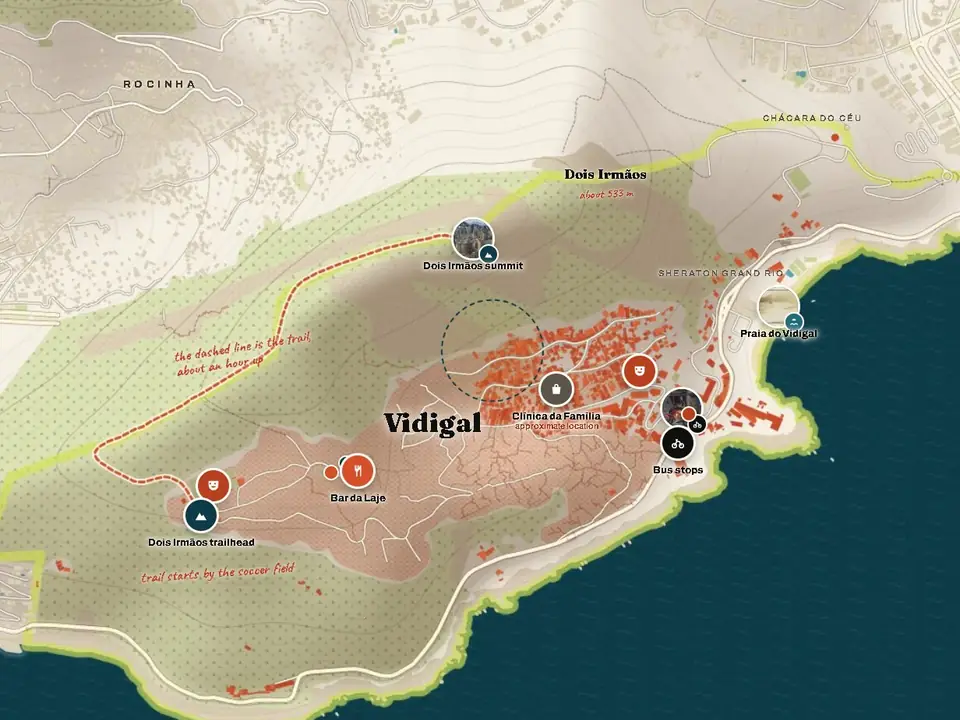

Rua Armando de Almeida Lima, the last stretch of asphalt before the sky opens. The moto-taxi cuts its engine, you hand over ten reais, and the whole coast is simply there — Ipanema, Leblon, the two blunt peaks of Dois Irmãos, the Atlantic going pink at the edges. That is Bar da Laje, Vidigal's rooftop over the sea, and getting to it is half the story worth telling.
The laje at the top of the hill
A laje is a flat concrete rooftop slab. In Rio's hillside neighborhoods it is where laundry dries, where kids fly kites, where a family adds another floor when the money comes in, and where, on a good evening, everyone drags plastic chairs up to watch the light go. Somebody in Vidigal looked at one of those slabs near the top of the morro, saw the view that came free with it, and built a bar. That is the short history of the place. The name is literal. The bar on the slab.
What sells it is geometry. Vidigal climbs the flank of Dois Irmãos, the twin peaks that close off the western end of Leblon, so the higher you go the more of the South Zone unfurls beneath you. From the terrace you look down the beaches of Leblon and Ipanema stitched end to end, out to Cagarras islands on the horizon, and back over Pedra da Gávea's great stone forehead. On a clear day you can trace the surf line all the way to Arpoador. There is no ticket booth at a viewpoint that does this, no queue, no glass. Just a low wall, a railing, and the drop.
People search for Bar da Laje Vidigal by name, and the question that follows is almost always the same: how do you actually get up there. It is a fair thing to wonder. Cars do not climb to the top of the hill. The address is real but the road narrows into lanes that a taxi will not attempt, and the last leg belongs to the motos and the vans. None of this is difficult once you know the moves, and the moves are the same ones residents make every day. Below is exactly how it works, what an evening costs in reais as of 2026, when the light is best, and the one line-item on the bill that catches nearly everyone by surprise.
Bar da Laje, roughly, in 2026
Prices sampled mid-2026, in reais. They drift. Treat them as the shape of a night, not a quote.
- Open roughly Tuesday to Sunday, around noon until 11pm. Monday usually closed. Hours shift — check their Instagram before you climb.
- Feijoada on Saturdays, about R$89 to share.
- No reservations for a normal evening. Special party nights are ticketed through Sympla.
- Cards and Pix work up top. Bring cash for the moto-taxi, which does not.
Getting there, step by step
Every route to Bar da Laje ends the same way — on the back of a motorbike or in a van, climbing the single road that spines up through Vidigal. The only question is how you reach the bottom of that road. The bottom is a place called Praça do Vidigal, the wide, loud entrance off Avenida Niemeyer where the hill meets the coast. Shoppers, delivery trucks, a bus or two, and a ragged line of maybe twenty motorbikes with their riders leaning on the seats. This is the handoff point. Cars stop here. The morro takes over from here.
From most of the South Zone the simplest approach is an Uber or a 99 to that praça. Type the destination as "Praça do Vidigal" or "entrada do Vidigal" rather than the bar itself, because the app will otherwise try to route a car up lanes it cannot use and leave you both confused. From Ipanema the ride is ten to fifteen minutes and lands somewhere around R$25 to R$40 depending on traffic and surge. From Copacabana add a little. The drive hugs the coast along Niemeyer, which is a small pleasure in itself.
At the praça you switch to the hill. Two options wait for you.
- Moto-taxi
- Around R$10 to the top, sometimes quoted at R$5 for a shorter hop. Fastest, most fun, a little exposed. Riders are professionals who do this run hundreds of times a day. Hold the grab-bar, lean with the bike, keep your bag in front.
- Kombi van
- The old Volkswagen vans, about R$4 to R$5. Cramped, frequent stops, slower. Cheaper and drier if it rains. They fill and go; you flag one and squeeze in.
- On foot
- Possible but long and steep. Most people ride up and walk down, or ride both ways. The climb is not the memory you came for.
Tell the moto rider "Bar da Laje" and he will know it before the second syllable. The ride up takes three or four minutes, past open doorways and sound systems and the smell of somebody's dinner, and then the buildings fall away and you are there. Pay in cash. Riders rarely carry change for a large note, so keep small bills. A ten and a couple of fives will cover a night's worth of moto legs for two people.
There is one shortcut worth naming. Bar da Laje has, at times, run its own shuttle from the Leblon beachfront up to the door, which spares you the praça scramble entirely. It is not always operating and the schedule changes, so treat it as a bonus rather than a plan — message the bar on Instagram the day you intend to go and ask if the van do bar is running. If it is, it is the smoothest way up there is. If it is not, the moto from the praça is your answer, and it is a good one. For the full logic of moto-taxis, vans and fares on the hill, our guide to getting around Vidigal lays out the whole system.
Coming back down after dark is the mirror image. Motos and vans run late, station themselves near the bar on busy nights, and cost the same in reverse. On a quiet weekday you may wait a few minutes; ask the staff to call a rider if none are idling. The return trip is where first-timers relax — you have done it once, the road is familiar, and the lights of the beaches are now spread below you the whole way down.

When to go: the sunset math
Timing is the difference between the evening you imagined and a dark climb to a crowded rail. The Bar da Laje sunset time is not a fixed thing — Rio sits far enough south that the light swings by more than an hour across the year, and Brazil no longer runs daylight saving, so what you see is the honest astronomical time.
Here is the range that matters. Right now, in July, deep in the Rio winter, the sun is gone by about 5:25 in the afternoon. The upside of winter is dry, clear air and the sharpest views of the year. The downside is that the good light comes early and the terrace turns cool once it goes. In high summer, December into January, sunset drifts back to roughly 6:45, the evenings are warm and long, and the trade is haze and the chance of an afternoon storm rolling in off the sea.
- Winter sunset (Jun–Aug)
- Around 5:15 to 5:30pm. Clear, cool, arrive by 4pm.
- Summer sunset (Dec–Feb)
- Around 6:40 to 6:50pm. Warm, hazier, arrive by 5:30pm.
- Shoulder months
- Somewhere between the two. When in doubt, aim to be seated 90 minutes before dark.
The reason to come early is not the sunset itself but the seat. The rail-side tables and the front edge of the laje fill first, and on a Friday or Saturday in season they are gone by late afternoon. Arrive with an hour of daylight to spare and you get the full arc: the beaches lit flat and bright, then the gold, then the moment the streetlights of Leblon come on in a single sweep while the sky behind Gávea is still burning. That sequence is the whole point. It cannot be reserved and it does not wait.
Days matter too. Weeknights are calmer, cheaper in spirit if not in price, and easier for a table. Weekends bring live music, a fuller crowd, and a longer wait for everything. Saturday is feijoada day, which turns the visit into a lunch as much as a sundowner. If your ideal is a quiet drink with the view mostly to yourselves, come Tuesday or Wednesday and arrive in the afternoon. If you want the place at full tilt, with a band and a packed rail, come Friday and accept the crowd as part of the deal.
One weather note. When the wind comes up off the Atlantic, and in winter it does, the exposed terrace gets genuinely cold for Rio. Bring a layer. Nobody pictures needing a jacket in the tropics, and everybody who has shivered through a windy dusk up here wishes they had one. ← a thin layer, always
You do not pay for the drinks up here. You pay for the sixty seconds when the streetlights of Leblon switch on all at once, and the drinks come along for the ride. — what we tell guests before they climb
The entry fee, and what it does not buy
Now the part that shows up in every honest review and surprises nearly every first-timer. There is a Bar da Laje entry fee. As of 2026 it runs about R$50 to R$60 a head on a normal evening, more on ticketed party nights. You pay it at the top of the road, before you have seen a menu or ordered a thing. And here is the wrinkle that irritates people: the entry does not count toward what you spend inside. It is not a consumação mínima, the common Rio arrangement where a cover becomes credit at the bar. It is simply a gate fee for the view, and then you pay full price for everything after it.
Read the reviews and the complaint is consistent. Visitors do not mind paying for the panorama, but they bristle that the fee buys nothing back, and that the drinks on top are dear by Rio standards. A R$44 caipirinha is roughly double what the same drink costs at a botequim down the hill. A 600ml beer is around R$22, a Corona nearer R$20, a shared feijoada about R$89. Two people having two drinks each, plus the two entries, is comfortably R$250 before any food. That is the real number. Go in expecting it and you will have a fine time. Go in expecting hill prices and the bill will sour the view.
Is it worth it. That depends entirely on what you are buying. If this is your one big sunset in Rio and you want the postcard from the most famous rooftop in Vidigal, the fee is the price of admission to a genuinely rare vantage, and you will not begrudge it once the light starts. If you are staying a week and looking for a nightly local, the math turns against you fast, and the neighborhood botecos a few streets down do the same beer for a third of the price without a gate. Both readings are correct. Know which trip you are on.
A practical note on paying. The entry and the bar both take cards and Pix, so you do not need a wad of cash for the venue itself. Keep the cash for the moto-taxi, which is cash-only, and for tips. The 10 percent taxa de serviço that Brazilian bars add to the check applies here as it does everywhere, and it is functionally expected rather than optional.
Five things first-timers wish they had known
None of these are dealbreakers. They are just the gaps between the photo and the reality.
- The entry fee is a gate, not a credit. Around R$50 to R$60, and it does not come off your bar tab. Budget it as a separate line.
- Bring cash for the wheels only. The moto and kombi are cash. The bar itself is card and Pix.
- Come early for the rail. The front-edge tables go first, well before sunset on weekends.
- Winter wind bites. The terrace is fully exposed. A light layer saves the evening.
- Check it is open. Hours drift and private events happen. A quick look at their Instagram before you climb spares a wasted trip.

What to order, and what it is like up there
The food is not why anyone climbs Vidigal, and the kitchen knows it, but it is better than a view-first bar has any need to be. The signature is the caipirinha — cachaça, lime, sugar, ice, and up here they make a properly balanced one rather than a sugar bomb. Order the classic lime first. If you want to branch out, the passion-fruit maracujá version is the safe upgrade. Beer comes cold and Brazilian, in the big shareable 600ml bottles that two people work through slowly while the light changes.
To eat, think sharing plates rather than dinner. Bar snacks in the Rio idiom — bolinho de bacalhau, fried and salty and made for beer; portions of steak with chips, rice, beans and farofa; the Saturday feijoada if you have come for lunch and plan to stay through the afternoon. It is honest botequim food charged at rooftop rates. Come hungry and it holds up. Come expecting a restaurant and you will feel the markup.
The room itself is open-air and unfussy. Plastic and wood, a long rail along the drop, a bar at the back, a stage or a corner for the band on music nights. It fills with a mix you rarely get in one place in Rio: residents of Vidigal out for a Saturday, cariocas up from the beach neighborhoods, backpackers who found it on a list, couples on a date, a bachelor group being loud in one corner and a pair of grandparents quietly delighted in another. On weekends a band plays samba or pagode and the whole slab leans into it. On a weekday afternoon it can be nearly still, just the wind and the view and a handful of people not talking much.
That range is the thing to understand before you go. Bar da Laje is not one experience. A Tuesday at four in the afternoon and a Saturday at ten at night are different bars sharing a floor. Decide which one you want and time your climb to match it. If you are chasing the postcard and a quiet drink, the afternoon is yours. If you want the party, come after dark on a weekend and let the music carry the night. Neither is wrong. They are simply not the same, and the entry fee buys you into whichever one is happening when you arrive.
The bar, or your own laje?
Here is the quiet truth that a lot of Vidigal regulars will tell you, and that the bar itself would rather you did not dwell on. The view from Bar da Laje is the view from most of upper Vidigal. It is not a secret vantage the bar owns. It is the vantage the whole top of the hill shares, and every building up here has some version of it. Which is why the calculus of where to watch the sunset comes down to what you value more: the buzz of a crowd and a band, or the peace of a rail that belongs, for the evening, only to you.
Bar da Laje
- The famous rooftop, the band, the crowd, the energy of a full slab at sunset.
- Someone else makes the caipirinha and clears the plates.
- Entry fee, rooftop drink prices, a wait for the rail on weekends.
- You climb up, and you climb down, on the hill's schedule.
- Best for one big night, a group, or a party you want to be inside of.
Your own terrace
- The same coastline, from a private laje or balcony, with no gate.
- Your own music, your own hour, your own count of who is there.
- A supermarket caipirinha costs what a supermarket costs.
- Sunset in a robe on night one, and again on night three.
- Best for couples, longer stays, and anyone who values the quiet.
This is not an argument against the bar. Go to Bar da Laje. It earns its reputation, and there is a specific joy in a rooftop full of people all turning to the same horizon at the same moment. But if the view is the whole reason you are drawn to Vidigal, it is worth knowing that you can also just book a place with the view built in and drink it slowly, every evening, for less than one night out costs. That is the case we make for the condo — a private terrace with the Dois Irmãos-and-ocean panorama, where the sunset is a nightly habit rather than a ticketed event. We go deeper into the best vantages, bar and private both, in our guide to the best views in Vidigal. And if you want a viewpoint that splits the difference — accessible, social, but a shade quieter than Bar da Laje — the Mirante do Arvrão up the hill is the other name to know.
~~~
After dark: music, funk, and getting home
The sunset crowd is only half of what Bar da Laje is. Stay past dark on a weekend and the bar becomes a music venue — live samba and pagode most weekends, and on special nights a ticketed event with a lineup you buy into through Sympla rather than at the door. Those nights run later, cost more at entry, and pack the slab. If you want one, look up "Bar da Laje" on Sympla a week ahead and see what is scheduled. The regular evenings need no ticket and no plan beyond showing up.
Vidigal's wider nightlife does not begin and end at this one rooftop. The hill has a real after-dark life, from the reggae and funk nights at the older hostel bars to the pagode at the Arvrão, and the great advantage of staying up here is that you can walk home from most of it. We map the whole scene in our Vidigal nightlife guide, but the short version is that a night out that starts at Bar da Laje rarely wants to end there, and the rest of the hill is a few streets away.
On getting home, and on safety, the honest version. Vidigal has a long, established tourism life, moto-taxis and vans run late into the night, and the ride down after a few drinks is routine — safer, frankly, than trying to walk unfamiliar lanes in the dark. On the main road up to the bar and back you are among a constant stream of people. The rule that matters is a simple one: stick to that main spine, take a moto or van rather than wandering into side alleys you do not know, and do not follow a phone's GPS into a lane just because the little blue dot says so.
The larger caveat, told plainly. Vidigal is not a theme park, and the calm is not guaranteed on every date. As of 2026 the hill sits outside the old pacification arrangement, and police operations do happen — one in April drew headlines when a dawn operation caught hikers on the Dois Irmãos trail. These events are occasional, usually early, and locals read the mood long before a visitor would. The practical takeaway is not fear, it is deference: if a resident, your host, or a moto rider says today is not the day to go up, believe them and change the plan. On an ordinary evening, which is the vast majority of them, none of this touches a sunset drink on a rooftop. For the fuller picture, our piece on whether it is safe to walk Vidigal at night is the one to read before you go.
Quick questions.
How do you get to Bar da Laje in Vidigal?
Take an Uber or 99 to Praça do Vidigal, the entrance off Avenida Niemeyer where cars stop. From there, ride a moto-taxi up the hill for about R$10, or a kombi van for R$4 to R$5. Cars cannot reach the top, so the last leg is always by bike or van. Tell the rider "Bar da Laje" and pay in cash.
Is there an entry fee, and does it count toward drinks?
Yes. The Bar da Laje entry fee is about R$50 to R$60 a head in 2026, higher on ticketed party nights. It is a gate fee for the view and does not come off your bar bill — a point many reviewers flag. Budget it as a separate cost on top of drinks and food.
Do you need a reservation for Bar da Laje?
Not for a normal evening — it is walk-in, first-come for tables. Arrive early on weekends because the rail-side seats fill before sunset. Special music nights are ticketed in advance through Sympla, so check there if you are aiming for a particular event.
What time is sunset, and when should I arrive?
In Rio's winter, around June to August, the sun sets near 5:20pm. In summer, December to February, it is closer to 6:45pm. Aim to be seated at least 60 to 90 minutes before, both to catch the full light and to claim a spot at the rail.
How much does a night at Bar da Laje cost?
Reckon on the entry (about R$50 to R$60 each), a caipirinha at around R$44, beer near R$22, plus a 10 percent service charge. Two people with a couple of drinks each land around R$250 before food. Add the moto-taxi both ways, roughly R$20 to R$40 total.
Is Bar da Laje safe to visit?
On an ordinary evening, yes. Vidigal has an established tourism scene and the main road to the bar stays busy. Take a moto or van rather than walking unknown lanes, keep to the main spine, and heed local advice — police operations occasionally close the hill, and residents know first. If someone says not today, change the plan.
Is it worth it, or just touristy?
Both can be true. The view is genuinely among Rio's best and the fee buys a rare vantage. But the same coastline is visible from most of upper Vidigal, so if you are staying a while, a private terrace gives you the identical sunset without the gate or the markup. For one big night, the bar is worth it. For every night, book the view.
Go once, for the band and the crowd and the ritual of a rooftop full of strangers all facing the same horizon. Then, if Vidigal keeps you longer than a night, find the version of that view you do not have to climb to or pay into — the one waiting on a terrace with your name on the door. The light is the same. Only the company, and the price, change.