
Wake on a high floor in Vidigal and the day arrives in layers. First the ocean, flat and pewter. Then Dois Irmãos, catching light on its western face. Then the long white curve of Leblon and Ipanema, sharpening as the sun climbs. The Vidigal best views are not a lookout you queue for or a ticket you buy. They are the wall you left open when you fell asleep.
The view is the reason people come (everything else is a footnote)
People give a lot of reasons for booking Vidigal, and most of them are the same reason wearing different clothes. They call it the price. They call it the walk to Leblon, four minutes downhill. They call it staying somewhere real. Underneath all of it sits one fact you can read from the back of a moto-táxi on the way up: Vidigal is built on the ocean flank of the Dois Irmãos massif, hung on the hillside between Leblon at one end and São Conrado at the other, and nearly every lane that climbs it points at the Atlantic. That geography is the entire product. The higher you sleep, the more sea you own.
This is worth saying plainly, because it changes how you book. In Copacabana and Ipanema you pay a premium for the front row, the pé-na-areia address, and then you spend the week looking along the beach through a gap between two towers. In Vidigal the arithmetic flips. The hillside is the grandstand and the beach is the stage, a kilometre off and far below. You are not fighting for a sliver. You are handed the whole coast at once, framed by a green mountain on the left and a great grey headland on the right. Calling this the best view in any Rio favela is close to a tautology. Vidigal simply owns the category, and has for as long as anyone has been climbing up here with a camera.
So this guide does two things. First it maps the public viewpoints — the bars, the pousada lookouts, the eco-park, the trail to the summit — and tells you honestly what each one costs in reais, in effort, and in moto-táxi rides, and exactly what it overlooks. Then it makes the quieter case, the one the listings are too polite to argue outright: that the finest seat on the hill is not a bar table you share with forty strangers and a hedge of tripods. It is a terrace with your name on it for the week. We will get there. Start with the map.
The view, in numbers
Sampled 2026. Reais, not dollars. Distances are vertical when it comes to the hill.
- Sunset lands between about 5:15pm in June and 6:45pm in January. Brazil dropped daylight saving years ago, so the clock is honest.
- Everything worth seeing sits near the top of the hill. So does the steepest access. That trade runs through this whole piece.
- A moto-táxi from the base to the summit bars is one song long and about R$10. Bring small notes.
- The Portuguese for viewpoint is mirante. You will see the word on half the signs up here.
What you are actually looking at — the view, read left to right
Stand on an ocean-facing terrace near the top of Vidigal and the panorama sorts itself into a sentence you can read left to right. To your left, close enough to feel its weight, Dois Irmãos rises green and steep — the Two Brothers, the twin peaks the whole neighbourhood is named around. Below and beyond it the coast opens into the long arc of Leblon, then Ipanema, two beaches reading as one unbroken ribbon from up here. Offshore, low and dark on the water, sit the Ilhas Cagarras, the little archipelago that most visitors never learn the name of. Straight ahead is the open Atlantic, doing whatever the weather tells it to. To your right the shoreline bends away toward São Conrado, and over that far beach stand two of Rio's great rocks: Pedra da Gávea, the vast flat-topped monolith, and Pedra Bonita beside it, the ramp where the hang-gliders step off into nothing.
Now the honest part, because the brief on every Rio balcony is the same question. Can you see Christ the Redeemer. From most ocean-facing terraces in Vidigal, no. Corcovado sits inland to the north, and the shoulder of Dois Irmãos stands squarely between you and the statue. You catch Cristo as a small pale figure from the highest bars, from the roadside Mirante do Leblon lookout down on Avenida Niemeyer, and unmistakably from the Dois Irmãos summit — but do not book a Vidigal ocean view apartment expecting the statue framed in your window like a postcard. Book it for the water and for the Two Brothers, which are the real headline. If Christ appears, and from a high enough laje he sometimes does, over your left shoulder at dusk, treat him as a bonus rather than the billing.
Sugarloaf, Pão de Açúcar, keeps to itself from most of the hill and then reveals itself from the summit and the higher edges, a grey thumb at the mouth of the bay. And then there is the version of the view nobody photographs enough: night. The whole coast turns to a strand of gold, Leblon and Ipanema burning steady while the Lagoa glows behind them, planes bank low over the sea on their way into Galeão, and a few fishing boats sit lit and patient offshore. The daytime view sells the booking. The night view is the one you end up standing in, barefoot, at one in the morning, not quite ready to go to bed.

The public viewpoints — ranked by how much effort they ask
Vidigal has more good vantage points than any other corner of Rio its size, and they range from a two-minute moto-táxi to a genuine hike. Here is the shortlist, easiest first, with what each one overlooks and what it will cost you to stand there. Do more than one. They are not interchangeable.
Mirante do Arvrão no hike
- Where
- Near the top of the hill on Rua Armando de Almeida Lima. It is a pousada, a bar, and a restaurant, all built around the lookout.
- Overlooks
- The whole South Zone coast — Leblon, Ipanema, the ocean, Dois Irmãos close on one side.
- Getting there
- Uber or 99 to the base (use "Hotel Shalimar" as the pin), then a moto-táxi or kombi van up. Roughly R$10 on the bike.
- Best for
- A view with zero climbing, a plate of food, and pagode on the right night.
The Mirante do Arvrão view is the one to reach for if you want Vidigal's altitude without Vidigal's staircases. You ride to the door. You sit down. The coast is simply there, laid out past the railing while a kitchen brings you a caipirinha and, most weekends, a live pagode roda works up in the corner. It has been a fixture up here for years and runs a proper réveillon party on New Year's Eve. If you want the full breakdown of access, event nights, and how it differs from the rooftop bars, we keep a separate piece on the Mirante do Arvrão viewpoint.
Bar da Laje R$50–60 door
- Where
- Near the top, beside the Sitiê eco-park and under the flank of Dois Irmãos, facing straight out to sea.
- Overlooks
- A near-360 sweep — Ipanema, Leblon, Dois Irmãos, the Atlantic, Pedra da Gávea on clear days.
- The catch
- An entry fee that sits around R$50 to R$60 per person as of 2026, charged at the door and separate from what you eat and drink.
- Best time
- Arrive by 5pm to claim a rail seat for sunset. It fills.
Bar da Laje is the name most visitors already know, and the view earns it. The laje — the flat concrete roof-slab that is the terrace of every Brazilian home — here becomes a viewing platform hung over the whole coastline. The honest note is the door fee, which shows up in reviews as often as the sunset does, and which some people resent on principle. Our take: pay it once, come for the sunset drink, and know that you are renting a seat at a rail everyone else is also renting. For the moto-táxi routes, the van option, and the timing, our Bar da Laje access guide has the detail. ← go for one drink, not the whole night
Alto Vidigal / Bar 180° party
Higher again, and a different animal. Alto Vidigal is a hostel with a bar attached, and the bar — Bar 180° — is named for exactly what it delivers: a hundred-and-eighty-degree ocean panorama that runs from Dois Irmãos across Leblon and Ipanema to the open water. By day it is two quiet levels serving feijoada and cold chopp to whoever climbed up. As the sun drops it turns into a dancefloor, reggae most nights, funk on others, an international DJ now and then. The Alto Vidigal view is the one the photographers chase at golden hour and the one the dancers keep till dawn, and it is genuinely worth setting an alarm for the sunrise here at least once, when the sea to the east goes from ink to rose and you have the rail to yourself. Party schedules shift, so check ahead before you count on a specific night. A moto-táxi to the door is about R$10.
Parque Sitiê community
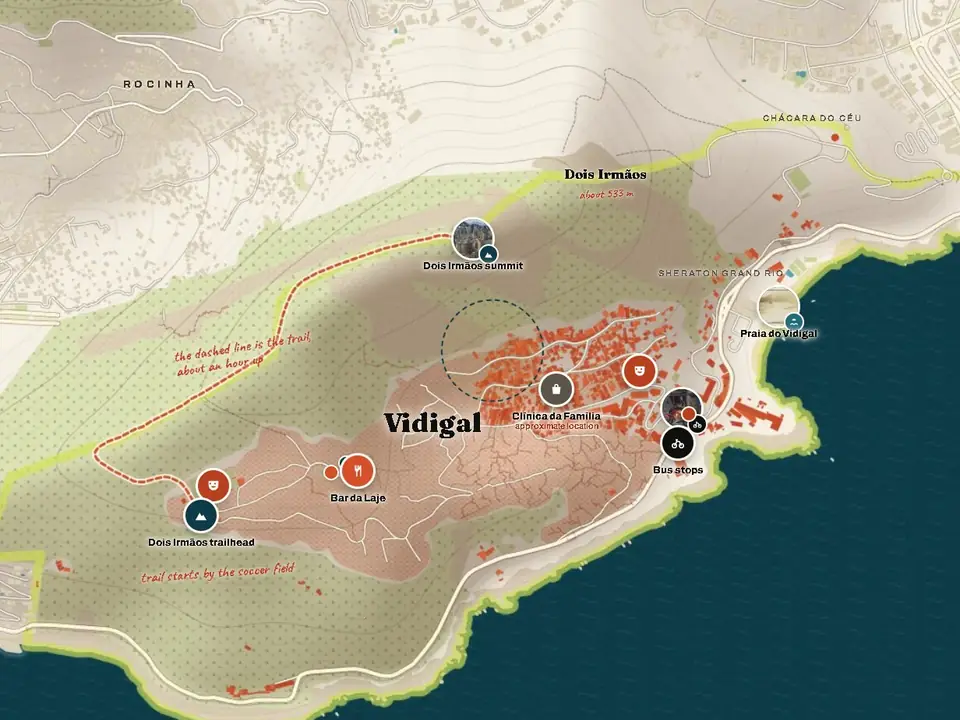
The one nobody puts on a tour flyer, and the one we send people to first. Parque Sitiê is an ecological park near the top of the hill, roughly 8,500 square metres of terraced garden that a group of residents clawed back from an informal rubbish dump between 2003 and 2015. It is now an official city park, still tended largely by a local named Paulinho and a handful of volunteers, still running on a thin trickle of tourism money and donations. You come for the calm as much as the view: native planting, hand-built paths, birds, and a lookout over the roofs of Vidigal to the sea beyond. Give what you can at the entrance. It is the most quietly moving vantage point on the hill, and the trailhead for the summit is right above it.
Morro Dois Irmãos summit the earned one
- Height
- 533 metres at the top of the taller brother.
- The walk
- About 40 minutes up through Atlantic forest from the top of Vidigal, moderately steep, well-trodden.
- You see
- Everything. Ipanema, Leblon, the Lagoa, Sugarloaf, Christ the Redeemer, São Conrado, Rocinha, the Cagarras islands.
- Best at
- Sunrise, before the haze and the crowd.
This is the reward view, the one that makes the whole hill make sense. The trail itself is free; you reach the trailhead at the top of Vidigal by moto-táxi or on foot past the Sitiê park, and from there it is a forty-minute climb through the trees to a bald summit that hands you the most complete panorama of Rio's South Zone you can get without a helicopter. From 533 metres the coast reads as a single unbroken map. Go early, both for the light and because the flat summit gets busy by mid-morning. We keep a full account of the route, the safety notes, and the guide question on the Dois Irmãos trail page.
Mirante do Leblon drive-by
Last, the one you can catch without entering Vidigal at all. The Mirante do Leblon is a roadside lookout on Avenida Niemeyer, the coast road that curls up out of Leblon toward the hill. Pull in and you get Cristo up to the left, the Lagoa and Ipanema and the whole grey-blue reach of the ocean to the right. No climb, no fee, thirty seconds off the road. It is the appetiser. Everything above it on this list is the meal.

A bar view is a view you visit. A terrace view is a view you live inside. The first is a photograph. The second is a week. — a thing we say to every guest on night one
The case for your own rail — why the terrace beats the bar
Do the public viewpoints. All of them, if you have the days for it. But there is a cost to each visit that the photos never show, and it is worth naming before you build a trip around bar tables. Every rooftop up here asks for something at the door: the R$50-plus entry at Bar da Laje, the moto-táxi there and the second one back down in the dark, the elbow you throw for a rail seat, the sunset you booked at the same hour as everyone else on the hill, the last-call scramble for a ride home. None of that is a complaint. It is simply the transaction, and the transaction resets every single evening.
A private terrace deletes the transaction. You get the same water and the same Two Brothers — often a cleaner sightline than the crowded bars, because you are not shooting over a hundred heads — and you get it at six in the morning with a coffee and again at six in the evening with a caipirinha, with nobody else's tripod in the frame and no clock running. That is the whole argument. Not that the bars are bad. They are wonderful, and you should give them a night each. It is that the best seat in Vidigal is one you do not have to share, and one that is still there, unbooked and free, at two in the morning when the funk drifts down from the top of the hill and you decide to stay up for it.
Our own place makes the point better than we can. It sits high enough on the hill that the ocean and Dois Irmãos fill the terrace rail, low enough that a moto-táxi reaches the door, and it is pointed the right way — southwest, at the water, not at the neighbour's wall. You can read the whole coast from the condo without putting shoes on. That is the version of the Vidigal ocean view apartment this entire neighbourhood is quietly selling, and it is the version worth holding out for. The honest tradeoff is money and mood: a terrace costs more per night than a hostel bunk, and it trades the shoulder-to-shoulder energy of Alto Vidigal for something closer to silence. If it is the party you are chasing, sleep near the party. If it is the view, sleep inside it.
The bar view
- A door fee every visit, R$50–60 at the headline spots.
- Two moto-táxi rides, up and back, each night.
- Shared rail, shared sunset, shared tripods.
- Kitchen, drinks, music, a crowd, an occasion.
- The photograph you post that night.
The terrace view
- Paid once, in the nightly rate, then free every hour after.
- No ride home. You are already home.
- Sunrise coffee and midnight nightcap on the same rail.
- Quiet, privacy, your own soundtrack, your own hours.
- The memory that turns into saudade on the flight back.
Bars for a night, a terrace for the week
How we actually tell guests to split it, if the view is why they came.
- One night at Bar da Laje for the sunset drink, door fee paid, no regrets.
- One night at Alto Vidigal or Mirante do Arvrão for the music and the altitude.
- One dawn on the Dois Irmãos summit, alarm set, legs earning it.
- Every other hour of the trip on your own rail, coffee or caipirinha in hand, watching the same coast change light for free.

The hours that matter — reading the light through the day
A view is not one thing. It is the same geography under six different lights, and part of learning a place is learning which hour belongs to which mood. Here is how the day moves across Vidigal's coast, so you can plan around the good light instead of stumbling into it.
Sunrise comes up to your left, over the sea beyond Ipanema, and it is the quiet secret of the hill. The bars are shut, the moto-táxis are just starting, and the light hits the far rocks first and then rolls in across the water toward you. If you only see one dawn from up here, make it this one, from your own terrace or from Alto Vidigal's empty rail. Mid-morning is clean and blue and made for the beach, so this is when you go down, not when you sit and stare.
Midday is the weak hour. The sun stands straight overhead, the ocean goes flat and white, the far mountains vanish into haze, and photographs come out washed. Do not judge the view at noon. Go swim, eat, sleep. Golden hour, the sixty minutes before the sun goes down, is the payoff — the light turns long and amber, the whole hillside glows the colour in the picture above, and the windows of Leblon flare one by one as the angle drops. This is the hour to be standing still with a drink, not fighting a moto-táxi for a bar seat you should have claimed an hour earlier.
Sunset itself is worth an expectation adjustment. You are not watching the sun sink into open ocean the way you would on a west-facing beach. It goes down to your right, behind the São Conrado headland and the great shoulder of Pedra da Gávea, and that is its own kind of good — the rock goes black against a burning sky while the sea in front of you turns from gold to lead. Then blue hour, the ten minutes after, the quiet favourite: sky and sea settle into the same deep blue while the first lights of the coast prick on. Stay for it. Almost everybody leaves too early.
~~~How to book a view that is actually a view
Here is where good intentions go wrong. "Ocean view" is the most abused phrase in Rio's listings, and Vidigal, being dense and vertical and stacked, is where it gets abused most creatively. A window that catches a triangle of sea between two neighbours is technically an ocean view. So is a shared rooftop three floors above your room that you are allowed to visit. Neither is what you are picturing. Before you pay, confirm a short list of things, in writing, with a host who answers quickly.
Ask which floor, and what sits above the terrace line. The view is a pure function of altitude and what blocks it. In a place built as steeply as Vidigal, a room ten metres lower or one lane further back can be the difference between the whole coast and somebody's laundry. Ask for the orientation. You want frente mar, front-to-the-sea, which here means facing roughly southwest. Ask for a photo taken from the actual terrace at standing height, phone held at eye level, not a drone shot lifted off the roof and not a wide-angle that bends a slot of blue into a panorama. If a host will not send that one honest photo, you have your answer.
Confirm terrace versus window. A view through glass is pleasant. A varanda or laje you can stand on, coffee in hand, wind in your face, is the thing this whole neighbourhood exists to sell. And decide your tolerance for access, because the best views are near the top and the top is the steepest part of the hill. A high terrace usually means either a stack of stairs or a moto-táxi to the door, and often both. A well-chosen Vidigal ocean view apartment resolves that tension by sitting high enough to clear the neighbours yet close enough to a bike stand that you are not carrying groceries up two hundred steps. For the moto-táxi and van logistics that make a high stay livable, our getting around Vidigal guide does the math. Get these five answers and the phrase "best view" stops being marketing and starts being a thing you can hold the host to.
Four things that quietly kill a view
None of them show up in a listing headline. All of them show up when you arrive.
- The ground-floor "ocean view." Near the base of the hill you see a wall, not the water. Altitude is the whole game.
- The building across the lane. Vidigal is dense. One structure in front can eat half your horizon. Ask what is directly opposite.
- The window that is not a terrace. A view you can only see is worth a fraction of a view you can stand in.
- The drone photo. A shot lifted off the roof shows the roof's view, not your room's. Insist on eye-level from the actual terrace.
Quick questions.
What is the best free view in Vidigal?
Parque Sitiê near the top, which runs on donations rather than a fixed fee, and the Dois Irmãos summit, where the trail itself is free even if a guide is optional. The walk up the main road at golden hour is free too, and better than most paid lookouts in the rest of Rio.
Can you see Christ the Redeemer from Vidigal?
From the highest points and the Dois Irmãos summit, yes, clearly. From most ocean-facing terraces, no — the bulk of Two Brothers stands between the hill and Corcovado. What you face instead is the open Atlantic, the Two Brothers, and the arc of Leblon and Ipanema, which is arguably the better deal.
How much does Bar da Laje cost to get in?
Around R$50 to R$60 per person at the door as of 2026, charged separately from anything you eat or drink inside. Arrive by 5pm to claim a rail seat for sunset, and treat it as a one-drink occasion rather than a whole evening.
Do I have to hike to get a good view?
No. Mirante do Arvrão and the top-of-hill bars are a R$10 moto-táxi from the base, no climbing involved. The Dois Irmãos hike is the reward view, the most complete one, but it is a choice, not a requirement. Plenty of Vidigal's best views ask nothing more than a short ride uphill.
Which is better, Bar da Laje or Alto Vidigal?
They are different experiences. Bar da Laje is the sit-down sunset with a kitchen and a door fee, aimed straight at the sea. Alto Vidigal, and its Bar 180°, is the 180-degree panorama that turns into a party after dark. Do both, on different nights, and let the sunrise at Alto Vidigal be the tiebreaker.
Is the Vidigal view really better than Copacabana or Ipanema?
For elevation and framing, yes. From the beachfront neighbourhoods you look along the sand at eye level, usually through a gap between towers. From Vidigal you look down on the whole coast at once, with mountains on both sides. You trade a two-minute beach walk for a four-minute one and gain a few hundred feet of altitude.
When is the best light for photos and for just looking?
The hour before sunset, when the hillside itself glows amber, and the first hour after sunrise, when the sea shifts from ink to rose and the bars are still shut. Midday is hazy and flat, so save it for the beach. Blue hour, the ten minutes right after the sun drops, is the quiet favourite most people leave before.
The view is the one souvenir you cannot pack. You will photograph it a hundred times and the phone will keep failing to hold what your eye did, and that failure is the point — it is why people come back. A public lookout gives you a slice of it for an hour and a door fee. A terrace of your own turns it from a thing you visited into a thing you lived beside, first coffee to last light, for as many mornings as you booked. That is the difference the listings cannot quite say out loud. Now you can hold them to it.