
A blue wall on the way up, still tacky with spray at nine in the morning. A woman's face three metres tall, eyes half-closed, signed in a corner by someone who was gone before the paint dried. Below her a kid's kite catches the wires. This is Vidigal street art the way it actually happens — not a museum, not a backdrop, a working hillside that happens to be covered in paint.
The open-air gallery, honestly
Let us clear something up first, because half the internet gets it wrong. There is no ticket booth at the bottom of Vidigal, no map handed out at a gate, no curated mural trail with numbered stops and a gift shop at the end. free to look, free to shoot, free to get lost in. What there is: a hill, a main road climbing it, and thousands of walls that people have painted over the last twenty years because a painted wall is better than a blank one. Some of it is careful, commissioned, museum-grade work. Some of it is a tag sprayed at two in the morning. Most of it is somewhere in between, and it all lives together, repainted whenever someone feels like it.
That is the thing to understand before you come looking for Vidigal street art with your camera out. This is not grafite arranged for you. It is a neighborhood that happens to be beautiful, and the beauty is incidental to the fact that four thousand people live here and hang their laundry and ride their motos up a slope most cities would have left empty. The art is real. It is also somebody's front wall.
There is a distinction locals draw that is worth carrying up the hill with you. Grafite is the painted work: the faces, the murals, the color-blocked staircases, usually made with permission and often celebrated. Pixação — pixo for short — is the cryptic, spidery lettering you will see tagged on higher walls and water tanks, an entire outlaw subculture of its own with roots in São Paulo. To an outside eye it can read as noise. It is not. It is a language, and Rio has spent forty years arguing about whether it is vandalism or the most honest art in the city. You do not have to settle that argument. You just have to know the two are different, and that pointing at a pixo and calling it "cool graffiti" marks you instantly as someone who just arrived.
One more correction, because people search for it constantly. The Meeting of Favela graffiti festival — MOF, the largest graffiti gathering in the country, running annually since 2006 — does not happen in Vidigal. It takes place in Vila Operária, up in Duque de Caxias in the Baixada Fluminense, an hour north of here, founded by the artist André Lourenço, known as Kajaman. Artists who paint MOF have painted Vidigal, and vice versa, so the styles rhyme. But if you arrive expecting a festival, you will be on the wrong side of the bay. Vidigal's art is quieter and more woven-in than any single event. It is the everyday version.
Before you point a lens
The practical shape of a photo day in Vidigal, as of 2026. Reais, not dollars.
- Your phone is enough. Nobody up here is impressed by a big lens, and a big lens draws attention you do not want.
- Walls are fair game. Faces are not — ask first, every time, in any language, with a gesture.
- No drone over homes. It is a legal problem and an ethical one, covered further down.
- The main road is the spine. The color lives in the becos — the alleys — off it.
Where the paint actually is
Start at the bottom, at Praça do Vidigal, the small square where the main road meets Avenida Niemeyer and the buses stop. This is the base camp for everything — the moto-taxis idle here, the vans load here, and the walls around the square are painted and repainted often enough that the square looks different every few months. It is a fair first frame and a bad last one: the good stuff is up the hill, and the square is where you orient, not where you linger.
From the square there are two ways up, and both are part of the photograph. You can walk the main road, which switchbacks steeply and rewards you with a new angle on the bay at every bend, or you can take a moto-taxi to the top for around R$ R$5 to R$7 and walk down, which is what most people who have done this twice will tell you to do. Climbing with a camera in July heat is a way to arrive sweaty and impatient at the exact moment the light gets good. Ride up, shoot down, let gravity carry you back toward dinner.
The wall people mean when they say "the graffiti wall" is on the pedestrian shortcut that cuts between switchbacks partway up — a long painted stretch that local artist @tarm1 keeps alive alongside visiting painters. It changes. That is the point of it. A face that was there last season may be a jungle of leaves this one. Do not chase a specific mural you saw on someone's feed in 2023, because it is probably gone, replaced by something you have not seen, which is better.
Higher up sits the Vila Olímpica do Vidigal, the community sports complex — a football pitch, a covered court, an athletics track, a kids' playground. The quadra, the court, is one of the most photographed things on the hill, because from the right angle above it you get the painted concrete, the net, the hoop, and behind all of it the ocean dropping away to the horizon. Rio's love of football-graffiti — painted players, club crests, the odd tribute to a kid who made it out — clusters around spaces like this. It is a working court. If a game is on, you watch the game.
And then there are the becos, which is where Vidigal actually keeps its color. The alleys are a metre wide, they climb in staircases, they turn back on themselves, and every few steps there is a doorway painted turquoise, a wall of hand-glazed tile, a mural of a saint or a grandmother or a heron, a tangle of electrical wire framing all of it like the world's most chaotic still life. You cannot map these. You find them by walking slowly and looking up, and you get lost on purpose, which in Vidigal is fine on the residential lanes in daylight and is the whole assignment.

The names worth knowing
You do not need to memorize a syllabus to enjoy a wall. But a few names change how you see the hill, and the first is Marcelo Ment. Ment is one of the first generation of Rio graffiti writers — nearly three decades in by 2025 — and his signature is a woman's face, oversized, calm, half-dreaming, rendered in bold line and warm block color. Once you have seen one you start seeing them everywhere, in Vidigal and across the Zona Sul and, because Ment has painted Paris and Berlin and New York, in cities that have never heard of this hill. The Vidigal murals people photograph and later find out are "the Marcelo Ment ones" are usually those faces. Self-taught, raised on classic New York lettering, he is the closest thing Rio street art has to a household name.
Then there is @tarm1, the local hand on the arts shortcut, less internationally famous and more constantly present, the kind of artist who is the reason a neighborhood wall stays alive rather than fading. The broader Rio scene threads through here too — Acme, who paints residential homes and helped found a favela museum project; Panmela Castro, whose feminist murals turned graffiti into a form of testimony; older names like Toz and Marcelo Eco. Not all of them have signature works in Vidigal, but they are the vocabulary the hill is painted in. If you want the fuller story of how art and music took root here — the theatre group, the music, the reason a favela became a place artists moved to — our piece on Vidigal's arts and culture is the deeper read.
Here is the honest part, and it will save you a wasted afternoon. The single most famous "favela art" images in your head are almost certainly not from Vidigal. The tiled rainbow staircase — that is the Escadaria Selarón, in Lapa, downtown, nowhere near here. The giant photographed eyes staring out from stacked houses — that was the artist JR's project on Morro da Providência, across the city. The postcard of an entire painted square, houses in candy blocks of color — that is Santa Marta, in Botafogo, the Favela Painting project from 2010. All extraordinary. None of them Vidigal. What Vidigal offers instead is not one blockbuster mural but a hillside where Vidigal street art is spread thin and lived-in, and where the best frame is as likely to be a doorway nobody planned as a wall somebody signed.
The best photograph you take in Vidigal will not be of a famous mural. It will be of a wall nobody named, in light nobody ordered, that will be painted over by the time you get home. — what we tell guests who ask for the mural map
The colour is the composition
Most people arrive with one shot in mind: the panorama, the whole hill tumbling to the sea. It is a real photograph and you should take it, and it is also the easy one, the one everybody has. The Vidigal Instagram spots that actually reward you are smaller and stranger, and they ask you to do one thing the panorama does not: look down and sideways, not just out.
Start with the layering. Vidigal is built in stacks — a turquoise house on a pink house on a yellow house, water tanks and satellite dishes and a hundred metres of hand-strung wire lacing it all together. Shoot straight across a beco and you get depth for free: a painted foreground wall, a middle of laundry and doorways, and the ocean punched through a gap at the end like a mistake nobody fixed. That gap-of-ocean-at-the-end-of-an-alley is the most Vidigal image there is, and you will find a version of it every fifty steps.
Then the tile. Cariocas love a glazed facade, and up here you get whole walls of small ceramic squares in a blue that photographs almost unreal in late light. Get close. Let it fill the frame. The same goes for painted doors, for a single hibiscus against a green wall, for the cats — Vidigal has a working population of hill cats and they pose better than most people. These are the details that make a set feel like you were somewhere specific rather than at a viewpoint anyone could reach.
A word on gear, since it comes up. A phone is the correct camera for this. It is discreet, it is fast, it does not announce you as a tourist worth following, and its wide lens handles the tight becos better than most of what you would carry instead. If you shoot a real camera, keep it on a strap under your arm on the residential lanes and out only when you are working a specific wall. The point is not to hide. The point is to not walk through someone's front room brandishing two thousand dollars of glass like the alley is a runway.
- The panorama
- From the base square or a moto stop on the climb. Easy, everybody has it, take it and move on.
- The alley-and-ocean
- Shoot across a beco to the sea punched through the far gap. The signature Vidigal frame.
- The detail
- Blue tile, a painted door, a hibiscus, a cat. Fill the frame. This is what says "here."
- The wall
- The arts shortcut, the quadra, whatever @tarm1 and friends painted this season.

Golden hour, and where to stand in it
Light is the whole game, and Vidigal's is unusually generous because the hillside faces the water and takes the sun's last hour full on the walls. The color you came for — the turquoise, the terracotta, the painted faces — goes molten for about fifty minutes at the end of the day and dead flat at noon. Plan the whole thing around the evening, not the middle.
Timing matters and it moves with the season, so here is the honest calendar. This is the Southern Hemisphere, upside down from the north. In winter — June through August, which is now — the sun drops early, around half past five, and the days are short, a little under eleven hours of light. In high summer, December through February, it holds out past half past six and the heat sits on the hill until late. Morning golden hour is the quieter secret: the sun comes up over the far side around half past six in winter, the hill is silent, and the light rakes sideways across the walls before the day gets loud. If you can stand one early alarm, the sunrise frames are the ones nobody else has.
Where to stand for the evening version, from least to most effort. Your own laje — the flat rooftop terrace that is the true living room of any good Vidigal building — is the one nobody talks about because it does not photograph as a "spot." It is a private terrace, no crowd, no cover charge, a drink in your hand while the hill turns gold below you. If you are staying somewhere with a terrace like the condo we keep here, the best golden-hour frame of your trip may be the one you take in a towel with wet hair, and that is not a joke, it is the plan.
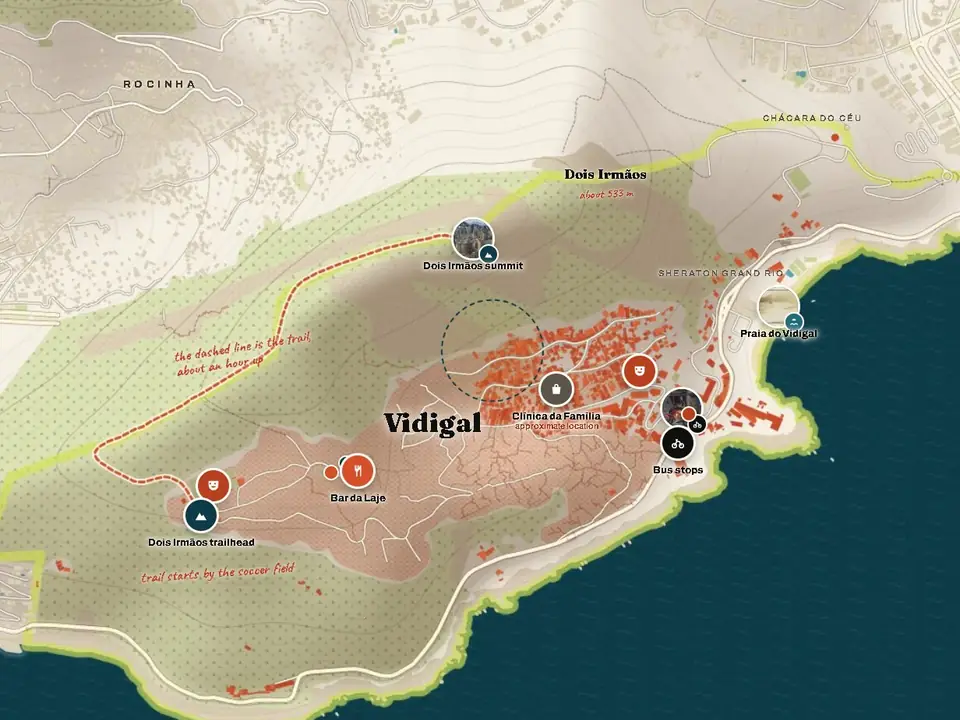
Beyond your own roof, the Mirante do Arvrão is the accessible viewpoint — a short moto-taxi to the top, a lookout and a bar, no hike required, and a clean sweep over Ipanema and Leblon and the ocean. Bar da Laje gives you the same postcard with a caipirinha and a small entry fee, best if you arrive by five and hold your table through the color change. And for the photograph that beats all of them, the Dois Irmãos trail climbs to the twin summit above the hill — a three-kilometre round trip, thirty to sixty minutes up — where the entire postcard lays itself out: Vidigal below you, Rocinha over the ridge, Ipanema and Leblon and the lagoon, and on a clear day Christ far off across the city. One note as of 2026: Avenida Niemeyer restricts westbound traffic on weekday mornings, roughly six to half past ten, so if you are heading up for sunrise, sort your ride the night before.

When the good light happens
Sampled for early July 2026. Winter in Rio — short days, early sun. All times shift later toward summer.
- Evening golden hour starts about an hour before sunset. Be on the roof, not still climbing.
- Morning golden hour is emptier and cooler. Worth one early alarm for the sunrise frames.
- Noon is the worst light of the day up here. Flat, harsh, no shadow. Shoot the market, save the walls for later.
It's someone's home — the etiquette
This is the part that separates a good visitor from the kind residents quietly resent, and it is not complicated. Vidigal is a residential neighborhood. The walls you are photographing are the outsides of houses where families are having lunch. Treat the hill the way you would treat a street of homes anywhere, because that is what it is, and the single rule under all the others is this: walls are fine, people are not, unless you ask.
Ask before you photograph a person, a child, an open doorway, an interior. A gesture and a smile crosses every language — hold the camera up, raise your eyebrows, wait for the nod. Most people say yes, some say no, and the no is the whole point of asking. Do not photograph children without a parent right there giving the nod. Do not point a lens through an open door because the light inside looked nice. The ethics of visiting Vidigal well come down to remembering you are a guest on a street, not a customer in an attraction, and behaving the way a guest behaves.
Then there is the drone question, which comes up constantly, so let us be plain about it. Flying a drone over Vidigal is a bad idea on two fronts. Legally, Brazil's aviation authority requires you to keep any drone thirty metres horizontally from people who have not consented, forbids flying over crowds, and treats Rio's airspace as among the most restricted in the country, needing clearance most tourists cannot easily get — and a dense hillside of homes is nothing but people who have not consented. Ethically it is worse: a camera hovering over someone's roof, into their yard, is exactly the surveillance-from-above that residents of this hill have every reason to hate. The aerial shot you want is not worth it. If you must have altitude, climb Dois Irmãos and shoot it with your feet on the ground.
Do
- Ask before any face, child, doorway, or interior.
- Shoot walls, murals, architecture, and the view freely.
- Buy a water or a beer from the bar whose roof you are using.
- Tip the moto-taxi driver who waited while you shot.
- Hire a resident guide if you want the alleys and the stories.
Don't
- Point a lens into an open home because the light was good.
- Photograph kids without a parent's clear nod.
- Fly a drone over the houses. Legal problem, ethical problem.
- Treat a beco like a film set or a fashion backdrop.
- Post a face that never agreed to be posted.
None of this makes Vidigal a tense place to photograph. It is one of the warmest. People will wave you toward a better angle, tell you which wall got repainted last week, sell you a beer and point you up the shortcut. The etiquette is not a set of hoops. It is the reason the hill stays open to visitors at all, and the reason the next photographer gets the same welcome you did.
~~~A half-day photo walk
If you want a shape for the afternoon rather than a list, here is the one that works, timed backward from sunset. It is not a tour and it is not fixed. It is the route we walk when a guest lands and wants the hill in one clean session.
Around three in the afternoon, start at Praça do Vidigal. Shoot the base — the square, the first walls, the moto-taxis loading — while the light is still ordinary, because these are your orientation frames, not your keepers. Get a feel for the main road and where it bends.
By half past three, take a moto-taxi to the top for a handful of reais, then begin walking down through the becos and the arts shortcut. This is the meat of it: the alleys, the tile, the murals, the doorways, the cats, the alley-and-ocean frames. Go slow. Backtrack when something catches your eye. You are not trying to cover ground, you are trying to see one small stretch of hill properly.
By half past four, position for the light. Peel off toward the Mirante do Arvrão or Bar da Laje, or better, back to a terrace of your own, and settle in with a drink an hour before the sun goes. Shoot the color change — the walls going gold, the hill lighting up, the beach below taking the last of it. This is the sequence you flew here for.
After dark, put the camera away. The hill after sunset is for a chopp at a botequim, not for a lens, and the residential alleys that are open and easy in daylight are not somewhere to wander photographing at night. If you want the fuller day — the hike, the beach, the food, the baile — our Dois Irmãos guide pairs naturally with this walk, and you can build a whole day out of the two.
Do this once and you will understand why the panorama was never the point. You will come home with the square, the summit, the postcard, sure. But the frames you keep will be the doorway on the third switchback, the blue tile in the last light, the face on the shortcut that will not exist next season. Vidigal street art is not a place you tick off. It is a place you photograph until you run out of light, and then come back for.
Quick questions.
Do I need a guide to photograph the street art in Vidigal?
No. Vidigal street art sits on public streets, and Vidigal is one of the favelas you can generally walk into freely in daylight, and the main road and arts shortcut are straightforward on your own. A resident guide is worth it if you want the deeper alleys, the stories behind specific murals, and someone to smooth the etiquette. For a first, view-and-walls visit, you do not need one.
Where is the famous painted staircase in Vidigal?
There is no single famous painted staircase in Vidigal — you are thinking of the Escadaria Selarón, which is in Lapa, downtown, an entirely different part of Rio. The candy-colored painted square is Santa Marta, in Botafogo. Vidigal's art is spread across its walls and alleys rather than concentrated in one landmark.
Is the Meeting of Favela graffiti festival in Vidigal?
No. MOF, the Meeting of Favela, has run since 2006 in Vila Operária, up in Duque de Caxias in the Baixada Fluminense, about an hour north of Vidigal. Artists cross between the two, so the styles overlap, but the festival itself is not on this hill. Vidigal's street art is everyday and year-round, not tied to an event.
Can I fly a drone over Vidigal for aerial shots?
You should not. Brazilian rules require keeping a drone thirty metres from people who have not consented and forbid flying over crowds, and a hillside of homes is exactly that. Rio's airspace is heavily restricted on top of it. Beyond the law, filming over people's roofs is the kind of surveillance residents rightly resent. For altitude, hike Dois Irmãos and shoot from the summit.
What time is best for photos in Vidigal?
The last hour before sunset, when the west-facing hillside takes the warm light and the painted walls go gold. In winter that is around half past four to sunset near half past five; in summer everything shifts an hour or so later. Sunrise is the emptier, cooler alternative. Midday light is flat and harsh — save the walls for the ends of the day.
Is it rude to photograph people's houses in a favela?
Walls, murals, and the general streetscape are fine to shoot. People, children, open doorways, and interiors are not, unless you ask first — a raised camera and a smile is enough to get a yes or a no, and the no matters. Treat it as a residential street you are a guest on, which it is, and you will be welcomed rather than resented.
Which is the single most photogenic spot in Vidigal?
For the sweeping frame, the Dois Irmãos summit or a rooftop laje at golden hour. For the street art itself, the arts shortcut and the alleys off the main road, where the murals and tile live. The most-Vidigal shot, though, is smaller: an alley framing a gap of ocean at its far end. You will find a version of it every few steps.
Come with a phone, an empty afternoon, and the manners you would bring to any street of homes. Leave the drone, the big lens, and the mural checklist behind. The hill will hand you more than you can carry down, and the one frame you will still be looking at in a year is the one you did not plan.