
Nine in the evening on the main road up the hill. A moto-taxi idles at the praça, a family shares a pastel under a bare bulb, and the whole morro hums with the low bass of someone's speaker three lanes up. The real question you arrived with — is it safe to walk in Vidigal at night — has an honest answer. It begins with knowing which street you are standing on, and whether it is still awake.
The short answer, then the honest one (they are not the same)
The short answer is yes, mostly, on the main road, with your head up. Vidigal is one of the calmer communities in Rio's Zona Sul, a hillside of ocean views and favela chic where guests walk between bars and pousadas every night of the week without incident. Thousands of residents come home in the dark. The padaria stays open. The moto-taxis run. Life does not stop at sunset up here. It changes key.
The honest answer is longer, because "safe" is not a single switch. Walking Vidigal at night is not one thing; it is a dozen small decisions. It depends on the road, the hour, the weather, the movimento on the street, and how much attention you are paying versus how much cachaça you have had. A visitor who walks the lit main road at ten, sober, phone in a pocket, is doing exactly what residents do without thinking. A visitor who wanders into an unlit beco at three in the morning, drunk, filming on a new phone, is writing a different story. Same hill. Different night.
So this piece is not a yes or a no. It is a way of reading the place so you can make the call yourself, block by block, the way people who live here do. We will cover where it is routinely fine to walk, when to put yourself on the back of a moto-taxi instead, how to read the mood on the street, and what to do on the rare night the hill goes quiet in the wrong way. None of it is dramatic. Most of it is common sense wearing local clothes. For the wider daytime picture, our piece on whether Vidigal is safe covers the ground this one builds on.
Walking Vidigal at night, in one screen
Sampled and cross-checked as of 2026. Reais, not dollars. Judgment still required.
- The lit main road is the spine — busy, watched, walked by everyone.
- Unlit side alleys (becos) after dark: skip them, ride instead.
- Moto-taxi short hop R$3–5, to the top around R$10, cash or Pix.
- Reading the street beats any rule: if life is out, you are fine.
Why this hill is not the favela in the headlines
To walk Vidigal at night with a clear head, it helps to separate it from the images the word "favela" drags along. There are more than a thousand favelas in Rio, and they are as different from one another as neighbourhoods anywhere. The ones that make international news — the vast North Zone complexes like Alemão, Penha, Maré — are large, dense, far from the tourist city, and periodically the stage for the kind of operation that fills a headline. Vidigal is none of those things.
Vidigal sits in the Zona Sul, the wealthy southern belt of Rio, wedged between Leblon and São Conrado, a fifteen-minute drive from Ipanema. It is comparatively small, a single hillside rather than a sprawling complex, and it has been a destination for the better part of two decades. There are pousadas, hostels, rooftop bars, a Sheraton at its foot, art studios, a steady flow of foreign guests, and residents whose livelihoods are now partly built on all of that. The place has been gentrifying, for better and worse, since the police unit arrived in 2011. Rents have climbed. Foreigners have moved in. That process carries real costs to the community, but it is also why, as a visitor, you walk into a hill that is used to you and set up for you.
Here is the honest frame. Vidigal is one of the most visited, most walkable, most tourist-accustomed communities in Rio, and it is routinely named among the safest to stay in. That does not make it a resort. It is a living, working community with its own codes, its own quiet, and its own occasional bad nights, the same as any real place. But the mental picture of dodging danger to reach your bed is simply not the nightly reality here. The reality is a lit road, a moto-taxi, a bar with a view, and a walk home you can make with your head up. The fear most visitors arrive with is calibrated to a different favela entirely.
The road is the thing — not the neighbourhood
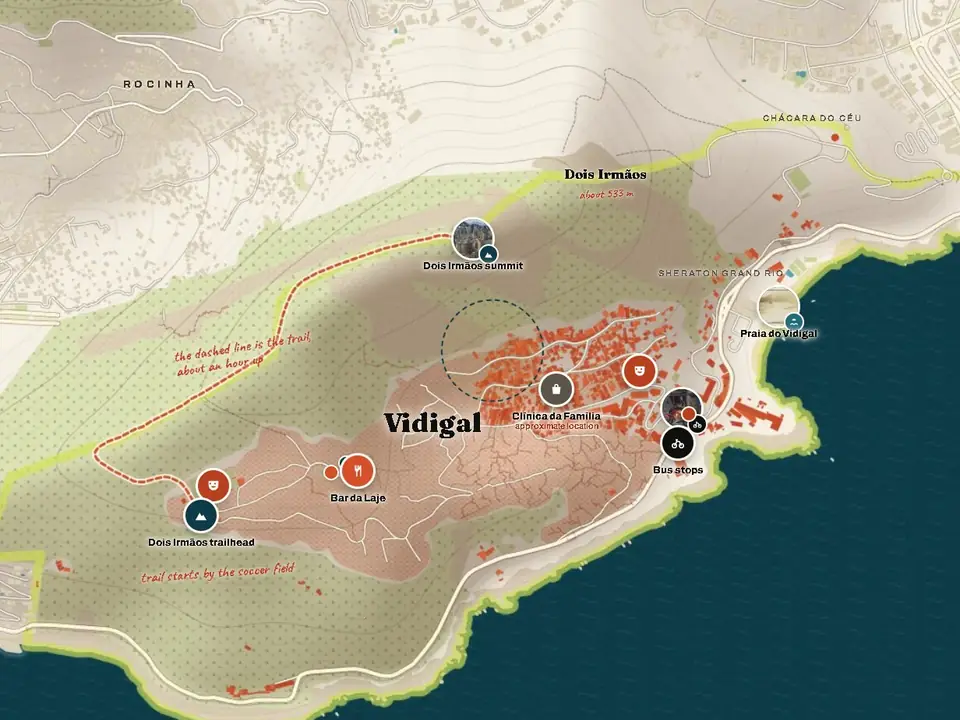
Forget the word "favela" for a second, because it flattens a place that is really a set of very different streets. Vidigal climbs a steep spur between Leblon and São Conrado, and it is built around one paved artery that switchbacks up from the beach road to near the top. Locals call it the main road. It is lit. It is lined with shops, bars, pousadas, a padaria, a pharmacy, and the moto-taxi praça. It carries traffic and people until very late. This road is the safe spine of the hill, and the great majority of what a visitor does at night happens on it, or a few steps off it.
Branching off that spine are the becos and vielas, the narrow stepped alleys that thread between houses, some barely shoulder-width, many unlit, most residential and private in feel. In daylight they are the texture of the place and, with a resident or a guide, a pleasure to wander. At night, for a visitor, they are the part to leave alone. Not because something will happen. Because you cannot read them in the dark, you do not know who lives where, and getting lost in a stranger's stairwell at midnight is how a good night turns awkward. The rule is simple, and it is the whole article in one line: stay on the lit road, and you are doing what everyone else is doing.
This is not a Vidigal rule. It is a Rio rule, and honestly a big-city rule anywhere. Copacabana has streets you walk at night and streets you do not. Ipanema empties out and gets quieter than people expect. The difference on the hill is that the safe network is smaller and more legible: essentially one road and its immediate elbows. That legibility is a gift. You do not have to memorise a map. You have to stay on the bright line.
Where does the bright line end. Practically, at the stretch near your building and the cluster of bars you are heading to or from. If your apartment sits up near the top — many of the best-view places do — the last leg from the main road to your door may be a short walk up a quieter lane. Do it with your phone away and your eyes up, or, after midnight, ride a moto-taxi the final hundred metres and let the driver drop you at the gate. That last-hundred-metres call is the one visitors most often get wrong, and it is the easiest one to get right.

When to ride instead of walk
The moto-taxi is the most useful safety tool on the hill, and almost no first-time visitor leans on it enough. These are the licensed motorcycle riders who gather at the praça at the base of Vidigal, and at points along the road as it climbs, with vests on and a spare helmet ready. They are the circulatory system of the community. Residents ride them to carry shopping, to get to work, to come home at two in the morning, and you should use them the same way. When the walk is uphill, unlit, or just later than you would like, you do not tough it out. You ride.
The money is small. A short hop along the road is R$3 to R$5. From the base all the way to the top runs around R$10 cash or Pix, the same going down. Late at night the price can nudge up a couple of reais, which is fair. tip There is no meter and no app, so agree the number before you sit; it is not a haggle, just a confirm. You walk to Praça do Vidigal, you say where you are going — "lá em cima" for the top, or the name of your bar or pousada — and someone nods you onto a seat. Hold the grab rail behind you, keep your knees in, and let them do the driving. They know every camber of that road in the dark far better than you will ever know your own street.
Is the riding itself safe. It is a motorcycle on a steep road that turns slick in the summer rain, so it carries the ordinary risk of any motorcycle, which is not nothing. Wear the helmet if one is offered. Do not ride if the driver seems drunk. Do not pile on three-deep as a joke. But in terms of the risk this article is actually about — being on foot, alone, in the wrong place at the wrong hour — the moto-taxi erases it. Fifteen seconds on the back of a bike replaces ten minutes walking a dark stretch. That trade is almost always worth R$5. For the full mechanics of getting up, down and across the hill, our getting around Vidigal guide has the moto-taxi, van and app math in one place.
One more thing the moto-taxi solves: arriving. If you land in Rio at night and take an Uber or a 99 up to Vidigal, the app car will very often stop at the base rather than climb the hill. That is normal, not a snub. The handoff at the praça to a moto-taxi or a resident van is the standard last leg, luggage and all, and it is how the community itself moves. If it is your first night, message your host before you land so someone knows roughly when you are coming, and you step off the bike at your own gate instead of squinting at a map in the dark.

On the hill, safety is not a wall or a gate. It is a hundred people who know each other, awake at the same time, on the same lit road. — a neighbour, our first week in Vidigal
A map of the hill after dark
Think of Vidigal at night as four zones, each with its own setting on the dial. You do not need to memorise them. You need to feel which one you are standing in.
The base and the praça. This is the busiest, most watched part of the hill at any hour. Moto-taxis, vans, a shop or two, people coming and going to Leblon. It is the transit hub, and transit hubs are where you are least alone. Standing at the praça at midnight waiting for a bike is a normal thing to do. Just keep your bag on your front and your phone in your pocket, the same as you would at any bus stop in any city.
The main road. The lit spine described above. Fine to walk in the earlier evening, busy with bar traffic on weekends, quieter but still trafficked on a Tuesday. This is where you will do most of your night walking, between dinner and a bar and home. The higher you go and the later it gets, the thinner the foot traffic, which is the cue to start riding rather than walking.
The bar zones. Vidigal's nightlife clusters — the rooftop bars, the lajes, the party at the top on a baile-funk night — are social, lit, full of a mix of residents and visitors, and generally the easiest place to be after dark because you are surrounded by people. The risk here is not the venue. It is the walk home afterwards, three drinks in, deciding to save R$5 by hoofing it up an unlit lane. Do not be that person. If you are planning a big night, our nightlife guide is honest about which parties are worth it and how late they run.
The alleys and the top edges. The residential becos, the unlit stairs, the far upper reaches past where the bars end. This is the zone to treat as private property after dark, because functionally it is. Nothing here is out to get you. It is simply not yours to wander at night, and there is no reason to.
Walk it
- The lit main road, early-to-mid evening.
- Between two bars a block apart.
- The praça and the base, any hour, bag in front.
- The short, lit stretch right outside your building.
- Anywhere people are still out and shops still open.
Ride it
- Uphill, late, after a few drinks.
- The last hundred metres up a quiet lane to your door.
- Any beco you are not completely sure of.
- When the street has emptied and gone quiet fast.
- When in doubt. It is R$5. Ride.
Night transport, priced
What it costs to not walk the wrong stretch. Reais, as of 2026, cash or Pix.
- App cars often stop at the base — plan the moto-taxi handoff up.
- No meter on the bikes. Agree the number first. Not a haggle, just a confirm.
- Keep R$20 in small notes for rides; not every driver wants Pix at 3am.
Reading the movimento
Residents do not walk around consulting a rulebook. They read the street, constantly and without thinking, the way you read a room when you walk into a party. The local word for it is movimento — literally movement, but it means the state of the street, the feel, whether things are normal. Learning to read movimento is the real skill, and it is not hard, because the signals are loud once you know to look for them.
Normal looks like this: shops open, music playing somewhere, kids and dogs out too late, people on plastic chairs, moto-taxis running, the padaria light on. When the hill looks like that — and it looks like that almost every night — you are fine to be out on the main road. The presence of ordinary life is the single best safety indicator there is. It beats any statistic, and it is free. If the grandmothers are still on their stoops, so can you be.
The signal to respect is the opposite: the street emptying fast and for no obvious reason. Shops pulling their shutters early. Music cut off. The moto-taxi praça suddenly thin. A quiet that arrives too quickly. On the rare night this happens, it usually means residents know something you do not — a police operation moving, a tension between groups, something passing through. You do not need the details. You need to do what everyone else is doing, which is go inside. Walk, do not run, to your building or the nearest open bar, and wait it out. It almost always passes within the hour, and it almost never involves visitors at all.
This is worth saying plainly, because headlines make it sound constant and it is not. Rio does have large, sometimes deadly police operations in its favelas. The worst on record came in late October 2025, with more than a hundred dead, but it unfolded in the Complexo da Penha and Alemão, in the North Zone, an hour and a different world from Vidigal. The South Zone hills were not part of it. Operations on Vidigal itself are far rarer and far smaller, and the community's own information network will register one long before you do. Trust the street. When residents are relaxed, relax. When they move, move.
If you are travelling alone, and especially if you are a woman weighing all of this for the first time, our solo female traveller's guide to Vidigal goes deeper on reading a stay, a host and a street when the calculus is yours alone.

The real risk is the road at the bottom, not the hill
Here is the part most safety pieces bury, so we will put it in a heading. The stretch of Vidigal that deserves the most caution at night is not up in the community at all. It is the coastal road at the base — Avenida Niemeyer, the cliff-hugging two-lane that connects Vidigal and São Conrado to Leblon. In daylight it is one of the most beautiful drives in Rio, ocean on one side, forested rock on the other. After dark it is unlit, fast, thinly walked, and the classic place where an on-foot tourist gets targeted precisely because there is no one else around.
The rule is short: do not walk Avenida Niemeyer after dark. Not to save a taxi fare, not because it looks close on the map, not because it was fine at four in the afternoon. The distance from the base of Vidigal to Leblon is walkable in maybe twenty minutes by day, and people do it, in company, in daylight, along the sea. At night you take a moto-taxi, an Uber, a 99, or a van. All of them are cheap. The saving from walking is a few reais and the cost of getting it wrong is the worst night of your trip. It is the easiest bad decision to avoid, because the good decision here is also the comfortable one.
The same logic applies to the beach itself. Praia do Vidigal and the wider sands of Leblon and Ipanema are daytime places. At night the beach is unlit, unpatrolled in long stretches, and simply not where you want to be wandering with a phone out. Watch the sunset, then move up to a lit bar or up the hill. The ocean will still be there in the morning, and the view of it from a terrace on the morro is better than the view from the sand anyway.
~~~Two nights that behave differently
Two situations change the calculus slightly, and both are easy to plan around.
Rain. Rio's summer storms are sudden and heavy, and on a steep hill of tiled steps and painted concrete, water changes everything. The becos turn slick, the main road runs like a stream, and the moto-taxis either stop for a while or ride slower and charge a little more. A wet night is not a dangerous night in the way this article means, but it is a fall-risk night. Wear shoes with grip, not flip-flops, and if it is truly coming down, wait twenty minutes under an awning with a beer rather than pick your way down wet stairs in the dark. The storm passes fast. It nearly always does.
The big nights. Carnaval, Réveillon on New Year's Eve, a major baile at the top — these pull crowds, and crowds bring pickpockets to any city on earth. The hill itself stays as safe as ever, arguably safer for all the extra bodies and eyes, but density is where phones vanish. On those nights, carry even less, keep the phone genuinely pocketed, and treat the crush the way you would treat a packed metro platform anywhere. The community turns those two weeks into something worth staying up for. Just leave the good watch at home and let your hands be free.
~~~A night protocol that actually works
None of this needs to live in your head as anxiety. Turn it into a handful of habits, then forget about them, the way you already do at home. Here is the protocol we actually give guests, stripped to what matters.
- Phone
- In your front pocket, not your hand, on the road at night. Check the map in a doorway, not mid-stride. A cheap second phone for the beach and the street is a real carioca habit, not paranoia.
- Bag
- Small, worn on your front after dark, nothing in it you would mourn. Leave the passport and the spare card locked at the apartment.
- Watch and jewellery
- Off. A visible watch or gold chain is the one thing that turns you from "tourist" into "target". This is the single highest-value habit on the list.
- Cash
- R$20–50 in small notes, enough for moto-taxis and a round, split between two pockets. Not a fat wallet.
- Route
- Main road, lit, peopled. When it thins, ride. Never a shortcut through an alley you have not walked in daylight.
- State
- Know your own. Two drinks, walk. Five drinks, ride, and text your host you are on your way up.
If the worst happens and someone does demand your phone or your bag — a rare thing, but the scenario this whole genre is really about — the only correct move is to hand it over without hesitation. Nothing you are carrying is worth your safety, which is exactly why you left the valuable version of everything at home. Do not chase, do not argue, do not film. Then tell your host, who will know whether and how to report it. This is the same advice you would get for Copacabana, for Barcelona, for any city with a street and a night. The difference in Vidigal is only that the safe path is shorter and easier to see.
Quick questions.
Is it safe to walk in Vidigal at night as a tourist?
On the lit main road, in the earlier evening, with your phone away and no flashy valuables, yes — it is something residents and visitors do every night. The judgment calls are the unlit side alleys and the very late, very high stretches, where the right move is a R$5 moto-taxi rather than a walk. Read the street: if ordinary life is out, you are fine.
Are moto-taxis available at night in Vidigal?
Yes. The riders work from Praça do Vidigal at the base and from points up the road until late, because residents need to get home at every hour. A short hop is R$3–5 and the full ride to the top is around R$10, cash or Pix, agreed before you sit. It is the most useful night-safety tool on the hill.
What is the most dangerous part of Vidigal at night?
Not the community itself but the coastal road at its base — Avenida Niemeyer, linking Vidigal to Leblon. It is unlit, fast and thinly walked after sundown, and the classic spot where an on-foot tourist gets targeted. Never walk it at night. Take a moto-taxi, Uber, 99, or van; they all cost a handful of reais.
Should I walk back up the hill after a night out?
To your building's block, if it sits on the lit main road and you are sober, sure. If it is up a quiet lane, or you have had a few, ride the last stretch. The mistake visitors make is saving R$5 on a moto-taxi after three drinks and walking an unlit alley. Do not be that person.
What should I do if the street suddenly goes quiet?
Do what the residents do: go inside. Shops shuttering early, music cut, the street emptying fast usually means locals know something is passing through, often a police operation. Walk, do not run, to your building or the nearest open bar and wait it out. It typically passes within the hour and rarely involves visitors.
Is Vidigal safe right now in 2026 with the police changes?
The dedicated police unit inside Vidigal was consolidated with Rocinha's in late 2024, which the state framed as restructuring rather than withdrawal. Day to day, Vidigal remains one of Rio's calmer South Zone communities and a normal place to stay. The big, deadly operation of October 2025 was in the North Zone, far from here. The night habits in this guide are what actually matter for a visitor.
Is it safe for a woman to walk in Vidigal alone at night?
The same road logic applies, with the usual added reality of catcalling that exists across Rio and most cities. Stay on the lit main road, ride when it thins, keep your host's number handy, and trust your read of the street. Our solo female traveller's guide covers choosing a stay and moving after dark in more depth.
Vidigal at night is not the story the word "favela" tells you to expect. It is a lit road up a mountain, moto-taxis idling at the bottom, music on a Friday, a padaria that never seems to fully close, and a few thousand people who all know which lane is theirs. Learn to read it and it reads easy. Stay on the bright line, ride when the line thins, keep the shiny things at home, and let the hill do what it has always done, which is carry everyone home in the dark. The view is the reason you came. The nights are the reason you will want to come back.