
Wheels down at Galeão. The cabin door opens and the heat finds you before the jet bridge does — salt, jet fuel, something green off the bay. Your bag is circling a carousel and a hillside is waiting across the water. This is how to get to Vidigal from the airport without the two mistakes everyone makes: overpaying at the curb, and forgetting that the car cannot climb the last stretch of the hill.
Two airports, one hill — which one are you landing at?
Rio has two airports, and the difference matters the moment you plan your arrival. The big one is Galeão, formally the Aeroporto Internacional Tom Jobim, code GIG. It sits out on Ilha do Governador, across Guanabara Bay from the beaches, and it handles almost every international flight into the city. If you are flying in from the United States, Europe, or on most connections through São Paulo's Guarulhos, you land at GIG. Budget roughly 33 kilometers and anywhere from 45 minutes to well over an hour between the arrivals hall and the base of Vidigal, depending entirely on traffic.
The small one is Santos Dumont, code SDU, planted right on the water at the edge of Centro. It is a domestic airport — the São Paulo air shuttle, Brasília, Belo Horizonte, the short hops. Santos Dumont is beautiful to fly into, low over the bay with Sugarloaf out the window, and it is much closer to where you are going: about 15 kilometers to the base of the hill, 25 to 45 minutes by car. So on the question of GIG vs SDU, which airport is closer, Santos Dumont wins easily.
Here is the catch. You rarely get to choose. Your international ticket lands where it lands, and that is almost always Galeão. The only time the choice is real is when you are connecting inside Brazil — flying into São Paulo or Brasília first and taking a domestic leg to Rio. In that case, a final flight into SDU rather than GIG puts you thirty minutes closer to Vidigal and drops you in the middle of the city instead of out on the island. If your itinerary offers that, and the fare is close, take Santos Dumont. If it does not, do not lose sleep over it — the Galeão run is well worn, and thousands of visitors make it every day.
Either way, the shape of the journey is the same. A car or a bus brings you across the city to the foot of Vidigal, on the coastal road past the Sheraton. And then the road narrows and rises, and the last leg happens on two wheels or in a van. Understand that handoff before you land and the whole arrival goes smoothly. Miss it, and you end up standing at the base of a hill with a suitcase and no plan.
Arrival at a glance
Distances and fares sampled in 2026. Reais unless noted. Traffic is the wildcard on every figure.
- GIG (Galeão): international flights, out on the island, 45–75 minutes by car.
- SDU (Santos Dumont): domestic flights, on the bay in Centro, 25–45 minutes by car.
- BRT Expresso Gentileza airport bus: R$15, every 20 minutes, 6am to midnight.
- Cars stop at the base. The last climb is moto-taxi or van, always.
The ride you actually want — Uber, 99, or a taxi
For most arrivals, the answer is a ride-hailing app. Uber works across Rio, and so does 99, the Brazilian app owned by Didi, which is often a little cheaper for the same route. Download both before you fly and you can compare fares in real time when you land. On the Galeão run, a car to the base of Vidigal generally costs R$90 to R$150 in ordinary traffic as of 2026, climbing to R$180 or beyond when surge pricing hits on a Friday evening, during Carnival, or in a downpour. From Santos Dumont the same car is cheaper and quicker, usually R$50 to R$90. That is the honest Rio airport to Vidigal taxi price most people pay.
Finding your car at GIG takes a minute of attention. Follow the signs for aplicativos — the ride-app pickup zone — rather than accepting the first "taxi, my friend?" from someone working the arrivals hall. Ignore the touts entirely. When you request the ride, the app shows you a specific pickup point and a plate number; walk to it, check the plate and the driver's name, and get in. If your phone died on the plane or your data is not working yet, the official taxi cooperatives have a booth in arrivals where you prepay a fixed cupom fare. Those coupon taxis run higher, frequently R$150 to R$200 for the Zona Sul, but they are legitimate, metered against a set table, and stress-free when your phone is dead. What you never do is follow a stranger to an unmarked car in the parking structure.
Now the detail that saves the arrival, and the one no app tells you. When you set your destination, drop the pin at the base of Vidigal — Praça do Vidigal, on Avenida Niemeyer just past the Sheraton — and not at some address high inside the community. Two things go wrong when you pin a spot up the hill. The GPS inside Vidigal is unreliable, so the car ends up circling the coastal road while the meter runs. And plenty of drivers simply will not climb the narrow interior lanes, which means an awkward conversation and, sometimes, a cancelled trip halfway up. Pin the base. Get out at the base. Do the last leg the way everyone who lives here does it. That single habit is the difference between a smooth airport transfer in Rio de Janeiro and a frustrating one, and it costs you nothing.
For a group, or a red-eye, or anyone with real luggage, the app car is the default and the right call. It is door-to-base in one clean move, you pay in the app, and you arrive with your bags and your patience intact.

The last leg — where the car stops and the hill begins
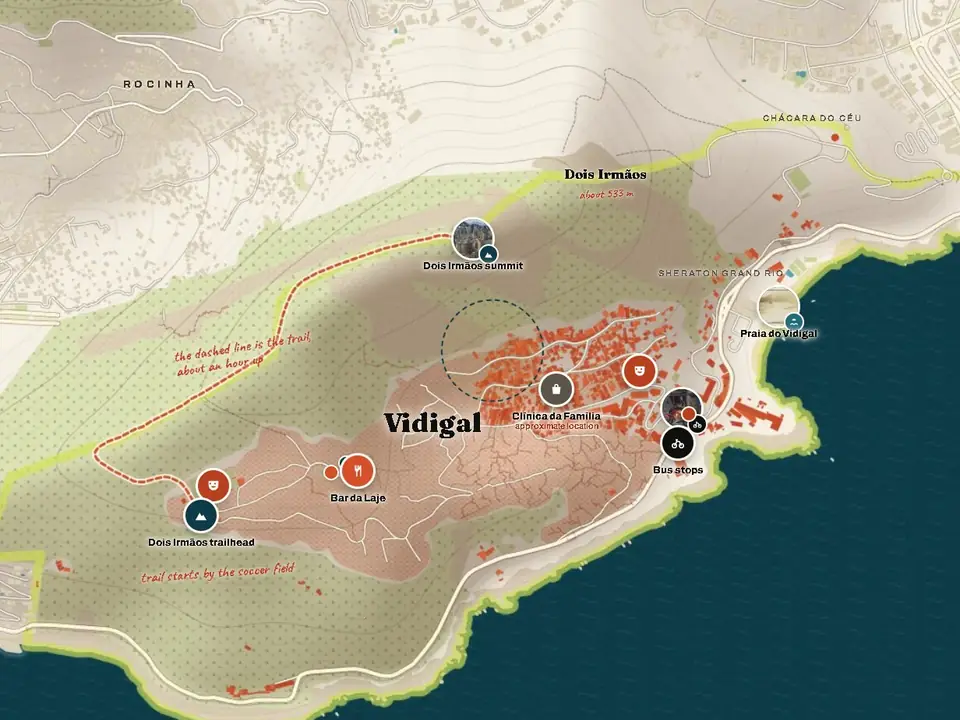
This is the part the guidebooks skip, and it is the part that defines the arrival. Every car — Uber, 99, coupon taxi, your own driver — stops at the base of Vidigal, on Avenida Niemeyer just after the Sheraton, at the small square everyone calls Praça do Vidigal. From here the road pitches up and narrows, the lanes tighten, and the way to your door is either a moto-taxi or a van. There is no third option and no car that glides you to the top. This handoff is not a failure of the system. It is the system, and it has been for decades.
The moto-taxis wait in a loose cluster at the base, riders in numbered vests leaning on their bikes. They know every building on the hill by name and every shortcut between them. You show the rider your building or your address, you put on the helmet they hand you, and you go. The fare up is about R$10 as of 2026, a little more — R$15 or so — if you are carrying a suitcase or riding late at night. A backpack rides on your back. A duffel wedges between you and the driver or across the fuel tank. A hard-shell roller is the awkward one: doable with a skilled rider going slowly, but if you are hauling a large case, ask the base moto-taxi rank for someone used to bags, or take the van.
The vans — everyone still calls them kombis even though the old Volkswagens are long retired — run the main road up and down all day for four or five reais. They are the cheapest way up and the local commuter default. You wait a few minutes, you squeeze in with residents and shopping bags, and you get out near the top. With light luggage and no hurry, the van is honest value. With three suitcases after a fourteen-hour flight, the moto-taxi is faster and simpler, even at a couple of trips.
- Where cars stop
- Praça do Vidigal, the base of the hill, off Avenida Niemeyer just past the Sheraton.
- Moto-taxi up
- R$10, closer to R$15 with a suitcase or late at night.
- Van up (kombi)
- Four or five reais, slower and tighter, the local commuter default.
- Time to the top
- Three to four minutes by moto, depending on your building's height on the hill.
How far up you are going changes the calculus. A building near the base is a ninety-second moto ride or a short walk. A place near the top of the morro is a longer, steeper climb that you genuinely do not want to attempt on foot with bags. Know your building's height on the hill before you arrive, and if it is high, plan for the moto-taxi rather than romantic notions of walking up. For the full breakdown of moto-taxi etiquette, van routes, and the internal geography of the community, our guide to getting around Vidigal maps the whole thing. The short version: the last 400 meters are steep, loud, and completely alive, and they are the part of the trip you will describe to people back home.
The car takes you to the bottom of Vidigal. The hill takes you the rest of the way — and the rest of the way is the part you remember. — what we tell every guest before they land
The cheap way, and the way to skip
If you travel light and you like public transport, there is a genuinely good budget route from Galeão, and there is an old one you should leave alone. Start with the good one. The BRT Expresso Gentileza is an express airport bus that runs from a station at GIG into the city along a dedicated corridor, the TransBrasil, with no stops and no exposure to the traffic on Avenida Brasil or the Linha Vermelha. It costs R$15, leaves roughly every 20 minutes between 6am and midnight, has air conditioning and luggage racks, and reaches Terminal Gentileza in Centro in about 25 minutes. For a single traveler with a backpack, that is a strong deal and a reliable clock.
The honest limitation is that the BRT drops you in Centro, not in the Zona Sul, and certainly not at the base of Vidigal. From Terminal Gentileza you connect onward — the VLT tram, then the metro, or a municipal bus, or simply an app car for the final stretch along the coast. Door to door on full public transport, Galeão to the foot of Vidigal runs somewhere around R$27 and takes roughly an hour and a half. To ride any of it you need a Jae card, Rio's electronic fare system, which you buy from the machine at the BRT station or load onto the Jae app on your phone. As of 2026, cash is no longer accepted on the city buses at all, so the card or the app is not optional. We cover the Jae system in depth in getting around Rio with the metro and Jae, and it is worth reading before you rely on the buses.
Now the way to skip. For years there was a cheaper airport coach that ran the scenic route — Galeão down along the bay and through the Zona Sul beaches. It was pleasant when it worked and notorious when it did not, with a long reputation for stickups while it sat in stalled traffic, passengers and passports on their laps. That old beach-route service has largely been overtaken by the BRT anyway. The lesson stands regardless: do not go hunting for a bargain airport bus that crawls through congestion with your luggage exposed. If you want cheap, take the BRT Expresso Gentileza into Centro and connect from there. If you want easy, take the app car. There is no prize for choosing the route that puts your bag on your knees in traffic.
Arrival street-smarts
None of this is alarmist. It is the same handful of habits every seasoned arrival runs on autopilot.
- Use only an app ride or an official coupon taxi from the booth. Walk past anyone offering a "taxi" in the hall.
- Pull cash from a bank ATM inside the terminal, not the first standalone machine you see. Take R$100–200 for the moto-taxi and van.
- Keep your phone low and out of sight at the curb. That is your ride, your map, and your money all in one hand.
- Agree your base-of-hill handoff before you board. Screenshot your building address and your host's arrival instructions so they work offline.
- Cards and PIX run everything in Rio, but moto-taxis and vans want cash. A little in your pocket keeps the last leg simple.

Timing it right — night landings, rush hour, the odd closed road
The single biggest variable on the whole trip is traffic on the run between Galeão and the Zona Sul, and it swings wide. On a clear Sunday morning the drive is quick, 40 to 45 minutes, and the coastal approach along the water is one of the best first impressions any city offers. On a weekday between five and eight in the evening, the same drive can stretch past 75 minutes as the city grinds home. If you can pick your flight, aim to land mid-morning or early afternoon on a weekday. You will pay less in surge and spend less time in the car.
Avenida Niemeyer, the coast road that carries you to the base of Vidigal, deserves one specific note. It hugs the cliffs between Leblon and São Conrado, and after heavy rain it occasionally closes for a stretch because of the risk of rockfall. When that happens, cars reach Vidigal by looping around through São Conrado and the far side of the hill instead, which adds time. Your driver will know if the road is shut and will route around it. It is not something you need to manage, only something worth recognizing if a rainy-season arrival takes a detour you did not expect.
Night landings worry people more than they should. Arriving at Vidigal after dark is entirely normal. The moto-taxis run late into the night, the main road up the hill is lit and busy with residents coming and going, and the base square is not a lonely place. What matters is the same thing that matters by day: have your handoff arranged, know your building, and go straight up rather than wandering into unlit side alleys with your bags at one in the morning. Arrive with a plan and a night landing is a non-event. For the fuller picture of the community after dark, we wrote is it safe to walk around Vidigal at night, which is honest about where you are fine and where you take the moto instead.
Two dates change the math completely. Carnival and New Year's Eve turn Rio's roads into a slow river and send app pricing through the roof. If you are arriving in the last days of December or the week of Carnival, arrange a transfer in advance and accept that the drive will take longer than any estimate. Outside those windows, the ordinary rules apply, and the ordinary arrival is easy.
Land smooth
- eSIM live before you land, so the app works at the curb.
- Pin the base of Vidigal, not an address up the hill.
- A little cash on hand for the moto-taxi and van.
- Handoff arranged with your host or a driver in advance.
- Mid-morning weekday flight if you get the choice.
Land rough
- Phone with no data, hunting for wifi in arrivals.
- A pin high inside the favela the driver cannot reach.
- Only cards, and a moto-taxi rider who wants cash.
- No plan for the last leg, standing at the base with bags.
- Friday-evening or Carnival landing, full surge, full roads.
Before you fly — the 2026 paperwork that shapes your arrival
Three things you sort out before you leave home decide how the airport goes, and all three changed recently enough to catch repeat visitors off guard. The first is the visa. Since 10 April 2025, citizens of the United States, Canada, and Australia need a Brazil eVisa to enter the country. This is the reinstated requirement, not a rumor, and you cannot board without it. As of 2026 the fee is around US$80.90, you apply online, and processing takes roughly ten working days, so do not leave it to the week before you fly. The eVisa is valid for up to ten years with multiple entries and allows stays of up to 90 days per visit. Land without it and your trip ends at immigration.
The second is connectivity, and it matters more here than in most cities because your entire arrival runs on data. Your ride app, your map, your building address and your host's messages all need the internet the moment you step off the plane. Buy an eSIM before you fly, from a provider like Airalo or Holafly, and activate it so it comes alive when you land. A physical local SIM bought at the airport can require a CPF, the Brazilian tax ID, and turns into a small ordeal at exactly the moment you are tired and want to be moving. An eSIM sidesteps all of that. This is the single cheapest upgrade to your arrival.
The third is money. Cards and PIX, Brazil's instant bank-transfer system, run almost everything, and you will use them constantly once you are settled. But the last leg up the hill wants cash, so pull R$100 to R$200 from a bank ATM inside the terminal — one attached to an actual bank, not a lonely machine in a corner — to cover the moto-taxi, the van, and a first-night snack. If you plan to ride the BRT or the buses, this is also when you sort a Jae card. We put the full pre-arrival checklist, from the eVisa to eSIMs to PIX, in Brazil arrival essentials. Read it once and the airport becomes a formality.

Let your host carry the arrival
There is an easy button, and for a lot of guests it is worth pressing. A good host will arrange a private transfer that meets you inside arrivals with your name on a card, drives you across the city to the base of Vidigal, and hands you to a trusted moto-taxi rider — or, where the building allows, a car that will actually make the climb — with your bags managed the whole way. You skip the app, skip the touts, skip the moment of standing at the base wondering which rider to trust. After a long-haul flight, that seamlessness is the thing you are actually buying.
It costs more than doing it yourself. A pre-arranged transfer runs roughly R$180 to R$260 depending on the airport, the hour, and whether it includes the moto-taxi handoff, against the R$90 to R$150 of a DIY app car plus a R$10 moto. What you pay for is the removal of every failure point after you land: no data anxiety, no pin problem, no negotiation on the hill, no guessing. For a first visit, a night landing, a solo traveler, or anyone arriving with more luggage than hands, that trade is usually the right one. If you are staying at our condo, we get the handoff sorted before you board, so the plan is in your pocket the moment you clear immigration.
If you would rather run it yourself, everything in this guide is enough to do it cleanly. The point is only that you should decide which arrival you want before you are standing at the carousel deciding under pressure. Both work. One is simply softer on a tired body.
~~~Wheels-down to key-in-the-door
Here is the whole thing, start to finish, the way a smooth Galeão arrival actually plays out. Your plane lands and taxis in. You clear immigration, where the officer scans the eVisa you sorted weeks ago. Your eSIM has already woken up, so by the time you reach the carousel your phone is live, your messages are landing, and you have texted your host that you are on the ground. You collect your bag, walk straight past the taxi touts in the hall, and follow the aplicativos signs to the ride-app pickup point.
Your car arrives in about ten minutes. You check the plate, get in, and settle into the drive — out over the bridge off the island, along the water, past the beaches as the city assembles itself out the window. On a good day this is 45 minutes to an hour. The driver pulls off Avenida Niemeyer into Praça do Vidigal, the base of the hill, and stops. This is where the car's part ends. You step out, walk to the moto-taxi rank, show a rider your building, put on the helmet, and ride up — three or four minutes of narrow lanes, painted walls, kids and dogs and the smell of someone's dinner, R$10 into the rider's hand at the top.
Key in the door. You drop the bag. You walk to the window or the laje and there it is, the reason the last climb was worth getting right — Dois Irmãos rising on one side, the ocean laid out flat, Leblon's lights starting to come on down below. Door to door on a clean day, Galeão to that window, runs about two hours. The airport is already forgotten.
Quick questions.
GIG or SDU — which airport is closer to Vidigal?
Santos Dumont (SDU) is closer, about 15 kilometers and 25 to 45 minutes from the base of the hill, because it sits in Centro on the bay. But it handles domestic flights only. Almost every international arrival lands at Galeão (GIG), out on the island, about 33 kilometers and 45 to 75 minutes away. You usually only get the choice when connecting inside Brazil.
How much is an Uber from the airport to Vidigal?
From Galeão, expect roughly R$90 to R$150 in normal traffic as of 2026, rising toward R$180 to R$200 with surge pricing at peak times or during Carnival. The 99 app is often a little cheaper for the same route. Fixed-coupon airport taxis from the arrivals booth run higher, around R$150 to R$200, but they are legitimate and prepaid. From Santos Dumont the fare is lower, roughly R$50 to R$90.
Do Ubers and taxis actually go up into Vidigal?
They stop at the base of the hill, at Praça do Vidigal on Avenida Niemeyer past the Sheraton. Set your destination pin there, not at an address up inside the community — the interior GPS is unreliable and many drivers will not climb the narrow lanes. From the base, the last leg up is by moto-taxi or van.
How much is the moto-taxi up the hill?
About R$10 as of 2026, a little more — around R$15 — if you have a suitcase or you are riding late at night. The moto-taxis wait in a cluster at the base; show the rider your building and put on the helmet. The shared vans, still called kombis, run the main road up for four or five reais but are slower and tighter with luggage.
Is it safe to arrive in Vidigal at night?
Yes, with a plan. Moto-taxis run late, the main road up the hill is lit and busy, and the base square is not deserted. Have your handoff arranged before you land, know your building, and go straight up rather than wandering into unlit side alleys with your bags. Arriving after dark is routine for guests here.
Can I take a bus from the airport instead?
Yes. The BRT Expresso Gentileza runs from Galeão to Terminal Gentileza in Centro for R$15, every 20 minutes from 6am to midnight, on a dedicated corridor that skips the traffic. From there you connect onward to the Zona Sul — around R$27 and 90 minutes in total to the base of Vidigal. You need a Jae card, since cash is no longer accepted on city buses. Skip the old scenic beach-route coach.
Do I need a visa to fly into Rio in 2026?
If you hold a US, Canadian, or Australian passport, yes. Since 10 April 2025 you need a Brazil eVisa, which costs around US$80.90 and is applied for online. Processing takes roughly ten working days, so arrange it well ahead. It is valid for up to ten years with multiple entries and allows stays of up to 90 days per visit.
Arriving is the only genuinely awkward hour of a trip to Vidigal, and it is awkward only if you improvise it. Sort the eVisa, wake up the eSIM, pin the base of the hill, keep a little cash for the moto-taxi, and the whole thing collapses into a car ride and a short climb. Then you are standing at a window above the sea, and the next problem you have is deciding where to eat.