
Wheels down at Galeão a little after six, the light already white over Guanabara Bay, your phone hunting for a signal it will not find in the jet bridge. Somewhere in your inbox sits a PDF you generated weeks ago, because the Brazil visa requirements for US citizens in 2026 now want one before you board. This is the arrival checklist we send every guest: the visa, the money, a working phone, and the one rule about ATMs.
Four things, before anything else
There is a version of a Rio trip where the first day is spent solving problems that should have been solved at home. No data on your phone. A card that will not tap. A confused half-hour at an airport currency desk, trading dollars at a rate designed to punish you. A bus into the city that everyone told you to skip, taken anyway because you did not have another plan. None of it is dangerous, exactly. Most of it is avoidable.
Four things decide whether you land smooth or land scrambling. Your entry paperwork. How you carry and spend money. How your phone gets online. And how you pay to move around the city. Sort those before the plane doors open and Rio meets you at its best — fast, warm, generous with directions, a stranger walking you half a block to point at the right van. Get them wrong and your first morning goes to queues instead of a terrace, a cafezinho, and the sea laid out in front of you.
We host on the morro in Vidigal, and the questions guests send in the week before they fly are always the same four. Do I actually need a visa now. How much cash should I bring. Will my phone work when I land. Is it safe to take money out of a machine. So here is the honest, current version, checked against mid-2026 prices and rules, written the way we would explain it to a friend the night before a flight.
One framing note first. Brazil in 2026 runs close to cashless. Cards tap in almost every shop, restaurant and kiosk, an instant bank-transfer system moves money in seconds, and the reais you do carry are mostly for beach vendors and moto-taxis. The old advice to arrive with a thick fold of cash is out of date, and in a city with the crime profile Rio has, it is also unsafe. Carry a little. Tap for the rest. Everything below is built around that single idea.
The four-line version
Numbers sampled mid-2026. Reais, not dollars. Rules current as of 2026 and worth re-checking the month you fly.
- Apply for the eVisa online, at home, days before you fly. Do not leave it to the airport.
- Bring one card that charges no foreign-transaction fee. Tell your bank you are travelling.
- Set up an eSIM before takeoff so data is live the second you land.
- Carry R$150–300 in cash, no more. Take out the rest from a machine inside a mall or bank, in daylight.
The visa — the paperwork that changed
Start with the thing that trips up the most travellers, because it is new and because plenty of old blog posts still say it does not exist. For roughly a decade, US citizens flew to Rio with nothing but a passport. That window closed. Brazil reinstated its visa requirement for citizens of the United States, Canada and Australia, and since April 2025 the rule has been in force. If you are reading a page that tells you Americans do not need a visa for Brazil, that page is out of date. In 2026, you do.
The good news is that the Brazil visa requirements for US citizens in 2026 are handled entirely online. There is no consulate appointment, no mailing your passport away, no interview. You fill in a form, upload a few documents, pay a fee, and wait for a PDF to land in your inbox. This is the electronic visa, the eVisa, and for tourism or a short business trip it is the only category most visitors will ever touch.
- Who needs it
- US, Canadian and Australian passport holders, for tourism or business. Most European and many Latin American passports remain visa-free for short stays.
- Cost
- US$80.90 per person as of 2026, paid by card during the application. Non-refundable, so enter your details carefully.
- Validity
- Ten years from issue, or until your passport expires, whichever comes first. One approval covers many trips.
- Length of stay
- Up to 90 consecutive days per entry, capped at 180 days total in any 12-month window.
- Where to apply
- The official government portal only, run through VFS Global at brazil.vfsevisa.com. Named lookalike sites charge a markup for the same thing.
- Processing
- Often 48 to 72 hours. Officially up to about ten business days in busy periods. Apply two to three weeks out and you will not sweat it.
A few details save people real grief. Your passport needs at least six months of validity beyond your arrival date and at least one blank page for the entry stamp. The photo and passport-scan uploads have to be clean and legible, or the system bounces them back and you start the clock again. And the visa is electronic, but airlines still like to see proof at check-in, so save the approved PDF to your phone, screenshot it, and print a copy for the folder you will inevitably need to open at some counter. tip Store it offline. The one moment you need it is the one moment you have no signal.
Be deliberate about where you apply. Search the words and the first results are often third-party agencies that fill in the same government form on your behalf and add a service charge on top of the US$80.90. They are not scams, exactly, but you are paying extra for a form you can complete yourself in twenty minutes. The genuine portal is the VFS Global one. If a site is quoting you a round number well above eighty-something dollars, close the tab. For the rest of the arrival logistics once the visa is sorted, our guide on getting to Vidigal from the airport picks up where this section ends.

Money — the real, the card, and the myth of cash
The currency is the real, plural reais, written R$ and broken into a hundred centavos. As of mid-2026 the dollar buys somewhere around 5.1 reais, though it moves week to week, so treat any price you read here as a snapshot rather than a promise. A useful shortcut in your head: divide a real price by five to get rough dollars. A R$40 lunch is about eight dollars. A R$15 beach beer is about three. A R$25 moto-taxi is a five-dollar ride with a better view than any taxi.
Here is the part that surprises first-timers. You barely need cash. Brazil adopted contactless payment early and completely, and in Rio a Visa or Mastercard taps in restaurants, supermarkets, pharmacies, most bars, and even a fair number of the informal vendors. Bring one card that charges no foreign-transaction fee, tell your bank the dates you will be in Brazil so the first tap does not get frozen as suspicious, and you have solved most of your spending before you pack. Amex is accepted in fewer places than Visa and Mastercard, so do not let it be your only card.
Cash still has a job, it is just a smaller one than the guidebooks imply. You want reais for the moto-taxi up the hill, for beach kiosks that prefer paper, for a small feira stall, for the informal parking attendant, for the odd shop where the machine is mysteriously broken that afternoon. R$150–300 on you covers a normal day with room to spare. That is the amount to carry. Not more. A traveller flashing a thick roll at a beach kiosk is doing free advertising for exactly the wrong audience.
Skip the currency-exchange counters at the airport and the ones on the tourist strips. Their rates are poor and the fees are worse. You will get a far better number by simply withdrawing reais from a bank machine once you are in the city, or by tapping your card and letting the network do the conversion. If you like to land with a little local cash in hand, order it from your home bank before the trip rather than trading dollars at Galeão. For the bigger budget picture — what a day, a week, a whole trip actually runs — we broke it down in how much a trip to Rio costs.
PIX — the thing everyone pays with
Spend two days in Rio and you will hear one word constantly at the till: Pix. So, what is PIX, and what does it mean for a tourist. PIX is Brazil's instant-payment system, launched by the central bank in 2020, and it has swallowed the country's everyday money. It moves funds between any two bank accounts in seconds, free, at any hour, usually by scanning a QR code or sending to a short key like a phone number. Tens of millions of merchants take it. Market stalls take it. The churrasco place with three plastic tables takes it. It is faster than a card and it never declines.
The catch for visitors is structural. PIX is tied to a CPF, the Brazilian tax-ID number, and to a local bank account. As a tourist you have neither, which means you cannot simply download a Brazilian banking app and start scanning QR codes the way a resident does. For years this left travellers watching locals pay in a blink while they fished for a card. In 2026 there are ways around it, though none is quite as frictionless as being handed a CPF at birth.
The lightest option is a travel-money app built for exactly this gap. Services such as Wallbit let a foreigner verify identity with a passport, load the balance in dollars or euros, and then pay any PIX QR code or key at the moment of purchase, converting on the spot. No CPF, no Brazilian bank. The other route, if you are staying a while, is to get a CPF yourself — it is free, and travellers report doing it in well under an hour at a Banco do Brasil branch or a Receita Federal desk — and then pair it with a multi-currency account like Wise that can hold a reais balance and send PIX. That is more setup than a two-week holiday warrants, but for a month on the hill it pays off.
Should you bother at all. Honestly, for a short trip, probably not. Cards cover something like nineteen in twenty transactions you will actually make, and cash handles the rest. PIX matters most at the margins: the beach kiosk that is card-shy, the small pousada that offers a discount for paying by PIX, the local who splits a bill and expects everyone to transfer their share rather than hand over notes. If you are staying a month and living like a resident, set up a PIX method. If you are here for a week of beach and sunsets, a good card and a little cash is plenty.
Carry a little cash for the moto-taxi and the beach kiosk. Tap for everything else. The thick fold of dollars belongs to a Rio that no longer exists. — what we tell every guest before they fly

ATMs and the one money rule — the part to read twice
This is the section that matters most, so here it is plainly. Is using ATMs in Rio de Janeiro safe. Yes, if you follow a short set of habits. No, if you treat a street-corner machine at midnight like the one outside your bank at home. The difference is entirely in where and when you use it, and in two settings you change before you ever leave your own country.
Where first. Use bank machines inside a mall, inside a bank branch, or inside the airport — places with light, cameras and foot traffic. The red Banco24Horas machines are everywhere and accept foreign cards, though they add a convenience fee of around R$20 a withdrawal, so take out a sensible chunk at once rather than paying that fee five times. Bradesco, Santander, Itaú and Banco do Brasil machines also take international cards. Daily withdrawal limits sit around R$800 to R$1,000 at most banks, and some machines cut that lower after dark, which is one more reason to do this in the afternoon.
Two habits at the machine itself. When it asks whether you want it to handle the currency conversion, decline — choose to continue "without conversion" or in reais. Letting the ATM convert layers on a poor rate they set themselves; letting your own card network convert is almost always cheaper. And cover the keypad, take your card and cash straight into a bag rather than counting it in the open, and walk on. None of this is Rio-specific paranoia. It is how careful people use machines in any big city.
Now the setting you change at home, and the single most important line in this whole piece. Rio has a crime called sequestro relâmpago, an express kidnapping, where someone is briefly forced to a machine or made to send money before being let go. It is not common for the average visitor, and it is not a reason to stay away from a city millions enjoy every year, but it is real enough that the smart move is to remove the payoff in advance. Before you fly, open your banking and payment apps and set a low daily cash-withdrawal limit and, if you use any Brazilian PIX method, a low daily and nightly transfer cap. If the worst ever happened, the amount exposed is small and capped, and that changes the whole calculation. It costs you nothing and it is the best five minutes of trip prep you will do.
Do
- Withdraw inside malls, branches or the airport, in daylight.
- Decline the machine's currency-conversion offer.
- Set low daily ATM and PIX limits before you fly.
- Carry a small everyday amount; leave the rest locked in the apartment.
- Keep a cheap "beach phone" or a little decoy cash if it puts you at ease.
Don't
- Use lone street machines late at night.
- Count cash in the open or flash a phone on the sand.
- Trade dollars at airport currency desks.
- Carry every card and all your cash on one beach day.
- Accept the "conversion" the screen pushes you toward.
The five minutes that de-risks your money
Do this at home, before the flight, while you still have your normal banking app and good wifi.
- Cap the cash. Set a low daily ATM withdrawal limit on your travel card.
- Cap the transfer. If you set up a PIX method, set a low daily and overnight transfer limit. PIX has no built-in ceiling by default.
- Split it up. Two cards, kept in two places. One lives in the apartment.
- Turn on alerts. Instant transaction notifications so you see anything odd the second it happens.
- Screenshot the essentials. Visa PDF, card-loss numbers, your address in Portuguese, all saved offline.
Phone theft deserves its own honest line, because it is the property crime you are far more likely to meet than anything dramatic. Reported phone robberies in Rio climbed sharply in recent years, and a smartphone held loosely on the beach or at a red light is the classic target. Lock your phone with a strong passcode, turn on the "stolen device" protections your handset offers, keep it in a pocket rather than a hand on the boardwalk, and do not leave it face-up on a beach kiosk table. This is the same street sense that keeps you comfortable anywhere in the city, and we go deeper on it, along with the named scams worth knowing, in our piece on Rio scams and what to pack.
~~~Getting connected — SIM, eSIM and the CPF snag
A working phone is not a luxury here, it is how you call a ride, read a QR menu, split a bill, follow a map up an unmarked lane and message a host. Sort it before you land and the first hours are easy. Land hoping to figure it out at the airport and you have handed yourself a queue at exactly the moment you are most tired.
For most travellers the clean answer in 2026 is an eSIM. If your phone supports one — every recent iPhone and most current Android flagships do — you buy a Brazil data plan online before you fly, install it in a minute, and it switches on the moment the aircraft's radios reconnect after landing. No kiosk, no passport photocopy, no Portuguese small talk while jet-lagged. The best eSIM for a Brazil tourist is whichever balances your data appetite against price, and as of 2026 the field is crowded and cheap. Airalo, which runs on Claro, sells around 1GB for a week for roughly US$5, 10GB for about US$25, and 20GB for around US$42. Holafly leans into unlimited data from about US$7.50 a day and rides TIM or Vivo. Nomad prices a 10GB Vivo plan near US$23. Budget players go lower still. Treat all of these as 2026 snapshots; the plans and prices churn constantly, so compare the week you buy.
If you would rather have a local number and a physical chip, you can, but know the one snag that catches people. By law a CPF is not required to buy a SIM, yet in practice the staff at Vivo and Claro counters often cannot activate a chip without one, simply because every Brazilian customer already has a CPF and the system expects it. The reliable exception is TIM, which routinely sells tourist SIMs on a passport alone — expect something like R$25 for a small starter plan plus a modest activation fee. Buy at a proper carrier store in a city mall where the staff handle foreigners daily, or at the airport arrivals desks, rather than a tiny neighbourhood kiosk where a passport-only sale may simply defeat them. Coverage across TIM, Claro and Vivo is strong throughout Rio's South Zone, Vidigal included, with solid 4G and expanding 5G.
Go eSIM if
- You want data live the second you land.
- Your trip is days or a couple of weeks.
- You would rather not queue or hand over documents.
- You mostly need maps, ride apps and messaging.
Go physical SIM if
- You need a local number for calls or a delivery.
- You are staying a month or more.
- Your phone has no eSIM slot.
- You can reach a TIM store, or a mall carrier desk, on arrival.
Phone, sorted in three lines
Prices are 2026 snapshots in US dollars, converted at roughly five reais to the dollar. Confirm the day you buy.
- Easiest: buy an eSIM at home, install before the flight, land online.
- Local number: TIM sells to tourists on a passport; Vivo and Claro often want a CPF.
- Buy physical SIMs at a mall carrier store or airport desk, not a small kiosk.

Paying to move — Jae, the metro, and the cashless bus
Rio changed how you pay for public transport, and the change is recent enough that older advice will steer you wrong. The city rolled out a new electronic ticketing system called Jae, run as both a physical card and a phone app, and the municipal buses went fully cashless alongside it. You cannot hand coins to a bus conductor any more. That is the headline, and it catches visitors out weekly.
What it means in practice is simpler than it sounds, and it splits by mode. tip The metro, MetrôRio, is the easy one: you can tap your own contactless Visa or Mastercard straight at the gate, no local card required, which makes it the most tourist-friendly way to cross the city. Buses, the BRT express lines and the little downtown VLT tram are the cashless ones that need a Jae or the older RioCard, or a PIX QR code scanned on board. If you want a Jae, you register in the app and can request a free physical Visa card to collect at a service store, or pay a small delivery fee of around R$7.95 to have it sent.
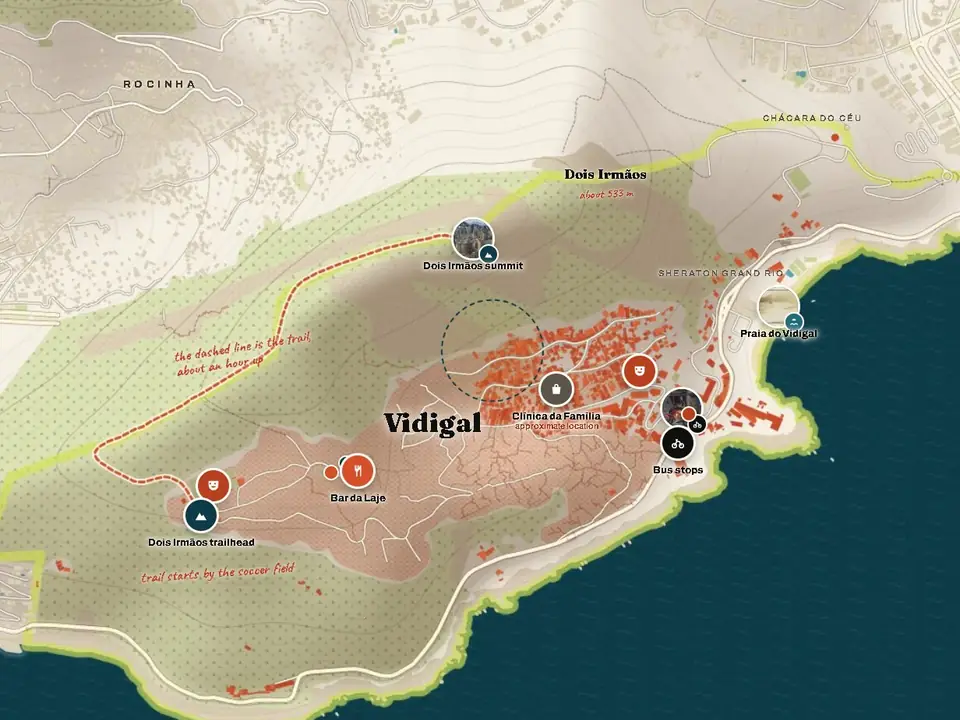
From Vidigal, the honest truth is that you will lean on ride apps and moto-taxis more than on public transport, because the hill is not on a metro line and the nearest station is over in Ipanema at General Osório. For a beach day in Ipanema or Leblon you walk or grab a quick Uber or 99. For a trip across town to the centre or the Zona Norte, the metro tap earns its keep. We map all of it — the tap, the card, the van down the hill, the moto-taxi math — in getting around Rio from Vidigal, which is the companion piece to this one.
~~~Your first two hours on the ground
Put it together and the arrival looks like this. You land at Galeão with the eVisa saved offline on your phone and printed in the folder, and you clear immigration with a passport that has its six months and its blank page. You do not queue at a currency desk. You do not take the cheap tourist bus into town, the one with the old reputation for roadside robberies. If you set up an eSIM, your phone is already online as you walk to baggage; if you did not, you find the TIM or carrier desk in arrivals before you do anything else.
Then you call a ride. Uber and 99 both work from the airport and both are cheaper and cleaner than a negotiated taxi. The car brings you along the coast to the base of Vidigal, because ride apps and taxis stop at the foot of the morro rather than climbing the narrow lanes, and from there a moto-taxi or a shared van carries you up. Keep R$50 in your pocket for that last leg so you are not fumbling for a card on a bike. It is a small, specific piece of choreography, and we walk through every step of it — airport to apartment door — in the airport transfer guide.
By the time you reach the apartment you have done the four things this whole piece is about. Visa cleared. Card in your pocket and a little cash for the hill. Phone online. A plan for moving around that does not involve coins on a bus. What is left is the part you came for. Drop the bags, step onto the terrace, and let the city do the rest — the light on Dois Irmãos, the sea folding into Leblon, the sound of a ball game two lanes down. If you are staying at our condo, the wifi is quick, the kitchen is stocked, and the view is doing the work no arrival checklist can. The admin was the price of admission. This is the thing you paid for.
One last honest note, because the whole point of this page is honesty over marketing. Rules move. The eVisa fee, the exchange rate, the eSIM plans, the transport cards — all of it can shift between the day this was written and the day you fly. The habits are what last. Sort your entry paperwork early, because the visa requirements for US citizens are the one genuinely new hurdle Brazil added in 2026. Carry little cash and cap what a machine can hand out. Get your phone online before you land. Tap for almost everything. Do those four things and Brazil in 2026 is one of the most straightforward big countries you will ever arrive in, whatever the numbers happen to read that month.
Quick questions.
Do US citizens need a visa for Brazil in 2026?
Yes. Brazil reinstated the visa requirement for US, Canadian and Australian citizens, in force since April 2025, so in 2026 Americans need an approved eVisa before they travel. It costs around US$80.90, is valid for ten years, and is applied for entirely online at the official VFS Global portal. Do not rely on older pages that say a passport alone is enough.
How far ahead should I apply for the eVisa?
Two to three weeks is comfortable. Approvals often come back in 48 to 72 hours, but the official window stretches to about ten business days in busy periods, and a rejected document upload restarts the clock. Apply early, save the PDF offline, and print a copy for check-in.
Do I need to bring a lot of cash to Rio?
No. Cards tap almost everywhere and PIX covers the rest for locals. Carry R$150 to R$300 for moto-taxis, beach kiosks and small stalls, and withdraw more from a machine inside a mall or bank when you run low. Skip the airport currency desks, whose rates are poor.
What is PIX, and can a tourist use it?
PIX is Brazil's free instant-payment system, usually paid by scanning a QR code. It normally requires a Brazilian CPF and bank account, which tourists lack, but travel-money apps such as Wallbit let you pay PIX codes with a passport and a foreign-funded balance. For a short trip a card and some cash are simpler; for a long stay, setting up PIX is worth it.
Is using ATMs in Rio de Janeiro safe?
Yes, with sensible habits. Use machines inside malls, bank branches or the airport, in daylight; decline the ATM's own currency conversion; and set a low daily withdrawal limit on your card before you travel. That last step also blunts the express-kidnapping risk by capping what anyone could force you to take out.
What is the best eSIM for a Brazil tourist?
There is no single winner, but the reliable names in 2026 are Airalo, Holafly and Nomad. Airalo runs fixed data plans on Claro from roughly US$5 for 1GB; Holafly sells unlimited data from about US$7.50 a day on TIM or Vivo; Nomad prices a 10GB Vivo plan near US$23. Buy and install before you fly so data is live when you land.
Can I buy a physical SIM card without a CPF?
Legally yes, in practice it depends on the carrier. TIM routinely sells tourist SIMs on a passport alone for around R$25 plus a small activation fee. Vivo and Claro staff often cannot activate a chip without a CPF, so if you want one of those, buy at a mall store used to serving foreigners rather than a small kiosk.
None of this is the trip. It is the ten minutes of planning that hands you the trip clean. Get the visa in your inbox, one good card in your pocket, an eSIM ready to wake up, and a low limit set on the money a stranger could ever reach, and you arrive in Rio unbothered by the things that bother the unprepared. The rest is saudade waiting to happen — the ache you will already feel on the flight home, planning the next one.