
A caipirinha on Ipanema sand runs R$25. A single night in a Copacabana five-star runs R$2,000. Both are Rio, and the distance between them is the entire question. So how much does a trip to Rio de Janeiro cost in 2026. Somewhere between R$280 and R$3,500 a day per person, and where you land inside that range is a decision, not a fate.
The honest answer, in one breath
Rio rewards planning and punishes assumption. The city has a way of being cheaper than nervous first-timers expect and more expensive than the backpacker blogs promise, often on the same afternoon. You can eat a full lunch for R$38 and then pay R$130 to stand on top of a mountain two hours later. Both prices are real. Neither is a rip-off.
Here is the frame we give every guest before they book. There are three Rios, and they cost roughly R$280, R$800, and R$3,000 a day per person once you add up lodging, food, transport, and the odd ticket. The budget Rio is a dorm bed, PF lunches, the metro, and the beach. The middle Rio is an apartment or a good three-star, sit-down dinners, the occasional Uber, and a paid attraction most days. The top Rio is a beachfront suite, tasting menus, private drivers, and a helicopter over the bay if the mood takes you. Most people who read this will live in the middle and dip into the other two by choice.
Currency matters more than any single price, so start there. As of July 2026 the exchange rate sits around R$5.11 to the US dollar, which rounds nicely to R$5 = $1 for mental math. That rate has held the real a touch stronger through the first half of the year, but it moves, so treat every dollar figure below as an approximation and every real figure as the number you will actually be charged. When a Brazilian quotes you a price, they quote reais. Learn to think in reais and the whole trip gets simpler.
One more piece of context that answers the sub-question everyone is really asking. Is Rio de Janeiro expensive for tourists. The short version. Not by the standards of Lisbon, London, or New York, and not if you hold dollars or euros. Groceries, transport, and casual food are inexpensive. Imported goods, air-conditioned taxis in traffic, and anything with the word rooftop attached are where the money leaks out. Control the leaks and Rio is one of the great value cities on the planet.
What a day in Rio costs, by style
Per person, per day, all-in (lodging, food, transport, one activity). Sampled July 2026. Reais first, dollars rounded at R$5 to the dollar.
- Lodging is the single biggest line and the one you can move the most.
- Food swings from R$38 (a PF lunch) to R$300+ (a tasting menu) on the same day.
- The beach, the sunset, and the walk are free. Budget Rio leans on all three.
- Flights are separate. Figure US-to-Rio round trips from roughly $490 to $930 depending on city and season.
The three Rios — budget, middle, and top
The most useful way to answer the Rio de Janeiro cost-per-day question is to pick your lane honestly and price it out. Nobody travels as a spreadsheet average. You are one of these three people, or some blend, and you know which.
Budget Rio — about R$250 to R$400 a day
This is the hostel-and-beach version, and it is a genuinely good trip, not a compromise. A dorm bed in Ipanema or Botafogo runs R$150 to R$220 a night as of 2026. Breakfast is bread and coffee at a padaria for under R$15. Lunch is a prato feito — the plate of the day, a protein with rice, beans, and salad — for R$30 to R$45. Dinner is a pastel and a chopp at a botequim, or a supermarket cook-up if your hostel has a kitchen. You take the metro (R$7.90) and the bus (R$5) everywhere and walk the rest. Your one paid attraction most days is the beach, which is free, and your entertainment is the sunset from Arpoador, which is also free. Rio de Janeiro on a budget is not a myth. It is arguably the truest version of the city, the one where you end up talking to strangers because you are all sitting on the same seawall.
Mid-range Rio — about R$700 to R$1,000 a day
This is where most visitors actually live, and where a short-term apartment starts to earn its keep. Lodging is a private room, a solid three-star, or a whole apartment split between two people, which lands anywhere from R$400 to R$900 a night depending on neighborhood and season. You eat one sit-down dinner a day at a mid-range restaurant for R$110 to R$155 a head, keep lunch cheap and local, and drink caipirinhas that cost R$20 to R$35 rather than R$50. You Uber when it is late or raining, metro when it is not. You do a paid thing most days — Sugarloaf, the Christ, a boat, a football match — and you never once check whether you can afford lunch. Two people traveling this way spend roughly R$1,400 to R$2,000 a day combined, and the trip feels unhurried.
Top Rio — about R$2,000 to R$4,000+ a day
The ceiling in Rio is high, and the money goes almost entirely into two places: the pillow and the plate. A sea-view room at the Copacabana Palace or the Fasano runs R$1,200 to R$2,200 a night, and peak-season rates during New Year or Carnival push well past that. Dinner at a serious restaurant is R$300 to R$500 a head before wine. Add a private driver, a guided Dois Irmãos hike, a helicopter loop over Guanabara Bay, and a day on a chartered boat, and R$3,000 a day per person disappears without any showing off. This Rio is beautiful and entirely optional. The view from the top of the hill, it turns out, is identical whether you paid R$2,000 for it or R$400.

Where the money actually goes
Every Rio budget is really five lines: lodging, food, getting around, doing things, and the boring stuff nobody counts until they are home. Understanding the shape of the spend matters more than any single price, because it tells you where effort pays off. Shaving R$5 off a beer forty times over a week saves you R$200. Choosing the right place to sleep saves you that much in a single night. Focus accordingly.
The rough split for a mid-range week looks like this. Lodging is 40 to 50 percent of what you spend on the ground. Food is 25 to 30 percent. Getting around is 8 to 12 percent. Attractions and activities are 10 to 15 percent. The remainder is the drips: water, sunscreen, a SIM, tips, a poncho you buy in a downpour. Flights sit outside all of it and often cost more than the entire week on the ground, which is the great irony of a cheap destination reached by an expensive plane.
Here is a price check on the individual things you will actually buy, so the abstract becomes concrete. These are 2026 street prices, sampled in the Zona Sul and around Vidigal, not resort menus.
- Coffee at a padaria
- R$4 to R$6 for a pingado, standing at the counter.
- PF lunch (plate of the day)
- R$30 to R$45 with a juice. The best value meal in Brazil.
- Chopp (draft beer)
- R$8 to R$15. Cheaper at a boteco, dearer on the sand.
- Caipirinha
- R$15 on the beach, R$25 to R$50 at a bar with a view.
- Bottled water (500ml)
- R$5 to R$9. You do not drink the tap here.
- Metro ride
- R$7.90 flat, any distance, air-conditioned.
- Sugarloaf cable car
- R$130 per adult. The Christ is about R$134 with the train.
- Mid-range dinner
- R$110 to R$155 a head, before drinks and the 10% service charge.
You cannot change the price of the cable car. You can change where you sleep. That one decision moves your budget more than everything else on the trip combined. — the single budget rule we actually stand behind
Lodging — the one line you can move
If you take one number from this whole piece, take this one. The gap between a mid-range hotel room and a shared apartment is the largest single lever in a Rio budget, and it is entirely within your control. The cable car costs R$130 for everyone. Dinner costs what dinner costs. But the bed can cost R$220 or R$2,200, and the view from the cheaper one is frequently better.
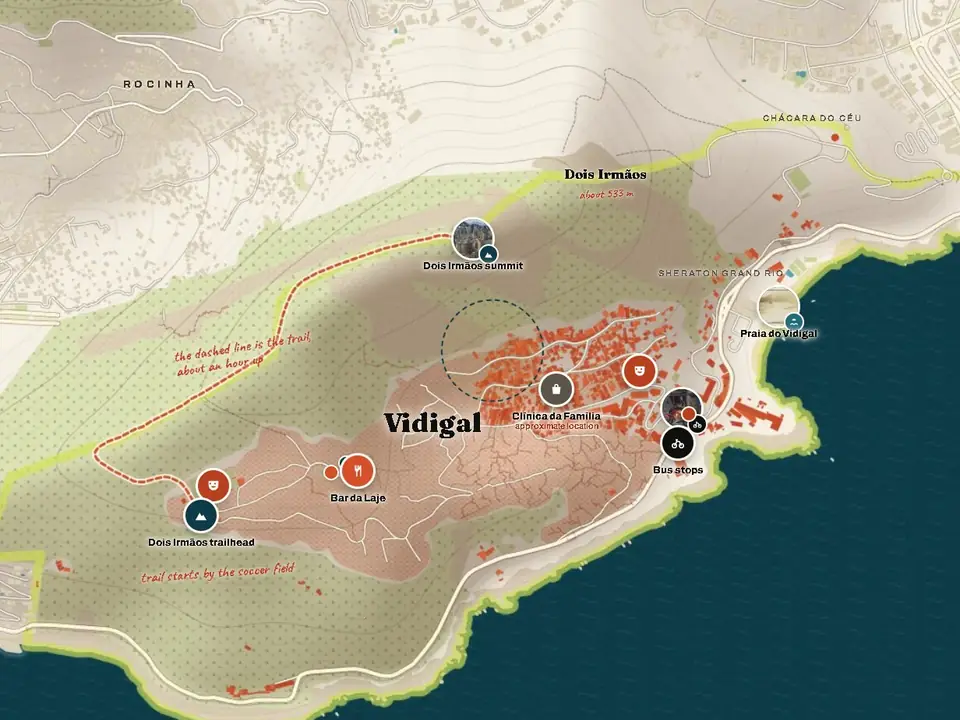
The numbers, as of 2026. A hotel room in Ipanema averages around R$1,150 a night ($228). Copacabana runs a little softer, roughly R$300 to R$800 for mid-range depending on season, with peak dates in December through February pushing the top of that. A five-star sea-view room is R$1,200 and up. Meanwhile, a whole apartment in Vidigal — the hillside neighborhood just west of Leblon, with the ocean on one side and Dois Irmãos overhead — starts around R$400 a night and tops out well below hotel rates for far more space. Split between two couples, a good Vidigal apartment can land under R$150 per person per night with a kitchen, a terrace, and a view that hotels charge a premium to imitate.
That is the whole trick of the save-versus-hotel math, and it compounds. The kitchen means breakfast is R$15 of supermarket bread and fruit instead of a R$70 hotel buffet. The living room means you are not paying for two rooms to fit four people. The terrace means the sunset drink is a R$8 supermarket beer on your own laje instead of a R$45 rooftop pour. None of this is deprivation. It is the difference between renting a room and borrowing a life.
The hotel math
- R$800 to R$1,200 a night, mid-range Zona Sul.
- Two rooms if you are four people. Double it.
- Breakfast included, but you eat it on their schedule.
- Housekeeping, front desk, a pool you use twice.
- Zero cooking. Every meal is bought.
The apartment math
- R$400 to R$900 a night for the whole place.
- Four people, one price. Per person it collapses.
- Kitchen, so breakfast and the odd dinner are cheap.
- A terrace and a view that is the reason you came.
- You live in a neighborhood instead of a lobby.
We are not neutral on this, and we will say so plainly rather than pretend otherwise. We keep a duplex near the top of Vidigal, and the reason the apartment-versus-hotel gap is the first thing we tell guests about is that it is the number that changed our own trips years before we ever rented to anyone. If you want to see how the arithmetic runs against the two obvious alternatives, our breakdown of whether Vidigal is cheaper than Ipanema puts the two side by side line by line, and you can always see the condo and do your own math against whatever hotel tab you were bracing for.
Four people, five nights — the lever in one table
Same trip, same neighborhood zone, two ways to sleep. Numbers rounded, 2026.
- That saved R$4,500 is two tasting-menu dinners, every cable car and ticket for four, and a boat day, with change.
- The kitchen quietly saves another R$100 to R$200 a day in breakfasts and beers.
- This is why lodging is the lever. Nothing else on the trip swings this hard.

Getting around, and what it costs
Transport in Rio is cheap if you use the systems locals use and expensive the moment you default to a taxi in traffic. The good news for anyone counting reais is that the cheap options are also, most of the time, the fast ones.
The metro is the backbone. A single ride is R$7.90 as of 2026, flat, any distance, and the trains are clean and air-conditioned, which on a February afternoon is worth the fare on its own. It runs from Ipanema through Copacabana and Botafogo into the center, and it is the way to cross the city without buying a lottery ticket on the roads. Municipal buses are R$5 and go everywhere the metro does not, though they take patience and a little Portuguese. Rio is rolling out a new integrated fare system called Jaé, a tap card and app that ties the metro, buses, BRT, and the licensed vans together, with the mandatory discounted integrations arriving in August 2026. For a visitor the practical upshot is simple: tap on, tap off, and the metro-plus-van combination up to a hillside neighborhood like Vidigal is capped around R$8.80 rather than two separate fares. Our full walk-through of the metro and the Jaé rollout lives in getting around Rio from Vidigal, because the details reward five minutes of reading before you land.
Uber is the tool for late nights, rain, and luggage, and it is far cheaper than a metered taxi. A short hop across Ipanema is R$15 to R$25. A five-kilometer ride is around R$20. The airport into the Zona Sul, a trip that intimidates first-timers, runs R$80 to R$120 by app depending on traffic and exactly where you are going, which is a fraction of what the airport taxi touts will quote you at arrivals. Inside Vidigal itself, the local moto-taxis and vans run the steep main road for R$3 to R$5, and they are the correct way up the hill unless you enjoy a twenty-minute climb with your shopping. If you are working out the airport leg specifically, the tip is to order the car from inside the terminal on your own phone and walk past the men holding signs.
Add it up and a mid-range visitor spends maybe R$40 to R$80 a day getting around, less if you lean on the metro and your own two feet. Budget travelers can hold it under R$25 a day. Only the top tier, with private drivers on call, turns transport into a real line item, and even then it is dwarfed by the room.
What you'll actually do, and what it costs
This is the line people over-estimate. Rio's signature pleasures are mostly cheap or free, and the paid attractions, while worth doing, are a smaller slice of the budget than the guidebooks imply. You are not in a city that nickel-and-dimes you at every turn. You are in a city whose best asset, the coastline, costs nothing to use.
Start with free, because it is a long list. Every beach in Rio is public and free — Ipanema, Leblon, Copacabana, Vidigal's own small strip, the wilder sand at Prainha and Grumari further out. The sunset from Arpoador rock draws a crowd that applauds when the sun drops, and it costs nothing. The Escadaria Selarón steps, the Sunday street life along the closed beachfront road, the Parque Lage gardens at the foot of the Christ, the view from the Mirante Dona Marta if you can get a ride up: all free. A day that costs R$50 in food and nothing else can still be one of the best days of the trip.
Then the paid icons, priced for 2026. The R$ Sugarloaf cable car is R$130 per adult for both stages. Cristo Redentor, the Christ statue, is around R$134 including the cog train up through the forest, and booking a timed slot online is close to mandatory in high season. A football match at the Maracanã is R$60 to R$200 depending on the fixture and your seat, and it is one of the great cheap thrills in world sport. A favela walking tour with a resident guide runs R$80 to R$150. Hang gliding off the ramp at São Conrado, the tandem flight that lands on the beach below Vidigal, is a real splurge at R$700 to R$900, and worth every real if the wind is right. A boat day, a helicopter loop, a Dois Irmãos guided hike: each is optional, each is memorable, and none is required to feel you have seen the city.
The realistic activity budget, then. A budget traveler might do one paid thing every second day and average R$40 to R$60 daily. A mid-range visitor doing something most days lands around R$80 to R$150 daily. Only a packed luxury itinerary of private tours and charters pushes activities into the hundreds of dollars a day, and by then you have stopped counting anyway.

A week in Rio, costed out
Abstractions are easy to argue with, so here are three real weeks for two people traveling together, seven nights on the ground, flights excluded. These are honest totals, not the fantasy-cheap numbers you see elsewhere and not the padded ones either. Round them, do not memorize them.
The budget week, two people: about R$4,600 total (~$900). Two dorm beds or a very cheap private room at R$200 a night is R$1,400. Food at R$120 a day for two, leaning on padarias, PF lunches, and the supermarket, is R$840. Transport on metro and bus at R$50 a day for two is R$350. Activities, a few paid things across the week, maybe R$600. Water, SIM, and the odd extra, R$400. That is a full week in Rio, both of you, for less than a single peak-season night at the Copacabana Palace. This is the answer to anyone who doubts you can do Rio de Janeiro on a budget.
The mid-range week, two people: about R$11,000 total (~$2,150). A whole apartment at R$700 a night is R$4,900 and is the single biggest number, which is exactly why the neighborhood you choose decides this tier. Food at R$400 a day for two, with one proper dinner daily, is R$2,800. Transport with a mix of metro and Uber, R$700. Activities across the week, R$1,600. Extras, R$1,000. Comfortable, unhurried, nothing skipped.
The luxury week, two people: about R$35,000+ total (~$6,900+). A sea-view suite at R$2,500 a night is R$17,500. Fine dining at R$1,200 a day for two is R$8,400. A private driver and guided experiences, R$6,000. Everything else, R$3,000. This is the ceiling, and it climbs from there without effort during New Year or Carnival, when the same suite can triple. If your dates are flexible, our month-by-month guide to the best time to visit Rio shows exactly when those peak multipliers hit and when they fall away.
~~~Cash, card, and Pix — the money question, answered
How much money to bring to Rio de Janeiro is less about a number and more about the mix. Here is the mix.
- Card first. Visa and Mastercard are accepted almost everywhere, including small restaurants and moto-taxis with a card reader. Bring a card with no foreign-transaction fee.
- Cash as backup. Carry R$200 to R$300 for beach vendors, the smallest kiosks, and tips. Withdraw from bank ATMs (Banco24Horas, Bradesco, Santander) in daylight, inside a branch or mall, not a lone street machine.
- Pix is king but hard for tourists. Brazil's instant-transfer system needs a local tax ID (CPF), which most visitors do not have. Do not count on it. Your host may accept it if you can get set up.
- The eVisa. US, Canadian, and Australian citizens need a Brazil eVisa, roughly $80.90, valid ten years, applied for online at the official portal. Budget it, and the ATM and scam details, via our arrival essentials guide.
How to spend less without missing Rio
Cutting a Rio budget is not about suffering. It is about knowing which costs are structural and which are just habits you can drop. Here is what actually moves the number, in the order it matters.
Move the room first, because you already know it is the lever. An apartment split two or four ways beats a hotel on every metric that counts, and it does so while giving you more room and a kitchen. If a hotel is non-negotiable for you, at least drop from Ipanema to Copacabana, where the same star rating costs meaningfully less, or push your dates out of the December-to-Carnival peak, when rates can run 50 percent above the quiet months. The cheapest time to visit, worth saying plainly, is the southern winter of June, July, and August, when the crowds thin, the sea is still swimmable, and lodging can run a third cheaper than summer.
Eat like a local for two meals and splurge on the third. The prato feito lunch at R$38 is not a downgrade from a R$150 restaurant lunch; it is often better, and it is what the people around you are eating. Buy your water and beer from a market rather than a beach vendor. Keep the fancy meals for dinner, when the room and the view justify the tab. On drinks, the beach caipirinha at R$15 and the supermarket beer on your own terrace are where the savings hide, not in skipping the one nice meal you will remember.
Use your feet and the metro. Rio's Zona Sul is walkable and stitched together by a cheap, cool, fast train. Save Uber for the nights it earns its price. And do the free things without apology, because they are not the consolation prize, they are the point. The sunset is free. The beach is free. The walk back up the hill at dusk, with the lights coming on across the water, is free and is the thing you will actually miss when you are home. The saudade that hits on the plane is never about the tasting menu. It is about the R$6 coffee and the view you did not pay extra for.
Quick questions.
Is Rio de Janeiro expensive for tourists?
Not compared to major North American or European cities, and not for dollar or euro holders as of 2026, with the real around R$5.11 to the dollar. Casual food, transport, and groceries are cheap. Imported goods, taxis stuck in traffic, and rooftop bars are where costs climb. Manage lodging and you will find Rio one of the better-value big cities anywhere.
How much does a trip to Rio de Janeiro cost per day?
Budget on roughly R$280 a day per person for a hostel-and-beach trip, R$800 for a comfortable mid-range trip with an apartment and daily dinners out, and R$3,000 or more for a five-star, fine-dining, private-driver trip. Flights are extra. Most visitors spend somewhere in the R$700 to R$1,000 range and dip lower or higher by choice.
How much money should I bring to Rio de Janeiro?
Bring a no-fee Visa or Mastercard as your main method, since cards are accepted almost everywhere, plus R$200 to R$300 in cash for beach vendors, small kiosks, and tips. Top up cash from bank ATMs in daylight. Pix, the instant-transfer system, is everywhere but needs a Brazilian tax ID most tourists cannot easily get, so do not rely on it.
Can you really do Rio de Janeiro on a budget?
Yes. Two people can spend a full week on the ground for around R$4,600 by using dorms or a cheap room, eating PF lunches and cooking, riding the metro, and leaning on the free beaches and viewpoints. The single biggest budget decision is where you sleep. Everything else is smaller and easier to adjust.
Do I need to tip in Rio?
Most sit-down restaurants add a 10% taxa de serviço to the bill, which functions as the tip and is almost always paid, though it is technically optional. Tipping beyond that is uncommon. At padarias, botecos, and beach kiosks there is no service charge and no tip expected, though rounding up is a kind gesture.
Cash or card in Rio, and what about ATMs?
Card for almost everything, cash for the margins. Use ATMs attached to banks (Banco24Horas, Bradesco, Santander, Caixa) during the day, ideally inside a mall or branch. Be alert to a scam where someone pressures you into an on-the-spot transfer or a strange ATM screen; when in doubt, cancel and walk away. Our arrival essentials guide covers the details.
When is Rio cheapest to visit?
The southern winter of June, July, and August is the value window, with lodging often a third cheaper than summer and the weather still warm enough to swim. Avoid December through Carnival if price is your priority, since rates in that peak stretch can run 50 percent or more above the quiet months, and the very top dates around New Year sell out first.
Rio does not have one price. It has a range, and the range is unusually wide even by the standards of big cities, which is why the honest answer to the cost question is always another question: which Rio do you want. Pick your lane, put your effort into the room, and let the beach do the rest for free. The number at the end will be smaller than you feared, and the week will be larger than you planned.