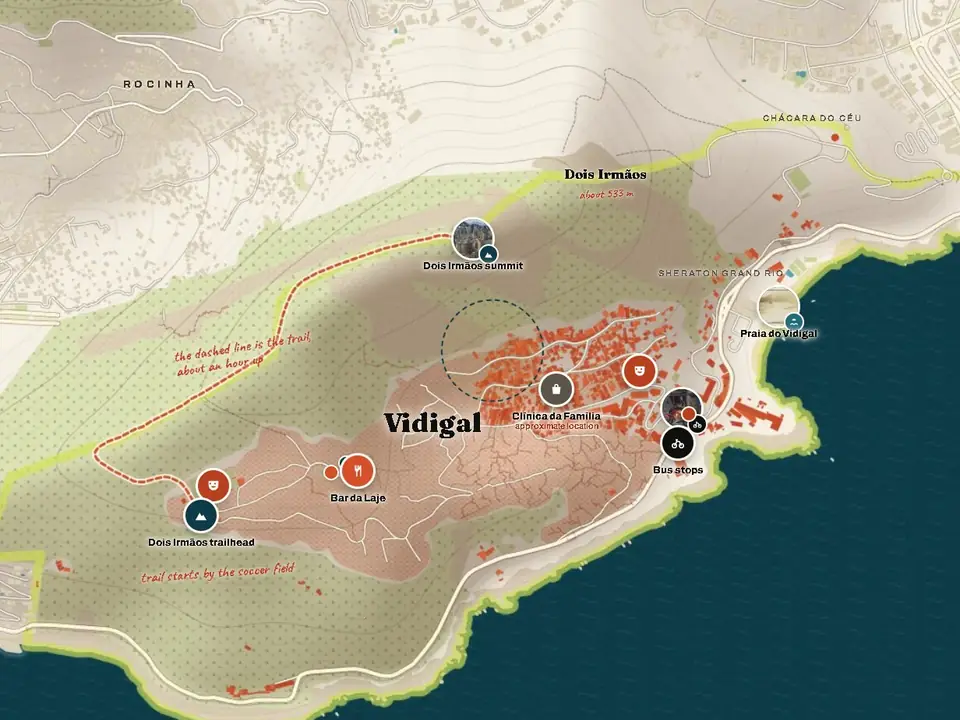

Eighth floor, a little before ten in the morning. Your laptop is open on the terrace table, a call with New York starts in twelve minutes, and the fiber router blinks a steady green while Dois Irmãos catches the first hard light off the water. This is the Vidigal digital nomad guide we hand to guests who land with a work contract and a month to spend — what actually connects, what it costs in reais, and where the desk beats the coworking cubicle.
The honest answer, before the brochure (can you really work from here?)
Yes. With three caveats you should hear before you wire a deposit. That is the whole review, and the rest of this piece is the fine print.
People ask is Vidigal good for remote work the way they ask whether you can drink the tap water — half expecting the answer to be a polite no. The polite no is wrong. Rio has spent the last decade quietly turning into one of the better remote-work cities in the Americas, and the reasons are boring and structural: cheap symmetric fiber, a time zone that overlaps the US East Coast almost perfectly, a large and growing nomad community, and a café habit that predates the laptop by a century. Vidigal gets all of that, plus a view that no rented desk in Botafogo will ever match. Fiber runs up the main lanes of the morro. The South Zone has some of the strongest mobile coverage in the country. And the beach is a few minutes down the hill when the workday breaks.
Now the caveats. First, this is a hillside, and the hill is real — your commute to a downhill coworking space is a moto-taxi or a walk with a gradient, not a stroll. Second, infrastructure up here is good but not flawless: power and water can blink for a few minutes at a time, which matters when you are mid-call, and the fix is a small piece of equipment we will get to. Third, Vidigal is a living neighborhood, not a co-work resort. Weekends can be loud. A baile funk two lanes over does not care about your Monday deliverable, except it is usually Friday and Saturday, and you will learn to schedule your hardest calls for weekday mornings when the hill is quiet and the light is best.
Hold those three in your head. Everything below is about turning them from surprises into logistics. If you want the money version of the same conversation — rent, food, transport, the full monthly math — that lives in our month-in-Vidigal budget piece, and the two are meant to be read together.
The connectivity picture, in four numbers
Sampled across Rio and Vidigal listings, as of 2026. Reais, not dollars. Ranges are honest, not marketing.
- Fiber providers up the hill: Vivo Fibra, Claro, TIM Live. True fiber is symmetric — upload matches download.
- Backup that saves calls: a nobreak (a small UPS) on the router, plus a 5G phone hotspot.
- Rio runs on UTC-3 and stopped changing its clocks in 2019. No daylight-saving confusion, ever.
- Pix and cards work everywhere. A coworking day pass runs R$60 in Botafogo to R$150 in Leblon.
The internet, honestly — what a favela hillside actually delivers
Start with the phrase people search in a nervous voice at 2am before booking: internet speed Rio favela. The mental image is a single overloaded router and a spinning wheel. The reality, in Vidigal in 2026, is fiber-optic cable strung along the same poles that carry the power, run by the same three national providers that serve Ipanema — Vivo Fibra, Claro, and TIM Live. Standard residential plans across Rio deliver anywhere from 300 Mbps to a full gigabit for roughly R$80–150/mo, and because it is true fiber, the connection is usually symmetric. That word matters more than the headline number. Symmetric means your upload is as fast as your download, which is the difference between being the person on the video call whose face freezes and the person whose face does not.
Actual Vidigal apartment listings back this up. The oceanfront apartments on the hill routinely advertise 500 Mbps, and some business-oriented ones push 750 Mbps or more, with a wired desk and a dedicated router. That is not a favela handicap you are overcoming. That is a genuinely fast connection with a genuinely good view attached to it. A fast wifi apartment Vidigal is not a contradiction in terms — it is the standard the better hosts up here now compete on.
The honest texture: fiber coverage is densest along the main road and the established lanes, and gets patchier at the very top and in the newest, highest self-built sections. The middle and lower reaches of the hill — where most of the apartments you would actually rent sit — are well served. This is one reason the floor and the exact address matter, and why you ask before you book rather than after.
- Typical Rio fiber
- 300 Mbps to 1 Gbps on standard plans, R$80–150 a month.
- Advertised in Vidigal
- Commonly 500 Mbps; business listings quote 750 Mbps and up.
- Upload
- Symmetric on true fiber — the number that saves video calls.
- New installs
- Need a CPF and 5–10 business days. As a visitor, you use the apartment's existing line — you do not install your own.
- Backup
- A 5G home router (Claro or Vivo) runs R$120–180 a month and holds 150–400 Mbps when fiber blinks.
One thing the speed-test screenshot will not tell you: reliability is not the same as speed. A line can be a gigabit and still drop for ninety seconds when the neighborhood power flickers, because the router reboots. That is not a Vidigal problem so much as a Rio problem, and the whole city solves it the same cheap way. More on that in the setup section. For now, hold this: the speed is real, the resilience is something you engineer, and both are within reach for less than you pay for mediocre internet at home.

Before you book a fast wifi apartment Vidigal — the listing checklist
Every remote worker who has been burned once knows that a listing photo of a desk means nothing. Here is what to actually ask the host, in the order that matters. Send it as a single WhatsApp message before you book. A good host answers all of it in one reply and often volunteers a speed test unprompted. A host who goes quiet on these questions is answering them anyway.
Ask for a screenshot of a real speed test run in the apartment, at a normal hour, showing both download and upload. Ask specifically for the upload number, because that is the one hosts forget to mention and the one your calls depend on. Ask whether there is a nobreak on the router — the Brazilian word for a UPS, an uninterruptible power supply — because that little box is what keeps you connected through the brief power blinks that are ordinary here. Ask whether you can plug in by ethernet cable, since a wired connection beats wifi for anything that has to be rock-solid. Ask which floor the unit is on and whether the desk faces a window, because a laptop in direct equatorial sun at noon is a laptop you cannot see. And ask, plainly, about weekend noise and how close the nearest bar or baile is.
Green flags in a listing
- A dated speed-test screenshot with the upload number visible.
- A nobreak or UPS mentioned on the router.
- An ethernet port or cable available at the desk.
- Air conditioning in the room you will work in, not just the bedroom.
- A real chair. Not a dining chair. A chair.
- A host who replies in minutes and answers all of it.
Quiet red flags
- "Fast wifi" with no number, no screenshot, no provider named.
- Silence on upload speed after you asked twice.
- No power backup mentioned, and vagueness when pressed.
- A desk that is really a kitchen table in the photos.
- Top-of-the-hill address with no coverage detail.
- Reviews that praise the view and never mention working.
The apartment we know best up here — the duplex we write this site around — is set up for exactly this: a wired option, a router on backup power, and a desk that faces the water rather than a wall, which sounds like a small thing until your third week when the view is the reason you are still in a good mood at 4pm. You do not have to stay there. You do have to stay somewhere that treats the connection as infrastructure and not decoration. In Vidigal, in 2026, that place exists at every price point. You just have to ask the six questions.
The best home office in Rio is not the quietest one. It is the one where you look up from a spreadsheet and there is the ocean, and you remember why you flew this far to work. — what we tell every guest who arrives with a laptop
Coworking near Vidigal Rio — from the hill to the lagoon
Some days you need to get out of the apartment. Maybe the light is wrong, maybe you have back-to-back calls and want redundancy, maybe you simply need other humans in the room. The good news for coworking near Vidigal Rio is that the options fan out in a neat ladder, from one flight up the lane to a fifteen-minute ride around the lagoon, and the price climbs with the postcode.
Start on the hill itself. Nova Era Vidigal, on Rua Major Toja Martinez Filho, is a coliving-and-coworking house built specifically for remote workers, with proper desks, decent chairs, a whiteboard, a shared kitchen, and a rooftop terrace that looks straight at Dois Irmãos and the sea. It is the only dedicated coworking actually inside Vidigal, and it is a genuinely useful thing to have four hundred meters from your door. It doubles as a bar and a community hub, so it is social by design — good for the days you want company, less ideal for the day you need silence for six hours. Ask them directly about a coworking day rate when you arrive, since the desk access and the room bookings shift with the season, and I would rather you get a current number from them than a stale one from me.
Down the hill, the value champion is Botafogo, about twenty minutes away by Uber depending on the tunnel traffic. Botafogo has quietly become Rio's main coworking cluster, and the math is friendly: day passes around R$60 and a monthly hot desk near R$600. If you are here for a full month and want a serious desk with fast wired internet and air conditioning that you do not have to think about, a Botafogo monthly is the most rational purchase on this whole list.
Closer and glossier, Leblon and Ipanema have the international-brand spaces — the ones with espresso machines and glass-walled call booths and a receptionist. Day passes there run R$100–150, roughly double Botafogo, and you are paying for the address and the polish as much as the desk. For a big client call where you need a silent, professional-looking backdrop, they earn it. For everyday grinding, they are a luxury. Citywide, a dedicated private desk on a monthly contract lands somewhere between R$600 and R$1,000 depending on neighborhood and how many perks come stapled to it.
The coworking ladder, cheapest to shiniest
Day rates and monthly desks around Vidigal, as of 2026. Ranges, not promises.
- Botafogo is the value play: R$600 buys a monthly hot desk.
- Leblon and Ipanema buy you the address and the call booths.
- For most people, home fiber plus the occasional day pass beats a full monthly membership.
The unglamorous truth is that if your fast wifi apartment Vidigal is set up properly, you will not need a coworking membership at all. You will buy the occasional day pass on a heavy-call day, keep a Botafogo option in your back pocket for the week the fiber acts up, and otherwise work from the terrace. The coworking is insurance and variety, not your primary office. Budget it as a treat, not a fixed cost.

The café circuit — where a laptop is welcome and where it is not
Rio had café culture long before anyone called it remote work, and the etiquette is generous: order something, stay a while, nobody rushes you. The trick is knowing which rooms are wired for a work session and which are strictly for a cafezinho and a conversation.
Inside Vidigal, be honest with yourself. The padaria at the base and the botequim on the corner are wonderful, and you can absolutely answer email over a coffee there for an hour. But they are not built for a four-hour deep-work block — the wifi is for the owner's phone, the power outlets are behind the counter, and the whole point of the place is that it is social. Treat them as a change of scene and a caffeine run, not an office. For where those places are and what to order, our Vidigal restaurant guide maps the whole hill.
For real café work you go down to Leblon and Ipanema, a short moto-taxi or a walk with a view. Ipanema has a cluster of laptop-friendly rooms that expats have already broken in: Gringo Café for all-day breakfast and reliable wifi, Kraft Café for an industrial room full of outlets, and Aussie Coffee, which is so full of foreigners on laptops that the staff have made peace with it. In Leblon, Talho Capixaba — the same deli-bakery the food guide sends you to for breakfast — has outlets and free wifi and a calm mid-morning lull, and Armazém do Café sits two blocks from the sand with the tranquil, slightly serious energy of a place where people actually get things done. On a calm weekday, a beach quiosque with a plug and a shaded table is the best office in the Southern Hemisphere, right up until the wind picks up and sand gets into your keyboard, which it will, so keep those sessions short and your laptop bag zipped.
The café rule of thumb: mornings for the good rooms, before the lunch crowd claims the tables and the wifi thins out. By one in the afternoon every laptop-friendly café in the Zona Sul is at capacity and the baristas start giving the four-hour campers a look. Do your café work early, then walk it off on the beach.
~~~Time zones: the quiet superpower — why your calendar just works
Here is the part of the pitch that sounds too good and happens to be true. Rio de Janeiro runs on UTC-3, and Brazil abolished daylight saving time in 2019, so the clock here does not move — not in your summer, not in your winter, not ever. For anyone coordinating across borders, that steadiness is worth more than an hour saved, because it means you never do the twice-a-year math of wondering whether the gap with head office just shifted.
For the US East Coast, the overlap is close to perfect. Rio sits one hour ahead of New York during the North American summer and two hours ahead in the depth of winter. In plain terms: when your team in New York sits down at nine in the morning, it is ten or eleven on your terrace, and you have already had coffee and watched the light come up over the water. A full working day lines up. You can take the 9am standup, the noon check-in, and the 4pm wrap without a single call landing at a barbaric hour. This single fact is why so many US-employed nomads pick Rio over Lisbon or Bali, where the workday either starts before dawn or ends near midnight.
The West Coast is a gentler overlap — Rio runs four to five hours ahead of California, so a Los Angeles nine o'clock is your early afternoon, which is fine, and it hands you a slow, unhurried morning that is arguably the best perk of the arrangement. Europe tilts the other way and still works: London is three to four hours ahead of Rio and Western Europe four to five, so their afternoon is your late morning, and there is a comfortable window in the middle of your day to catch anyone in Lisbon, London, or Berlin before they log off. You will not please everyone on every continent at once. Nobody can. But if your work anchors to the Americas, Rio is one of the most calendar-friendly cities you can pick, and Vidigal gives you the same clock with a better window.

Setting up a month-long base — SIM, visa, power, rhythm
A weekend needs nothing. A month needs a short setup ritual, and doing it in the first forty-eight hours is the difference between a smooth stay and a fortnight of small frictions. Here is the order we walk guests through.
Get a local number first. A Brazilian SIM makes everything else easier — Uber, iFood delivery, the WhatsApp messages that run this entire country, and the two-factor codes for anything local. Prepaid tourist SIMs from Claro or Vivo cost R$30–70 for 15–30 GB and, crucially, you can buy them at an airport kiosk on your passport alone, no CPF tax number required. Claro and Vivo have the strongest 5G across the South Zone, so pick one of those. If you would rather not swap a physical SIM, an eSIM from Airalo or Holafly gets you online the minute you land, usually for a little more per gigabyte. That mobile line is also your connectivity insurance — the hotspot you tether to when the apartment fiber takes its ninety-second nap. The full arrival checklist, including the eSIM options and how PIX works, is in our Brazil arrival essentials piece.
Know which visa you are actually on. Most people reading this are on the tourist e-Visa, which US, Canadian, and Australian citizens have needed since April 2025. It costs US$80.90, is valid for ten years with multiple entries, and lets you stay up to 90 days per visit and 180 days total in any twelve-month window. That is plenty for a month, or even a long season, of working remotely for a company back home. If you intend to stay longer or base yourself here properly, Brazil runs a dedicated digital nomad visa — the VITEM XIV — which asks for proof of roughly US$1,500 a month in foreign income or about US$18,000 in savings, and grants a year, renewable once. One line to keep in view: cross 184 days in the country within a rolling twelve months and Brazil considers you a tax resident on worldwide income, at rates up to 27.5 percent. For a month-long stay none of that bites. For a six-month experiment, it is a conversation to have with an accountant before you book the second half.
- Tourist e-Visa
- US$80.90, ten-year validity, apply at brazil.vfsevisa.com, usually approved in 48–72 hours.
- Stay limits
- 90 days per entry, 180 days total per 12 months.
- Longer than that
- The VITEM XIV digital nomad visa — one year, renewable once.
- Nomad income test
- Around US$1,500 a month in foreign income, or US$18,000 in the bank.
- Tax tripwire
- 184+ days in a rolling year makes you a tax resident. Plan for it before you cross it.
Engineer around the flicker. This is the caveat from the top of the page, solved. Rio's power and water are generally reliable and occasionally not, and the outages that matter for work are the short ones — a few minutes, enough to reboot a router and drop a call. The whole city handles it with two cheap habits. A nobreak (a UPS) on the router keeps the internet alive through the blink, and a charged phone on a mobile plan is your instant hotspot for anything longer. Confirm the first exists in your apartment and carry the second in your pocket. Water interruptions are rarer and shorter; most buildings up the hill have a rooftop tank that bridges them, and you will likely never notice. Once these are in place, the reliability worry that fills the forums simply stops being your problem.
Then settle into the rhythm. Getting around from a Vidigal base is its own small skill — the moto-taxis up and down the lane for a handful of reais, the buses and the metro at the bottom of the hill, and the Jaé card that in 2026 has replaced the old RioCard on the city's buses and vans. Our getting around from Vidigal guide has the whole system mapped, including which trips are faster by app. For a month-long stay, the other number worth chasing is the monthly discount — Airbnb and most direct hosts drop the nightly rate substantially for 28-plus nights, which is the single biggest lever on your budget and the reason a long stay here can undercut a hotel week in Copacabana.
So — is Vidigal good for remote work? The verdict, and who it is not for
For the right person, Vidigal is one of the best-value remote-work bases in Rio, and Rio is one of the best in the Americas. That is the earned conclusion of everything above. But "the right person" is doing work in that sentence, so let me be specific about who thrives here and who should book Ipanema instead and pay the premium with a clear conscience.
You will love it if you are anchored to American working hours, if your job is calls and documents rather than a trading desk that dies at one dropped packet, if you like the idea of closing the laptop and being on the sand in ten minutes, and if a hill, a moto-taxi, and a neighborhood that is loud on Saturdays read as texture rather than obstacle. You will love it if you want your rent to buy a view instead of a lobby, and if you would rather have the money you saved to spend on the city.
You should think twice if you need certified, uninterrupted uptime for latency-critical work with zero tolerance for a ninety-second blip — book the corporate coworking and stay near it. Think twice if stairs and gradients are a genuine barrier for you, because the hill does not flatten out for anyone. And think twice if your ideal of a work trip is a sealed, silent, identical box in any city on earth, because Vidigal is emphatically a place, with a place's moods. None of that is a knock on the neighborhood. It is just honesty, which is the only useful thing a guide like this can offer. The hill is not trying to be a business hotel. It is trying to be somewhere you actually want to be while you work, and for a lot of people that turns out to be the whole point.
Quick questions.
Is the internet in Vidigal actually fast enough for video calls?
Yes. Fiber from Vivo, Claro, and TIM runs up the hill, and Vidigal apartment listings commonly advertise 500 Mbps, with business-oriented units quoting 750 Mbps or more. On true fiber the upload matches the download, which is what video calls actually depend on. Ask any host for a dated speed test showing both numbers before you book.
What happens to my call when the power flickers?
Nothing, if the apartment has a nobreak — a small UPS — on the router, which keeps the internet alive through the brief outages that are normal in Rio. For anything longer, tether to your phone on a local 5G plan. Confirm the UPS exists and keep your phone charged, and the short blinks stop mattering.
Do I need a coworking membership, or can I work from the apartment?
Most people work from the apartment and buy the occasional day pass. If your fast wifi apartment Vidigal is set up with wired internet and power backup, a full monthly membership is usually unnecessary. Keep a Botafogo day pass (around R$60) in reserve for heavy-call days or the week the fiber acts up.
Is there coworking actually inside Vidigal?
Yes — Nova Era Vidigal on Rua Major Toja Martinez Filho is a coliving-and-coworking house with desks, a whiteboard, a kitchen, and a rooftop looking at Dois Irmãos. It is social by design, so it is great for company and less ideal for six hours of silence. Ask them for the current day rate on arrival. Beyond the hill, Botafogo, Leblon, and Ipanema have the larger spaces.
How well does Rio's time zone work with the US and Europe?
Very well for the Americas. Rio is UTC-3 with no daylight saving, so it sits one to two hours ahead of New York year-round — a New York 9am is your 10 or 11am, giving a near-total workday overlap. California is four to five hours behind you, an easy afternoon. Europe is three to five hours ahead, so their afternoon meets your late morning.
Do I need a special visa to work remotely from Vidigal?
For a stay under 180 days in a year, the standard tourist e-Visa (US$80.90, ten-year validity) covers working remotely for a company based abroad. For longer or a proper base, Brazil's VITEM XIV digital nomad visa asks for about US$1,500 a month in foreign income and grants a renewable year. Cross 184 days in a rolling year and you become a Brazilian tax resident, so plan long stays carefully.
Where can I work outside the apartment if I want a change of scene?
Down in Ipanema and Leblon there is a solid café circuit — Gringo Café, Kraft Café, and Aussie Coffee in Ipanema, Talho Capixaba and Armazém do Café in Leblon, all with outlets and wifi. Go in the morning before the lunch crowd. Inside Vidigal, the padaria and botequim are for a coffee and email, not a four-hour block.
The clean version of all this fits on an index card. The fiber is fast and the upload is real, the power backup is a ten-dollar box you make the host confirm, the clock lines up with New York without you lifting a finger, and the coworking is there when you want it and unnecessary when you do not. Everything else is just a laptop, a good chair, and a window with the ocean in it. That last part is the one you cannot download, and it is the one you will miss on the flight home — the saudade that starts before you have even left.