
Day nine of the month. You already know the padaria opens at six, that the moto-taxi to the top runs R$8, that the good light lands on your desk around four. A Vidigal monthly rental buys you exactly that — not a week of postcards, but the slow arithmetic of a place turning ordinary. Ocean on one side. Thirty days to spend it.
The long stay changes the math (all of it)
A week in Rio is a hotel. You pay by the night, you eat every meal out, you photograph the view and you leave before it becomes furniture. A month is something else. A month is a lease in miniature, a routine, a counter lady who starts your coffee before you order it. The moment you cross into a Vidigal long term rental — anything past that magic 28-night line — the whole cost structure of your trip rearranges. The nightly rate drops. The eating-out reflex fades. The city stops being a checklist and starts being a place you live.
That 28-night line is not arbitrary. It is the threshold where a monthly discount kicks in automatically on the big booking platforms, and it is the difference between tourist pricing and something close to rent. This piece is the honest budget for that stay. What a month in Vidigal actually costs, line by line, in reais and in dollars, for the value-conscious remote worker deciding whether the hill is a smart base for the season.
A word on the money before we start. Everything below is priced in reais, because that is what you will hand over. As of mid-2026 the US dollar buys roughly R$5.5, though the rate wanders week to week, so treat every USD figure here as a soft conversion and not a promise. Prices were sampled across the first half of 2026. Rents move with the season — December through Carnaval is the expensive stretch, the southern winter of June through August is the quiet, cheap one.
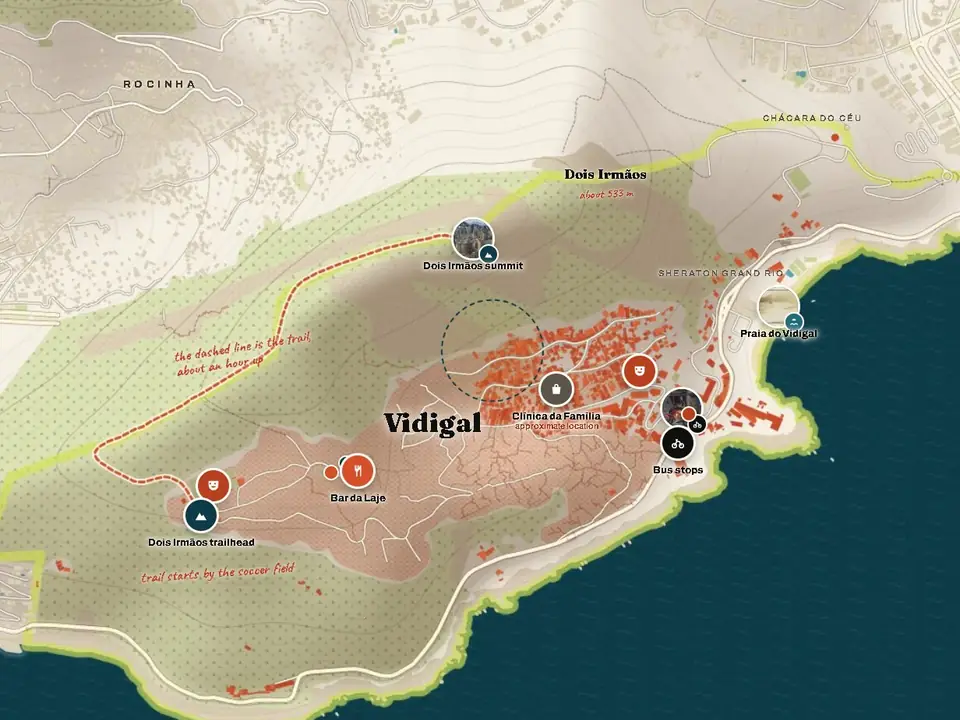
Why Vidigal specifically, and not Botafogo or Copacabana where most nomads land. Three reasons, and they are the same three every month. The view, which no amount of money buys you flat down in the Zona Sul. The price, which sits below Leblon and Ipanema for a private apartment with more air and more light. And the walk to the sand, which is a few minutes downhill along Avenida Niemeyer instead of a metro ride. You are paying favela-adjacent rent for a Leblon-adjacent life. That gap is the entire pitch.
Who does a Vidigal monthly rental actually suit. The remote worker on a European or East Coast salary, spending a currency that stretches a long way here. The freelancer between contracts who wants one productive month somewhere the sun does half the work. The couple testing whether they could live abroad before they sign away a year at home. It suits the person who reads a budget before they book and wants the view without the Ipanema markup. It suits almost nobody who needs a doorman, an elevator to every floor, and a flat five-minute stroll to a supermarket. Know which one you are before you commit to thirty nights on a hillside.
A month on the hill, three ways
Ballpark all-in monthly totals for one remote worker, 2026 reais. Rent is the swing factor. Everything else is close to fixed.
- Lean — a studio or room, cook most nights, work from the apartment, moto-taxi only when it rains.
- Comfortable — a private ocean-view one-bedroom, eat out half the week, a few coworking days, one flight over São Conrado.
- Plush — a design duplex with a terrace, eat wherever, a hot desk in Ipanema, weekends out of town.
The rent line — where most of the money goes
Housing is the biggest number on any digital nomad budget Rio per month and Vidigal is no exception. It is also the number you have the most control over, because the hill offers a genuinely wide spread. A room in a shared house or a compact studio, booked monthly, can land around R$2,800 to R$4,000. A private one-bedroom with a real ocean view — the sweet spot for a solo worker or a couple — runs roughly R$4,500 to R$7,500 for the month. A proper duplex or a penthouse with a terrace and a pool climbs to R$9,000 and well past it. For context, a furnished one-bedroom down in Botafogo averages around $950 a month in 2026, and the equivalent in Leblon or Ipanema pushes toward $1,450. Vidigal slots under both, with a better view than either.
The mechanism that makes a monthly apartment rental in Vidigal affordable is the 28-night discount. Book 28 nights or more and platforms apply a long-stay reduction automatically, on top of any monthly rate the host has set. There is no universal percentage — a host moves a slider anywhere from a token cut to a steep one — but in practice a well-run listing knocks a meaningful slice off the nightly for a month-long guest. Fifteen to thirty percent is a fair thing to expect. Some hosts go further for the low season. This is the difference between a Vidigal Airbnb monthly discount and paying tourist rates for thirty straight nights, which no one should do.
Booking direct is the other lever. Platform service fees stack up on a month-long reservation, and a host you can reach on WhatsApp will often match or beat the online total for a direct transfer, because they keep more of it. Ask. Politely, once, after you have read the reviews and confirmed the place is real. Our own condo is bookable both ways for exactly this reason, and the direct route is the cheaper one for a stay this long. If you want the full mechanics of finding and vetting a place, the Vidigal apartment rental guide walks through the whole process.
One honest caveat that lives inside the rent line: the hill has an altitude tax. The higher the apartment, the better the view and the more stairs or moto-taxi it costs you to get home with groceries. A place near the base is easier on the legs and the wallet but sees less ocean. A place at the top sees everything and asks for a R$8 ride up when you are tired. Decide which trade you want before you book, because you will make that walk twice a day for a month.

The rest of the budget — food, transport, data, fun
Once rent is settled, the monthly numbers get friendlier and far more predictable. Here is the comfortable tier broken out, the one most people actually land on — a private apartment, cooking some and eating out some, working a little from a desk in Ipanema and a lot from the terrace.
- Rent
- Private ocean-view one-bedroom, monthly rate. R$5,500 / ~$1,000
- Food
- Feira produce, home cooking, plus eating out half the week. R$1,800 / ~$325
- Getting around
- Moto-taxi up the hill, metro, the odd Uber to Centro. R$400 / ~$73
- Work
- A handful of coworking day passes or a light hot desk. R$400 / ~$73
- Data
- An eSIM or a local prepaid plan for the month. R$120 / ~$22
- The fun budget
- Bars, a hang-glide, a weekend, the things you came for. R$1,200 / ~$220
- Monthly total
- ~R$9,420 / ~$1,700
Food is where the hill quietly saves you. A prato feito lunch — protein, rice, beans, salad — runs R$20 to R$35 at the base of the morro. A coffee at the padaria is R$5 to R$7. If you cook, the Thursday feira on Rua Cupertino Durão down in Leblon sells fruit, fish and vegetables at a fraction of supermarket prices, and a week of groceries for one costs less than a single dinner in a white-tablecloth room. Budget R$1,800 for the month if you split your meals between the kitchen and the neighborhood botequim. Push it to R$2,800 if you eat out most nights.
Transport barely registers over a month if you organize your life around the hill. A single metro ride is R$7.90 in 2026, and the metro now takes a contactless tap of your own credit card at the turnstile. Moto-taxis up and down Vidigal cost R$5 to R$10 depending on how far up you live. An Uber or 99 to Ipanema is R$20 to R$30. The nearest metro station is General Osório in Ipanema, which you reach by a short bus, van or ride from the base. For the full breakdown of the metro, the buses along Niemeyer and the new payment card, the getting around Rio from Vidigal piece has the routes and the math.
The data line is small and worth getting right. More on the SIM question further down, but budget R$100 to R$220 a month and you are covered either way. Coworking is optional and folds into the work line — some months you will want a desk with air conditioning and other people in it, and some months the terrace is enough.
Set that comfortable total against the usual yardsticks and Vidigal reads well. A digital nomad renting a coliving room with a coworking membership elsewhere in Rio runs around $1,485 a month in 2026, and that buys a private room and a shared kitchen. Your comfortable Vidigal month lands near the same figure but hands you a whole apartment, your own stove, and a view the coliving brochure would put on its cover. Drop to the lean tier and you are living in the Zona Sul's orbit for around a thousand dollars. That is the quiet argument for a Vidigal monthly rental over a coliving bunk, and it is the reason so many one-month bookings quietly become two.
A week in Rio empties your wallet one meal at a time. A month refills your routine and lets the city get cheap around you. — what the second Monday teaches you
Working from the hill: wifi, the desk, and the four o'clock light
The first question every remote worker asks about a favela is whether the internet holds. The honest answer for Rio in 2026 is better than the reputation suggests. The city's median fixed broadband sits around 120 Mbps down and 75 up, and gigabit fiber is sold widely, including up the hill — Vidigal is wired by fiber providers, not left on old copper. Brazil as a whole ranks in the global top thirty for fixed broadband, with a national median north of 200 Mbps. That is genuinely fine for video calls, large uploads and a full workday.
The caveat is specific, so read it twice. Averages are not your apartment. Before you commit to a Vidigal monthly rental for the purpose of working, ask the host for the actual plan speed and, more importantly, the upload figure — video calls die on weak upload, not weak download. Ask whether the building has fiber or shares a slower line. Ask if there is a backup, because power and internet in any hillside neighborhood can blink during a heavy storm. Keep an eSIM with a data plan as your fallback so a two-hour outage does not become a missed meeting. If connectivity is the whole reason you are here, the working remotely from Vidigal guide goes deeper on what to verify in a listing.
Then there is where you actually sit. A month is long enough that a proper desk and a real chair matter more than a nice view for the first hour of the day. Confirm the listing has both. If it does not, you have two moves. You work from cafés — Leblon and Ipanema are dense with them a short ride downhill — or you buy into a coworking space for the days you need focus and other humans.
Work from the apartment
- Zero commute, zero cost beyond rent.
- The terrace and the four o'clock light are yours.
- Best for heads-down weeks and good weather.
- Needs a real desk, a real chair, verified upload speed.
- Lonely by Thursday if you are an extrovert.
Work from a coworking
- Air conditioning, backup power, other people.
- Day passes around R$45 to R$160 in the Zona Sul.
- A hot desk runs R$385 to R$1,200 a month by brand.
- A ride down to Botafogo, Ipanema or Leblon.
- Best for call-heavy weeks and networking.
The formal coworking scene worth knowing sits down the hill, not on it. WeWork keeps a location on Praia de Botafogo, day passes at the bigger operators run from about R$45 at a spot like Goma in Glória to R$160 at the premium end, and a dedicated hot desk for the month spans roughly R$385 to R$1,200 depending on the brand and the postcode. Vidigal itself is thin on formal desks, so if a room full of other people working is non-negotiable, price a short daily ride into the budget. Most month-long guests end up splitting the difference — the terrace on the quiet days, a Botafogo or Ipanema desk on the weeks that are wall-to-wall calls.
On the clock itself, Rio runs three hours behind Greenwich, which is kind to the transatlantic worker. Your afternoon overlaps a European end-of-day, and a New York morning meeting lands mid-morning here with coffee already in hand. The West Coast is the awkward one — a 9am Pacific call is 1pm in Vidigal, which is fine, but a late-afternoon California standup eats your evening. Most people find the overlap workable and the light, frankly, motivating. There are worse things than closing the laptop at five and watching the sun drop behind Dois Irmãos.
The connectivity and admin cheat sheet
The small numbers that shape a working month, current for 2026.
- Metro fare: R$7.90 a ride, contactless card tap accepted at the turnstile.
- Jaé card: the city's transit card and app, now required on municipal buses, BRT and vans. The app is free, a physical card ships for about R$8.
- eVisa (US/CA/AU): required since April 2025, about $80.90, valid up to ten years, 90 days per visit.
- eSIM: from roughly $5 for a small data plan to $42 for 20GB. No CPF needed, unlike a physical SIM.
- PIX: instant bank transfer, accepted everywhere, the way locals pay for almost everything.

The paperwork you cannot skip: visa, SIM, money
A month in Rio sits comfortably inside a tourist entry, but the rules changed recently and you should know them. Since April 2025, citizens of the United States, Canada and Australia need a Brazil eVisa to enter. It costs about $80.90, processes in roughly ten working days, and once granted is valid for up to ten years with multiple entries, letting you stay 90 days per visit and no more than 180 days across any twelve-month window. Apply on the official VFS portal, leave two weeks of runway before your flight, and make sure your passport has six months of validity and a blank page. A single month-long stay does not come close to the limits, so for most nomads the tourist eVisa is the whole story.
If you fall for the place and want to stay past three months, that is a different document. Brazil runs a digital nomad visa, the VITEM XIV, for remote workers earning from a foreign source. The 2026 test asks for about $1,500 a month in foreign income or roughly $18,000 in the bank, plus health insurance valid in Brazil and a criminal background check. It grants a year, renewable once, for two years total. Worth knowing it exists; not worth the paperwork for a single season. Weigh it if Vidigal becomes a habit rather than a trip.
Getting online the moment you land is the next admin box. The friction is the CPF, Brazil's tax number, which physical SIM cards effectively require and tourists rarely have. The clean workaround is an eSIM, which needs no CPF and no local ID. Airalo sells a 1GB plan for about $5 and 20GB for around $42, and Holafly runs unlimited-data plans priced by the day. Load one before you fly, land connected, and buy a cheap local prepaid plan later only if you want a Brazilian number. For the full arrival checklist — the eVisa, PIX, ATMs and the SIM question — the Brazil arrival essentials piece is the one to read on the plane.
Money itself is easy and mostly cashless. Cards work everywhere. PIX, the instant bank transfer system, is how Brazilians pay for a coconut on the beach and a month of rent alike, and if you can link a local account or a fintech to it, you will use it daily. Keep R$50 to R$100 in cash for moto-taxis and the smallest vendors, watch your card at ATMs, and never let a stranger help you at the machine. That is the whole of the money advice for a stay this length. ← cash for the moto, PIX for the rest
What a month on a hillside actually asks of you
None of these are dealbreakers. They are just the texture of the place, and they matter more over thirty days than over three.
- Stairs and slopes. Vidigal is vertical. Groceries, laundry and a bad knee all feel the incline. Pick your floor accordingly.
- The occasional blink. Water and power can drop briefly in heavy rain. A backup data plan and a filled water bottle solve most of it.
- Weekend sound. Friday and Saturday nights carry music up the hill. Charming for some, a reason to book a quieter street for others.
- Moto-taxi budget. R$5 to R$10 a trip is nothing once, but it adds up if you ride up every single time. Walk when you can.
The rhythm of a month — why the value is real
Numbers only tell half the story. The other half is what a month feels like, because the reason a Vidigal monthly rental beats a string of hotel weeks is not only the discount. It is that the place stops performing for you and starts belonging to you. By the second week you have a padaria, an açaí spot with no sign, a boteco stool that is functionally yours. The barber knows your name. The moto-taxi drivers wave. The view you paid a premium for on day one becomes the wallpaper of an ordinary Tuesday, which is the whole point of staying long enough for wonder to soften into home.
A working week here has a shape. You wake to roosters and bread. You work the morning while Europe is awake, break for a PF lunch at the base, work the afternoon on the terrace as the light turns gold, and close the laptop when the sun hits the sea. Beach in the early evening a few minutes downhill, dinner in the neighborhood or in Leblon, home up the hill on foot or by moto. Weekends belong to the things you came for — a hike up Dois Irmãos, a flight over São Conrado, a night of live samba at the top of the morro. The monthly rate makes all of it cheaper per day than any short stay could.
For the value-conscious remote worker, the arithmetic keeps improving the longer you stay. The rent is amortized across thirty nights instead of seven. The kitchen replaces restaurants when you want it to. The transport is cents, not fares. And the intangible line — the one that does not fit in a spreadsheet — is that you are living inside one of the most photographed views on earth for less than a studio costs flat down in Ipanema.
Put a hard number on it. Thirty nights at a tourist nightly of R$400 would be R$12,000 before you have eaten a single meal. The same apartment on a monthly rate, with the long-stay discount and a direct booking, can land nearer R$6,000 to R$8,000. That saved four thousand reais is a month of groceries, or a fistful of flights over São Conrado, or simply the margin that clears your own budget test and lets you say yes. The longer you stay, the thinner the fixed costs of arriving spread — the flight, the eVisa, the first-week fumbling for a padaria and a laundromat all divide down across the days until they barely register.
~~~
There is a specific feeling that arrives around day twenty-five, and every long-stay guest describes it the same way. You start counting down. Not with dread, exactly, but with a low saudade for a place you have not even left. You catch yourself pricing the next month, checking whether the apartment is free in September, doing the sums on staying through Carnaval. That is the monthly rental doing its quiet work. A week sells you Rio. A month makes you want to keep it.

Quick questions.
What does a monthly rental in Vidigal actually cost?
For a private ocean-view one-bedroom, budget roughly R$4,500 to R$7,500 a month in 2026, with the monthly discount applied. A studio or room is closer to R$2,800 to R$4,000, and a design duplex with a terrace runs R$9,000 and up. Direct booking and the low season, June through August, push the number down.
How much is the Airbnb monthly discount for 28-plus nights?
There is no fixed rate. The discount applies automatically at 28 nights, but each host sets the percentage on a slider. In practice a well-run Vidigal listing takes somewhere around 15 to 30 percent off the nightly for a month-long guest, and some go further in the quiet season. Always compare the platform total against a direct WhatsApp quote from the host.
Is the internet good enough to work from Vidigal?
Generally yes. Rio's median fixed broadband is around 120 Mbps down and 75 up in 2026, and fiber reaches up the hill. The catch is that averages are not your apartment. Confirm the specific plan speed and, above all, the upload figure before booking, and keep an eSIM as a backup for outage days.
Do I need a visa to stay a month?
US, Canadian and Australian citizens have needed a Brazil eVisa since April 2025. It is about $80.90, valid up to ten years, and allows 90 days per visit, so a single month is well within it. Apply on the official VFS portal at least two weeks before you fly. Staying longer than 90 days means looking at the digital nomad visa instead.
What is the total monthly budget for a digital nomad here?
A lean month lands near R$5,500 (about $1,000), a comfortable month around R$9,500 (about $1,730), and a plush month near R$16,500 (about $3,000). Rent is the swing factor; food, transport and data together are close to fixed and modest.
Can I get a SIM card without a CPF?
A physical Brazilian SIM effectively requires a CPF tax number, which most tourists do not have. The clean solution is an eSIM, which needs no CPF or local ID. Airalo runs from about $5 for a small plan, and Holafly sells unlimited data by the day. Load one before you land and you are online at the gate.
Is a month in Vidigal cheaper than staying in Ipanema or Leblon?
For a comparable private apartment, yes, and usually with a better view. Furnished one-bedrooms in Leblon or Ipanema run toward $1,450 a month in 2026, while a Vidigal equivalent sits under that. You trade flat streets and a metro at the door for a hillside and a walk down to the same beach.
A month is the unit where Rio stops being a trip and starts being a life you can afford. The discount is real, the internet holds, the view does not fade, and by the time you leave you will already be doing the sums on coming back. That is not a sales line. It is just what the hill does to people who stay long enough to unpack.