
The base of the hill on Avenida Niemeyer, seven in the morning. A moto-taxi idles at the curb, a Kombi van fills with kids in school uniforms, and the 557 to Copacabana leans into the bend past the Sheraton. This is how to get around Rio de Janeiro when you wake up in Vidigal — get down to the coast road first, and after that the whole city opens. Metro at Ipanema, buses along the sea, an Uber when the hill has had enough of you.
The one rule for leaving Vidigal (everything else is detail)
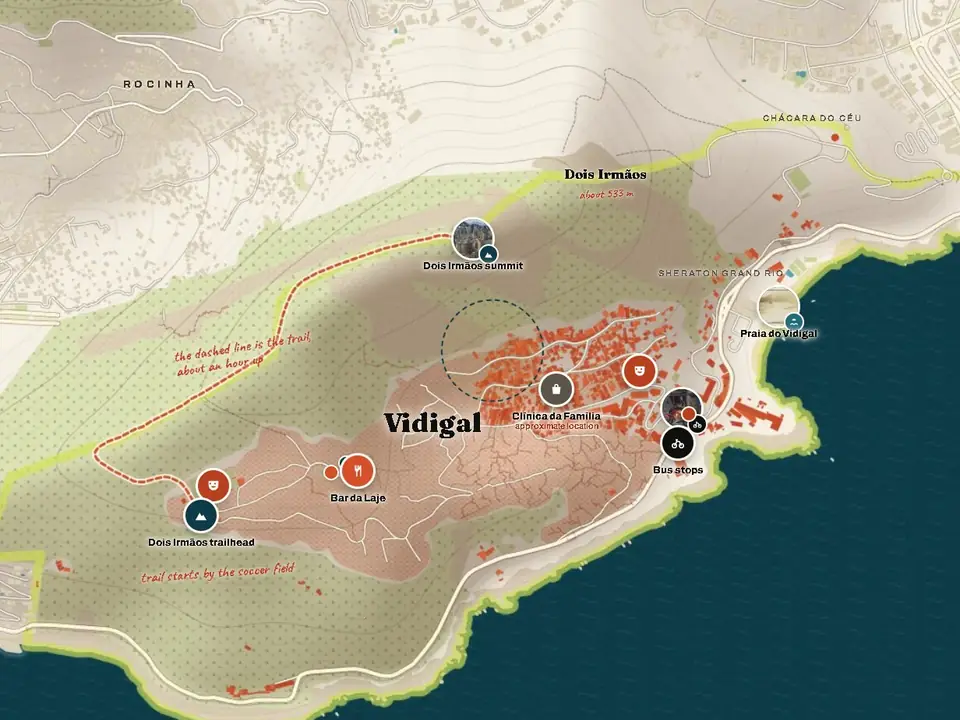
Vidigal is a hill. That single fact is the entire logistics puzzle, and once you accept it the rest is easy. The community climbs from Avenida Niemeyer — the coastal road that runs between Leblon and São Conrado, hugging the rock above the sea — up a road called Estrada do Vidigal that switchbacks toward the top. Cars come in at the bottom. Some go partway up. Almost none go to the top. So the first move of every journey, no matter where in Rio you are headed, is the same: you get yourself down to the base.
From an apartment near the top that means a moto-taxi, a van, or your own two legs. From the middle of the hill it might just be a downhill walk. Either way, the base of the morro is your terminal — the place where the hill's private transport hands you off to the city's public transport. Think of it as your own little station. The moto-taxis are the platform. Niemeyer is the track.
We have lived near the top for years, and this is the honest version of how to get around Rio de Janeiro from a hill address. Not the guidebook version that pretends you tap a card and glide onto a train. The real one, with the moto-taxi at the bottom, the contactless tap that finally works on the metro in 2026, the new Jaé card nobody quite explains, and the twelve-minute reality of getting from Vidigal to Ipanema when you actually try it. The city is more reachable than its reputation suggests. It just asks you to change modes once at the bottom of the hill.
The good news is that Vidigal sits in the Zona Sul, the wealthy southern belt where Rio's transport is densest. You are minutes from two metro lines, a wall of bus routes along the coast, and Uber coverage as good as anywhere in the city. Compare that to a hill in the Zona Norte and you understand part of why people pay to stay here. The view is the headline. The location is the quiet argument underneath it.
What a day of moving around costs
Fares sampled in Rio, July 2026. Reais, not dollars. Everything below is per person, per ride.
- The metro now takes a contactless tap of your own Visa or Mastercard at the turnstile. No local card needed.
- City buses and the downtown VLT tram do not take foreign bank cards — those want a Jaé card or the app.
- Women-only "pink" metro cars run weekday rush hours, roughly 6–9am and 5–8pm.
- Keep R$20–30 in cash for the moto-taxi and the van. They are cash-and-Pix, not card.
Down the hill first — moto-taxi, van, or your own legs
Start at the top, because that is where you wake up. The mototáxi is Vidigal's circulatory system, and by day two you will use it without thinking. A red-vested driver, a scuffed helmet he hands you, a two-minute plunge down the switchbacks with the ocean flashing between houses. It is the fastest way down and the only sane way up when you are carrying groceries or wearing anything you would like to arrive uncreased. The fare from the top to the base runs about R$ R$8 to R$10. Shorter hops are R$5. Agree the price before you sit down, in reais, out loud. The number climbs the moment a driver reads you as a visitor, and a five-second conversation at the curb saves the argument at the bottom.
If two wheels are not your thing, the vans — old VW Kombis and their newer replacements — run the same road on a loop, cramming in as many riders as the springs allow. They cost a couple of reais, they leave when they are full rather than on a schedule, and they are a small masterclass in how the hill actually moves. You will be shoulder to shoulder with someone's grandmother and someone else's toolbox. It is the local rhythm, and it is completely fine.
Walking down is free, scenic, and steeper than it looks in photos. From the upper stretches it is fifteen to twenty-five minutes of knees-first descent past murals, bars, and the smell of someone's lunch. Walking up is a different proposition — a genuine cardio event that first-timers routinely underestimate. Our standing advice to guests is simple: walk down if you feel like it, moto up almost always. The four-minute drop to Leblon downhill becomes a forty-minute penance in the other direction, and the hill does not care how fit you think you are.
For the deeper mechanics of the hill itself — which lanes connect, where the vans turn around, how the moto-taxi stands work — we keep a separate piece on getting around Vidigal that goes lane by lane. This article is about the next step: what happens once you reach Niemeyer and the whole city is in front of you.

The metro, and why it is easier than the guidebooks say
Here is the single most useful thing in this entire Rio de Janeiro metro guide for tourists: as of 2026 you tap in with your own contactless credit or debit card. Visa, Mastercard, phone wallet, whatever is in your pocket at home. Walk to the turnstile, tap, the gate opens, R$7.90 leaves your account. No queue at a ticket window, no local card, no fumbling with reais. For years the metro was the one thing that made visitors reach for a transit card. That friction is gone. If you only ever use the metro, you never need to think about Jaé or RioCard at all.
The system itself is clean, air-conditioned, and modern in a way that surprises people who arrived braced for chaos. It is widely considered the safest way to cross the city. Three lines matter. Line 1, the orange one, is the spine of the Zona Sul: it runs from General Osório in Ipanema up through Copacabana, Botafogo, Flamengo, and into the Centro at Cinelândia, the stop for Lapa and the old downtown. Line 4, the yellow one, branches west from General Osório toward Barra da Tijuca, passing under Leblon, São Conrado, and Rocinha on the way. Line 2, green, peels off north toward the Maracanã and the Zona Norte, which matters mostly if you are going to a football match. Trains run Monday to Saturday from 5am to midnight, and Sundays and holidays from 7am to 11pm.
Now, the question every guest asks and most guides answer wrong: which station is closest to Vidigal. The honest map is more interesting than the usual reply.
- São Conrado
- Line 4, the far side of the hill toward Barra. The last Zona Sul station on the line, and the one with official van integration to Rocinha and Vidigal. Closest on the map.
- Antero de Quental
- Line 4, in the heart of Leblon. A short bus, van, or Uber hop from the base of Vidigal, and your quickest door to the Leblon and Ipanema restaurant strips.
- General Osório
- Lines 1 and 4, at the Ipanema end near Arpoador. The famous terminus, the transfer point between the two lines, and the classic answer people give — a little farther, but the most connected.
You will read on the aggregators that General Osório is a "four-minute walk" from Vidigal. It is not. That is software confusing a favela with a bus stop of the same name. In real life you cover a few kilometres of coast to reach any of these stations, which means the practical route is: moto down to the base, then a bus, van, or short Uber to the platform. The prize once you are on the train is worth the two-step. Line 1 will have you standing in front of Copacabana beach in ten minutes, or in Lapa for the samba in twenty, without touching Rio's famous traffic once.

The metro is the part of Rio that behaves. Everything else negotiates with the traffic. The train just goes. — what we tell guests who arrive nervous about the city
RioCard vs Jaé: the 2026 card question, answered plainly
If you have read anything about Rio transport written before last year, you met a card called RioCard. Retire that memory. Through 2025 the city rolled out a new electronic ticketing system called Jaé, and since August 2025 it has been the mandatory way to pay on municipal buses, the BRT express lines, and the downtown VLT tram. RioCard is being wound down. Jaé is the present tense. The whole RioCard vs Jaé debate that fills older forum threads has basically resolved itself: on city transport, Jaé won.
Jaé comes in a few flavours, and the names matter. The green card is the one built for occasional riders and visitors — you buy it, you load it with cash credit, you tap. It cannot be linked to an account in the app, so you top it up in person. The black card is the registered version for residents, which recharges online through the Jaé app. A yellow card handles free-fare passes for students and the elderly. For a traveler, green is the card with your name on it. A blank card costs about R$5, on top of whatever credit you load.
You can buy a green Jaé card at metro and VLT stations, BRT terminals, and the little transport kiosks around the Zona Sul, then feed it reais at the same machines. You do not need a CPF — Brazil's tax ID — to buy or load one, which spares tourists the bureaucratic rabbit hole. The app is the slicker option if you have a local data SIM and the patience to register, but for a week in Rio the physical green card is less fuss and less admin.
The one trap worth naming: the VLT, the downtown light-rail tram that loops through the port district, Praça XV, and out to Santos Dumont airport, does not take contactless bank cards. Only Jaé or an old RioCard Mais will pass its validators. So if your plan includes the Museu do Amanhã, the Boulevard Olímpico murals, or catching a domestic flight from SDU by tram, that is the moment a Jaé card earns its R$5.
Which card, honestly
Match the card to the trip. Most visitors need only the first line.
- Metro only? Tap your own contactless bank card. Buy nothing. This covers Ipanema, Copacabana, Botafogo, and Centro.
- Buses or the VLT tram too? Buy a green Jaé card, load R$30–50 in cash, tap it on board.
- Staying a month? Register the Jaé app with a local SIM and top up from your phone. Skip the kiosk queues.
- Moto-taxis and vans? Neither card touches these. Cash and Pix only, up on the hill.
Buses and vans along the sea
The bus is where Rio's transport stops behaving and starts having personality. From the base of Vidigal on Niemeyer, a wall of routes runs along the coast in both directions. Head east and you are in Leblon, Ipanema, and Copacabana within minutes. The 557 runs to Copacabana. The 554, marked INT9, links the hill to the Rio Sul area near Botafogo and does the Copacabana-to-Vidigal run in something like half an hour. Other lines and the circular vans thread Vidigal, Rocinha, and Copacabana together on a near-constant loop. A city bus fare is R$5 as of January 2026, paid with a Jaé tap.
The reason to take the bus is not speed. It is the road. Avenida Niemeyer is one of the great urban drives on Earth, a two-lane ribbon cut into the cliff with the Atlantic breaking on the rocks below and Dois Irmãos rising behind you. On the top deck of the day, in the seat by the window, the ten minutes to Leblon is a small piece of theatre you paid five reais for. We still take it sometimes when the metro would be quicker, purely for the view.
Now the honest part. Rio buses ask a little more of you than the metro. They are cash-poor targets for pickpockets, so the sensible traveler keeps a phone in a front pocket, a bag closed and in front, and nothing valuable on the lap by the window at a red light. Late at night, on emptier routes, most residents switch to an Uber and so should you. In daylight, on the busy coastal lines, the bus is an ordinary, useful, cheap way to move, ridden by everyone. Read it the way you would read any big-city bus. Alert, not afraid.
One more mode most visitors never discover: the metro's own surface buses, branded Metrô na Superfície. These run from stations like General Osório out into the neighbourhoods the rails do not reach, and when you connect from train to bus on the same tap within a couple of hours, the second leg is free. It is a quiet efficiency buried in the system. If you are stitching together a longer cross-town day, it is worth knowing the integration exists, even if the coastal route from Vidigal rarely needs it.
~~~Uber, 99 and taxis
For most visitors most of the time, the app on your phone is the answer. Uber and its local rival 99 both blanket Rio, and both are cheaper than a taxi, cheaper than the same ride at home, and safer than flagging a car on the street because the route, the driver, and the price are all logged before you move. A ride from Vidigal into the Centro is a modest fare. Hops around the Zona Sul — down to Ipanema, over to Copacabana — land in the low tens of reais outside surge hours. You pay in the app, you skip the language and the change, you go.
The Vidigal wrinkle is the same one that governs everything here: the hill. Order a car and it will happily take you to the base of Vidigal. Getting it to climb is another matter. Some drivers go up the paved lower stretch without complaint. Others stop at the bottom and would rather not attempt the narrow, moto-thick switchbacks, which is a fair call and not a snub. The clean method, coming home, is to app a car to the base of the hill and take a moto-taxi the rest of the way up. Coming down, moto to the base and meet your Uber there. The handoff at the bottom is the rhythm of living on a hill, and after a day you will do it on autopilot.
A note on which app: on a Brazilian data SIM, both Uber and 99 work identically to how they do anywhere. Fares track closely; if one is surging, the other often is not, so it is worth having both. Taxis still exist and still have their place, mostly for airport runs with luggage where a fixed metered car is simple. But for city moving, the app wins on price and on the peace of mind that comes from a tracked, cashless ride.
Reach for the metro when
- You are going Copacabana, Botafogo, or Centro and it is not late.
- Traffic is bad, which along the coast is often.
- You want the cheapest fixed price in the city.
- You are solo and want the busy, watched option.
Reach for the app when
- It is late, or you are coming home to the base of the hill.
- You have bags, or you are three people splitting a fare.
- You are going somewhere off the rail map, like Jardim Botânico.
- The rain has arrived, as it does, suddenly.
Is the Rio metro safe, and the Vidigal-to-Ipanema routine
Is the Rio metro safe? For the ordinary tourist, yes — it is routinely the mode locals recommend first. It is well lit, staffed, monitored, and busy, and busy is your friend. The risks are the petty ones of any dense system: a bag left open on a crowded platform, a phone waved around near the doors as they close. Keep your valuables zipped and in front of you at the pinch points and the metro is one of the least stressful parts of a Rio day. Solo travelers, and solo women in particular, tend to find it the easy, anonymous, low-hassle way across town, and there is a specific comfort built in for them.
That comfort is the women-only carriage. On weekday rush hours — roughly 6 to 9 in the morning and 5 to 8 in the evening — designated cars, marked in pink and monitored by staff, are reserved for women. Outside those windows, and on weekends and holidays, every car is mixed. If you are a woman riding at peak hour and want the calmer option, look for the pink markings on the platform floor and the carriage door. We go deeper on all of this in the solo female traveler's guide, which covers the night moves and the host-contact habits that make a solo stay here work.
So, the question guests actually mean when they ask about transport: how to get from Vidigal to Ipanema. Here is the real routine, the one we text people on their first morning. Moto-taxi from the apartment to the base, two minutes, R$8. At Niemeyer you have three clean options. Grab an Uber straight to Ipanema for a small fare and be on the sand in ten to fifteen minutes. Or catch a coastal bus east through Leblon and into Ipanema for R$5. Or, if you want the train, hop to Leblon's Antero de Quental station or ride to General Osório and let Line 4 or Line 1 carry you. Most days we just app the car or take the bus, because the beach at Ipanema is genuinely close and the metro shines more for the longer crossings to Copacabana and downtown. For the pure beach logistics — which sand, which walk, the Niemeyer route on foot — the beaches near Vidigal piece maps it out.
The through-line of all of it is that Vidigal trades a little vertical effort for a lot of location. You spend two minutes and a few reais getting down the hill, and in exchange you sit between Rio's two most useful metro lines, a coastal bus corridor, and full app coverage, with Leblon four minutes downhill. From our apartment near the top, the daily equation has never once felt like a burden. It feels like the toll on a very good road.

Putting a day together
Once the modes make sense, the whole question of how to get around Rio de Janeiro dissolves, and a day assembles itself. A beach morning at Ipanema is a moto, then a bus or a short Uber, and you are on the sand before the umbrellas fill. An afternoon at the museums in the port district is a metro to Cinelândia and a VLT tram the last stretch, which is the one time you will be glad you bought the Jaé card. A night in Lapa is Line 1 to Cinelândia on the way out and an Uber to the base of the hill on the way home, because the last train leaves before the samba does. A trip out to Barra is Line 4 west from General Osório. None of it requires a car of your own, and almost none of it requires learning anything you have not read here.
The tip we give every guest is to front-load the admin. On your first afternoon, tap your bank card through the metro turnstile once to confirm it works — most do, a few foreign cards are fussy, and you want to know before you are in a hurry. Buy a green Jaé card the same day if buses are in your plans, and load fifty reais onto it. Put twenty in small notes in your pocket for the moto-taxi. Do that once and the rest of the week you simply move, the way residents do, without a transaction ever slowing you down.
If you are arriving straight from the airport and wondering how all this connects to the door of the hill, that is its own small saga of vans, Ubers, and the base-of-hill handoff, and we handle it start to finish in how to get to Vidigal from the airport. Get to the base once, and everything in this guide picks up from there.
Quick questions.
What is the nearest metro station to Vidigal?
On the map it is São Conrado on Line 4, which sits on the Barra side of the hill and has official van integration to Vidigal and Rocinha. Antero de Quental in Leblon, also Line 4, is the quickest for the Leblon and Ipanema strips. General Osório in Ipanema, on both Line 1 and Line 4, is the classic answer and the best-connected, though a little farther. All of them require getting down to the coast road first.
Do I need a Jaé card, or can I just tap my credit card?
For the metro, just tap your own contactless Visa or Mastercard at the turnstile — no local card needed as of 2026. You only need a green Jaé card if you plan to ride city buses, the BRT, or the downtown VLT tram, which do not accept foreign bank cards. A blank Jaé card is about R$5 and you load it with cash at station machines.
Is the Rio metro safe for tourists?
Yes, it is generally regarded as the safest way to cross the city — clean, air-conditioned, staffed, and busy. Treat it like any big-city subway: keep your phone and bag zipped and in front of you on crowded platforms and near closing doors. Women-only pink carriages run during weekday rush hours for an added measure of calm.
How do I get from Vidigal to Ipanema?
Moto-taxi down to the base of the hill on Avenida Niemeyer, about two minutes and R$8, then choose your mode: an Uber straight to Ipanema is ten to fifteen minutes for a small fare, a coastal bus east through Leblon is R$5, or the metro from Leblon's Antero de Quental or Ipanema's General Osório if you prefer the train. Most locals app the car or take the bus, since Ipanema is close.
How much is a moto-taxi up the hill in Vidigal?
Roughly R$5 for a short hop and R$8 to R$10 from the base all the way to the top, paid in cash or by Pix. Agree the price in reais before you get on, since the quoted fare tends to rise once a driver clocks you as a visitor. It is the fastest way up and worth every real when you are carrying anything.
Can I use Uber in Vidigal?
Yes, both Uber and 99 work well and are cheaper than taxis. The catch is the hill: a car will take you to the base of Vidigal readily, but many drivers will not climb the narrow switchbacks. The standard move is to app a car to the base and take a moto-taxi the rest of the way up, and reverse it going down.
What happened to the RioCard?
It is being phased out in favour of Jaé, the city's new ticketing system, which has been mandatory on municipal buses, the BRT, and the VLT since August 2025. If you have an old RioCard Mais it may still work on some validators, but any new card you buy will be a Jaé. For the metro, you can skip the card question entirely and tap a contactless bank card.
That, start to finish, is how to get around Rio de Janeiro from a Vidigal address: learn the base-of-the-hill handoff and the city stops feeling like a maze. You drop down to Niemeyer, you pick a mode, the city carries you. Two minutes of vertical, a tap or a wave at the driver, and Copacabana, Ipanema, Lapa, and the sand are all inside half an hour. The hill asks for a little. It gives back a location most of Rio would trade for.