
A woman leans across the kiosk table on Ipanema and offers you a caipirinha she poured herself. She is warm. The drink is free. This is the exact moment most of the Rio de Janeiro tourist scams to avoid actually begin — not in a dark alley, but in bright afternoon light, with a smile and a full glass. Rio is not out to get you. It rewards the traveler who reads the room.
Read the room, not the rumors (the honest version)
There is a version of Rio that lives on the internet, and it is scarier than the real one. Search "is Rio safe" and you will find a wall of worst-case stories, most of them written by people who spent four days here, lost a phone, and never came back. The stories are not lies. They are just missing the part where two million tourists a year have a completely uneventful, sunburned, over-caipirinha'd week and go home fine.
Here is the useful framing. The Rio de Janeiro tourist scams to avoid divide into two families. The first is opportunistic property crime — a phone snatched off a beach towel, a bag lifted from the back of a chair, a chain pulled at a traffic light. The second is the confidence trick — someone using your politeness against you, whether that is a fake cop, a spiked drink, or a card machine set to rob you in plain sight. Almost nothing on either list involves random violence against a stranger. Nearly all of it is preventable with behavior, not fear.
We write this from the eighth floor of a building near the top of Vidigal, the favela on the hill above Leblon. We have hosted guests here for years, met them at the base of the morro, walked them up, and answered the same nervous questions in the car from the airport. Vidigal itself is one of the calmer places to be a visitor in this city, which surprises people who expect the opposite. If you want the neighborhood-specific version of the safety conversation, we keep an honest one in our is Vidigal safe piece. This article is the wider lens: the scams working across the whole city right now, and how to pack and dress so you stop being the obvious mark.
None of what follows is meant to frighten you. It is meant to make you boring to a thief. Boring is the goal. Boring gets to keep its phone.
The five rules that prevent ninety percent of it
If you read nothing else, read this. Everything below is detail on these.
- Never accept a drink you did not watch being poured or opened.
- Real police do not demand to inspect your wallet or your cash on the street.
- At any card machine, pay in reais, never in dollars, and read the amount before you tap.
- Set a low daily ATM limit and a low PIX limit on your banking app before you fly.
- Carry a slim crossbody in front of you. Keep your phone in it, not in your hand.
The scams worth knowing by name
Name a thing and it loses half its power. Here are the common scams in Rio de Janeiro that actually target visitors in 2026, described plainly, with the tell that gives each one away. Most share a single trait: they need you to be polite, flustered, or greedy for a beat too long. Take that beat back and the trick collapses.
The fake police stop
- How it runs
- A person in plain clothes flashes a badge, says "polícia", and asks to check your wallet, your cash, or your phone "for a security matter."
- The tell
- Real officers wear uniforms and use marked cars. Nobody legitimate needs to hold your money to inspect it.
- What to do
- stay calm Ask for the delegacia. Offer to walk to the nearest police post together. Do not hand over cash or your unlocked phone.
This one preys on the reflex to obey a badge. You do not have to. A genuine stop by the Polícia Militar looks like a uniform, a marked vehicle, and a request to see identification, not to pocket it. If someone in a polo shirt is pressing you to produce your wallet on a Copacabana corner, you are being worked. Keep your hands on your own belongings, keep talking, and drift toward a shop, a hotel doorman, or a crowd. The con needs privacy. Deny it.
The PIX squeeze and the express kidnapping
PIX is Brazil's instant bank-transfer system, and it is genuinely wonderful — you will use it for everything from a beach beer to your moto-taxi. It is also the engine behind the fastest-growing robbery in the country. In a street mugging, thieves now demand you open your banking app and transfer your balance by PIX on the spot. Unlike an ATM, a PIX transfer has no daily ceiling in that moment, so the amount they can force is only capped by what you set in advance. There is also the sequestro relâmpago, the "lightning kidnapping," where someone is taken by car to a series of ATMs to pull the daily maximum before being let go. Attempts rose through 2025 and the average episode runs around ninety minutes.
The defense is boring and total. Before you leave home, open your banking app and set the lowest daily and nightly PIX limit it allows. Set a low ATM withdrawal ceiling too. Keep your real savings behind a second account the app on your phone cannot reach. If you are ever robbed, you comply, you stay quiet, and you hand over a phone that simply cannot move much money. The thief gets a bad night's wage. You get to fly home.
The card-machine shuffle and the DCC trick
Brazilian card machines — the maquininha — come to your table. That is convenient and it is also where two scams live. The first is dynamic currency conversion: the screen offers to charge you "in your home currency," which sounds helpful and buries a rotten exchange rate plus a fee. Always choose reais. The second is the amount itself. Glance at the number on the screen before you tap or type your PIN, because a stray zero turns R$45 into R$450 and "oops" is hard to argue in a second language. Keep your card in your own sight the whole time. At ATMs, use the machines inside a bank branch during business hours, give the card slot a firm wiggle before inserting (a loose reader is a skimmer), and cover the keypad with your other hand.

Boa Noite Cinderela and the rest of the night
The scariest scam is also the most avoidable. Boa Noite Cinderela — "Goodnight Cinderella" — is the practice of spiking a drink or a snack with a sedative, then robbing the victim once they are blacked out. The drugs vary, but scopolamine and similar knock-out agents produce total memory loss and zero motor control, which is exactly why thieves like them. The US Embassy in Brazil put out a specific alert about this in early 2025, and there were widely reported cases through the year involving tourists on the Zona Sul beaches and in nightlife districts. It is rare relative to the number of people out drinking every night. It is also devastating when it lands, so the rules are strict.
Never accept a drink, a piece of candy, or a bite of food from someone you just met, however charming they are, and however sunny the beach. Watch your caipirinha get made or your beer get opened. Keep a hand on your glass and do not leave it on a table while you dance. The classic setup is a friendly stranger, often working in a pair, who insists on treating you. Warmth is not proof of safety. It is often the delivery mechanism.
The dating-app version is the one catching solo travelers off guard. A match suggests meeting at a quiet bar or, worse, at a private address. Do not. First meetings happen in busy public places, in daylight or early evening, with a friend or your host knowing where you are. If the person is real and lovely, they will understand. If they push back hard on a public meeting, you have your answer. For the specifics on moving around after dark, when to walk and when to take a moto-taxi, we go deep in is it safe to walk around Vidigal at night.
Two smaller night cons round out the list. The golpe do falso taxista is the unofficial "taxi" idling outside a club that takes a scenic route to a fat fare, or worse. Use the app — Uber or 99 — so the route and the driver are logged. And watch for the helpful stranger at the ATM who offers to "assist" a confused tourist and memorizes the PIN. You never need help at a cash machine. If you do, walk into the bank.
A free drink from a stranger is the most expensive thing on the menu. Buy your own. It is four dollars and it is the cheapest insurance in Rio. — what we say to every guest on night one

How to not look like the obvious mark
Thieves are efficient. They scan a crowd for the easiest return and move on. The whole game of how to not look like a tourist in Rio is not about fooling anyone into thinking you are a carioca — your sunburn will handle that. It is about not advertising a payday. That means leaving the signals of one at the hotel.
Start with the jewelry. The gold watch, the engagement ring, the chain, the designer sunglasses on a strap: all of it reads as value from thirty feet, and none of it belongs on a beach or a bus. Cariocas themselves do not wear their good pieces to the sand. Leave them locked up. Your phone is the other beacon. Phone theft is the single most common crime affecting visitors here, usually a snatch-and-run by a kid on foot or a passenger on a motorbike, and it happens fastest when the phone is in your hand at a corner or dangling while you photograph the view.
The dress code is genuinely easy, because Rio's is relaxed. Men live in a sunga or board shorts and a plain tee. Women wear a bikini under a light dress or shorts. Everyone wears Havaianas. A loose linen shirt, a cotton tank, quiet colors, and rubber sandals will make you invisible in the best way. Skip the Hawaiian print, the money belt worn outside your clothes, the giant DSLR around your neck, and the backpack worn on your back where you cannot see it being opened. A slim crossbody worn across your front is the single best bag decision you will make.
Then there is what to wear in a favela like Vidigal, which is its own small question. The hill is steep, the lanes are uneven, and half of it is stairs. Flip-flops are fine for the main road and the beach run, but if you are climbing to a viewpoint or walking home late, closed shoes with grip save your ankles and your dignity. Dress modestly and normally. You are a guest in a residential community, not on a movie set, and the fastest way to be treated with warmth here is to move through it like you belong, quietly and without a camera pointed at someone's front door.
Pack it
- Slim crossbody bag, worn in front.
- A cheap unlocked phone for the beach and nights out.
- Closed shoes with grip, for the hill.
- Havaianas, a sunga or bikini, light cotton and linen.
- A photocopy of your passport, kept separate from the real one.
- Reef-safe sunscreen. The sun here does not negotiate.
Leave it home
- The good watch, the fine jewelry, the wedding rock.
- Designer logos worn head to toe.
- The bulky DSLR you sling around your neck.
- A backpack you cannot see the zips of.
- Every credit card at once. Bring one, leave one in the safe.
- The instinct to argue with a mugger. It is only stuff.
The Rio carry, refined over many airport runs
What to pack for Rio de Janeiro, stripped to what actually earns its place in the bag.
- The decoy phone. A R$400 Android with WhatsApp, Uber, and your offline map. If it walks off a beach towel, you shrug.
- One card, one backup. A travel debit card with low preset limits for daily use. A second card sleeps in the apartment safe.
- Cash, small and split. Around R$100 for the day, some in a pocket, some in the bag, never all in a wallet you flash.
- Grippy shoes and a light layer. The morro is steep and the rooftop terraces get windy after dark.
- A crossbody with a zip. Not a tote, not an open beach bag. Something that closes and rides in front of you.
Money, phones and the daily carry
Most bad afternoons in Rio are really just one wrong object in one wrong pocket. Get the money and the phone right and the rest is beach. Here is the routine we run and recommend, day in and day out.
Carry a little cash and no more. Around R$100 covers a day of kiosk beers, a pastel, a moto-taxi, and a juice, and if it all vanishes you have lost a lunch, not a holiday. Split it so it does not all live in one wallet. Draw cash from ATMs inside a bank branch, in daylight, ideally the big ones like Banco do Brasil, Bradesco, Itaú, or Santander, and never from a lonely machine in a convenience store where a skimmer can sit for weeks. Brazil runs largely cashless now, so you will tap a card or PIX for almost everything, which is precisely why the pre-set limits matter so much.
- Daily cash
- R$ R$100 is plenty for a normal Vidigal day.
- ATM rule
- Inside a bank branch, in daylight, keypad covered.
- PIX limit
- tip Set it low at home. This is your ceiling if robbed.
- Beach phone
- The cheap one. Your good phone stays in the safe.
The cheap-phone strategy sounds paranoid until the first time you watch someone's iPhone disappear off a towel at Ipanema in the two seconds they turned to the water. A second, disposable handset for the beach and for nights out is the highest-value R$400 you will spend on this trip. Load it with WhatsApp, Uber, 99, and an offline map, keep it in your crossbody, and take it out only when you have stopped walking and stepped out of the flow. On any phone, turn on the find-and-erase feature before you land, so a stolen device can be wiped from your laptop the moment it is gone.
One more habit, easy to build: photograph nothing valuable-looking in motion. The classic snatch is the tourist standing at a corner, phone up, framing the mountains, oblivious to the motorbike slowing behind them. Stop. Step to a wall or into a shop doorway. Take the shot with your back covered. Then put the phone away before you start walking again. It costs you three seconds and it removes you from the entire category of victim.
~~~Vidigal has its own rulebook
Staying on the hill instead of in a beachfront hotel changes the safety math in ways worth understanding. Inside Vidigal, street crime against residents and guests is uncommon, in part because the community is small, everyone knows everyone, and the social order is its own. The friction points are different from the Zona Sul, and once you learn them the place feels calmer than the postcard neighborhoods below.
The etiquette is simple and it is about respect. Do not photograph people without asking, and never photograph anything that looks like it involves the local security structure or anyone who might be armed. Point your camera at the view, the murals, the ocean, and your own group, not at doorways and faces. Say bom dia to the people you pass. Buy your beer and your açaí from the shops on the hill so your money circulates where you are sleeping. Move quietly late at night. This is somebody's home, and treating it that way is both the right thing and the safe thing.
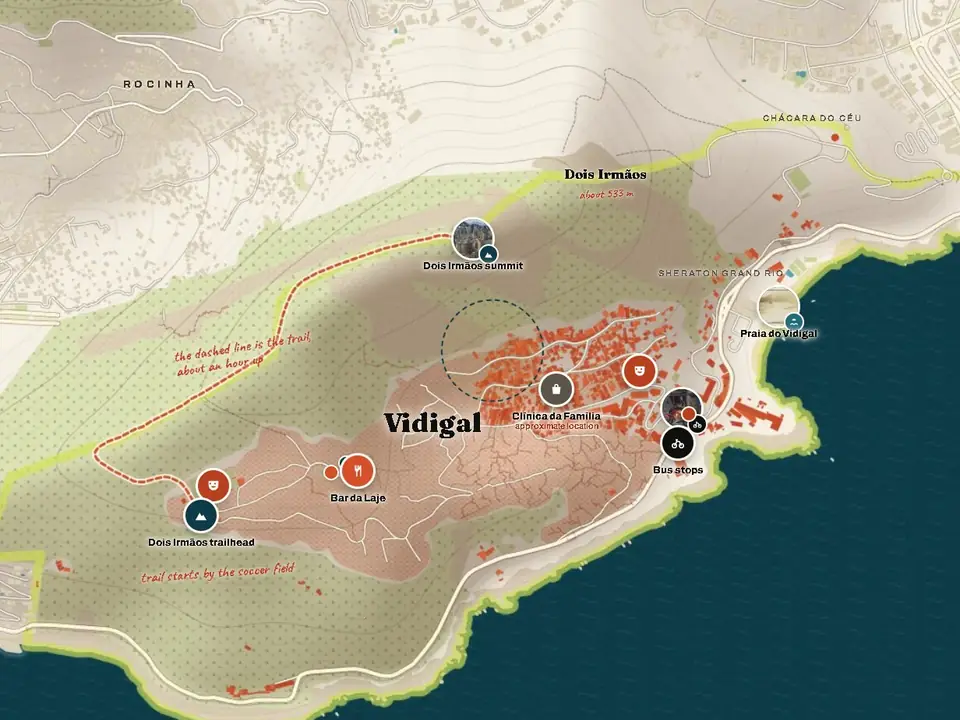
Getting around inside Vidigal means the mototaxi, the cheap and slightly thrilling backbone of the hill. A ride up the main road runs about R$10 as of 2026, and the short hop to the Dois Irmãos trailhead is around R$5. Hold on, trust the driver, and use them freely after dark when you do not want to walk the steep stretches alone. When you stay at our condo, we meet you at the base of the morro and bring you up the first time, which takes all the guesswork out of the arrival and means you have a local number in your phone from minute one.
The honest caveat is police operations. Vidigal was pacified under the UPP program back in 2012, drew a wave of celebrity attention, and has since settled into a quieter, less policed normal. Operations still happen occasionally and without warning. In April 2026, a police action in the community briefly stranded a couple hundred hikers on the Dois Irmãos trail during a shootout, which resolved with arrests and no reported injuries but made international news for a day. These events are rare, usually short, and almost never involve tourists as targets. The rule is straightforward: if you hear sustained fireworks-like sounds or the mood on the street shifts, go inside, stay off the trail that day, and ask your host what is happening. It passes. Then the hill goes back to being the calmest balcony in Rio.
The thirty-second plan for a bad moment
You will almost certainly never need this. Read it once anyway, so it is muscle memory.
- Comply, do not resist. Hand over the phone and the cash. Property is replaceable and insured. You are not.
- Then dial 190 for police once you are safe. For English-speaking help, the tourist police (DEAT) sit on Av. Humberto de Campos in Leblon and run a 24-hour line.
- Freeze the money. Open your banking app on your backup device, lock the card, and confirm your PIX limit held.
- Erase the phone remotely from your laptop, then file the report you will need for insurance and for a new SIM.
- Tell your host. A local who knows the neighborhood can shortcut every one of these steps.

Before you land: the 2026 admin
A few practical things have changed recently, and getting them right at home removes most of the arrival stress that makes people careless in their first jet-lagged hours. This is the paperwork half of staying safe.
First, the visa. As of 2026, US, Canadian, and Australian passport holders need a Brazil eVisa, reinstated in April 2025 after years of visa-free entry. It runs about US$80, is valid for up to ten years with multiple entries, allows stays up to ninety days, and is applied for entirely online. Give it at least ten working days before you fly, because there is no visa-on-arrival to fall back on. Check your own nationality's rules, as they differ. We keep the full pre-trip checklist, including SIM cards, PIX, and money, in our Brazil arrival essentials guide.
Second, getting around. Rio has rolled out the Jaé card, the city's new electronic ticketing system for municipal buses, the BRT, and the VLT tram. You can order a physical card or run it as a virtual card in the app, and registration is free with a small fee if you want it mailed. The metro is easier still: you can tap a contactless credit or debit card straight at the turnstile. For the full breakdown of tapping, topping up, and the quick hop down to Ipanema, see getting around Rio from Vidigal.
Third, connectivity and money, done before you need them. Buy an eSIM so you land already online and never have to stand on a street corner fumbling with a paper map. Set those bank limits we keep mentioning. Turn on find-my-phone. Photograph your passport and email it to yourself. Screenshot your building's address and your host's arrival instructions so you can show a driver without unlocking a shiny phone at a stoplight. Ten minutes of this at your kitchen table is worth more than any amount of on-the-ground vigilance.
Do all of that and you arrive as the calm, unbothered, slightly-too-relaxed traveler who is simply not worth the trouble. Which, in the end, is the entire art of it.
Quick questions.
What are the most common scams in Rio de Janeiro right now?
The common scams in Rio de Janeiro that target visitors are drink-spiking (Boa Noite Cinderela), the PIX and express-kidnapping robbery where you are forced to transfer money or hit ATMs, fake plainclothes "police" who want to inspect your wallet, and card-machine tricks including dynamic currency conversion. Almost all are prevented by low bank limits, watching your own drink, and not carrying valuables.
What should I wear so I do not look like a tourist?
Keep it plain and light: a sunga or board shorts, a bikini under a simple dress, quiet colors, and Havaianas. Leave the jewelry, watches, and logos at home, carry a slim crossbody worn in front, and pack closed shoes with grip for the Vidigal hill. The goal of how to not look like a tourist in Rio is simply to not advertise value.
Is it safe to use ATMs and cards in Rio?
Yes, with care. Use ATMs inside bank branches during business hours, wiggle the card slot to check for skimmers, and cover the keypad. On card machines always pay in reais, never your home currency, and read the amount before you tap. Set a low daily withdrawal limit and a low PIX limit on your app before you travel.
What do I do if someone tries to rob me?
Comply. Hand over the phone and the cash without resistance, because it is only property and it is replaceable. Once you are safe, dial 190 for police, or contact the English-speaking tourist police (DEAT) in Leblon, then lock your cards and remotely erase your phone. Tell your host, who can help with the report and a new SIM.
Is staying in Vidigal more dangerous than a beachfront hotel?
Not in the day-to-day sense most people imagine. Street crime against guests inside Vidigal is uncommon because the community is small and self-regulating, and many find it calmer than Copacabana. The one variable is occasional, usually brief police operations, during which you simply stay indoors and off the trail until it passes.
Should I really bring a second phone?
If you can, yes. A cheap unlocked handset for the beach and nights out means a snatch-and-run costs you a lunch instead of your whole digital life. Keep your good phone in the apartment safe, load the decoy with WhatsApp, Uber, 99, and an offline map, and enable remote-erase on both before you land.
Do I need a visa, and how do I get around the city in 2026?
As of 2026, US, Canadian, and Australian travelers need a Brazil eVisa, applied for online at least ten working days ahead, valid up to ten years. Inside the city, the metro takes a contactless card tap, while buses, the BRT, and the VLT run on the new Jaé card. Around Vidigal itself, the moto-taxi is your friend, roughly R$10 up the hill.
Rio is not a test you pass or fail. It is a city that responds to how you show up. Nearly all of the Rio de Janeiro tourist scams to avoid simply never get close to the traveler who moves like they have somewhere to be, keeps the shiny things out of sight, buys their own drinks, and lets a little pre-trip admin carry the weight. Do that, and the only thing that will follow you home is saudade — the ache to come back before you have even left.