
Three running steps down a wooden ramp and the ground simply stops. Five hundred meters below your feet the forest opens onto São Conrado beach and the grey-green Atlantic, and the pilot strapped alongside you says, calmly, to stop running. You are flying. This is hang gliding São Conrado style — launched off Pedra Bonita, landed on the sand at Pepino, and close enough to Vidigal that you can be back on the hill before the beach fills up.
The beach one bend past Vidigal — and the rock above it
Stand on almost any rooftop in Vidigal and look right, past Dois Irmãos, along the coast. The next beach down is São Conrado. Above it, hooked into the green wall of the Tijuca forest, sits a flat grey tongue of rock called Pedra Bonita. On a clear morning you will see small bright triangles peeling off the top of it, one after another, drifting out over the water and curling down toward the sand. Those are people flying. Some of them booked the flight the night before from an apartment two streets from yours.
That is the whole appeal of doing this from here. Rio's voo livre — free flight, the local word for hang gliding and paragliding together — happens almost entirely from one launch point, and that launch point is not across the city. It is the mountain leaning over the beach next door. Vidigal sits on the flank of Morro Dois Irmãos, on Avenida Niemeyer, halfway between Leblon and São Conrado. The road that runs past the bottom of the morro runs straight to the landing field. You are not making a pilgrimage across town at dawn. You are going one neighborhood over.
The launch is the famous Pedra Bonita ramp, inside Tijuca National Park, roughly 510 meters above the sea. It is the only ramp cleared for tandem flights in the whole city, which is why every operator you will ever read about ends up at the same place. Pilots run off the front of it with a passenger clipped to their harness, catch the air coming up the face of the mountain, and glide out over the treetops, over the edge of the Rocinha hillside, over São Conrado, and down onto Praia do Pepino, the western end of São Conrado beach where the flying club keeps a patch of grass and sand for landings.
None of this is a niche stunt. It has been part of the furniture in this corner of Rio for decades. On a good day there is a steady, unhurried procession of wings coming off the top and touching down on the beach, watched by families eating pastries at the kiosks. It looks, from below, less like an extreme sport and more like a slow parade. That impression is roughly correct, and we will come back to it when we talk about safety.
Hang gliding São Conrado, in numbers
Prices sampled July 2026. Reais, per person, before the club fee. Weather-dependent, as everything here is.
- Club, ramp and insurance fee: roughly R$110–150, paid in cash on the day, on top of the flight.
- Onboard video: R$200 for the front and side angles, R$300 for the 360-degree rig.
- Most bookings take a deposit online and the balance in cash to the flight coordinator. Card payments carry about a 10% surcharge.
- Launch: Pedra Bonita. Landing: Praia do Pepino, São Conrado. Both minutes from Vidigal.
Hang gliding or paragliding — the honest difference
You will book one of two things off this rock, and the operators sell them almost interchangeably, so here is the plain version before you pay. Both launch from the same mountain. Both land on the same beach. Both put a licensed pilot in control and you along for the ride. What changes is the wing over your head and, a little, what the flight feels like in your body.
Hang gliding is the rigid one. The Portuguese is asa-delta, the delta wing — an aluminium and Dacron triangle, taut and fixed, the shape everyone pictures. You lie prone, face down and stretched out beside the pilot in a fabric cocoon, and you launch by running off the ramp together until the wing takes the weight. It feels like flying in the way a child draws flying. Faster off the top, more of a clean forward glide, more of a bird and less of a balloon. This is the classic Rio postcard, and at around R$1,199 it is the pricier of the two.
Paragliding is the soft one. Parapente in Portuguese — a fabric canopy, closer to a steerable parachute, that inflates above you as you launch. You sit upright in a harness, more like a garden chair in the sky, and the ride is gentler and floatier, with a bit more hang time when the air is working. It launches from the grassy slope beside the ramp rather than the ramp itself, and it usually comes in a touch cheaper, around R$999. If your honest question is which is less frightening, most first-timers find paragliding the softer landing, literally and emotionally.
Both are tandem flights. You are not learning anything, steering anything, or making a single decision after you say yes on the ramp. You run when the pilot says run and you keep your legs tucked until they tell you to put them down for landing. Everything in between is scenery. The choice between the two is really a choice of texture: the sharp forward rush of the delta wing, or the slow drifting float of the canopy.
Pick hang gliding if
- You want the iconic Rio shot — the rigid triangle, the prone dive off the ramp.
- You like speed and a forward-leaning, committed launch.
- The extra couple of hundred reais is not the deciding factor.
- You want the version most people mean by "the Pedra Bonita flight".
Pick paragliding if
- You want the gentler, floatier ride and an upright, seated position.
- You are nervous and want the least intense launch.
- You would rather save the difference for the video.
- You care more about time hanging over the view than speed.

The ramp, the run, the drop
Here is how the morning actually goes, minute by minute, because the flight itself is the short part. You meet your pilot at the base in São Conrado — most operators use a fixed meeting point near the beach and the flying club, and many will collect you from a hotel or the São Conrado metro stop on Line 4. From there a van or open jeep takes you up the winding road into the Tijuca forest, a climb of maybe fifteen minutes through dense green with the city dropping away behind you. That drive is half the pleasure and nobody tells you that in advance.
At the top there is a platform, a queue of pilots laying out wings, and the ramp. The ramp is smaller than you imagine and it points straight out into nothing. Your pilot clips you into a shared harness, walks you through the only instruction that matters — run hard, do not stop running, do not sit down until they say — and then you wait. You wait for the wind. When a clean gust comes up the face of the rock the pilot calls it, and you run the few steps down the boards together, and the wing loads, and the ramp ends, and your legs are still moving over five hundred meters of empty air.
The panic, if it comes, lasts about two seconds. Then the wing settles into the air and the whole thing turns quiet and oddly calm. You are looking down at the canopy of the rainforest, then at the rooftops of the Rocinha and São Conrado hillsides, then at the beach and the surf lines and the little kiosks. On a clear day you can see the Pedra da Gávea headland, Dois Irmãos, the long curve of the coast toward Barra. The pilot banks gently, sometimes circles to hold height, and lines up the final approach to Pepino. Landing is a soft jog onto grass or sand. Your legs come down, you take a few steps, and it is over.
- Launch
- Pedra Bonita ramp, Tijuca National Park, roughly 510 meters above the sea.
- Landing
- Praia do Pepino, the western end of São Conrado beach, on grass or sand.
- Time in the air
- 8–15 minutes on a normal day. Sometimes 20 when the wind is generous, sometimes 7 when it is thin.
- Whole activity
- Budget two to three hours from meeting point to feet on the beach, most of it waiting and driving.
- What you do
- Run when told. Tuck your legs. Look. That is the entire job.
A word on the video, because everyone regrets not deciding in advance. The pilot flies with a camera on a boom or a small 360 rig, and you cannot bring your own — no selfie sticks, no phones in your hand at launch, for reasons that become obvious the moment your feet leave the ramp. The front-and-side package runs around R$200, the 360 version around R$300. It is an upsell and it is also the only footage you will ever have of the two most interesting seconds of your trip. Decide before you are standing on the ramp with adrenaline making the decision for you.
The run is the whole thing. Three steps on wood, then the ramp is behind you and your legs are pedalling five hundred meters of nothing, and after that there is only the view. — what the pilots do not quite manage to warn you about
What it costs, and what "how much is hang gliding in Rio" really means
The single most-typed question about this flight is some version of how much is hang gliding in Rio, so here is the arithmetic done properly, with the parts the headline prices leave out. As of 2026 the tandem hang gliding flight sits around R$1,199 per person, and tandem paragliding around R$999. Those are the honest going rates across the reputable operators, and they move a little with season and demand. Treat R$1,100 to R$1,300 as the real hang gliding band and just under R$1,000 as the paragliding one.
Then come the extras that are not optional. There is a club, ramp and personal-accident insurance fee — roughly R$110 to R$150 — that almost every operator collects in cash on the day, on top of the flight price. It funds the landing field, the ramp upkeep and the mandatory insurance, and it is not a scam, it is simply quoted separately. Budget it in from the start. If you want the paragliding São Conrado cost or the hang gliding one to be the true number, add that fee and, if you are filming, the video.
Payment is where first-timers get caught. The common structure is a deposit online — often through PayPal or a card, somewhere around R$250 to R$300 — with the balance handed over in cash to the flight coordinator at the meeting point. Paying the whole thing by card is usually possible but carries about a 10% surcharge, and Brazil's instant transfer, Pix, is often accepted and cheaper. The practical move is to arrive with the cash balance and the club fee already in reais in your pocket. Cash machines are not on top of the ramp.
- Hang gliding
- R$ around R$1,199, tandem, before the club fee.
- Paragliding
- R$ around R$999, tandem, before the club fee.
- Club + insurance + ramp
- Roughly R$110–150, cash, on the day.
- Video
- R$200 front and side, R$300 for the 360.
- All in, realistically
- Reckon on R$1,400–1,600 for hang gliding with the fee and a video.
Is it expensive. Yes, by the standards of everything else you will do in Vidigal, where a full dinner runs R$60 and a beach day costs the price of a coconut. This is the splurge line item of a Rio trip, on par with a private favela-history walk or a long boat day. Whether it is worth it is a question only the ramp can answer, and everyone we have ever sent up has come down grinning and slightly changed. The honest counsel is to book it once, book it properly, and not chase the cheapest quote you can find. The difference between operators is not the wing. It is the pilot and the paperwork, and those are exactly the things you do not want to bargain on.
Before you show up at the ramp
Small things that save a wasted morning. None of them are hard once you know them.
- Wear closed shoes. Trainers, laced. No flip-flops, no sandals, no bare feet on the ramp. You are running on wood and landing on grass.
- Skip loose glasses and hats. Anything that can fly off, will. Contacts beat glasses. Sunglasses on a strap are fine.
- Bring the cash. Balance plus the club fee, in reais. Confirm your weight when you book — light winds can lower the tandem limit on the day.
- Go early. Book the first slots of the morning. Calmer air, shorter queues, and time to rebook the same day if the wind stalls.
- Decide on the video first. You cannot bring your own camera. Choose the package on the ground, not on the ramp.

Is it safe — the part everyone asks about
Let us be direct, because it is the question behind every other question. Tandem free flight from Pedra Bonita is a mature, heavily regulated operation with a long track record, run by professionals who do this thousands of times a year. It is not a fairground ride and it is not risk-free either. Both things are true. What keeps it firmly on the safe side of the ledger is the regulation, and knowing what that regulation looks like is how you pick a good operator from a cheap one.
In Brazil, only licensed pilots registered with the free-flight body — the Associação Brasileira de Voo Livre, or ABVL — are permitted to carry a passenger. Flying tandem is not an entry-level rating. It requires the top level of pilot competency, years of logged solo flying first, and current certification. Every legitimate tandem pilot on that ramp flies with a reserve parachute packed and maintained, on top of the main wing. When you book, the single most useful thing you can ask is whether your pilot is licensed for tandem by the association and how long they have been flying. A good operator answers that without hesitating. Many of the veterans on Pedra Bonita have twenty years and tens of thousands of flights behind them.
The equipment is inspected, the ramp is managed by the flying community that has used it for decades, and the launch conditions are the real safety valve — pilots simply do not fly when the wind is wrong. That is worth sitting with for a second. The reason your flight might get scrubbed is the same reason it is safe: the people in charge would rather send you home unflown than launch into air they do not like. A cancelled flight is the system working, not failing.
There are honest limits. Weight caps exist and they matter — most operators put the tandem ceiling somewhere around 90 to 100 kilos, and a light-wind day can pull that number down, so confirm your weight when you book rather than at the ramp. There is usually a minimum age of around 14 with a parent's written consent, and 18 to fly without a guardian. If you have a serious heart condition, recent surgery, a bad back, or you are pregnant, this is a conversation to have with the operator and your doctor first, not a thing to spring on the pilot at the top. And the landing, gentle as it is, is still a run-out onto your own two feet, so a functioning pair of knees helps.
Everything else is scenery and nerves. The nerves are the point. What you are buying is a two-second decision to run off a mountain, wrapped inside a very well-run safety operation, and the gap between how terrifying it looks and how controlled it actually is turns out to be most of the thrill.
When to fly — weather, season, and the wait
The one thing you cannot book is the weather, and free flight is more at its mercy than almost anything else you will do in Rio. Flights run year-round, seven days a week, from early morning to late afternoon, but only when the sky and wind agree. That agreement is the whole game. A flat calm day and a blown-out stormy one are both no-fly. What you want is a clear morning with a steady breeze coming in off the ocean and up the face of the rock.
Season matters at the edges. Rio's wetter, hotter stretch runs roughly from November into March, with more cloud, more sudden rain, and more days where the morning looks flyable and then closes in. The cooler, drier months from about April to September tend to hand you more clean blue mornings, though nothing is guaranteed in either direction. If your trip is flexible, weight it toward the drier half of the year and toward the start of the day. Early flights get the calmer, cleaner air before the heat builds the afternoon clouds, and they get you to the front of the queue. For the wider picture of what each month in Rio actually feels like, our month-by-month guide to visiting Rio breaks it down.
Two windows to avoid outright if you can. New Year's, roughly the 30th of December through the 2nd of January, and the two weeks around Carnaval. Pedra Bonita is the only tandem ramp in the city, and in peak season the number of flights it has to push through triples or quadruples. The waits get long, the pilots get stretched, and a thing that should feel unhurried starts to feel like a queue at an airport. If your Rio trip lands on those dates, do the flight on a quiet weekday morning at the start or end of the visit, not on the holiday itself.
~~~Build in slack. The single best piece of advice we give guests is to plan the flight for one of your first mornings, not your last. That way, if the wind says no — and sometimes it will, with a blue sky overhead and no obvious reason a beginner can see — you have another morning to try again. People who schedule the flight for the day before they leave are the ones who go home unflown and disappointed. People who give it a two or three-day window almost always get up. The mountain rewards patience and punishes tight schedules.

Doing it from Vidigal — the easy version
This is the argument for basing yourself on this particular hill. Half the friction in any Rio adventure is the getting-there, the pre-dawn taxi, the cross-town crawl. For hang gliding São Conrado, that friction is gone, because the launch and the landing are your next-door neighbors. The meeting point in São Conrado is a short ride from Vidigal's main entrance on Avenida Niemeyer — a few minutes by Uber, a bit less and a bit more thrilling by moto-taxi down the same coastal road. You can be at the base while your coffee is still warm.
So the morning writes itself. Book the flight for around eight, take the short ride down Niemeyer to the meeting point, ride the jeep up through the forest, fly, and land on Pepino beach before most of Rio has finished breakfast. Then you are already at the beach, harness off, adrenaline still going, with the whole day ahead of you. Swim it off. If the surf is up, São Conrado's break is right there and worth a look — our guide to surfing near Vidigal covers the same stretch of coast. Or ride back up the hill for an açaí and a long lunch, which is the more common outcome.
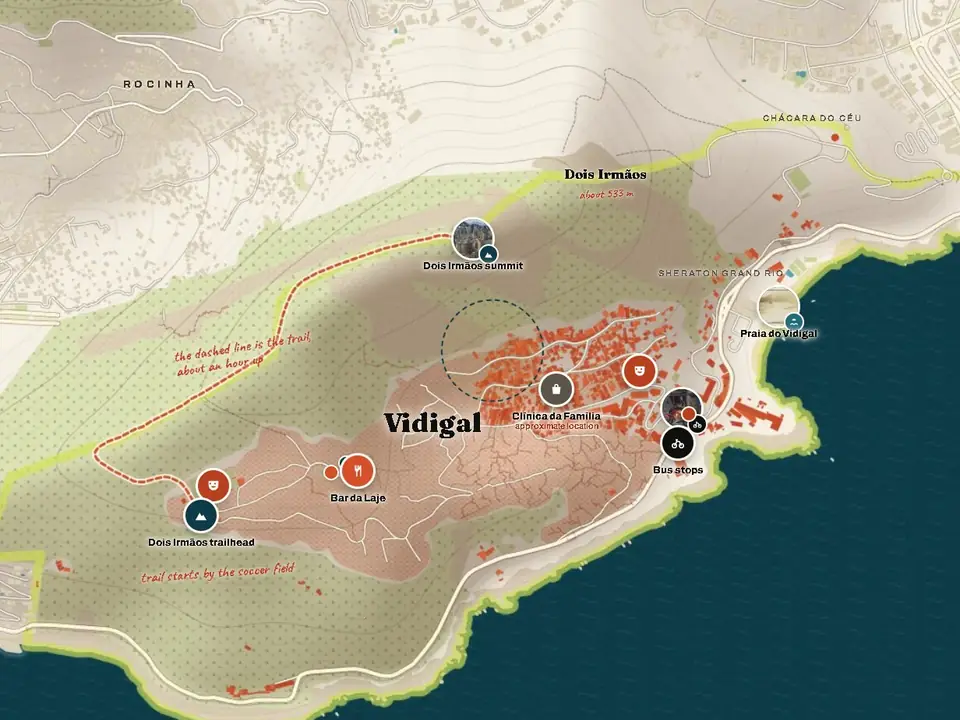
Staying up here also solves the logistics quietly. From our apartment near the top of the morro you can watch the wings come off Pedra Bonita from the terrace in the morning, decide over coffee whether the sky looks flyable, and be at the ramp inside the hour if it does. For the mechanics of moving between the hill, Niemeyer and São Conrado without losing time to traffic, the getting around Vidigal piece has the moto-taxi and rideshare math worked out. And if flying leaves you wanting more of Rio from above but with your feet on the ground, the Dois Irmãos trail starts from the top of Vidigal and delivers a version of the same view for the price of a sweat.
The pairing is the point. You do the most vertiginous thing in the city in the first two hours of the day, and then you go back to being a person who lives on a quiet hill and eats pão de queijo. Few trips let you swing that far, that fast, without a single long transfer in between. That contrast — ramp in the morning, hammock by afternoon — is the whole case for doing it from here.
Would we send a first-timer up
Yes, with three conditions, the same three we tell every guest who asks over the railing at sunset.
- Book it early in your trip. Give the weather two or three mornings to cooperate. Never save it for the last day.
- Ask about the pilot's tandem licence. Association-certified, years flying, reserve packed. If the answer is vague, book elsewhere.
- Pay for the video. You will not believe it happened by the time you land, and the footage is the only proof that isn't a memory.
Quick questions.
How much is hang gliding in Rio, really?
As of 2026, tandem hang gliding off Pedra Bonita runs around R$1,199 per person and tandem paragliding around R$999, before extras. Add roughly R$110–150 in cash on the day for the club, ramp and insurance fee, and R$200–300 if you want the onboard video. Reckon on R$1,400–1,600 all in for hang gliding with the fee and footage. Prices drift with season and operator, so confirm when you book.
Hang gliding or paragliding — which should I pick?
Hang gliding uses the rigid delta wing, you fly face-down and prone, and the launch and glide feel faster and sharper. Paragliding uses a soft canopy, you sit upright, and the ride is gentler and floatier with more hang time. Nervous first-timers usually find paragliding the softer experience. Hang gliding is the iconic Rio image and costs a little more. Both launch from the same mountain and land on the same beach.
Is hang gliding in São Conrado safe?
It is a mature, regulated operation with a long record. In Brazil only pilots licensed for tandem by the free-flight association (ABVL) may carry passengers, they fly with a reserve parachute, and they simply do not launch when the wind is wrong. The best safeguard is choosing a certified, experienced pilot and accepting that a scrubbed flight means the system is working. It is not risk-free, but it is far more controlled than it looks from below.
Is there a weight limit or age limit?
Most operators cap tandem passengers somewhere around 90 to 100 kilos, and light winds can lower that on the day, so confirm your weight when you book. Minimum age is usually about 14 with a parent's written consent, and 18 to fly without a guardian. Serious heart conditions, recent surgery, back problems or pregnancy are conversations to have with the operator beforehand, not at the ramp.
What happens if the weather is bad?
Free flight is entirely weather-dependent. If the wind or sky are wrong, the flight is postponed or cancelled, and reputable operators refund or rebook when the ramp closes for conditions. You will not be charged for a flight that cannot fly safely. The practical fix is to book early in your trip so you have another morning to try. Give it a two or three-day window and you will almost always get up.
How long does the whole thing take, and how long is the flight?
The flight itself is short — usually 8 to 15 minutes in the air, sometimes 20 in generous wind, sometimes as little as 7. The whole activity runs two to three hours from meeting point to feet on the beach, most of it the drive up through the forest and the wait for the right gust. Budget half a morning, not fifteen minutes.
How do I get to the launch from Vidigal?
Easily — this is the point of doing it from here. The São Conrado meeting point is a few minutes from Vidigal's entrance on Avenida Niemeyer by Uber or moto-taxi. The operator's jeep then drives you up to the Pedra Bonita ramp, about fifteen minutes through the Tijuca forest. You land back down on Pepino beach, one bend of the coast from where you started. See our getting around Vidigal guide for the ride options.
The strange thing is how ordinary it feels by the time you are eating lunch. You ran off a mountain at nine in the morning, you saw your own neighborhood from the height of a passing bird, and by one o'clock you are back on the hill arguing about where to get açaí. Hang gliding São Conrado does not stay dramatic. It becomes a thing you did, casually, before the beach — which is exactly the kind of story this corner of Rio hands out to anyone who books early and waits for a clear morning.