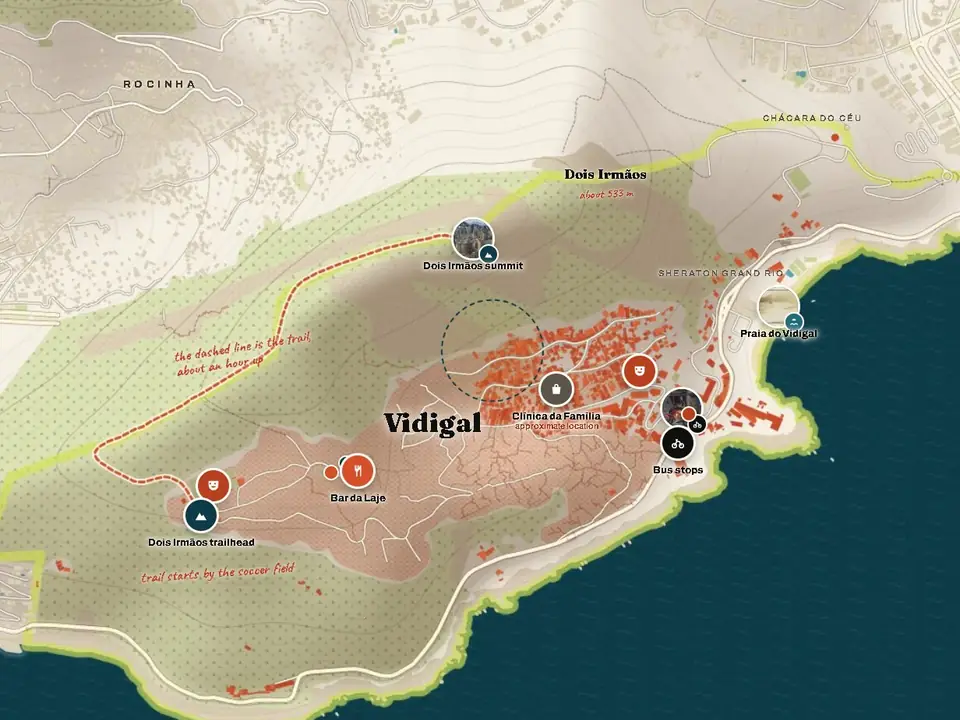

Six in the morning at the foot of the *morro*. The moto-taxi drops you on Avenida Niemeyer while the road is still cool, and already there are boards being waxed in the half-light. This is what surfing near Vidigal actually looks like: São Conrado breaking left around the headland, Arpoador ten minutes east past Ipanema, and Dois Irmãos watching the whole thing from above.
Three beaches, three directions (and one that isn't a surf beach)
Vidigal has a geography most surf towns would trade for. It sits on the shoulder of Dois Irmãos, between Leblon on one side and São Conrado on the other, with Avenida Niemeyer threading the coast beneath it. That means the water is never far, and it comes in three flavors depending on which way you point.
Go southwest and you hit São Conrado, the closest open beach break to the hill. Its far end, the stretch called Praia do Pepino, is where the hang gliders come drifting down off Pedra Bonita. Go the other way, back through Leblon and along Ipanema, and you reach Arpoador, the rock-fringed point where Brazilian surfing was more or less invented. Keep going west past São Conrado, through the tunnel and out to Barra, and the coast opens into a string of bigger, wilder beaches that reward a car and a free morning.
One honest note before you pack a board. Praia do Vidigal itself, the small calm cove you reach by walking down through the community, is not a surf beach. It is protected, shallow, and usually flat as a pond, which is exactly why families and end-of-shift workers love it. It is a beautiful place to swim and drink a beer. It is not a place to catch a wave. We cover that little beach in its own guide to Praia do Vidigal, but for surf you are going next door in one direction or the other.
What makes Vidigal work as a surf base is not that the waves break at its feet. It is that two genuinely good beginner-to-intermediate breaks sit within a fifteen-minute ride, both reachable before the wind comes up, and you can be back on the hill eating açaí by mid-morning. The rest of this guide is the honest version of how to do exactly that, verified for 2026 prices and conditions, with the caveats a local would actually tell you.
Surfing near Vidigal, at a glance
Distances and figures sampled in 2026. Prices in reais, times are traffic-dependent.
- Closest break: São Conrado / Pepino, a five-to-ten-minute drive or moto-taxi.
- Best beginner wave: Arpoador on a small day, early, before the crowd.
- Best swell: roughly April to September. Flattest: high summer, December to February.
- Wetsuit: mostly unnecessary. A 2mm top is nice in July, not required.
São Conrado and Pepino — the break next door
São Conrado is the beach you can practically see from the top of Vidigal, a wide arc of sand running beneath Pedra da Gávea and the flight path of the gliders. It is the obvious first stop, and on the right day it is the best surf near Vidigal you can reach without a car. The wave is an exposed beach break, sand-bottomed, and it tends to break left, peeling toward the São Conrado end when a clean south or southeast swell lines up with an offshore wind off the mountain.
- Type
- Exposed beach break, sand bottom, predominantly left-hand waves.
- Best swell
- South to southeast groundswell, offshore wind from the north-northwest.
- Best season
- Autumn through winter. Cleanest and most consistent around March.
- Level
- Intermediate on a normal day, expert on a big one, beginner-friendly only when small.
- Getting there
- A couple of kilometres southwest along Avenida Niemeyer. Moto-taxi or Uber, five to ten minutes.
Here is the truth about São Conrado that the booking sites skip. It is inconsistent. In high summer it goes flat for days at a time, which is fine if you want to float and watch the gliders, less fine if you drove down with a board. When a proper winter swell arrives, the beach can turn heavy and closed-out, and the takeoff becomes the domain of experienced cariocas who have been surfing this sand since they were nine. On those days it is genuinely one of the better waves in the city, and it is not a beginner beach. The sweet spot is the in-between: a small-to-medium clean swell, early, when the wall is soft enough to learn on and the crowd is thin.
The Pepino end carries a bit of history worth knowing. It takes its name from a hang-gliding and surfing pioneer, and it is still the sand where the tandem flights touch down all afternoon, which makes for a surreal lineup where you paddle for a wave with a glider settling onto the beach behind you. If the flying looks more tempting than the paddling, that is a whole separate day out, and we mapped it in the hang gliding over São Conrado piece.
Two warnings, both real, neither meant to scare you off. São Conrado gets rip currents, especially on bigger days, so read the water before you paddle out and do not fight a rip head-on. And after heavy rain, the water quality drops. Storm runoff reaches this beach, and the local rule is simple: give it a day, maybe two, after a big downpour before you get in. Keep your mouth closed on the duck-dives regardless. None of this is unusual for an urban break. It is just the part the postcard leaves out.

Arpoador — where Brazilian surfing was born
If you have never stood on a board, Arpoador is where you start. It is a short, dramatic wedge of sand and rock at the far eastern tip of Ipanema, pressed up against Copacabana, and it is the closest thing Brazil has to a surfing shrine. This is the beach where the sport took root in Rio in the 1960s, and more than half a century later it is still the most reliable beginner wave in the Zona Sul. It sits a little further from Vidigal than São Conrado does, about fifteen to twenty minutes east depending on traffic, back down through Leblon and the length of Ipanema. It is worth the extra ten minutes.
The wave at Arpoador is an exposed beach break with the rocky point on its eastern edge, and it works across most of the tide. It breaks mainly left, and because the rocks bend the swell and the sand shelves gently, the waves lose a little of their punch as they roll toward the beach. That softening is exactly what makes it forgiving. On a small clean day the inside reforms into slow, waist-high walls that a first-timer can ride to the sand over and over, which is why every surf school in Rio runs its beginner lessons here.
The catch is the crowd, and the fix is the clock. Arpoador is popular, central, and photogenic, so the lineup fills fast. There is a counterintuitive logic locals live by: when the beach is packed with surfers, the conditions are usually mellow, which means it is safe enough for beginners too. When it thins out and the takeoff gets serious, that is your signal to sit on the shoulder and watch. Either way, the move is to be in the water early. In the water before eight is the standard advice, and before six-thirty is better still, both for the cleanest morning wind and for the thinnest crowd. Sunrise at Arpoador, board under your arm, the Two Brothers pink behind you, is one of the quiet great experiences of the city.
Arpoador is also famous for something that has nothing to do with catching waves, and everything to do with why you should come at the end of the day too. The rock at the point, Pedra do Arpoador, is the most beloved sunset spot in Rio. Every clear evening a crowd gathers on the stone to watch the sun drop behind Dois Irmãos, and when it goes, they applaud. You can surf the morning and come back for the clap. Few surf beaches send you off like that.
The wave you remember from Rio will not be the biggest one. It will be the small clean left at Arpoador you caught at sunrise, before the city woke up, with the mountain going pink behind you. — what we tell every guest who asks where to start
Lessons, boards, and what it costs
You do not need to arrive knowing how to surf, and you do not need to bring a board. The surf schools clustered along Arpoador and the Ipanema end of the beach exist for exactly this, and the standard offer is well established. A group lesson runs around ninety minutes and includes the board, a rashguard, and an instructor who will push you into your first waves and shout when to stand. As of 2026, expect to pay roughly R$ R$120 to R$180 a person for a group session, which lands somewhere near twenty-five to thirty-five US dollars depending on the day's exchange rate. That is genuinely good value for a coached first hour on a good beginner wave.
If you want more attention, a private lesson costs more and delivers more. Budget around R$250 to R$350 for one-on-one time, which is worth it if you are nervous, short on time, or trying to fix a specific habit rather than just stand up for the first time. Several of the better operators cap their small-group sessions at two or three students per instructor, which is the honest middle ground, close to private coaching at closer to group prices. The instructors at the established schools are used to travelers and most speak enough English to get you safely through your first session, though a few words of Portuguese always warm the exchange.
On boards. For a lesson, the board is included, and it will be the right one for you, a big soft-top foam board that floats a beginner and forgives a bad pop-up. If you already surf and just want to rent, the same schools and the beachfront kiosks rent boards by the hour or the half-day. Prices are not posted online with any consistency, so confirm on the sand, bring a photo ID, and expect to leave a deposit or a document while the board is out. A rough rule from experience is to budget a modest hourly rate that climbs to a fuller day rate if you keep it all morning. Ask two kiosks before you commit. There is no fixed tariff and a friendly face gets a friendlier number.
One thing worth saying plainly. You can surf the whole trip for very little money. A morning at Arpoador that includes a group lesson, a coconut afterward, and the moto-taxi home comes in well under R$250 all-in, which is less than a single dinner downhill in Leblon. Surfing is one of the cheapest serious things you can do in this city, and it is happening a fifteen-minute ride from the hill.
What a surf morning costs in 2026
Reais, sampled across South Zone schools. Ranges, because prices move with season and the dollar.
- Lessons include board and rashguard. You bring sunscreen and a towel.
- Standalone board rental: confirm on the beach, leave a deposit or ID.
- Bring some cash. Pix works at the schools, less so with a beach kiosk at 7am.
- Small-group lessons capped at two or three students are the value pick.

When to come — season, swell and water
Rio's surf runs on a rhythm that surprises northern-hemisphere visitors, because the good swell arrives in what you would call the off-season. The most consistent, cleanest, most powerful waves land roughly from April through September, the southern-hemisphere autumn and winter, when south and southeast groundswells become regular and the peak quality shows up between June and August. If you are a competent surfer chasing real waves, plan for those months. That is when São Conrado turns on and the whole coast lights up.
High summer is the opposite. December through February is hot, crowded, and often flat, with long spells of small, gutless surf at the South Zone beaches. That sounds like bad news, and for an experienced surfer it can be. For a total beginner it is quietly ideal. Small, warm, forgiving water is the friendliest place to learn, and Arpoador on a January morning is about as gentle as an ocean gets in Rio. So the honest answer to when you should come depends entirely on which surfer you are. The person who wants to be pushed into their first wave and the person who wants to be humbled by a real one are looking at opposite ends of the calendar.
The water itself is kind year-round. Sea temperatures sit somewhere between 20 and 26 degrees Celsius across the seasons, which is 68 to 79 in Fahrenheit, dipping to an average around 21 in the depth of winter. What that means in practice is that you almost never need a wetsuit. Most of the year you surf in boardshorts or a bikini. In July a light 2mm top or a spring suit makes a long dawn session more comfortable, but plenty of locals still paddle out in trunks in the coldest month and think nothing of it. Leave the thick neoprene at home.
Summer, roughly Dec–Feb
- Small, gentle, often flat. Easy to learn on.
- Warmest water, longest days, best for total beginners.
- Busiest beaches and highest prices in the city.
- São Conrado can go flat for a week. Arpoador still reforms.
Winter, roughly Jun–Aug
- The real swell window. Bigger, cleaner, more powerful.
- Water dips to around 21°C. A 2mm top is nice, not essential.
- Fewer tourists, lower rates, dry sunny days between fronts.
- São Conrado can turn heavy. Know your limit before you paddle out.
There is a shoulder logic here that suits a Vidigal stay well. The winter months are also Rio's value season, dry and clear and cheaper, and they happen to carry the best waves. If you are choosing dates around the surf, late autumn and winter give you swell, thinner crowds, and better room rates all at once. We make the fuller case for that timing in the beaches near Vidigal guide, which covers the walk and the coastal geography in more detail.
The safety stuff, said plainly
None of this should keep you out of the water. All of it is what a local would mention on the walk down.
- Rips are the real risk. At São Conrado especially, on bigger days. Learn to spot the calm, churny channel and never swim against it. If caught, go sideways, not shoreward.
- Skip the day after heavy rain. Urban runoff hits these beaches. Give it 24 hours, and keep your mouth shut on the duck-dives.
- Respect the local lineup. São Conrado on a good swell belongs to people who grew up on it. Wait your turn, do not drop in, and it stays friendly.
- Take nothing to the beach you would hate to lose. A cheap phone, minimal cash, no watch. Someone watches the sand while you are in the water.
The breaks beyond the doorstep
São Conrado and Arpoador cover almost everything a visiting surfer needs, but the coast keeps going, and if you catch the bug it is worth knowing what sits further out. West of São Conrado, through the Zuzu Angel tunnel, Barra da Tijuca opens up as a long, straight, wave-rich beach that is the everyday break for a huge slice of Rio's surf population. Beyond Barra the road runs on to Recreio, Macumba, and the small, curved, half-wild jewel called Prainha, widely rated the best wave in the city and protected as part of a park. Prainha is roughly an hour west of Vidigal by car on a clear morning, and on a good winter swell it is worth every minute of the drive.
None of these are casual moto-taxi hops. They are a morning's mission, best done with a rented car or a driver, ideally very early to beat both the wind and the traffic on the coastal road. If your trip is short and your ambitions are moderate, you will never need them. São Conrado and Arpoador will fill your week. But if you surf seriously and the forecast lights up, ask a local at the Arpoador schools where it is best that particular day. The swell direction decides everything, and someone on the sand at dawn always knows.
Worth repeating, because visitors get it wrong: the beach directly below Vidigal, the one you reach through the community, is a swimming beach, not a surf beach. Do not lug a board down those steps expecting a wave. Go there for a sunset beer and a float, and go elsewhere to surf.

A surf morning from Vidigal, start to finish
Here is how the day actually runs when you are staying up on the hill and you want to be in the water for it. The whole appeal of surfing near Vidigal is that the logistics are short. You are not driving an hour to a beach. You are dropping down the front of the *morro* to water you could see from your terrace.
- 5:45am
- Up in the dark. Board shorts, sunscreen, a cap, a cheap phone, R$100 in cash.
- 6:00am
- Moto-taxi from the top down to Avenida Niemeyer, R$15 or so. Cool air, empty road.
- 6:20am
- Arpoador for a first lesson, or São Conrado if the swell is clean and small. Board rented or lesson booked the night before.
- 8:30am
- Out of the water before the wind and the crowd. Arms like noodles, grinning.
- 9:00am
- Coconut on the sand, then back up the hill. Açaí bowl, cold shower, the whole day still ahead.
The part that sells this place as a surf base is that last hour. You are not fighting cross-town traffic back to a hotel. You take a moto-taxi up the main road, you are showered and fed by ten, and the ocean is already behind you before most of the city has finished breakfast. If you want the moto-taxi and Uber math in full, including night rates and where the cars stop, the getting around Vidigal guide lays it out.
It helps, too, to have a base you can walk back into salty and half-asleep without anyone minding. A private apartment with an outdoor tap to rinse the board, a terrace to dry the wetsuit top nobody quite needed, and a kitchen for the eggs you crave after a dawn session beats a hotel room for a surf trip every time. That is most of why guests at the apartment end up in the water more mornings than they planned. The friction is gone. The wave is right there.
Quick questions.
Where is the closest surf beach to Vidigal?
São Conrado, roughly two kilometres southwest along Avenida Niemeyer, a five-to-ten-minute drive or moto-taxi. Its far end, Praia do Pepino, is where the hang gliders land. It is the nearest open beach break, though it is inconsistent and better for intermediates than first-timers.
Is São Conrado good for beginners?
Only when it is small and clean. São Conrado is an exposed beach break that can turn heavy and closed-out on a winter swell, and on those days it is a wave for experienced local surfers. For your very first session, Arpoador is the safer, softer choice. Save São Conrado for once you can already stand up.
How much does a surf lesson cost in Rio in 2026?
A ninety-minute group lesson, board and rashguard included, runs about R$120 to R$180 a person. A private one-on-one lesson is roughly R$250 to R$350. Small-group sessions capped at two or three students sit in between and are the best value. Most instructors at the Arpoador schools speak some English.
Can I rent a surfboard without taking a lesson?
Yes. The schools and beach kiosks at Arpoador and the Ipanema end rent boards by the hour or half-day. Prices are not posted online, so confirm on the sand, bring a photo ID, and expect to leave a deposit while the board is out. Ask two kiosks before you commit.
What is the best time of year to surf near Vidigal?
For real swell, April through September, peaking in the winter months of June to August. For learning, high summer, December to February, when the surf is small, warm and forgiving. The best wave window and the best beginner window are at opposite ends of the calendar.
Do I need a wetsuit to surf in Rio?
Almost never. The water sits between about 21 and 26 degrees Celsius across the year. Most of the time you surf in trunks or a bikini. In July a light 2mm top or a spring suit makes a long dawn session more comfortable, but plenty of locals still surf in boardshorts in the coldest month.
Is it safe to surf at São Conrado and Arpoador?
Yes, with normal ocean sense. The real risks are rip currents on bigger days and water quality after heavy rain, so read the water and give it a day after a downpour. Keep valuables off the beach, respect the local lineup on a good swell, and surf early when it is cleanest and calmest.
Surfing is the cheapest way to feel like you belong to this city rather than visiting it. A board, a small left, a mountain going pink behind you, and a moto-taxi waiting to run you back up the hill. You do not need to be good. You need to be in the water by seven. Everything else is *saudade* in advance, the feeling you will have on the plane home, already checking the swell for next time.