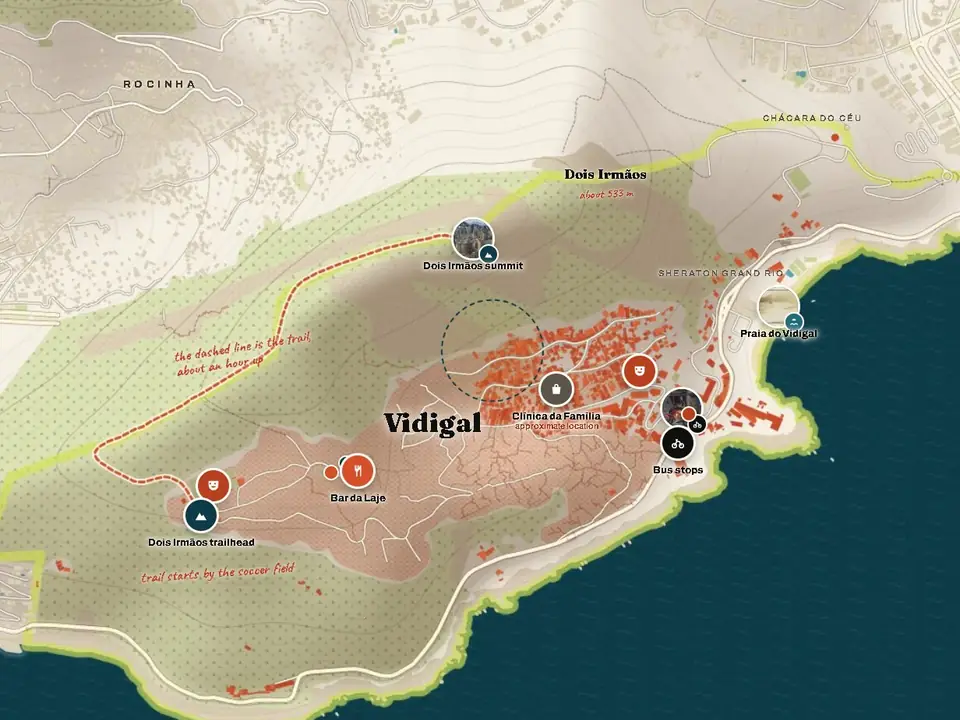

From the terrace in Vidigal you can trace almost the whole coast at dusk — the beaches going amber, the Two Brothers black against the last light, the open Atlantic turning to hammered metal. What you cannot quite see, tucked around the headland at the mouth of the bay, is the other one: Sugarloaf Mountain, Rio de Janeiro's second great lookout, a bare granite thumb pushed straight up out of the water. You reach the top of it the way people have since 1912 — sealed in a glass box on a cable, swinging out over Guanabara Bay with the city tilting underneath you. It is touristy, it is ticketed, and it is still, on the right evening, one of the finest hours you will spend in this city. Here is how to do it without wasting the money or the light.
Lux Vidigal is our two-story apartment in Vidigal, with the ocean on one side and the Dois Irmãos mountain on the other, and you can check dates and book it on Airbnb.
Sugarloaf Mountain, Rio de Janeiro's other height
Rio hands out its panoramas from two great heights, and everyone comes for both. One is Cristo Redentor on Corcovado, arms out, inland, the postcard the whole world already owns. The other is Pão de Açúcar — Sugarloaf — a 396-meter monolith of bare granite at the spot where Guanabara Bay meets the ocean. Cristo looks down on the city like a benediction; Sugarloaf stands inside it, at eye level with the planes, and lets you look back. They are two halves of the same view, and if you do only one you will spend the flight home wishing you had done the other.
The name is older than the cable car. When the Portuguese ran sugar through this coast in the sixteenth and seventeenth centuries, refined sugar was pressed into tall conical clay molds — pães de açúcar, sugar loaves — and someone decided the peak at the bay mouth looked like one turned upside down. Guides will also tell you, with equal confidence, that it is a corruption of a Tupi phrase for a high, pointed, solitary hill. The rock does not care what you call it.
What makes Sugarloaf a day out rather than just a landmark is the bondinho — the cable car, or more formally the teleférico — that runs to the summit in two stages. It opened in 1912, one of the first cable cars built anywhere in the world. The cars have been rebuilt and re-glassed several times since, but the idea has not changed in over a century: you step into a glass gondola, and a steel cable carries you to a place your legs would need an afternoon and a rope to reach. From the Vidigal hillside it is the sibling attraction across the water — the one you point at from the laje and then, one afternoon, go and stand on.
Sugarloaf, at a glance
Sampled for 2026. Reais, not dollars. The cable-car fare moves with the calendar, so treat the ticket figure as a guide and confirm the day's price on the official site.
- Base station: Praça General Tibúrcio, at Praia Vermelha in the Urca neighborhood.
- Two stages: Praia Vermelha to Morro da Urca, then Morro da Urca to Pão de Açúcar.
- Buy online at bondinho.com.br to skip the ticket queue, or pay at the base.
- From Vidigal: roughly 40 to 50 minutes by car or Uber, longer at rush hour.
- Cheaper way up: hike Morro da Urca free via the Pista Cláudio Coutinho, ride only the top stage.
How to get to Sugarloaf Mountain — from Vidigal and the South Zone
Sugarloaf sits in Urca, a small, quiet residential pocket on the far side of the South Zone from Vidigal — past Copacabana, around the shoulder of Botafogo, out on the little peninsula that guards the entrance to the bay. There is no clever shortcut and no cable car from your side of the city. The honest answer to how to get to Sugarloaf Mountain is the simple one: you take a car.
From Vidigal, order an Uber or a 99 down at Praça do Vidigal, the square at the base of the hill, and give the driver one destination — Praia Vermelha, or the Parque Bondinho at Praça General Tibúrcio. That is the base station, and every driver in Rio knows it. On an ordinary day the ride runs 40 to 50 minutes; in the thick of morning or evening traffic along the beachfront it can stretch past an hour, so build in slack if you are chasing a specific sunset slot. The fare is moderate by any standard and splits nicely across two or three people. ← leave earlier than you think for sunset
If you are staying elsewhere in the South Zone the math shortens. From Copacabana or Botafogo you are 15 to 25 minutes out. The metro will get you as far as Botafogo station, from where a short Uber or the 512 bus finishes the job, but for a group the door-to-door car is worth the few extra reais and the saved confusion. Cars can drive right up to the base station and there is paid parking if you have rented one, though almost nobody staying in Zona Sul bothers to drive themselves.
One thing worth knowing before you commit the afternoon: Urca is genuinely far from Vidigal in Rio terms, and the trip only makes sense as its own outing, not something you squeeze between the beach and dinner. The move most of our guests make is to pair it with the one attraction that sits on the way — Christ the Redeemer, up on Corcovado — and turn the whole thing into a single big Rio day. More on how to sequence that further down.
The two-stage ride — Praia Vermelha to Morro da Urca to the summit
The bondinho does not go straight up. It climbs in two hops, and the in-between stop is a genuine part of the experience rather than a technicality, so it helps to know the shape of the journey before you are standing in the queue wondering which line you are in.
Stage one leaves the base at Praia Vermelha and carries you up to Morro da Urca, the shorter hill at 220 meters, in about three minutes. The gondola lifts off, the ground drops away, and suddenly the little crescent of sand below is a toy. Morro da Urca surprises a lot of first-timers, because it is not just a transfer point. It has restaurants and a café, a gift shop, an open-air amphitheater that has hosted proper concerts, a helipad where scenic flights clatter away over the bay, and a view over Botafogo's yacht-filled cove that would be the headline anywhere else. Plenty of people mistake this level for the top, take their photos, and only then notice the second cable climbing higher still.
Stage two is the one you came for. From Morro da Urca a second gondola runs a 1,400-meter span of cable across open air to the summit at 396 meters. The glass cars hold around 65 people and leave every 20 minutes or so, and this is where the drama lives — for a full minute you hang over nothing, bay on one side and ocean on the other, the cable humming, the rock face swelling up to meet you. People go quiet. Then the doors open and you walk out onto the granite.

The summit is a broad, walkable dome — paved paths, low trees, a couple of kiosks selling water and beer, railings on every edge — and the view arranges itself in a full circle around you. Directly below, the cove of Botafogo with its forest of sailboat masts; behind it, rising out of the Tijuca green, Corcovado with Christ the Redeemer small and unmistakable on his perch. Swing left and Copacabana unrolls in its long white arc to the point at Leme. Swing right and the whole of Guanabara Bay opens up — the downtown towers, the Rio-Niterói bridge stitching across the water, Niterói on the far shore, and the runway of Santos Dumont airport where planes thread in low over the bay, passing beneath you as you watch. Turn the last quarter and it is the open Atlantic, flat to the horizon. Most cities give you one good angle. Sugarloaf gives you 360 degrees of them.
Sugarloaf cable car tickets, hours, and buying smart
The Sugarloaf cable car tickets are sold as a single round-trip fare that covers both stages, up and down. For 2026 the standard adult round trip runs about R$170, with reduced fares near R$85 for children aged 6 to 12 and around R$110 for seniors over 60 and students carrying valid ID; children under 6 ride free on a paying adult's lap. Those numbers move with the season and the venue's pricing tiers, so read them as a guide rather than gospel and check the official site for the day you plan to go.
- Base station
- Praça General Tibúrcio, Praia Vermelha, Urca.
- Round trip
- Roughly R$170 adult, R$85 child (6–12), R$110 senior and student in 2026. Verify current rates.
- Hours
- Daily, about 9:00 to 20:00, opening nearer 8:30 on busy weekends. Last car up around 19:30.
- Where to buy
- Online at bondinho.com.br, or at the base-station box office. Online lets you skip the ticket line.
- How long
- Allow 2.5 to 3 hours on the mountain, plus travel each way.
Buy online if you possibly can. The official site is bondinho.com.br, and a ticket bought in advance sends you straight to the boarding queue instead of the ticket queue, which on a busy afternoon is the difference between catching your light and missing it. The base-station box office does sell same-day tickets and you will not be turned away for showing up in person, but you inherit whatever line the cruise-ship crowd has built by the time you arrive. Book direct with the official operator rather than through a random reseller, and be a little wary of third-party sites promising deep discounts on what is a fixed-price public attraction.
The hours flex, which matters more here than at most attractions because the entire point of an evening visit is timing. As a working rule the base station runs from around 9:00 in the morning to about 20:00 at night, opening a touch earlier on weekends, with the last car up at roughly 19:30. That schedule shifts for private events, maintenance, weather, and the season, so if you are building a plan around a specific sunset, confirm the day's operating hours and the exact sunset time before you commit the trip.
Before you go up
The small things that decide whether the afternoon goes well.
- Buy the ticket online. bondinho.com.br. Skip the ticket line, walk to boarding.
- Watch the sky, not just the clock. On a hazy or overcast day the distance view flattens badly. Clear winter afternoons are the sharpest of the year.
- Give yourself three hours. Two stages up, time at each level, two stages down. It is not a quick in-and-out.
- Carry water and a layer. The summit catches the wind off the bay once the sun drops, even in summer.
- Cards and Pix work at the kiosks and box office. Keep a little cash for the Uber and tips at either end.
Sunset or daytime — the honest tradeoff
There are two right times to ride the bondinho, and they give you two different mountains. Knowing which one you actually want will save you a small disappointment at the top.
The famous slot is the Sugarloaf Mountain sunset, and it deserves the fame. You arrive an hour or so before the sun goes down, ride up with the light already turning gold, and watch the whole bowl of the city catch fire — the beaches going from white to amber, the granite around you glowing, and then, as the color drains, the lights of Rio coming on one district at a time until the entire coast is a scatter of gold against the dark water. It is genuinely one of the great urban sunsets on the planet. The catch is that everyone knows it. The late-afternoon cars are the fullest of the day, the summit railings get shoulder-to-shoulder at the best angles, and a hazy evening can rob you of the clean distance you came for. Go for the atmosphere, not the solitude, and get up there early enough to claim a spot on the western rail before the crowd does.
The quieter, underrated slot is a clear morning. Rio's air is at its sharpest early, especially in the dry winter months from June to August, and on a crisp morning you can see clear across the bay to the mountains behind Niterói with a definition that the evening haze never allows. The cars are emptier, the summit is calm, and the light is honest rather than romantic. If your priority is seeing the geography of the city laid out clean — where the bay meets the ocean, how the neighborhoods fit together, exactly where your hillside in Vidigal sits in the whole picture — the morning is the better mountain. If your priority is a feeling, take the sunset.
The trail up Dois Irmãos makes you earn the view with your legs. Sugarloaf makes you earn it with a queue and a ticket. The one from your own terrace asks for nothing but that you look up from your coffee. — what we tell guests weighing the day

The cheaper way up — hiking Morro da Urca
Here is the part the ticket page will not tell you. You do not have to pay for both stages of the cable car, because the first stage has a free alternative on foot, and it is one of the more pleasant short walks in the whole city.
At the far end of Praia Vermelha, an asphalt path called the Pista Cláudio Coutinho runs along the base of the rock with the sea on one side and the green flank of Morro da Urca on the other. It is 1.25 kilometers long, paved, flat, pedestrian-only, and completely free — locals use it for morning runs, families push strollers along it, and the birdsong and the fig trees make it feel a world away from the traffic you just left. A little way in, a marked sign points left to the Trilha do Morro da Urca, a genuine forest trail that climbs to the top of the first hill. It is roughly 900 meters and about 40 minutes of walking, easy to moderate with a few steep, rooty stretches, and it delivers you to Morro da Urca at 220 meters without spending a cent.
From there you have a choice. You can buy a single-stage ticket at the Morro da Urca booth for just the upper cable car to the summit of Pão de Açúcar — meaningfully cheaper than the full round trip, since you have already done the bottom half with your own legs — and ride the dramatic leg you actually came for. Or you can enjoy the Morro da Urca view, buy nothing at all, and walk back down the way you came for a free half-day with a serious payoff. Confirm the single-stage price at the booth on the day, because it shifts along with everything else, but the saving over the two-stage fare is real.
Ride both stages
- Full round-trip ticket, around R$170 adult.
- Zero effort, sealed glass gondolas the whole way.
- Right for sunset, mixed fitness, or a tight schedule.
- You queue with everyone else at peak hours.
Hike stage one
- Free walk up the Trilha do Morro da Urca, ~40 min.
- Pay only the cheaper single stage to the summit, or nothing at all.
- Right for a clear morning and reasonable legs.
- Closed shoes, water, sunscreen. Skip it in the rain.
If you hike the first stage
The short, honest checklist for doing Morro da Urca on foot.
- Go early. Morning is cooler, clearer, and the light on the bay is best before the haze builds.
- Wear grip. Sneakers, not sandals. The trail has roots and smooth rock that turn slick after rain.
- Bring water and small cash for a single-stage ticket at the top if you decide to ride the rest.
- Watch for monkeys. The saguis on this hillside are bold. Do not feed them, and do not leave a bag open.
- Skip it in wet weather. The rock scrambles are not worth it in the rain, and the view will be closed in anyway.
Praia Vermelha and Urca — the quiet corner at the base
Do not treat the base as just a car park with a cable car attached. Urca is one of the calmest, most old-fashioned neighborhoods in Rio — a small grid of 1930s houses and low apartment blocks wrapped around the foot of the two hills, with almost no through traffic and a pace that belongs to a different decade. If you arrive with time in hand, spend some of it here.
Praia Vermelha, Red Beach, is the little half-moon of coarse golden sand right beside the base station, hemmed in by the two granite hills so that it feels held, protected, nothing like the wide-open beaches on the ocean side. The water is usually flat and calm. Just around the point runs the mureta da Urca, the low seawall where cariocas sit at dusk with a cold beer and a plastic cup, watching the light go down over the bay with the downtown skyline across the water. It is a beloved local ritual and costs nothing. A handful of simple bars nearby will sell you a chopp and a plate of bolinhos to carry to the wall, which is exactly the sort of thing you should do while you wait for your cable-car slot.
The point is that a trip to Sugarloaf does not have to be a smash-and-grab. Come a little early, walk the Pista Cláudio Coutinho, sit on the seawall, ride up for the sunset, and you have turned a single attraction into a genuinely lovely half-day in a part of Rio most visitors never slow down in.
One day, two icons — pairing Sugarloaf with Christ the Redeemer
Because Urca is a haul from Vidigal, the smart play is rarely to visit Sugarloaf on its own. The two great Rio heights, Sugarloaf and Corcovado, sit on roughly the same side of the city, and plenty of visitors do both in a single well-planned day. The venues know it too, and combined Sugarloaf-and-Christ tickets and tours are widely sold, often bundled around R$290 to R$340 depending on how you reach Corcovado — a modest saving over buying the two separately, and a real saving in logistics.
If you are stitching the day together yourself, the timing logic is simple and worth getting right. Do Christ the Redeemer in the morning, when Corcovado is most likely to be clear of the cloud that so often swallows the statue by midday, then work your way down and across to Urca so you are riding the bondinho as the afternoon tips toward gold. That sequence gives each icon its best conditions — the mountaintop statue before the clouds, the bay lookout at sunset — and leaves you on the Sugarloaf summit for the finale. Our companion piece on Christ the Redeemer from Vidigal covers the access, the ticket types, and the timing for the Corcovado half, and if you would rather see how a full trip fits together, the three-days-in-Rio itinerary from a Vidigal base slots both icons into a workable week without you living in the back of an Uber.
One honest caveat: two mountains and a lot of city driving is a full, tiring day, and it is better done rested than crammed. If your legs are already spent from the beach or from the walk down to Leblon and Ipanema, split the icons across two days and give each one the unhurried afternoon it deserves.
~~~The free nightly version — from the hillside
Here is the quiet argument this whole guide has been walking toward. Everything Sugarloaf sells you — the ticket, the queue, the two-stage climb — is, at bottom, one thing: Rio seen from a height, at the hour the light turns gold. It is worth doing. You should do it. But it is worth knowing that you can also have the essence of it, free, every single night, without a car ride to Urca or a line at a box office.
Be honest about the geography first, because we will not pretend otherwise. From the Vidigal terrace you do not see the Sugarloaf monolith itself — the rock sits around the headland at the mouth of the bay, and our hillside faces the other way, out over the open ocean toward São Conrado and the Two Brothers. What you get instead is the same experience the mountain is really selling. You are already high on the hill. The beaches curve away below you. The light does the same molten thing over the water that it does from the summit, the city lights come on the same way after dark, and the whole panorama is yours from a private laje with a coffee or a caipirinha in your hand and not another soul in the queue. Sugarloaf is the paid, ticketed, once-in-a-trip version. The terrace is the nightly one.

This is the whole logic of staying up here rather than commuting in from a hotel. Do the big-ticket icons — ride the bondinho, climb to Cristo, hike Dois Irmãos next door — and then come home to a hillside that hands you its own version of the reward for nothing, at the end of every day. We make the fuller case for the terrace and exactly what it looks at in our piece on Vidigal's best views and the ocean-view apartment, and if you have read this far into a guide about a mountain across the water, you can probably already picture the evening. When you are ready, see the condo and the terrace it comes with.
Quick questions.
How do you get to Sugarloaf Mountain from Vidigal?
Take an Uber or 99 from the Praça do Vidigal at the base of the hill straight to Praia Vermelha, the base station in the Urca neighborhood. It is roughly 40 to 50 minutes on a normal day and longer at rush hour. There is no cable car or shortcut from the Vidigal side, so a car is the simplest way, and it splits cheaply across a couple of people.
How much are Sugarloaf cable car tickets in 2026?
The standard adult round trip covering both stages runs about R$170, with reduced fares near R$85 for children 6 to 12 and around R$110 for seniors and students with ID; under-6s ride free. Prices shift with the season, so confirm the current rate at bondinho.com.br and buy online to skip the ticket queue.
What are the opening hours, and when is best for sunset?
The base station runs daily from about 9:00 to 20:00, opening nearer 8:30 on busy weekends, with the last car up around 19:30. For the Sugarloaf Mountain sunset, arrive about an hour before the sun sets so you ride up in the golden light and hold a spot on the western railing. Hours flex for weather and events, so check the day's schedule first.
Can you hike up instead of taking the cable car?
Partly. The first stage has a free alternative: walk the Pista Cláudio Coutinho from the end of Praia Vermelha, then take the marked Trilha do Morro da Urca, about 900 meters and 40 minutes, up to the first hill at 220 meters. From there you buy only the cheaper upper cable car to the summit, or walk back down for free. The upper stage to the 396-meter peak has no walking route.
Is Sugarloaf Mountain in Rio de Janeiro worth it if I am already doing Christ the Redeemer?
Yes, and they are different experiences rather than a repeat. Christ looks down on the city from inland; Sugarloaf stands inside the bay and lets you look back, with a full 360-degree view over Guanabara Bay, Copacabana, and the ocean. Many visitors do both in one day, often on a combined ticket, with Christ in the clearer morning and Sugarloaf at sunset.
How long should I set aside for the whole visit?
Plan two and a half to three hours on the mountain itself — two stages up, time at both Morro da Urca and the summit, then two stages back down — plus 40 to 50 minutes of travel each way from Vidigal. If you are pairing it with Corcovado, treat it as a full, tiring day and do not try to squeeze the beach in as well.
Do I need to book ahead, or can I just show up?
You can show up and buy at the base-station box office, but on a busy afternoon that means queuing twice. Buying online in advance at bondinho.com.br sends you straight to the boarding line and is the single easiest way to protect your sunset slot. Book with the official operator rather than a discount reseller.
That is Sugarloaf. A two-stage glass ride that has been carrying people over Guanabara Bay since 1912, a summit that turns the whole city into a 360-degree map at your feet, a free forest path up the first hill for anyone with the legs and the morning, and a sunset that earns every bit of its fame. Do it once, do it properly, ride up early enough to claim the rail. And then come back across the water to the hillside, where the same light does the same thing every evening, and the only ticket is the coffee already in your hand.