Eighth floor, Vidigal. Sugarloaf sits off to the left, the open ocean fills the right, and somewhere below you the moto-taxis are already running the switchbacks. This is the 3 days in Rio de Janeiro itinerary we hand to first-time guests — beaches on day one, the two great icons on day two, the old city and the hill on day three — all of it built around one base on the slope between Leblon and São Conrado. Three days is short. Planned from the right address, it is enough.
Lux Vidigal is our two-story apartment in Vidigal, with the ocean on one side and the Dois Irmãos mountain on the other, and you can check dates and book it on Airbnb.
How this 3 days in Rio de Janeiro itinerary works
Most Rio itineraries read like a checklist someone typed out in a hotel lobby: Cristo, Sugarloaf, Ipanema, Selarón, repeat. What they miss is the thing that actually decides whether three days feels rushed or right, and that is where you sleep. Base yourself in the wrong part of the city and half your weekend disappears into traffic. Base yourself on the hill in Vidigal, ten to fifteen minutes from Ipanema and a few minutes above the quietest beach in the Zona Sul, and every morning starts ahead of schedule.
The rhythm is simple, and it is the same one we give guests planning a full week. One big thing a day. One good meal a day. The hill to come home to every night. Day one stays in the South Zone and never gets in a car for long — beaches, the walk down, sunset from the rocks. Day two goes east for the two icons, Cristo Redentor and Pão de Açúcar, which sit close to each other and far from everything else. Day three is the old city and the neighborhood itself: Centro and Santa Teresa by day, a half-day back on the hill, Lapa at night. If you have been asking what to do in Rio in 3 days, this is the honest version, paced for a real body in real heat.
A word on expectations, because a good first time in Rio itinerary is honest about its limits. Three days will not give you the whole city. It will give you the two summit views, the best of the sand, one old-town wander, one night of samba, and — if you want it — a sunrise on a mountain most visitors never learn is walkable from the front door. Treat it as a long Rio weekend itinerary rather than a conquest. The city rewards the traveler who does less, slowly, and looks up more than down at a map.
The weekend at a glance
What the three days add up to, from a Vidigal base. Prices in reais, per person, excluding where you sleep, sampled in 2026.
- Day 1
- South Zone beaches — Ipanema, Leblon, the walk down, Arpoador at sunset
- Day 2
- Cristo Redentor early, Urca for lunch, Pão de Açúcar for sunset
- Day 3
- Centro and Santa Teresa, Bar da Laje at golden hour, Lapa by night
Day one — the South Zone and the sand
Land into the trip gently. The first day asks nothing of you but a swimsuit and a willingness to come down the hill, and the geography here is the whole trick. Vidigal spills down the seaward face of Morro Dois Irmãos, wedged between Leblon on one side and São Conrado on the other, with Avenida Niemeyer threading the base. The beaches are not a bus ride away. They start where the moto-taxi drops you off. Save the icons for tomorrow when you have slept a night on the hill and found your feet.
Morning
Gravity is generous before noon. Take a moto-taxi down the hill for a few reais, or walk the switchbacks if your knees are willing, and give the morning to the famous sand. If you want the parade, aim for Ipanema around Posto 9, rent two chairs and an umbrella from a barraca, and do it properly — água de coco, a swim, the slow theatre of the beach waking up. If you want quiet, stay closer and let Leblon run out into Praia do Vidigal at the foot of the hill, where a small fishermen's colony still hauls wooden boats up the sand. Our full walk through the beaches near Vidigal maps every stretch from the base outward, including how far Ipanema really is on foot.
- Vidigal → Praia do Vidigal
- Moto-taxi down the hill, R$ roughly R$8–10, or a short walk down the switchbacks.
- Vidigal → Ipanema
- ~10–15 min by car once you are at the base; or ~30–40 min on foot down Niemeyer through Leblon.
- Vidigal → Leblon sand
- About a 25-minute walk along the shore road, mostly flat and worth doing once.
- Vidigal → Arpoador
- ~15 min by car to the rock at the far end of Ipanema.
Afternoon
Now the counterintuitive move, and the one that separates people who know Rio from people reading a list. The window from noon to about two is the beach at its worst — hardest sun, thickest crowd, no shade that is not rented. So leave it. Come back up the hill, eat something at a botequim on Avenida João Goulart, and take an hour flat with the ocean as white noise. The walk down was a breeze; the ride back is a R$8 note handed to a man on a motorbike, or a climb that makes your calves an honest part of the holiday. Either way you are home in minutes, which is the entire argument for the address.

Sunset
Come back out at four, when the light goes long and the sand refills with locals rather than tourists. For the classic first-night ending, walk out to Arpoador, the low black rock between Ipanema and Copacabana where the city gathers to watch the sun drop behind Dois Irmãos and, on a good evening, applauds when it goes. It costs nothing. Or skip the crowd entirely and take the four-minute walk down to Praia do Vidigal, where at golden hour the sun sets behind the hill and lights the stacked houses gold, then pink, then violet. You watch the community, not the horizon. Dinner is easy tonight: stay on the hill, order a wood-fired pizza or plastic-chair chopp and bolinho de bacalhau, and let day one end where it should, above the lights of Leblon.
The two tickets to buy before you fly
Almost nothing on this weekend needs reserving. These two do, and forgetting them is the one mistake that dents a 3 day plan.
- Cristo Redentor. Timed entry, sold online. Book at least a few days ahead in low season and a week or more for peak months (December to March) and any holiday. Sunrise and late-afternoon slots go first.
- Pão de Açúcar. The cable car does not sell out the way Cristo does, but sunset slots in high season can go three to four weeks out. Buying online is a little cheaper than the window and lets you walk past the queue.
- Everything else here — beaches, Selarón, the Santa Teresa tram, Lapa, the hill — is walk-up or free. Keep some cash for moto-taxis and the trail fee.
Day two — the two icons
Today you go east, and you should know that going in. From a Vidigal base this is the day with the longest hops — Cristo and Sugarloaf both sit over on the Botafogo and Urca side of the city, half an hour to fifty minutes each way depending on traffic. The good news is that they sit close to each other, which is exactly why you do them on the same day. Cristo first thing, Sugarloaf at dusk, and a long slow lunch in between so it never feels like a race.
Morning — Cristo Redentor
Out the door by 7:30. Cristo Redentor opens at 8:00, and the first hour is the only hour worth having: cooler air, thinner crowd, and the tour buses still loading downtown. There are two honest ways up. Take an Uber to the Paineiras visitor center and ride the official van the last stretch, or go to Cosme Velho for the cog train, a twenty-minute climb through the forest that is a small attraction in itself. Either way the combined ticket runs roughly R$100–135 as of 2026, the site is open 8:00 to 7:00, and the last transport back down leaves around 6:30. Forty-five minutes at the summit is plenty — on a clear morning you can pick out Vidigal across the water, which is a strange and good feeling. If you would rather earn it, the Paineiras trail walks up free in ninety minutes. For the full route from the hill, our guide to Christ the Redeemer from Vidigal lays out every option and the timing that beats the crowd.
- Vidigal → Paineiras / Cosme Velho
- ~30–45 min by car, R$ roughly R$45–70 as of 2026.
- Cristo hours
- Open 8:00–19:00; last van and train down around 18:30. Summit by 9:00.
- Vidigal → Urca
- ~35–50 min by car, R$40–65, easiest done straight from Corcovado.
- Sugarloaf hours
- Open 8:00–21:00; last cable car up around 20:30. Around R$170 round-trip.
Midday — Urca
Come down off the mountain and make lunch the rest you have earned. Urca is the neighborhood most three-day visitors skip, a fishing village the city grew around and then left alone, with a low seawall — the mureta — where people sit with a cold beer and watch Guanabara Bay do very little. Have a long lunch at one of the simple seafood places near the water, order a caldo or grilled fish, and let the afternoon heat pass while you are not moving. This is the pause that makes two icons in a day feel civilized instead of frantic.

Sunset — Pão de Açúcar
Then the bondinho. The cable car up Pão de Açúcar climbs in two stages, from Praia Vermelha to Morro da Urca and then to the great rock itself, cars leaving every twenty minutes and each leg taking only a few. Round-trip is around R$170 as of 2026, a touch less online. Time your ascent so you are on the upper rock as the light turns — sunset falls near 5:30 in winter and closer to 6:30 or 7:00 in high summer — and watch the whole city switch on behind Cristo, the beaches curling away, the bay going from blue to bronze to black. The last car down runs near nine, so there is no rush to leave the view. Skip the pricey priority-boarding upgrades; the queue moves and the sunset is the same from every ticket. Our Sugarloaf cable car guide has the timing, the two-stage layout, and where to stand for the shot.
Two mountains in one day is not too much. Doing them at noon is. Go up Cristo at nine and Sugarloaf at six, and the day breathes. — what we tell every guest who asks if it can be done
Day three — the old city, and the hill
Here is where three days forces an honest choice, and we would rather make it with you than pretend the day is bottomless. You cannot climb Dois Irmãos, wander Centro, ride up to Santa Teresa, photograph the Selarón steps, watch a sunset from the hill, and close down Lapa — all in one turn of the clock. Pick a shape. The ambitious version starts at dawn on the mountain and slows after lunch. The gentle version sleeps in, gives the middle of the day to the old city, and keeps the evening for the hill and the music. Both end in the same place: Vidigal at golden hour, then samba if you have the legs for it.
Morning — the hill, or a slow start
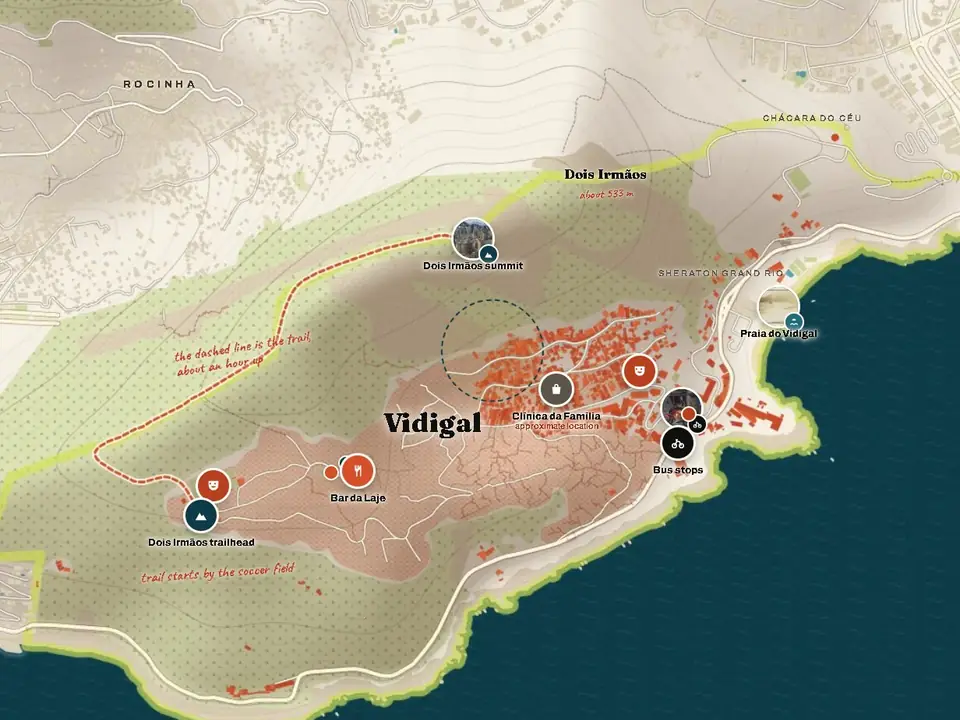
If you want the single best view of this whole itinerary and you are willing to work for it, this is the morning to climb Dois Irmãos, the twin peak the neighborhood is named for. The trailhead sits at the top of Vidigal: take a moto-taxi up for around R$14, pay the community entry fee of about R$10 in cash at the gate, which opens around 8:00, and give yourself an hour on stairs and rock steps through real Atlantic forest, marmosets and all. The summit shows you the entire weekend in one slow rotation — Ipanema, the lagoon, Cristo on his perch, Sugarloaf, Rocinha pouring down the far side. Our field guide to the Dois Irmãos trail covers the fee, the footing, and the sunrise version. If a mountain on your last morning sounds like too much, it is a fair call — sleep in, take the laje and a long coffee, and let the old city be the whole outing instead.
Afternoon — Centro and Santa Teresa
Head downtown for the half of Rio the beaches make people forget. Centro is the old colonial and imperial core — Praça XV, tiled churches, the century-old Confeitaria Colombo for a coffee under stained glass — and from its edge the yellow bondinho tram leaves Carioca station, rattles across the arches of the Arcos da Lapa, and climbs into Santa Teresa for about R$20 round-trip. Santa Teresa is the hilltop of cobblestones and tile-roofed houses that survived the twentieth century by being too steep to redevelop. Get off at Largo do Guimarães, wander the galleries and ateliers, and take the slow walk downhill as the light stretches. The Escadaria Selarón, the 215 tiled steps between Santa Teresa and Lapa, are best after four when the midday queue thins; our Lapa and Selarón steps guide threads the stairs into the night that follows.
- Vidigal → Centro
- ~30–40 min by car, R$ R$40–60. A daytime neighborhood; ride back before it empties out.
- Santa Teresa tram
- Yellow bonde from Carioca station, about R$20 round-trip, across the Arcos da Lapa.
- Lapa → Vidigal, late
- ~30–45 min by car, R$50–70. Uber straight home; do not wander Centro after the bars fill.
Sunset and night — Bar da Laje, then Lapa
Whichever shape your day took, bend it back toward the hill for sunset. This is the thread that ties the three days together, and the most carioca way to pull it is a drink at Bar da Laje, the rooftop bar built onto a laje high in Vidigal, where the view runs from Ipanema all the way to the open sea and the whole South Zone lights up beneath you. It is the last, quiet argument for having slept up here rather than in a hotel block below. Then, if the weekend still has one night left in it, go down to Lapa for the samba. Friday and Saturday turn the streets under the arches into a full-scale party, loud and young; a weeknight is smaller and more musical, with rodas forming around the squares. A street beer runs about R$10, a properly made caipirinha R$20–30. Stay as late as the music deserves, then take a car straight up the hill, where the door and the laje and the lights of Leblon are waiting exactly where you left them.

The wet-day rearrangement
Rio rains hard and briefly, usually in summer. A soaked forecast does not ruin a 3 day plan; it just reshuffles it.
- Cristo and Sugarloaf are wasted in cloud. Move them to the clearest morning on the forecast, whatever day that lands on, and do not burn a ticket on a grey summit.
- Rain closes the Dois Irmãos trail — wet rock and no view. Trade it for the indoor city.
- The good wet-weather list: the Maracanã stadium tour, a long lunch at Confeitaria Colombo, the museums at Praça Mauá, or the galleries of Santa Teresa, which is atmospheric in the drizzle.
- Beach days flex easily. Swap day one and day three around the sun and let the weather write the order.
Money, pacing, and the notes nobody puts in the brochure
Budget the weekend honestly and it holds few surprises. Plan on roughly R$400–600 per person per day if you eat well, take cars comfortably, and buy one ticketed attraction a day; a leaner version built on prato feito lunches, moto-taxis, and the free sights runs closer to R$250. The two fixed costs are Cristo, around R$100–135, and Sugarloaf, around R$170. Nearly everything else on these three days is under R$30 — a beach chair, a tram, a caipirinha, the trail fee. Carry some cash, because moto-taxis and the community gate at Dois Irmãos do not take cards, and the small markets on the hill sell the same water and cachaça as the airport at a third of the price.
You do not need a rental car. Parking in the Zona Sul is a sport with no winners, and the mix of Uber, 99, moto-taxis, the Jaé-card buses and metro, and your own feet covers every hour of this itinerary for far less than a car would cost. The only pacing rule that matters is the one day one teaches you: retreat from the beach at midday, move at the edges of the day, and let the hot middle hours happen while you are eating or resting. And eat like it is part of the sightseeing, because here it is — from pão de queijo at the padaria to a proper feijoada, our carioca food guide is the map to the meals this schedule leaves room for.
One last note on the base, since it is the quiet engine under all of this. Every day of this weekend ends the same way — a car or a moto up the hill, the door, the laje, the ocean going dark below. That ending is what guests mention long after they have forgotten which morning they climbed which mountain, and no itinerary can hand it to you unless you sleep on the hill. If you want the address these three days were built around, the condo is here, two floors above the quietest beach in the South Zone.
~~~That is Rio in three days, done from one hillside instead of scattered across the city. The beaches, the two icons, the old town, one night of samba, and — if you reached for it — a sunrise on a mountain you can walk to from bed. The list is the same list everyone gives you. What changes the weekend is where you stand at the end of each day, and on this itinerary you stand above the whole thing, watching the lights come up over Leblon. The plan is the structure. The hill is the trip.
Quick questions.
Is 3 days enough for Rio de Janeiro?
Yes, for the essentials. Three days is enough to see both summit views, the best of the beaches, one old-town wander, and one night of samba, provided you base somewhere central and do not sprint. It is a long weekend, not a full survey of the city — if you have a week, you add the slow local days rather than more landmarks.
How should I structure my 3 days in Rio de Janeiro itinerary?
Front-load the flexible day and protect the ticketed one. We put South Zone beaches on day one, the two icons on day two, and Centro, Santa Teresa and Lapa on day three, with a half-day back on the hill. If the forecast turns, move Cristo and Sugarloaf to the clearest morning and let the beach and city days fill in around the weather.
Can you see Christ the Redeemer and Sugarloaf on the same day?
Comfortably, if you split them by time of day. Do Cristo at opening around 8:00 to beat the heat and the buses, take a long lunch in Urca, then ride the Pão de Açúcar cable car for sunset. They sit close together on the east side of the city, so the only real cost is the commute out from the Zona Sul, roughly 30 to 50 minutes each way.
Is this a good first time in Rio itinerary, and where should I stay?
It is built for a first visit — the icons, the sand, and one night out, paced for the heat. For a Rio weekend itinerary the base matters more than the neighborhood name: somewhere in the Zona Sul, close to Ipanema and Leblon, keeps every day short. Vidigal sits on the hill just above that strip, which is why we run the whole plan from here.
What do I do if it rains?
Reshuffle rather than cancel. Cristo and Sugarloaf are pointless in cloud, so move them to the clearest morning on the forecast. Fill the wet slot with the indoor city — Confeitaria Colombo, the Maracanã tour, the Praça Mauá museums, or damp, atmospheric Santa Teresa. The Dois Irmãos trail closes in rain, so save the hike for a dry morning.
How much does 3 days in Rio cost, and do I need a car?
Plan on R$400–600 per person per day eating and moving well, or nearer R$250 on a leaner budget, excluding lodging. The fixed tickets are Cristo, around R$100–135, and Sugarloaf, around R$170. You do not need a rental car — Uber, 99, moto-taxis, and the Jaé-card buses cover the whole itinerary for less, and parking in the South Zone is more trouble than it is worth.