
You will not see Christ the Redeemer from Vidigal. The apartment faces the ocean, the statue stands inland behind the ridge, and the two never share a frame. What the hillside gives you instead is the honest version of the trip — how to visit Christ the Redeemer without the queue, the markup, or the wasted morning. There are exactly two legal ways to the top of Corcovado, and neither of them is your own car. From here it is a half-day out and back: coffee on the laje, a moto-taxi down the hill, and by mid-morning you are standing under thirty-eight meters of open-armed concrete with the whole city laid out below.
Lux Vidigal is our two-story apartment in Vidigal, with the ocean on one side and the Dois Irmãos mountain on the other, and you can check dates and book it on Airbnb.
The one thing nobody tells you first
Start with the fact that saves the most frustration. You cannot drive to Christ the Redeemer. Not in your own car, not in a taxi, not in an Uber. The statue sits at the top of Corcovado, 710 meters up, inside the Parque Nacional da Tijuca — the largest urban forest in the world — and the last stretch of that mountain road is closed to private traffic. An Uber will happily take your money and drop you at a boarding point partway up. It cannot take you to the feet of the statue. Nothing private can. The only vehicles that finish the climb are the official cog train and the licensed park vans.
This trips up more visitors than any ticket price ever will. People book a car to "Cristo Redentor," watch the app route them to a car park at the Paineiras Visitor Center, and stand there confused while everyone else queues for a van. So before anything else: there are two ways up, both run by the same concession, and you choose one of them in advance. The Trem do Corcovado, a red cog train that has climbed out of the Cosme Velho neighborhood since 1884 — older than the statue by nearly half a century. Or a fleet of white Paineiras vans that grind up the forest road from a handful of pickup points in the city. That is the whole menu. Everything else in this guide is detail hung off that one decision.
The good news for a Vidigal guest is that both options start on your side of town. Cosme Velho and the van points at Largo do Machado and Copacabana all sit in the Zona Sul, a straightforward ride from the hill. You are not crossing the city. You are looping around the back of the same mountains you already look at every morning.
How to visit Christ the Redeemer, in one glance
Sampled 2026, in reais. Prices move with the season and the exchange rate, so treat them as ranges and confirm on the official site the day you book.
- Two official ways up: the Trem do Corcovado cog train from Cosme Velho, or the licensed Paineiras vans.
- No private cars, taxis, or Ubers past the Paineiras Visitor Center. The last stretch is official transport only.
- Tickets are timed and date-specific. Book ahead at tremdocorcovado.rio (train) or paineirascorcovado.com.br (van).
- Escalators and panoramic lifts carry you the final climb. No stairs required unless you want them.
How to visit Christ the Redeemer — the two ways up
Both routes end in the same place: a terraced plaza just below the statue, where a bank of escalators and two panoramic elevators lift you the rest of the way to the feet of the Cristo. What differs is the character of the climb, the price, and where you catch it. Here is each one, plainly.
The cog train (Trem do Corcovado)
This is the one with the history. The Corcovado Railway opened in 1884, an engineering flourish of the imperial era, electrified in 1910, and it has been hauling passengers up the mountain longer than the statue has stood on top of it. You board at the station on Rua Cosme Velho 513, in a quiet residential pocket at the foot of the mountain, and the little red train tips backward and starts to climb almost immediately. Twenty minutes later you step out near the summit. The ride itself is half the reason to choose it — the track cuts straight through the Tijuca forest, close enough that branches brush the windows, and the city keeps dropping away below the right-hand seats. Sit on the right going up, on the left coming down.
As of 2026 the official round-trip adult fare on tremdocorcovado.rio is around R$134 — roughly US$25 — and that price already includes entry to the monument. Children pay less, and Brazilian seniors and students get their own reduced rates. Trains leave every twenty to thirty minutes, and capacity is finite, which is exactly why the popular morning and late-afternoon departures sell out days ahead in high season. The train is the more expensive option and the more atmospheric one. If you only do this once, and you like the idea of arriving the way people have arrived for a hundred and forty years, pay for the train.
The Paineiras vans
The vans are the workhorse. Operated by the same Paineiras–Corcovado consortium, they climb the forest road in official white minibuses and cost a little less — roughly R$95 to R$115 round-trip as of 2026, depending on where you board. There are three pickup points: Praça do Lido in Copacabana, Largo do Machado in Flamengo, and the Paineiras Visitor Center up on the mountain road itself. That last one matters for a specific kind of traveler. If you make your own way by Uber up to the Paineiras Visitor Center — which private cars can reach — the van only has to cover the final protected stretch to the summit, and the fare drops accordingly. It is the budget move, and it is entirely legitimate.
The van takes a bit longer than the train, thirty to forty-five minutes, and it winds. If you are prone to motion sickness on switchbacks, that is worth knowing before you commit. But the vans run frequently, they leave from more places, and on a day when the train is sold out they are often the reason you get up the mountain at all. There is no shame in the van. Most cariocas taking visiting family up Corcovado take the van.
Take the train if
- You want the 1884 railway and the forest ride.
- You are staying near Cosme Velho or crossing the Zona Sul anyway.
- You booked ahead and grabbed a good time slot.
- The extra thirty-odd reais does not decide your day.
Take the van if
- The train is sold out for your date.
- You want to save a little, or board from Copacabana.
- You will drive yourself up to Paineiras and van the last leg.
- You do not mind a winding road for a lower fare.
That is the whole of the Corcovado train vs van question. They deliver you to the same escalators, under the same statue, with the same view. Choose on price and mood, book the slot, and stop overthinking it. The mountain does not care which one you rode.

Cristo Redentor from Vidigal — the honest route
Here is the part most guides skip, because most guides assume you are staying in a beachfront tower in Ipanema. You are not. You are on a hillside in Vidigal, between Leblon and São Conrado, and the logistics are slightly different — mostly in your favor, once you know them.
The route has two legs. First, get off the hill: a moto-taxi or a short walk down the ladeira to Av. Niemeyer, where the Ubers can reach you, takes about five minutes. Second, ride to your boarding point. For the train, that means Cosme Velho station, a loop around the back of the Zona Sul — through Leblon, past the Lagoa, into the quiet streets below Corcovado — that runs thirty to forty-five minutes in normal traffic. For the van, Praça do Lido in Copacabana is a touch closer. Call the whole thing forty-five minutes to an hour, door to boarding, and pad it in December and January when the beach traffic thickens.
- Leg 1
- Moto-taxi or walk down to Av. Niemeyer — about 5 minutes.
- Leg 2
- Uber to Cosme Velho station (train) or Praça do Lido (van) — 30 to 45 minutes.
- Total, door to boarding
- Roughly 45 to 60 minutes in normal traffic.
- The climb
- 20 minutes by cog train, 30 to 45 by van.
- Time at the summit
- Most people stay 45 to 90 minutes.
You do not need Rio's buses for any of this, though they exist — the 583 and 422 run to Cosme Velho from Largo do Machado if you enjoy the local way of doing things, and the city's tap-and-go Jae card covers them at a fare around R$4.70. For the door-to-mountain version, an Uber is simpler and the difference in cost is small when you split it. If you want the full picture of moving around the city from the hill, our guide to getting around Rio from Vidigal lays out the metro, the Jae card, and when a car beats them.
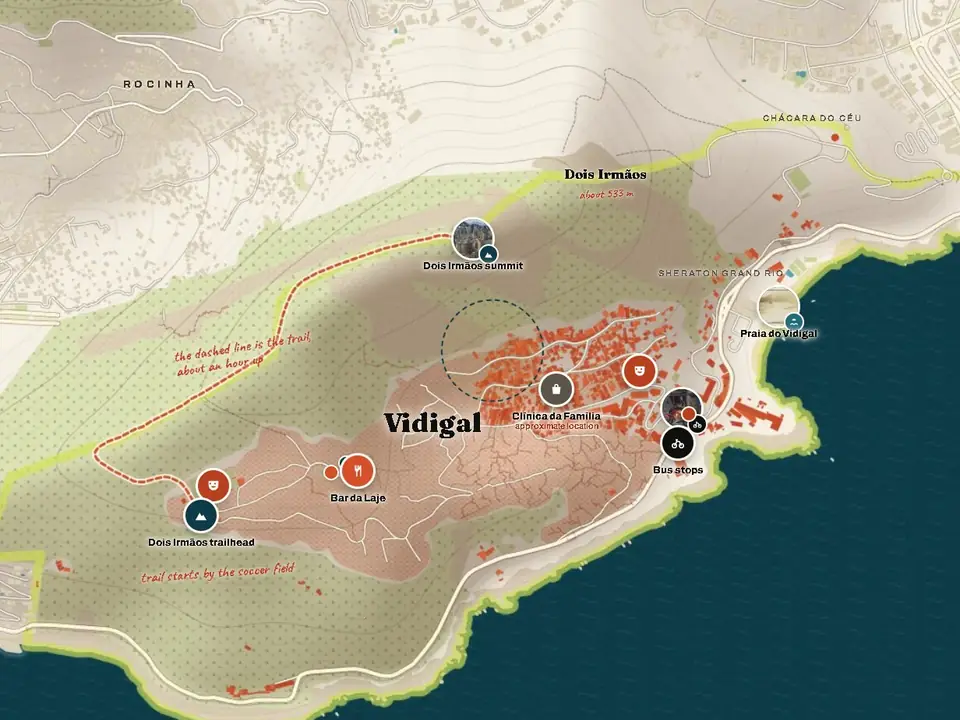
Now the honest part, since the search that brought some of you here is "Cristo Redentor from Vidigal." You cannot see the statue from the neighborhood. Vidigal faces southwest, out to the ocean and the beaches; Corcovado stands inland to the east, screened by the ridgeline of the Tijuca massif. From the laje you get Dois Irmãos, the sea, São Conrado, Pedra da Gávea — a seaward panorama, and a very good one — but not the Cristo. The single place near Vidigal where the statue does appear is the summit of Dois Irmãos, the trail that starts at the top of the community; from up there, on a clear morning, you can pick out the small white figure with its arms open across the valley. If seeing Christ from a Vidigal viewpoint is the goal, that hike is the answer, not the apartment window. We are precise about all of this in the piece on what you actually see from the Vidigal hillside.
Christ the Redeemer tickets — timed entry, and the traps
Christ the Redeemer tickets are timed. You do not buy a general "admit one" and wander up whenever; you choose a date and a specific entry slot, and that slot is what you are paying for. It is the mechanism that keeps the terrace from becoming an unmovable crush, and it is non-negotiable. Miss your window and you may have to buy a new ticket to get in. So the first rule is simple: book ahead, and book the exact time you intend to be standing at the boarding point, not the time you plan to leave the apartment.
Buy from the official channels and nowhere else if you can help it. The train is tremdocorcovado.rio. The van is paineirascorcovado.com.br. Both let you pick your slot, pay by card, and carry a digital ticket to the gate. There is an entire industry of resellers — the "skip the line," "official partner," "fast track" sites that rank above the real ones in search — and most of them are simply buying the same public tickets and adding a markup of twenty, forty, sometimes eighty percent for the service of clicking the button for you. Some bundle a guide and hotel pickup, which can be worth it if you want a guide. If you just want the ticket, the two official sites are all you need, and they take five minutes.
How far ahead to book depends on the season. In the quiet months a day or two of lead time is usually enough. In the December-to-March high season, and around Carnaval and New Year's, the good slots go two to three days out, and the coveted early-morning and sunset departures go first. ← book the first slot of the day If your heart is set on a sunrise-adjacent visit with the cleanest light and the thinnest crowd, treat it like a dinner reservation and lock it a week ahead.
Before you pay, read this
The four things that cost visitors money or a morning, in order of how often they happen.
- The reseller markup. If the site is not tremdocorcovado.rio or paineirascorcovado.com.br, you are likely paying a premium. Compare before you check out.
- The car that cannot finish. Never book a private car "to the statue." It can only reach the boarding points. The last stretch is train or van, full stop.
- The missed slot. Tickets are time-specific and non-refundable. Traffic from the Zona Sul is real. Aim to arrive at boarding thirty minutes early.
- The cloud. There is no weather refund. If Corcovado is socked in during your slot, that is the gamble. Book mornings and dry-season dates to shorten the odds.
The best time to visit Christ the Redeemer
The best time to visit Christ the Redeemer answers two questions at once: what hour, and what season. Both come down to the same enemy — cloud — and the same secondary nuisance, crowds.
Take the hour first. Go early. The first slots of the day, right after the 8:00 opening, give you three things: the coolest air, the thinnest crowd, and the clearest sky, because Corcovado tends to gather its own cloud as the day heats up and the moisture rises off the forest. By late morning in summer the summit can be sitting inside a cloud while the beaches below bake in full sun. An early ticket does not guarantee a clear statue — nothing does — but it stacks the odds hard in your favor. The other good window is the last light, the sunset slots, when the concrete goes gold and the city lights start to prick on below. Those are the most beautiful and the most booked, and they carry more cloud risk than the morning. Pick your poison: certainty in the morning, romance at dusk.
Now the season. Rio's dry winter, roughly May through September and sharpest in June to August, is the clearest stretch of the year. The air is drier, the sky is harder, the long-range views actually reach the horizon, and the punishing summer haze lifts. It is also, conveniently, the low season, which means fewer people on the terrace and easier ticket slots. The trade is temperature and daylight — winter mornings on the summit can be genuinely cool and breezy, so bring a layer you would not think to pack for a beach city. Summer, December to February, delivers the postcard heat and the late sunsets, but also the afternoon storms and the cloud that can erase the statue for hours. If you have any flexibility in when you come to Rio, a winter morning is the single best bet for seeing the Cristo the way the photographs promise.
Corcovado keeps its own weather. The statue you flew across the world for can spend your whole slot inside a cloud — which is why you go early, and why, if you can, you go in winter. — what we tell guests the night before
The morning that goes right
How we tell guests to shape the day if they only get one shot at the summit.
- Night before — book the 8:00 or 8:20 train slot on the official site. Screenshot the ticket.
- 06:45 — coffee on the laje. Check the sky over the ridge; if it is clear, go.
- 07:00 — moto-taxi down to Av. Niemeyer, Uber to Cosme Velho.
- 07:45 — at the station with time to spare. Board.
- 08:20 — the terrace, mostly to yourself, the city clear below.
- 10:00 — back down before the mid-morning cloud and the tour buses arrive.
What waits at the top
The statue is bigger and quieter than you expect. Thirty meters of figure on an eight-meter pedestal — thirty-eight meters in total — with the arms reaching twenty-eight meters from hand to hand, all of it reinforced concrete faced in a skin of pale soapstone, built between 1922 and 1931 and hauled up this mountain in pieces on the same railway you probably rode. From directly below, at the base, you cannot take it all in; you tip your head back and the arms run off past the edge of your vision into the sky. Most people go quiet for a second when they first round the terrace and see it whole. Then everyone lifts a phone and lies down on the stone to get the arms in frame, and you will too.
Getting up to it is easier than it used to be. For decades the last stage was a climb of more than two hundred steps. Since the early 2000s a set of escalators and two panoramic elevators carry you from the upper plaza to the feet of the statue, which means the summit is now reachable for wheelchair users, older visitors, and anyone who would rather not finish a mountain on foot. The stairs are still there if you want them. Most people take the escalators up and drift down the steps to linger.
The view is the other half of the ticket, and on a clear day it is the more staggering half. From 710 meters the whole of Rio arranges itself into a single legible map. Directly below, Guanabara Bay and the sugarloaf plug of Pão de Açúcar at its mouth. Swing right and the beaches unspool — Botafogo, Flamengo, the long white curves of Copacabana and Ipanema and Leblon beyond. The Lagoa Rodrigo de Freitas sits like a mirror in the middle of it all. The Maracanã stadium, the downtown towers, the bridge stretching across the water to Niterói, and on the far side the green wall of the Tijuca peaks — from which, if you know where to look, you can trace the twin bump of Dois Irmãos and, under its ocean flank, the hillside where you slept. The city is enormous from the ground and a village from up here. That compression, more than the statue, is what people carry home.
A word on the crowds, because they are the honest downside. This is the most-visited attraction in Rio and one of the most-visited in South America, and even with timed entry the terrace fills. The photo without a stranger's elbow in it takes patience. The early slot is your best defense; the cloud, when it comes, ironically thins the crowd and can gift you a strange, intimate ten minutes with the statue half-dissolved in mist. Not the shot you wanted. Sometimes the better memory.
Christ in the morning, Sugarloaf at dusk
If you have one full day for Rio's two great high viewpoints, do them in the right order. Christ the Redeemer first, on an early slot, while the winter air is clearest and the summit crowd is thinnest. Come back down, eat lunch, rest. Then take Pão de Açúcar — Sugarloaf — in the late afternoon, riding the cable car up in time to watch the sun drop behind the city and the lights come on across the bay. The two viewpoints face each other, more or less, so you spend the morning looking at Sugarloaf from Corcovado and the evening looking at Corcovado from Sugarloaf, with the golden hour thrown in between. It is a long, full, satisfying day, and it does not require a tour to stitch together. Our Sugarloaf cable car guide has the tickets, the timing, and why the second cable-car stage at sunset is worth the wait.
Do not try to reverse the order to save a morning. Sugarloaf holds its view better through the day than Corcovado does, and Christ punishes the late, cloudy, crowded afternoon slot. Morning statue, evening cable car. If you would rather spread the whole thing across a calmer few days — a viewpoint here, a beach there, a hike up Dois Irmãos, the samba at the top of Vidigal — the three-days-in-Rio itinerary from a Vidigal base paces it out so you are never rushing between mountains.
~~~The basecamp you come home to

Corcovado is a spectacle, and spectacles are tiring. You share the statue with several thousand people, you time-box your slot, you fight for the frame, you ride back down in a full train or a winding van. It is entirely worth doing. It is also the kind of morning that is much better when you have somewhere calm to return to — not a hotel room three floors above a Copacabana avenue, but a quiet apartment on a hillside where the loudest thing is the wind off the ocean and the occasional kite.
That is the case for staying in Vidigal, and it is a quiet one. You will not see Christ the Redeemer from the laje — we have been clear about that, and we would rather be honest than sell you a view that faces the wrong way. What you get instead is the other side of the same range: Dois Irmãos rising straight overhead, the ocean filling the whole southern horizon, São Conrado curving off to the west, and a sunset that arrives over the water rather than behind a ridge. You do the famous statue in the morning as a day trip, the way everyone does, and then you come back to a place most visitors never get to call theirs. That trade — the icon out there, the calm up here — is the entire argument for the apartment. Go see the city's most famous face. Then come home to the face it keeps to itself.
Quick questions.
How do I visit Christ the Redeemer from Vidigal?
Get off the hill first — a five-minute moto-taxi or walk down to Av. Niemeyer — then take an Uber to your boarding point: Cosme Velho station for the cog train, or Praça do Lido in Copacabana for the van. Reckon on 45 to 60 minutes door to boarding. Buy your timed ticket in advance from tremdocorcovado.rio or paineirascorcovado.com.br, and aim for an early slot.
Can I take an Uber or drive to the top?
No. Private cars, taxis, and Ubers cannot pass the Paineiras Visitor Center. The final stretch through Tijuca National Park is served only by the official cog train and the licensed Paineiras vans. A car can take you to a boarding point, never to the statue.
Corcovado train vs van — which is better?
The train is pricier (around R$134 round-trip in 2026), more scenic, and runs from Cosme Velho on an 1884 railway. The vans are a little cheaper (roughly R$95 to R$115), leave from Copacabana, Largo do Machado, or the Paineiras Visitor Center, and are the fallback when the train sells out. Both end at the same escalators below the statue. Choose on price and mood.
How much are Christ the Redeemer tickets in 2026?
As of 2026, the official adult train ticket is about R$134 round-trip, entry included — roughly US$25. Van fares run about R$95 to R$115 depending on your pickup point. Children, Brazilian seniors, and students pay reduced rates. Prices shift seasonally, so confirm on the official site when you book.
When is the best time to visit Christ the Redeemer?
Early morning, on the first slots after the 8:00 opening, for the thinnest crowd and the least cloud. For the season, the dry winter — roughly May to September — gives the clearest skies and the emptiest terrace, though the summit can be cool and windy. Summer is hotter, hazier, and cloudier on top. A winter morning is the surest bet for a clear statue.
Do I need to book in advance?
Yes, and it matters. Tickets are timed and date-specific, and the good slots sell out two to three days ahead in high season, faster for sunrise and sunset. Missing your slot can mean buying a new ticket. Book at least a day or two out, a week for a prized early or late slot.
Is the summit accessible without climbing stairs?
Yes. Escalators and two panoramic elevators, added in the early 2000s, carry you from the upper plaza to the feet of the statue, so wheelchair users and anyone avoiding the old 200-plus steps can reach the terrace. The stairs remain as an option for those who want them.
Can you see Christ the Redeemer from Vidigal?
Not from the neighborhood or the apartment — Vidigal faces the ocean, and the statue sits inland behind the ridge. The one nearby spot where it appears is the summit of the Dois Irmãos trail above the community, from which, on a clear day, you can pick out the statue across the valley.
Christ the Redeemer is the easiest of Rio's great sights to get wrong and one of the simplest to get right. Skip the car, book the official timed ticket, pick the train or the van, go early, go in winter if you can, and give yourself an hour on the terrace before the cloud and the crowd arrive. Do that and you get the statue clear, the whole city legible below, and a story that starts with coffee on a Vidigal rooftop and ends thirty-eight meters under a pair of open concrete arms. Then you ride back down to the quiet side of the mountain, which is the part the day-trippers never see.