
Ten at night on a laje above Vidigal, and the loudest thing you hear is a moto-taxi downshifting on the switchback below. Ipanema glitters across the water. A neighbor is frying pastéis. If you have been circling the same question — what is the safest favela in Rio de Janeiro to actually sleep in, not just tour by day — here is the honest, favela-by-favela answer, with the tradeoffs no brochure prints.
The short version, before the nuance
There is no favela in Rio you can call "safe" the way you'd call a Swiss village safe. Anyone who tells you otherwise is selling a tour. What there is, instead, is a spread — a handful of Zona Sul communities that have carried tourists for fifteen years, that residents and visitors move through daily without incident, and that differ from one another in scale, altitude, and how much of a scene they've built for someone who wants to stay a week rather than pass through in two hours.
For an overnight base, the real contest is short. Vidigal leads for most travelers, and we'll defend that below without pretending it's flawless. Santa Marta and Cantagalo–Pavão–Pavãozinho are excellent to visit and thin on places to stay. Babilônia and Chapéu Mangueira, above Leme, are the quiet alternative. Rocinha is the immersive one, best done with a local who lives there. That is the whole map in five sentences.
What follows is the long version, because the question "which favela is safe to visit Rio" and the question "which favela should I book a bed in" are not the same question, and the difference is the whole point. A place can be perfectly fine to walk through at two in the afternoon with a guide and a group, and still not be where you want to be alone at two in the morning with a suitcase and no Portuguese. We live up here. We've watched guests get this right and get it wrong. Below is how to get it right.
Rio's five visitable favelas, in one line each
Where they sit, and what they're for. Status as of 2026.
- Vidigal — South Zone between Leblon and São Conrado. Ocean views, real hotel-and-restaurant infrastructure, the deepest apartment inventory. The default answer.
- Rocinha — long called Brazil's largest. Dense, vertical, alive. A city inside the city. Go with someone who lives there.
- Santa Marta — Botafogo. Small, storied, the first favela Rio ever pacified. The Michael Jackson hill. A great morning, a rare overnight.
- Babilônia & Chapéu Mangueira — above Leme. Atlantic forest, ocean, community-run pousadas and bars. The calm choice.
- Cantagalo–Pavão–Pavãozinho — between Ipanema and Copacabana. An elevator to the metro, a viewpoint over three beaches. Central, compact.
What "safe" even means on a hillside
Start here, because most of the fear travelers carry is aimed at the wrong thing. The danger people imagine in a favela — a mugging on every corner, a tourist as a target — is not the danger that actually shapes daily life on these hills. In the Zona Sul communities that carry visitors, street robbery of a resident or a guest is rare, and for a simple, unromantic reason: the faction that runs the territory does not permit it, because petty crime brings police, and police are bad for business. That is not a moral order. It is an economic one. But it produces a street that is, day to day, calmer than the tourist-facing sidewalks of Copacabana, where pickpockets work the crowd precisely because no one is watching the block.
The real variable is not crime against you. It is the weather system above you: which armed group controls the hill, whether a rival is pushing in, and whether the police decide to run an operation while you happen to be there. A police operação is the single thing that turns a quiet morning loud, and it is unpredictable by design. This is the honest core of the safety question, and it is why "which is the safest favela in Rio de Janeiro" is really a question about stability, not about muggers.
You have to understand the pacificação era to read the present. Starting in 2008, Rio rolled out the UPP — Unidade de Polícia Pacificadora, the Pacifying Police Unit — installing permanent police bases inside dozens of favelas ahead of the 2014 World Cup and 2016 Olympics. At its peak the program ran around 38 units and some 9,000 officers. For a while it worked: gunfire dipped, businesses reopened, kids played outside after dark in Santa Marta and Vidigal and Cantagalo. Then the money ran out after the mega-events, training and staffing slid, scandals broke, and the model frayed. By 2026 the UPP as a coherent project is largely gone, replaced by a patchier, less predictable security picture across the city.
What that means for you is concrete. The Zona Sul favelas still carry more permanent police presence and more steady tourist traffic than communities in the Zona Norte or Oeste, which is exactly why they remain the visitable ones. But none of them is frozen in the calm of 2013. The golden rule up here has not changed in a decade: before you book, and again the week you arrive, you ask a person who is physically there. Your host. The pousada owner. The guide. "Está tranquilo?" — is it quiet? A local will tell you the truth in four words, because their own night depends on the same answer.

Vidigal — the case for the hill we live on
We are not neutral, so let us be transparent and then let the facts carry the argument. Vidigal sits in the Zona Sul, wedged onto the flank of Morro Dois Irmãos — the Two Brothers — with Leblon on one side and São Conrado on the other. That single geographic fact does most of the work. You are inside Rio's wealthiest coastal strip, a few minutes from one of the best beaches in the city, looking down at Ipanema and Leblon from an altitude that people in the apartments below pay millions to almost match.
The 2010 census counted 12,797 residents in Vidigal. The real figure is higher, as it always is up here, but the point stands: this is a mid-sized community, not a metropolis. You can learn its main road, Rua Presidente João Goulart, in a day. That legibility matters when you're deciding where to sleep. A place you can read is a place you can move through with confidence, and confidence — the quiet, non-showy kind — is most of what keeps a traveler out of trouble anywhere in Rio.
Then there's the infrastructure, which is the part people underestimate. Vidigal has spent more than a decade as Rio's "favela chic" address. After the UPP arrived in 2012, foreign money followed: boutique guesthouses, design apartments, restaurants with real kitchens, and the persistent rumor — never quite confirmed, never quite dying — that David Beckham bought a place up here. The caipirinha-and-exposed-brick aesthetic that bars in London and Berlin imitate was, in part, imitating this hillside. That gentrification has a real cost to residents, and honest coverage says so. But for the narrow question of where a visitor can stay well, it means Vidigal offers something the other favelas mostly don't: a genuine range of places to sleep, from hostel bunk to laje apartment with a plunge pool and a 180-degree view.
- Where
- South Zone between Leblon and São Conrado, on Morro Dois Irmãos.
- Size
- ~12,800 by the 2010 census; realistically more. Mid-sized and legible.
- Pacified
- UPP installed 2012. Steady tourist traffic since.
- Best for
- Couples, groups, longer stays, anyone who wants an ocean view and a real bed.
- The catch
- It's a hill. Everything is up. And gentrification is a live tension, not a solved one.
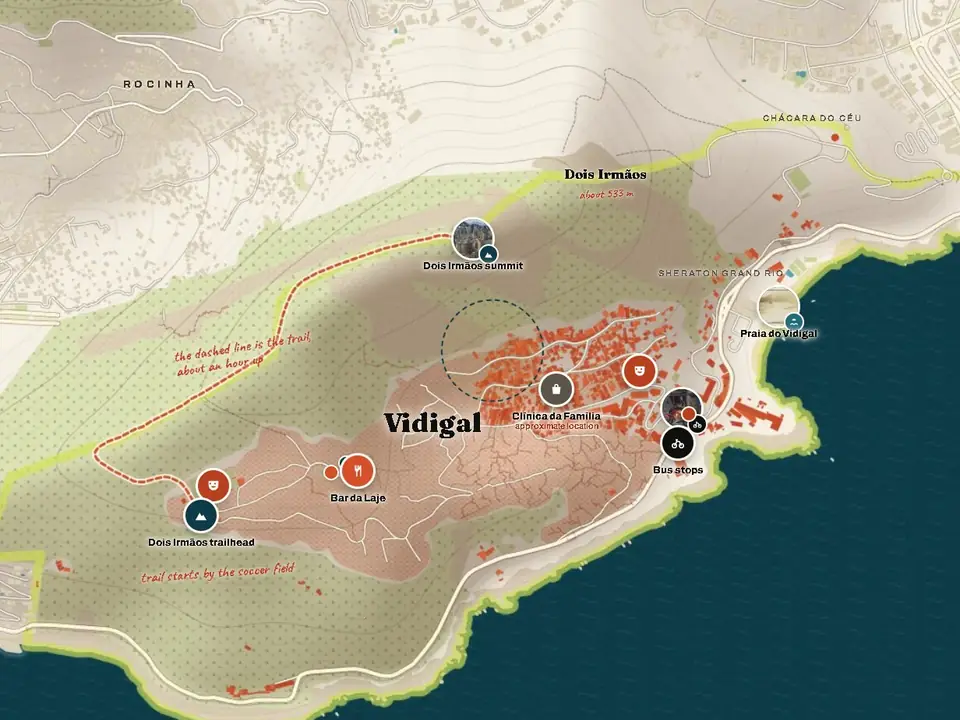
The view is not a marketing line, it's the reason the whole community reads differently at dusk. From the upper streets you see Dois Irmãos rising on your right, the Atlantic straight ahead, Leblon and Ipanema curving off to the left, and on a clear evening the light does something to the water that empties the bars of conversation for about ten minutes. You can pay for that view at Bar da Laje, the rooftop everyone photographs. Or you can wake up to it from a private terrace, which is the argument for renting an apartment rather than queuing for a table. Our own place — the duplex we keep — is up near the top for exactly this reason, and the walk back up from the beach is the tax you pay for it.
Access is easier than the switchbacks suggest. Cars, Ubers, and 99 taxis come up the paved main road to a point; from the praça at the base, moto-taxis and Kombi vans run the steeper stretch for a few reais, all day and most of the night. The Dois Irmãos trail — the one that ends at the most famous view in the Zona Sul — starts from the Vila Olímpica up top; you van or moto to the trailhead and walk about an hour through shaded forest to the summit. None of this requires a tour. Thousands of residents and visitors do it every single day. For the fuller safety picture, including the parts we're not glossing, read our straight-talk piece on whether Vidigal is safe.
The safest favela is not the one with the most police. It's the one where enough people know your face by Thursday that you stop being a stranger. — what we tell every guest on night one
Rocinha: the biggest, the most alive, the most complicated
Rocinha is the favela the world has heard of, and it earns the attention. Draped across the hills between São Conrado and Gávea, it has been called Brazil's largest favela for so long that the title sticks even though a few sprawling communities now rival it. The 2010 census counted around 70,000 people; residents and the NGOs working there will tell you the true number is well past 100,000, maybe far past. Whatever the count, the experience is unmistakable: this is not a neighborhood, it's a vertical city, with its own banks, bus lines, clinics, nightclubs, and a main drag that never fully sleeps.
For a visitor, Rocinha delivers a density of life you will not find anywhere else in Rio. The food is extraordinary and cheap. The community projects — dance, music, jiu-jitsu, cooperatives — are serious and worth your money. A good walking tour led by someone born there is one of the most honest half-days you can spend in this city, and it puts your reais directly into local hands. If you want to understand how most of Rio actually lives, Rocinha is the classroom. Our Rocinha guide goes deep on how to visit it well.
The honest "Vidigal vs Rocinha which is safer" answer, for an overnight stay specifically, is this: Rocinha is more variable. It was pacified in 2011 with the largest UPP deployment the program ever mounted, and for years it was the most-visited favela in the city. But it has also seen open disputes between factions — the mid-2010s were rough — and its sheer size makes it harder to read as a newcomer. The energy that makes Rocinha thrilling by day is the same energy that makes it a lot to navigate alone at night. There are hostels and rooms, and people do stay, and many have a wonderful time. We simply point guests who want a first favela stay toward the hill that's easier to learn. R$ Rocinha is where you go to be immersed. Vidigal is where you go to be based.
Five hills, roughly to scale
Census counts undercount favelas everywhere — treat these as the low end. IBGE 2010 figures, the last full count widely cited in 2026.
- Scale changes everything: a small hill is easy to learn, a huge one is a city you need a local to read.
- All five sit in or beside the Zona Sul, which is why they carry tourists at all.
- Babilônia and Chapéu Mangueira together are small — a few thousand — and share one hill above Leme.

Santa Marta: small, storied, and the easiest morning in Rio
If Rocinha is the city, Santa Marta is the village. It climbs a compact, steep hill in Botafogo — Morro Dona Marta — and it holds only a few thousand people, which makes it the most contained of the visitable favelas. It is also the one with the deepest place in Rio's story, because Santa Marta was the very first community the UPP ever entered, in December 2008. It became the pilot, the proof of concept, the postcard the whole program pointed to. That history shows up in how ready it is for a visitor.
Two things pull people up Santa Marta's slope. The first is the funicular — a little inclined tram, installed in 2008, that carries residents up the hairpin stairs and gives visitors a rare sit-down ride through the middle of a favela. The second is Michael Jackson. In 1996 he came here with Spike Lee to film part of the video for "They Don't Care About Us", dancing on a terrace with the community around him, and the hill has kept him ever since: a bronze statue at the mirante, a bright mosaic mural, a small trade in photographs and souvenirs at the square where the cameras rolled. Whatever you think of celebrity pilgrimage, it made Santa Marta a place where a first-time visitor feels immediately oriented.
The "Vidigal vs Santa Marta" comparison, though, comes down to that same visit-versus-stay split. Santa Marta is a superb morning: take the funicular up, walk the painted lanes down, see the statue, drink a beer at the top with all of Botafogo Bay laid out below, and be back in the city for lunch. What it does not have is much of anywhere to sleep. There are a few guesthouse rooms and the odd rental, but nothing like Vidigal's range, and the hill is so steep and so residential that an overnight base makes less practical sense. Come for the story. Base yourself elsewhere.
- Where
- Botafogo, on Morro Dona Marta. Small and very steep.
- Claim to fame
- first UPP Rio's first pacified favela, December 2008. The Michael Jackson hill.
- Getting up
- The funicular tram, or the stairs if you have the legs.
- Best for
- A half-day visit, a mural photo, a view over Botafogo Bay.
- To stay?
- Thin. A couple of guesthouse rooms, little apartment inventory.
This is the pattern worth naming out loud, because it decides your booking more than any safety ranking does. The favelas split cleanly into two groups: the ones built to be visited, and the one built to be lived in as a guest.
Come for a day
- Santa Marta — funicular, murals, the MJ statue, a bay view, back by lunch.
- Cantagalo–Pavão–Pavãozinho — elevator up, viewpoint over three beaches, metro at the bottom.
- Rocinha — a proper guided half-day with someone who lives there.
Stay the week
- Vidigal — the range of real apartments, the ocean views, the walk to Leblon.
- Babilônia / Chapéu Mangueira — quieter, community-run rooms above Leme.
- Everywhere else — possible, but you're improvising.
Babilônia, Chapéu Mangueira, and the Copacabana-side hills
Two more names belong in any serious "best favela to stay in Rio de Janeiro" conversation, and they sit at opposite ends of the same famous beach strip. Above Leme, at the quiet north end of Copacabana, one hill holds two communities: Babilônia and Chapéu Mangueira. They are small, they are wrapped in Atlantic rainforest, and they have built one of the gentlest versions of favela tourism in the city — community-run pousadas, family-run bars with some of the best cheap food in Rio, and a hiking circuit up the Morro da Babilônia to lookout rocks with the whole southern coastline underneath you. The UPP came in 2009, tourism followed, and the mood up here is more forest-retreat than street-scene.
Honesty check, because we promised it: Babilônia has had its own faction frictions over the years, and it is neither a fortress nor a war zone. It is a working community that welcomes respectful visitors and asks the same of you as anywhere else — come in daylight your first time, spend money locally, don't photograph people or anyone armed, and read the room. For a traveler who wants the Zona Sul and the ocean but finds Vidigal's scene a little too discovered, this hill above Leme is the calm counter-proposal. Inventory is thin but real.
At the other end, between Ipanema and Copacabana, sits Cantagalo–Pavão–Pavãozinho — one interlinked community on a hill that pokes up right behind the beach hotels. Its signature is pure Rio ingenuity: the Rubem Braga elevator complex, opened in 2010, lifts residents from street level straight up the hillside, connected to the General Osório metro station at the bottom. At the top is the Mirante da Paz, a viewing platform that looks out over Copacabana, Arpoador, and Ipanema at once — arguably the most central great view in the city. Pacified in December 2009, it's compact and easy to reach. The caution is practical rather than dramatic: the elevators have had long stretches of poor maintenance and outright breakdown, so don't build a plan around them without checking they're running that week.

Put those two next to Vidigal and the shape of the whole decision appears. Cantagalo–Pavão–Pavãozinho gives you the most central location and a metro at your feet, but almost nothing in the way of an apartment to book. Babilônia gives you quiet and forest and honest bar food, with a handful of community rooms. Vidigal gives you the widest choice of places to actually stay, the biggest open-ocean view, and a walk down to Leblon — at the cost of being the most gentrified and the most "discovered" of the group. There's no free lunch on any of these hills. There's just the tradeoff that fits your trip.
~~~So which favela is safest to stay in?
Here is the verdict, stated plainly, because you scrolled this far for one. If you have been asking which is the safest favela in Rio de Janeiro to stay in, this is where we commit. For the specific job of an overnight base — somewhere to keep your bags, sleep well, come home to after dark, and use as a launch pad for the rest of Rio — Vidigal is the answer for most travelers, and it isn't especially close. Not because it is magically safer than the others in some absolute sense. All five of these Zona Sul hills share the same broad reality, and all five depend on the same shifting security weather. Vidigal wins on the practical stack: a genuine choice of apartments and guesthouses, the deepest tourist infrastructure, an ocean view you can wake up to, a location inside the wealthiest coastal strip in the city, and a size you can learn in a day.
Santa Marta and Cantagalo–Pavão–Pavãozinho are the ones to visit — a morning, a viewpoint, a story, a photograph — precisely because they're compact and central and easy. They're just not built to hold you overnight, and pretending otherwise sets you up to improvise a bed in a place with almost no beds. Babilônia and Chapéu Mangueira are the thinking traveler's quiet pick if Vidigal feels too polished and you want forest and calm above Leme. Rocinha is the one you give a full guided day, led by a resident, and it will likely be the most memorable thing you do in Rio — as a visit, not as a first favela address to sleep in alone.
And here is the part that outranks the entire ranking: within any of these communities, your safety is set far more by your own choices than by the name of the hill. The building you pick. The host who answers the phone at midnight. The private, locking entrance versus the room at the top of a maze of alleys you can't yet navigate. The street sense to take a moto-taxi instead of walking a dark lane, to leave the good watch at home, to not wave a phone around filming, to ask "está tranquilo" and actually listen to the answer. Get those right and Vidigal is a wonderful place to spend a week. Get them wrong and no ranking will save you — not here, not in Copacabana, not anywhere in this city. If you want the texture of what those nights actually feel like, our piece on what staying in a favela is really like is the unvarnished version.
None of this is a reason to be afraid. It's a reason to be deliberate. The travelers who have the best time up here are not the fearless ones; they're the ones who did ten minutes of homework, booked a well-reviewed place with a responsive host, arrived in daylight the first time, and then relaxed completely. Rio rewards that posture everywhere, and it rewards it double on a hillside.
2026 practicalities that cut across all five hills
The stuff that changed recently, so your old guidebook is wrong. Verify the moving parts the week you travel.
- You now need a visa. Since 10 April 2025, US, Canadian, and Australian citizens need a Brazil e-visa. It runs R$ about US$80.90, is valid up to ten years with multiple entries and 90 days per visit, and you apply online — allow roughly ten working days.
- Transport went cashless. Through 2026 the new Jaé card and app took over Rio's municipal buses and the VLT tram, replacing the old RioCard. The metro is simpler still — you can tap a contactless credit or debit card straight at the turnstile.
- Getting up the hill. Ride apps reach the base of most of these communities and the paved stretch of some; from there it's moto-taxi or Kombi van for a few reais. Confirm with your host exactly where the car drops you.
- Photography. Shoot the views all you like. Do not photograph residents without asking, and never photograph anyone armed. This is the fastest way to turn a warm welcome cold.
Reading the hill — habits that keep you easy
Everything above is about choosing a community. This is about moving through it once you're there, and it applies whether you land in Vidigal, spend a morning in Santa Marta, or hike Babilônia. None of it is complicated. All of it is the difference between looking like someone who belongs and looking like a problem waiting to happen.
Move like you know where you're going, even the first time, because hesitation reads as vulnerability everywhere in the world and favelas are no exception. Learn your main road first and treat the side alleys as advanced terrain you graduate into once a neighbor has walked you through them. Take moto-taxis at night without a second thought — they cost a handful of reais, the drivers know every stone of the hill, and a ride is always the right call over a solo walk down an unlit lane. Keep the flashy stuff in the apartment safe: the expensive watch, the second phone, the passport once you've checked in. Carry a little cash for the moto and the botequim, and pay for everything else with Pix or a tapped card like everyone else does.
Read the mood, which is easier than it sounds. Favelas broadcast their own weather. If the streets are full — kids playing, music from a bar, the padaria busy — it's a normal day and you should relax into it. If a block has suddenly emptied, if shops are shuttering mid-afternoon, if the adults have gone quiet, that's the community telling you something, and the move is simple: go inside, message your host, wait it out. That instinct is worth more than any statistic, and your host will have it long before you do. This is also why solo travelers, and solo women in particular, do best with a host who is genuinely reachable and a place that isn't buried at the far end of the maze. Night movement, moto-taxis, and the women-only rush-hour metro carriage are worth reading up on before you come.
The last habit is the warmest one, and it's the whole secret hiding in plain sight. Say hello. Bom dia in the morning, boa tarde after noon, boa noite at night, to the doorman, the padaria lady, the guy fixing a moto outside your building. Greet people when you walk into a shop. Learn four words of Portuguese and use them badly and often. By day three you will not be a tourist on that block; you'll be the gringo from the blue building who always says hi, and that quiet social membership is the best security a hillside offers. For moving between all this without losing an hour to traffic — the metro, the buses, the Jaé card, the hop down to Ipanema — our getting around Rio from Vidigal guide has the routes and the fares.
That's the entire method. Choose the hill that fits the job, choose a good building with a real host, arrive in the light, greet everyone, and let the place become ordinary — because ordinary, on these hills, is the safest thing there is.
Straight answers.
What is the safest favela in Rio de Janeiro to stay in overnight?
For an overnight base, Vidigal leads for most travelers — it's in the South Zone with ocean views, the deepest range of apartments and guesthouses, and a size you can learn quickly. No favela is "safe" in an absolute sense, but Vidigal combines the practical factors that make a stay comfortable better than the alternatives. Santa Marta, Cantagalo, and Babilônia are excellent to visit and much thinner on places to actually sleep.
Vidigal vs Rocinha — which is safer?
For a first favela stay, Vidigal is the easier choice: mid-sized, legible, and built for visitors, with a real apartment market. Rocinha is far larger and more complex — thrilling to spend a guided day in, harder to read as a newcomer, and historically more variable between factions. Many people stay in Rocinha and love it, but we point first-timers who want a base toward Vidigal and treat Rocinha as a guided visit.
Is Santa Marta safe to visit?
Santa Marta is one of the most visitor-ready favelas in Rio and the first the city ever pacified, back in 2008. A daytime visit — the funicular up, the painted lanes, the Michael Jackson statue and mural, the view over Botafogo Bay — is straightforward and popular. As with any favela, go in daylight, be respectful with your camera, and it's a genuinely easy half-day. It's just not set up for overnight stays.
Can I walk into a favela on my own, without a guide?
In Vidigal, yes — the main road and the tourist-facing areas see visitors all day, and you don't need a tour to walk up, eat, or reach the Dois Irmãos trailhead. Santa Marta and Cantagalo are similar for a daytime visit. Rocinha is where we'd urge a resident-led guide, at least the first time, because of its scale. Everywhere, your first outing is best done in daylight while you learn the layout.
Which favela has the best views?
Vidigal has the biggest open-ocean panorama — Dois Irmãos, the Atlantic, Ipanema and Leblon all at once, which is why its rooftops and terraces are so prized. Cantagalo's Mirante da Paz gives you the most central view, straight over Copacabana, Arpoador, and Ipanema. Babilônia trades the ocean for Atlantic-forest lookouts above Leme. If the view is your priority, a private Vidigal terrace is hard to beat.
Are Rio's favelas safe at night?
In the visitable South Zone communities, the main roads and the areas near your building are routinely fine at night, and residents move around normally. The smart move after dark is to take a moto-taxi rather than walk unlit side alleys, stay off your phone in the open, and follow your host's read on the evening. If a street has suddenly emptied or shops are closing early, go inside and wait — that's the community signalling, and locals always know before you do.
Do I need a visa, and how do I pay for transport in 2026?
US, Canadian, and Australian citizens have needed a Brazil e-visa since April 2025 — roughly US$80.90, valid up to ten years, applied for online with about ten working days' lead time. For transport, Rio's buses and the VLT tram now run on the Jaé card or app, while the metro simply takes a tapped contactless credit or debit card. Carry a little cash for moto-taxis on the hill.
Pick the hill for the job. Visit Santa Marta for the story and the funicular, give Rocinha a full guided day, keep Babilônia in your pocket for a quieter trip. But when the question is where to unpack, sleep, and come home to for a week with the ocean under your window, the answer we'd give a friend is the same one we chose for ourselves. Learn one hillside well and the whole city opens up beneath it.