The houses of Vidigal lit up at night below the Dois Irmãos
the people behind the view

Culture and community in Vidigal

A theatre group that has trained actors since 1986, a tile mural of human rights at the entrance to the hill, a park built on an old dump and a sports complex named after a Flamengo player.

Nós do MorroHuman Rights PathParque SitiêVila Olímpica
Wilfredor, CC0, via Wikimedia Commons
The places

Places and projects

Each of these is part of everyday life on the hill. Visit with the same manners you would expect at home.

Nós do Morrotheatre group
Theatre group · since 1986

Nós do Morro

Nós do Morro is a theatre and film group founded in Vidigal in 1986 by the actor and journalist Guti Fraga and collaborators. It trains young people from the community in acting and stagecraft and produces its own plays and films.

Its 80-seat theatre, the Teatro do Vidigal, opened in 1996. Former students include the actors Babu Santana, Roberta Rodrigues, Thiago Martins and Juan Paiva. In September 2024 the group marked its 38th anniversary with a free festival in Vidigal of films, talks, workshops, music and plays.

Shows and courses are announced on the group's social media. Ask Bruno if anything is on during your stay.

Where
Teatro do Vidigal, lower Vidigal, off the main road
Shows and courses
Announced on the group's Instagram
Praça do Vidigal tilestile mural by françoise schein
Tile mural by Françoise Schein

Praça do Vidigal tiles

The small square at the foot of the hill, where Avenida Presidente João Goulart meets Avenida Niemeyer, is covered in blue and green hand-painted tiles by the Belgian artist Françoise Schein, unveiled in 2001. They show a map of the community alongside poems by Vinícius de Moraes and Manoel de Barros and quotations from philosophers and writers.

The tiles are the first stretch of Schein's Human Rights Path in Rio, made with her organization Inscrire. The square itself was built in the early 2000s under the city's Favela-Bairro program and hosts concerts, June festivals and a carnival bloco.

Next to it, the moto-taxi stand has a roof planted with medicinal herbs, designed by the architect Guto Graciano. It is one of the Monumentos Vivos do Vidigal and is recognized as part of Rio's intangible urban heritage.

Where
Where Avenida Presidente João Goulart meets Avenida Niemeyer
Also here
The moto-taxi stand, whose roof is planted with medicinal herbs
Parque Ecológico Sitiêrio's first agroforest
Rio's first agroforest

Parque Ecológico Sitiê

Parque Sitiê began in 2005, when Vidigal residents led by the musician Mauro Quintanilha, with Paulo César de Almeida, started clearing a hillside that had become an informal garbage dump. Today it is a community-run ecological park with planters made from reused tires, sinks and toilets, a vegetable garden and fruit trees, and it has been recognized as Rio's first agroforest.

Press reports between 2012 and 2016 described harvests of more than 700 kg of produce. The park also connects to the Caminho do Céu path toward Morro Dois Irmãos. Check its Instagram, @oparquesitie, for current access.

Where
Off Avenida Presidente João Goulart, down the tire steps from the Biroscão stop
Instagram
@oparquesitie
Vila Olímpica Adíliosports complex at the top
Sports complex at the top

Vila Olímpica Adílio

The municipal sports complex at the top of the hill was renamed Vila Olímpica Adílio in August 2024, a week after the death of Adílio, the Flamengo midfielder. It serves residents with sports programs; for visitors it is the landmark for the Dois Irmãos trailhead, beside its soccer field.

Where
Rua Samuel Rodrigues Muniz, top of Vidigal
History

A short history of the hill

Houses on Avenida Niemeyer under the Dois Irmãos, between about 1916 and 1923

Instituto Moreira Salles collection, public domain

Vidigal takes its name from Major Miguel Nunes Vidigal, a 19th-century commander of Rio's military police, who received land at the foot of Morro Dois Irmãos from the Benedictine monks in 1820.

Avenida Niemeyer, the road along the sea at the bottom of the hill, opened on 20 October 1916. It is named after Conrado Jacob Niemeyer, who paid for its construction. Between 1933 and 1954 it was part of the Circuito da Gávea, a street-racing circuit of about 11 km around Morro Dois Irmãos that drivers nicknamed the Devil's Trampoline.

The first houses of today's community went up in the 1940s. The favela grew slowly until the early 1960s and faster after that. In 1977, when houses were marked for removal, the residents' association, the Associação de Moradores da Vila do Vidigal, won a suspension with the help of a state deputy, and the community stayed.

Our longer history of Vidigal and the Vidigal in photos page, with pictures of the avenue from 1902 to the 1940s, go further.

Manners

Visiting well

A street in Vidigal with market stalls, a motorbike and people walking

Wilfredor, CC0, via Wikimedia Commons

  • Ask before you photograph people, their homes or their children.
  • Stay on the main road and the busy stairways unless you are with someone who lives here.
  • Buy from the neighborhood: a coffee at a counter, lunch at a local kitchen, a drink at a bar at the top.
  • If you want a guided walk, book one run by people from the community. Bruno can recommend one.

Our guides to the unspoken rules of Vidigal and visiting a favela responsibly say more.

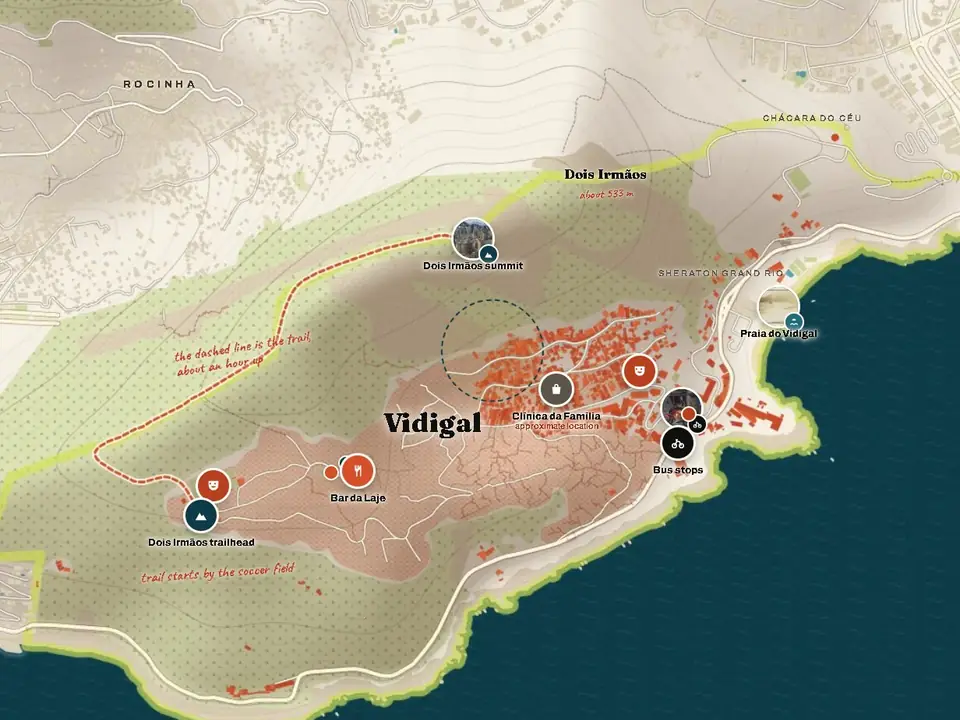
An illustrated map of Vidigal with pins for the trail, bars, the beach and the theatre
Map

Culture on the map

The theatre, the tile mural, the sports complex and the trailhead are all pinned on the Vidigal map.

  • Nós do Morro
  • Praça do Vidigal
  • Vila Olímpica Adílio
Open the map →
Keep going

More of the guide